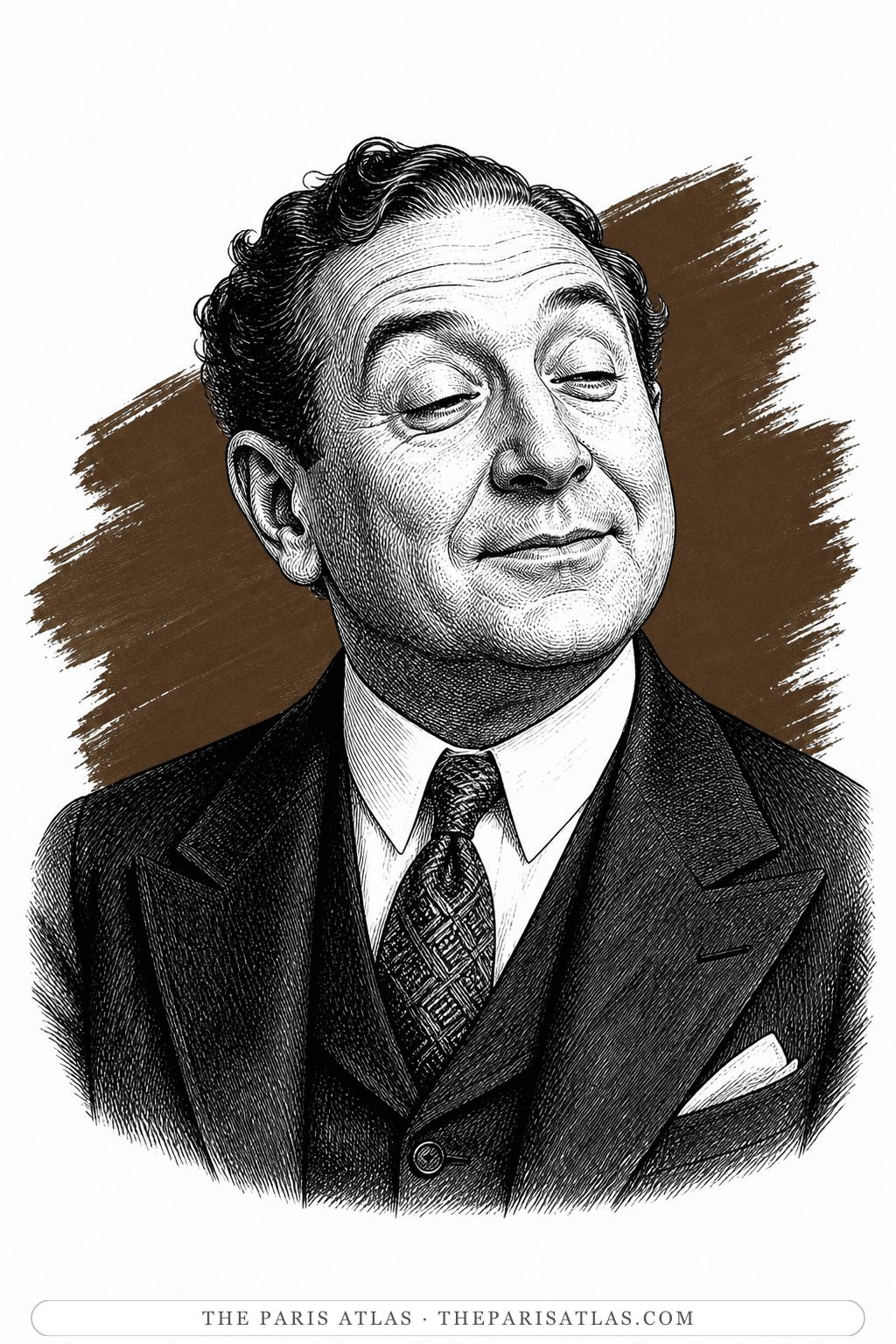
Sheldon
A Polish-born dealer in precious stones who speaks of himself in the third person, believes Val is writing a great book, and cannot hear the word Pole without spitting.
He wants God to punish the Poles, and says he prays for it every night.
The book

At a glance
- An old acquaintance of Val's, and a dealer in precious stones
- Poland — a Jew who got out, and whom O'Mara calls a walking pogrom
- About himself in the third person, and always calls Val "Mister Miller"
- A police whistle, a revolver, and a pocketknife
Who they are in the book
Spoiler-freeSheldon is a character in Plexus, the 1953 novel by the American writer Henry Miller. Plexus is the middle book of a three-part autobiographical novel called The Rosy Crucifixion, narrated by Miller under the name Val and set in New York in the middle 1920s. Sheldon is an old acquaintance of Val's who turns up again by chance on a street corner. He deals in precious stones, calls it a legitimate business, and is doing well. Everyone calls him Crazy Sheldon. He refers to himself in the third person, by name, in almost every sentence he speaks.
He is a Jew who was born in Poland and got out of it, and Val's friend Ted O'Mara calls him a walking pogrom — meaning a man who is still carrying a massacre around with him years later and an ocean away. He flinches at strangers in the street, he carries a police whistle and a revolver, and he cannot be in a room with a Polish man without losing control of himself. He is also generous, ceremonious, and completely certain that Val is a great writer, which nobody else in the book is.
Miller renamed the people in his books, and no model for this one is identified in the text. This profile is taken from the Grove Weidenfeld printing, read in the Internet Archive's scan.
How Sheldon Is Portrayed
- He had been searching the city for ValVal and O'Mara run into him on a street corner. Sheldon is overjoyed, tells them he has been looking all over town for Val, and reports that he is doing well now and has an office near his home. The two of them take an arm each and walk him towards the river.
- He speaks about himself by nameSheldon almost never says I. "Sheldon understands." "Sheldon knows." "Sheldon never refuses." "Sheldon is not afraid of the police." Asked his first name at a party, he answers that there is only Sheldon. He introduces himself to people by bowing, saying the name, and closing and opening his eyes.
- He is sure Val is writing a great bookOn that first corner he announces, slowly and as if summoning the world to listen, that he had always wanted Val to write a book. When O'Mara teases him with an invention about the Klondike, Sheldon wags a finger under their noses and insists that Mister Miller is writing a great book, and that Sheldon knows it. Then he puts a finger to his lips and asks for quiet.
- Frightened all the way to the subwayWalking with them, he stops without warning, opens his overcoat and jacket, buttons his inside pockets, buttons everything up again, pulls his hat down over his eyes and pushes on in silence, treading as if the pavement were broken glass. He turns his gemstone rings inwards so they do not show, whispers at them to hurry, and swings his head from side to side. At the station Val has to write his address out for him on the inside of a matchbox. Sheldon's hands are still trembling and his teeth chattering.
- Born in Poland, and not to be called a PoleAsked where he comes from, he draws the words out so there can be no misunderstanding: he was born in Poland, and he is proud to say he is not Polish. At a party where the architect Osiecki innocently asks whether he is a Pole, Sheldon rises, demands the floor, and delivers a speech about what Poles do — "A Pole never apologizes," he says, looking straight ahead — spitting on the floor each time he has to say the word, and apologising to the women present for it.
- The rings, handed round the tableHe calls his trade a legitimate business and rubs his hands together saying it. Then he slips a ring off and holds it under Osiecki's nose — a large ruby. A second, an emerald, goes to Mona. Two diamonds he places in Val's hand. Then he puts a finger to his lips again.
- The whistle, and the revolverAt the same party he blows a police whistle, and while the others improvise a loud argument to explain it to any officer who arrives, he stands against the window with his arms folded, refusing to help. "They always come when I blow the whistle," he says. Asked to show it, he puts both palms out, whispers for quiet, reaches behind him and says that if he ever loses the whistle he still has this — then draws a revolver and points it at each person in the room in turn, until he is satisfied they are impressed. Afterwards he produces a pocketknife as well.
- He pays for supper and carries the bagsDuring the months the couple are selling boxes of candy round the night spots, Sheldon sometimes comes along. He insists on carrying both suitcases, and on paying for the meal they eat afterwards at a Jewish delicatessen on Second Avenue: sour cream, radishes, onions, strudel, pastrami, smoked fish, dark bread, sweet butter, Russian tea, caviar, egg noodles and seltzer water. Then a taxi home over the Brooklyn Bridge.
- He disappearsBy the time the candy business collapses, Sheldon has gone. Val's account of it is one line: he had mysteriously vanished. He does not come back.
If you like Plexus


If you like Henry Miller
Explore authors with a similar voice, perspective, and influence.

Louis-Ferdinand Céline
Miller's acknowledged master at making literature out of the gutter. Journey gave him permission; Cancer is what he did with it.
View author
Ezra Pound
Pound read Cancer and sent Miller a famously backhanded postcard. Both believed literature's job was to wake the reader by any means necessary.
View author
Simone de Beauvoir
French writer and philosopher whose novels, memoirs, and social analysis examined freedom, gender, responsibility, aging, and the material conditions that shape a life.
View author