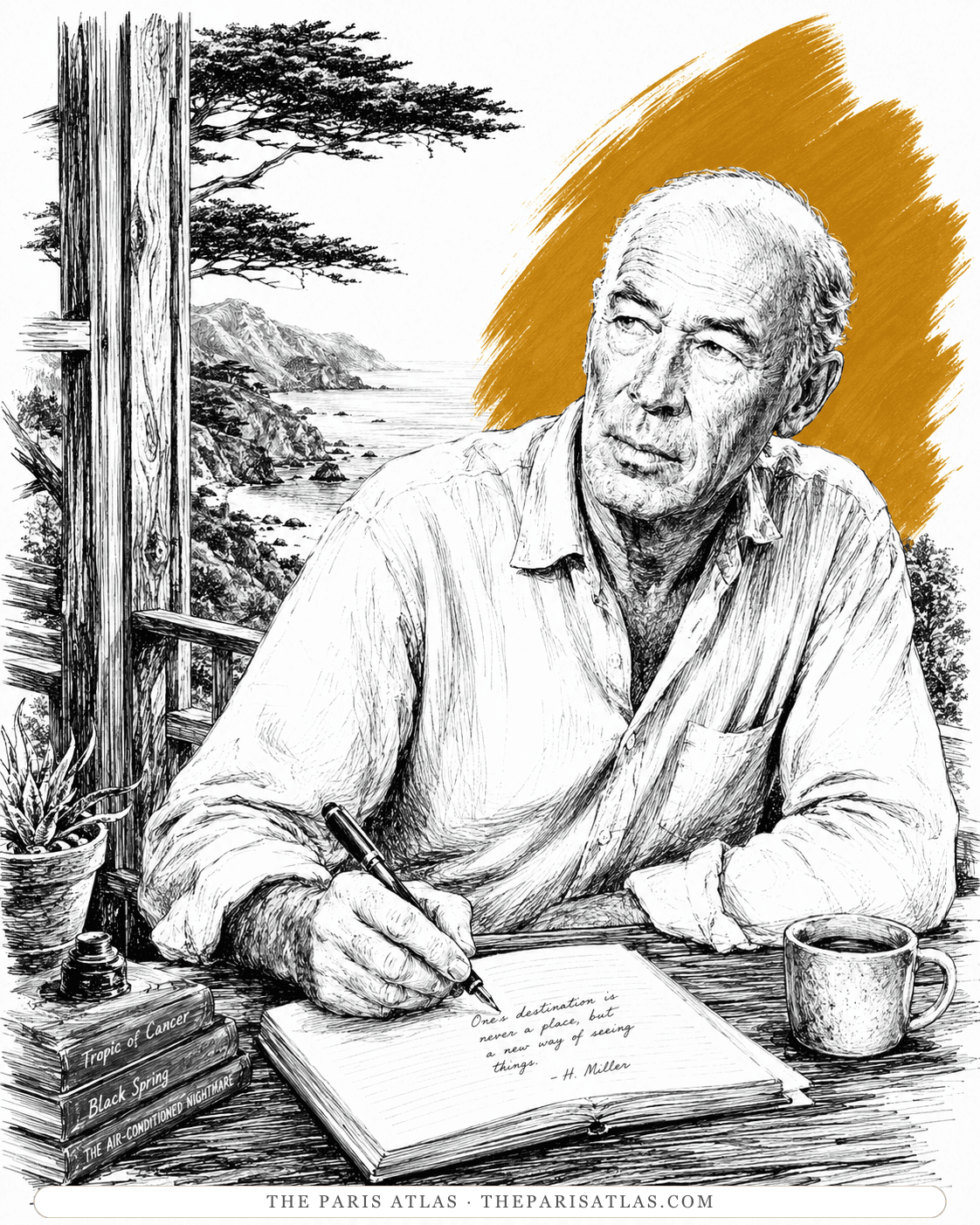


Plexus
by Henry Miller
The Rosy Crucifixion, book two: married to Mona, done with jobs forever, and learning — expensively — how to become a writer.
- 1953
About Henry Miller
The story, briefly
Spoiler-freeThe middle panel of the trilogy. Henry Miller tells his own story here under his first name, and Mona is his second wife, June Miller, renamed. The two are newly married, the telegraph job is abandoned for good, and what follows is years of schemes, borrowed money, and failed prose standing between a man who has decided to be a writer and a man who is one. Gentler and funnier than Sexus — the storm calms into picaresque — it is the volume about apprenticeship: the speakeasy, the hustles, the reading. Published in Paris in 1953, still contraband at home. (Full story below; the ending is behind the accordion.)
The story, in more detail
Miller wrote the trilogy's middle volume in Big Sur at the turn of the fifties, and the distance shows as warmth: where Sexus burned, Plexus mostly glows. The years covered are the mid-twenties — the first married years with Mona, when Henry quit the telegraph company on her promise that he need never work again, and didn't: she generated money by mysteries he learned not to examine, admirers and stratagems the book only half unveils, while he sat home turning out prose that wouldn't come alive.
It is the great book of his apprenticeship: the prose-poem 'mezzotints' hawked door to door, the Greenwich Village speakeasy the couple ran, the schemes and moves and borrowed rooms — and, threaded through the failure, the reading that was actually the education: Dostoevsky, Elie Faure, and above all Oswald Spengler, whose Decline of the West detonates in the closing pages. Olympia Press published the English text in Paris in 1953, in two volumes; America had to wait for Grove in 1965. Readers who find Sexus too much often like Plexus best — least explicit of the three, most companionable, the trilogy's long middle afternoon.
The full story
New York, the middle twenties. Henry and Mona are already married when the book opens — the ceremony at Hoboken comes up only in passing, later — and they are hunting for a flat in Brooklyn. Henry then does the unthinkable: he stops working. Mona insists the writing is all that matters; money will appear — and it does, from dance-hall admirers, 'gold-digging' expeditions, and enterprises she narrates selectively. The book ambles through their ventures — the candy-and-mezzotint hustles, the Village speakeasy, apartments taken and fled — and through the gallery of friends, spongers, and talkers who eat at their table whenever there is a table.
Under the comedy runs the real story: the writing won't come. Henry produces pages that imitate everyone and live nowhere, collects rejection slips, and begins to suspect the terrible length of the road. The consolations are the books — long, ecstatic accounts of what he read and what it did to him — and the conviction, never quite extinguished, that the failure is somehow the preparation.
How it ends — spoilers ahead
No twist — the volume ends on a book rather than an event. In the final movement Henry falls into Spengler's Decline of the West and the reading becomes the volume's climax: hundreds of pages of world-history catastrophe received like scripture, the failed writer discovering the size of the instrument he means to play. Nothing is resolved — Mona's mysteries deepen, the writing still refuses to live — but the apprenticeship has found its scale. The reckoning that will crack the marriage open is held over, deliberately, for Nexus.
Themes and analysis
A writer selling sweets
The candy-selling scene turns humiliation into a test of the narrator's own values. When café customers mock him, Henry recalls having entertained friends by tormenting an elderly Jewish peddler in the same place. His wounded pride exposes an assumption that being white, American and an artist should protect him from such treatment. The reversal makes his complaint less innocent. Yet the customers' later hospitality is also entangled with his identity as a writer: recognition softens the encounter without removing the dependence on status that the episode has exposed.
The apprenticeship inside a book
Miller's enthusiasm for Spengler is not simply agreement with a theory of historical decline. He explicitly values the movement of the philosopher's thought more than the truth of every conclusion, and sets that influence beside very different books. Reading becomes a means of loosening fixed categories rather than acquiring a finished doctrine. Near the ending, the hope of discovering a pattern in his own life connects this intellectual excitement to autobiography. Another writer's ideas help him imagine how apparently scattered failures might take form in a work of his own.
Why we recommend it
The apprenticeship, honestly
Almost no writer documents the years of writing badly. Plexus is hundreds of pages of exactly that, told without flinching or false modesty.
Mona's economy
How the household actually ran — the admirers, the schemes, the questions not asked — is the trilogy's slyest sustained comedy.
The reading rhapsodies
Dostoevsky, Faure, Spengler — nobody writes about the experience of reading with more appetite.
What this book explores
The people in its pages

Val
The narrator: a telegraph-company manager who quits his job to become a writer and spends the book failing at it. Henry Miller, under the name his wife calls him.

Mona
The narrator's wife, and the person who pays for everything while he learns to write. June Miller, renamed.

Ted O'Mara
An old friend of Val's, who arrives with a few hundred dollars, puts it on the table for everybody, and moves in.

Ulric
A commercial artist who paints tomato cans for a living and talks about the old masters as though he knew them.
Sheldon
A Polish-born dealer in precious stones who speaks of himself in the third person, believes Val is writing a great book, and cannot hear the word Pole without spitting.

Osiecki
An architect losing his grip, kept awake by bedbugs and determined not to give his employer the satisfaction of a resignation.

MacGregor
A lawyer and boyhood friend who thinks Val is wasting his life, says so at every meeting, and keeps turning up anyway.

Kronski
A doctor in the couple's circle: unreliable with money and objects, generous when it matters, and the man who told Val to go to France.

Ned
A commercial artist from the advertising trade who talks Val into interviews, carries a ukulele to Florida, and lands the job Val wanted.
Also in the book

Arthur Raymond
A friend who cannot end an argument without wrestling the other man to the floor, and who is delighted the night someone finally beats him.

Curley
A younger friend who spent a night in Central Park listening to a wanted murderer, and gave Val the material for a story he then published as his own.
Timeline
early 1950s
Miller writes the trilogy's middle volume at Big Sur, the distance from the events showing as warmth.
1953
Olympia Press publishes the English text in Paris in two volumes; it stays contraband in America.
1965
Grove Press issues the American edition.
Book editions
Paperback
- Paperback
- Olympia Press
- 1953
Paperback
- Paperback
- Grove Press
Reader reviews
Readers may also like


Tropic of Capricorn
The same twenties compressed to fury; Plexus is the leisurely second pass.
Read our takePlexus: frequently asked questions
Who wrote Plexus?
Henry Miller. It was published in Paris in 1953 as the second book of The Rosy Crucifixion.
What is Plexus about?
Henry and Mona newly married, the telegraph job abandoned for good, and the years of schemes, borrowed money, and failed prose between a man who has decided to be a writer and a man who is one.
How does it compare to Sexus?
It is gentler and funnier — the least explicit of the trilogy by a wide margin — the storm of Sexus calmed into picaresque. Readers who find Sexus too much often like Plexus best.
What is it really about underneath the comedy?
Apprenticeship: the prose-poem "mezzotints" hawked door to door, the Village speakeasy, and above all the reading — Dostoevsky, Elie Faure, and Spengler — that was the real education.
Where does it sit in the trilogy?
It is the middle panel, between Sexus and Nexus. All three books tell the story of Henry Miller's marriage to June Miller, who appears in them as Mona, and Plexus is its long middle afternoon: the years after he quit his job and before he became a writer.
If you like Henry Miller
Explore authors with a similar voice, perspective, and influence.

Louis-Ferdinand Céline
Miller's acknowledged master at making literature out of the gutter. Journey gave him permission; Cancer is what he did with it.
View author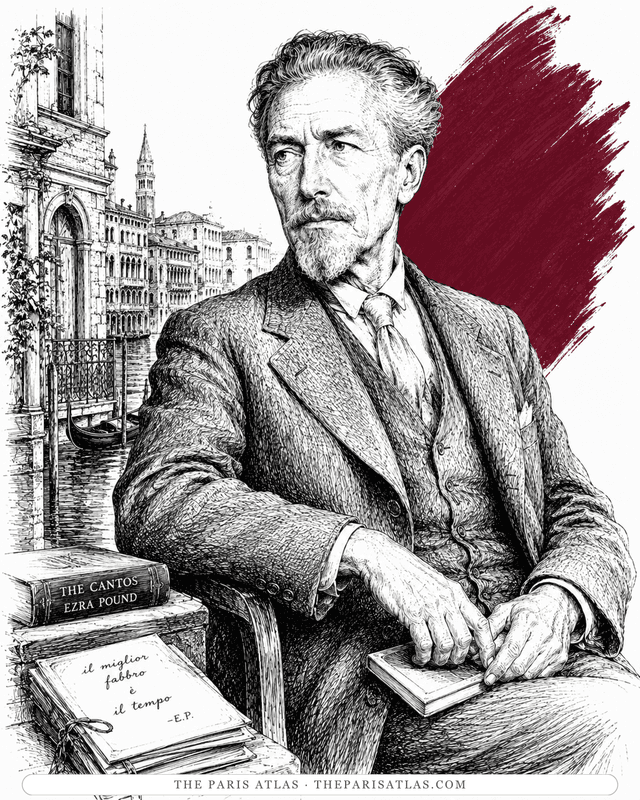
Ezra Pound
Pound read Cancer and sent Miller a famously backhanded postcard. Both believed literature's job was to wake the reader by any means necessary.
View author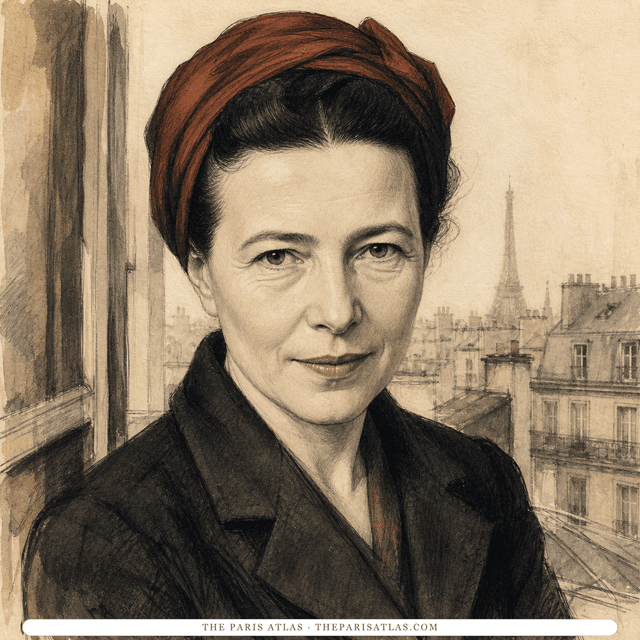
Simone de Beauvoir
French writer and philosopher whose novels, memoirs, and social analysis examined freedom, gender, responsibility, aging, and the material conditions that shape a life.
View author
References
References
The sources below include the primary text, editions, scholarship, archival materials, and other records that informed this page. They document Plexus, its publication, and its place in literary history.


1Plexus
NovelHenry Miller, 1953Used forThe primary text represented by this page, used for descriptions of the work’s contents and for any quoted passages shown here.
2Plexus — public text transcription
WebsiteThePhilosopher.netUsed forUsed for two passage-specific readings. Relevant pages were read in the public reflowed text, not a verified first-edition facsimile or a complete collation of the novel.
3The Happiest Man Alive: A Biography of Henry Miller
BiographySimon & Schuster, 1991Used forBiographical evidence used to verify chronology, relationships, and historical context connected to Plexus.
4Henry Miller: A Life
BiographyW. W. Norton, 1991Used forBiographical evidence used to verify chronology, relationships, and historical context connected to Plexus.

5Henry Miller: New Perspectives
NonfictionBloomsbury AcademicUsed forThe scholarly collection places Plexus within The Rosy Crucifixion and Miller's experiments with autobiography.
6Henry Miller: The Paris Years
BiographyBrassaï, 1995Used forBrassaï's firsthand account supplies independent context for Miller's Paris career and the life he transformed into the trilogy.
i
Why these sources are here
The primary text is the baseline reference for every book page. Additional references document publication history, interpretation, and historical context where that evidence is available.
 Explore more resources