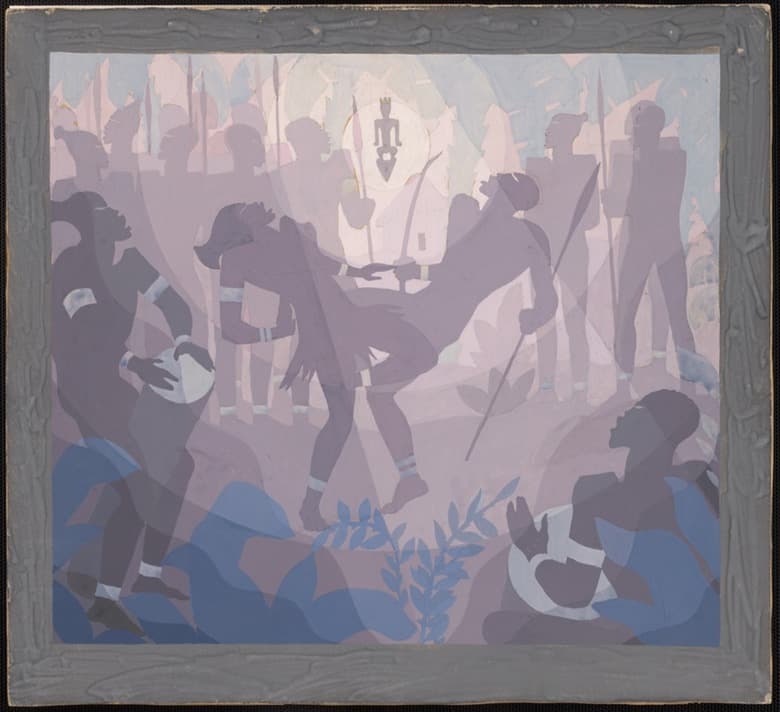
Study for Aspects of Negro Life: The Negro in an African Setting
Drummers, a dancer and a carved figure on a stand, worked in violet, grey and blue gouache on a board little bigger than a sheet of paper. Aaron Douglas made it in 1934 as the finished design for the first panel of Aspects of Negro Life, the mural cycle he painted for the 135th Street branch of the New York Public Library in Harlem. The Art Institute of Chicago bought it in 1990.
- 1934
- Gouache, with touches of graphite, on illustration board
- Art Institute of ChicagoChicago, United States
About Aaron Douglas
What the study shows
A crowd of flat silhouettes fills the sheet, all of them in profile, in a narrow range of violet, plum, grey-mauve and slate blue. At the left a figure leans forward over a drum held between the knees, both hands on the drumhead. At the centre a dancer throws one leg high and bends backward from the waist, the head tipped back, pale bands at the wrists and ankles.
Behind the dancer, at the top centre, a carved figure stands upright on a plinth inside a disc of pale light, arms at its sides and a crown or headdress above a narrow mask-like face. A row of spear points rises across the upper half of the board, ten or more of them, tilted at different angles.
Two more figures sit in the lower corners. The one at the lower left holds a white oval shape against the body. The one at the lower right raises both hands, palms open, in front of a white disc. Between them, at the bottom centre, two sprigs of pointed leaves grow up out of a band of cobalt blue.
Light is drawn as shape rather than shadow. Pale concentric rings widen out from the carved figure, and where they cross a silhouette they lift its colour a step. The board is 37.2 by 40.6 centimetres — fourteen and a half inches by sixteen — and the photograph the museum publishes includes the grey painted frame it sits in.
What the sheet is, and what it is not
It is not the mural. Aspects of Negro Life is painted on canvas mounted in the library building in Harlem. The New York Public Library records the murals as the centrepiece of the Aaron Douglas room in its Jean Blackwell Hutson Reference and Research Division, at the Schomburg Center for Research in Black Culture.
The Art Institute of Chicago calls the sheet a finished study for the first of the murals, and that is how the atlas records it. It is the design, in the artist's hand, for a painting that lives in another building and in another city. The museum bought it from Galerie Americana in Chicago in 1990, and lists it as not currently on view.
The sheet also carries a small disagreement. The Art Institute of Chicago's own text says the study was made for the first of five murals. The Kansas Historical Society names four, and gives their titles: The Negro in an African Setting, An Idyll of the Deep South, From Slavery Through Reconstruction, and Song of the Towers. Four is the count everywhere else, and Song of the Towers is a panel of the cycle rather than a separate painting — the New York Public Library captions its own photograph of the artist standing in front of "Aspects of Negro Life: Song of the Towers".
The commission, 1934
The New York Public Library records that Aaron Douglas completed Aspects of Negro Life in 1934 through the Public Works of Art Project. That was one of the New Deal programmes that kept artists in work during the Depression, and the library's stated intention was that the murals be prominently displayed there. The building was the 135th Street branch, which had housed the library's Division of Negro Literature, History and Prints since 1925.
The four panels run African American history in sequence, from an African setting through slavery and Reconstruction to the industrial cities of the North. The first panel is the one this study designs.
The Art Institute of Chicago describes the method in the study as Egyptian figures in profile and West African masks blended with Cubism and art deco. It calls the result a hybrid Western-African aesthetic that became a hallmark of the Harlem Renaissance.
Made the year after Paris
Aaron Douglas reached Paris in 1931 and spent about a year there. The Kansas Historical Society records that he had moved to Harlem in June 1925 intending to pursue an art career ultimately in Paris, and that the year he finally spent in the city went on studying classical art. The Amistad Research Center at Tulane University names the school: the Académie Scandinave, a private art academy in Paris.
He was home in New York by 1932, and the mural commission followed in 1934. That is the nearest thing to a Paris fact this sheet has. Nothing in the subject is French, and no source we consulted claims that the year abroad changed how he drew.
What did change was the size of the work. Before Paris he had made book jackets, magazine drawings and small mural schemes; after it came the four panels in Harlem, then Dallas, then Nashville.
Close reading
Reading the work, detail by detail
The sheet is crowded, so take it in five passes. Start with the two heads thrown back at the left, then the dancer at the centre, then the carved figure inside the disc of light, then the standing ranks and their spears, then the hands and leaves along the bottom.
1.Two heads thrown back
Two figures, both leaning backwards with the face turned up and to the left. The nearer one is the darkest shape on the sheet; the second is a step lighter, and a hand with the fingers spread rises beside its jaw. Pale blue-white bands at the wrists are the only cool colour in this corner.
2.The dancer at the centre
One dancer, and one reaching hand belonging to somebody else. The body is drawn as a single flat plum shape bent at the waist, with the raised leg crossing the sheet's centre. Banded cuffs mark the wrist and the ankle. The pale rectangular forms behind are the light ground showing between the standing figures.
3.The carved figure in the disc
One carved object, not a person: it stands on a pale support with its arms out straight and its lower body tapering to a point. The disc of light behind it is the brightest area of the sheet and the only complete circle in the design. A spear shaft passes in front of the disc at the left.
4.The standing ranks and their spears
Two whole figures here, and parts of two more at the edges. Each holds a single upright shaft; the pale triangles between them are spear blades and the light ground seen through the crowd. Slate blue at the top is the only patch of open sky in the study.
5.The open hand at the lower right
One seated figure, with the near hand raised and the fingers apart in front of a pale crescent. A second head is in profile at the right edge, facing left like every other head on the sheet. The cobalt leaves are the only saturated blue in the design and they mark the bottom of the field.
6.Bare feet above the leaves
Two feet, belonging to one standing figure, planted flat with the toes drawn as separate notches. The banded anklets match the wristbands elsewhere on the sheet. The blue leaf sprays grow up from the bottom edge and overlap the feet, so the figures stand in the plants rather than in front of them.
Timeline
1925
The 135th Street branch of the New York Public Library takes in the Division of Negro Literature, History and Prints, the collection that becomes the Schomburg Center.
1931
Aaron Douglas reaches Paris, having planned on it since before he moved to Harlem, and spends about a year at the Académie Scandinave.
1934
Paints the study in gouache on illustration board, and completes Aspects of Negro Life for the library through the Public Works of Art Project.
1990
Sold by Galerie Americana, Chicago, to the Art Institute of Chicago, which accessions it as 1990.416 and shows it that June in New Acquisitions: Early American Modernist Painting.
2003
Shown in A Century of Collecting: African American Art in The Art Institute of Chicago, 15 February to 18 May.
2007–08
Travels with Aaron Douglas: African American Modernist from the Spencer Museum of Art to Nashville, Washington and the Schomburg Center in Harlem.
2025–26
Shown at the Art Institute of Chicago in Critical Fabulation, 10 October to 4 January.
Where to see it
Art Institute of Chicago
111 South Michigan Avenue, Chicago, IL 60603, United States
The Art Institute of Chicago lists the study as not currently on view. It was shown in Critical Fabulation from 10 October 2025 to 4 January 2026.
Plan your visit on the museum’s official website (opens in a new tab)Frequently asked questions
Where is Aaron Douglas's study for Aspects of Negro Life?
The Art Institute of Chicago, reference number 1990.416, bought from Galerie Americana in Chicago in 1990 with the Solomon Byron Smith and Margaret Fisher funds. The museum lists it as not currently on view. The murals it designs are in New York, at the Schomburg Center for Research in Black Culture.
Is this the mural or a study for it?
A study. The Art Institute of Chicago calls it a finished study for the first of the Schomburg Center murals, made in gouache with touches of graphite on illustration board at 37.2 by 40.6 centimetres. The mural itself is painted on a far larger scale and is still in the library building in Harlem.
How many panels does Aspects of Negro Life have?
Four. The Kansas Historical Society lists them as The Negro in an African Setting, An Idyll of the Deep South, From Slavery Through Reconstruction, and Song of the Towers. The Art Institute of Chicago's own text says five, which does not match the titles anyone publishes; four is the count the New York Public Library's own material supports.
Is Song of the Towers a separate painting?
No, it is the fourth panel of Aspects of Negro Life. The New York Public Library captions its photograph of Aaron Douglas and Arturo Schomburg standing in front of the work as "Aspects of Negro Life: Song of the Towers," 1934. The Kansas Historical Society lists it last among the four mural titles.
Who paid for the Aspects of Negro Life murals?
The Public Works of Art Project, one of the New Deal programmes that kept artists in work during the Depression. The New York Public Library states that Aaron Douglas completed the murals in 1934 through that programme, with the intention that they be prominently displayed at the library. The commission is often attributed to the Works Progress Administration instead, which is a different agency.
Where can you see the Aspects of Negro Life murals?
At the Schomburg Center for Research in Black Culture in Harlem, part of the New York Public Library. The library records the murals as the centrepiece of the Aaron Douglas room in its Jean Blackwell Hutson Reference and Research Division. One panel travelled to the Metropolitan Museum of Art in 2023 for The Harlem Renaissance and Transatlantic Modernism.
More by Aaron Douglas
If you like Aaron Douglas
Explore painters from the same movements and circles.
Loïs Mailou Jones
Boston-born painter and Howard University professor for forty-seven years, whose 1937–38 year at the Académie Julian in Paris produced Les Fétiches and opened a seven-decade career spanning French landscape, African design and Haitian colour.
View artist
Tarsila do Amaral
Brazilian painter who spent the 1920s moving between São Paulo and Paris, studied Cubism under André Lhote, Albert Gleizes and Fernand Léger, and used what she learned to paint Brazilian towns, railways, plants and bodies. Her 1928 painting Abaporu prompted the manifesto that gave the Anthropophagic movement its name.
View artist
Rosa Bonheur
At the horse markets of Paris and in her studio beside the forest of Fontainebleau, Rosa Bonheur gave animals the presence of great portrait subjects. The success of The Horse Fair helped her build a life shaped by her work, financial independence, and the women she loved.
View artist
References
The sources below include collection records, catalogues, scholarly research, and primary materials that informed this page. They document Study for Aspects of Negro Life: The Negro in an African Setting, its making, and its place in cultural history.


1Aaron Douglas, Study for Aspects of Negro Life: The Negro in an African Setting (1934) — object record, 1990.416
WebsiteArt Institute of ChicagoUsed forThe museum's object record: title, date, medium, dimensions, credit line, provenance, exhibition history, and the description that calls the sheet a finished study for the first of five murals.
2Schomburg Center Centennial Timeline
WebsiteThe New York Public LibraryUsed forThe library's own chronology, for the Public Works of Art Project commission, the Aaron Douglas room, and the caption naming Aspects of Negro Life: Song of the Towers.
3Douglas, Aaron
WebsiteKansas Historical Society, KansapediaUsed forThe Kansas Historical Society, which names four murals and gives all four titles, and records the Paris year of 1931.
4Aaron Douglas
WebsiteAmistad Research Center, Tulane UniversityUsed forThe archive that records the Académie Scandinave enrolment.
5Aaron Douglas, Go Down Death (1934) — object record, 2005.181
WebsiteCleveland Museum of ArtUsed forThe record that prints the credit line naming the heirs of Aaron Douglas and VAGA as the licensing agent.
These references provide the documented foundation for this work's history and interpretation. Claim-level citations remain attached to the specific claims they support.
 Explore more resources