The Birth of the World
by Joan Miró
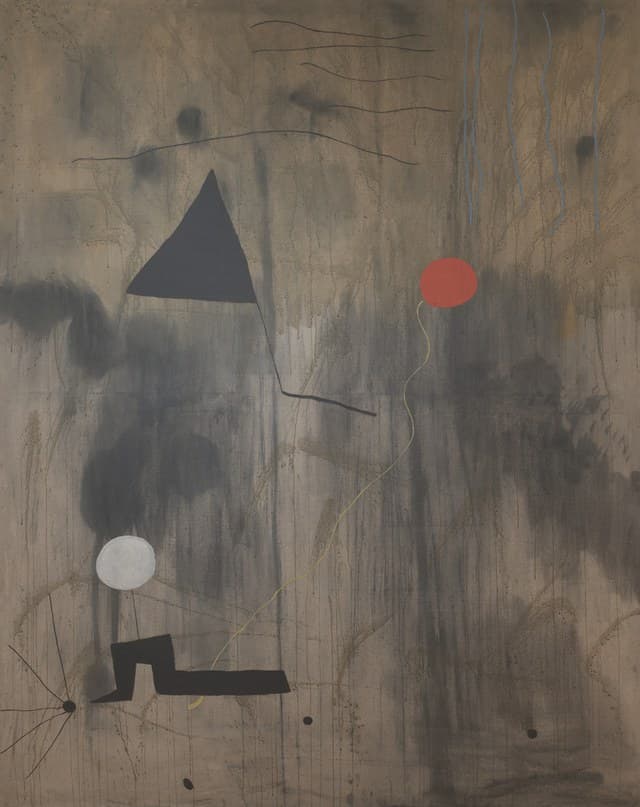
A canvas two and a half metres tall whose ground was poured rather than painted, soaking into the unevenly primed cloth in some places and sitting on top of it in others. Over that mottled grey-brown field Joan Miró set a black triangle on a bent string, a red disc, a white head on a stem, a black figure and a yellow thread. The Museum of Modern Art acquired it in 1972, partly by purchase and partly as a gift from the artist.
- Montroig, late summer–fall 1925
- Oil on canvas
- The Museum of Modern ArtNew York, United States
About Joan Miró
What the painting shows
Most of the canvas is ground. Grey-brown washes pool and bleed across it, dark where the paint soaked in and pale where it stayed on the surface, with long vertical drips running the full height in places. Smoky patches gather at the upper left, the left edge and the right.
Five black lines cross the upper part: four short waves stacked at the centre-right and one much longer line running almost the width of the canvas below them. Four thin blue verticals waver down from the top right edge.
A black triangle sits high on the left, and a thin black line runs from its lower point down and to the right, bending twice along the way. A red-orange disc hangs at the upper right, with a pale yellow line dropping from it in a long wavering curve down to the lower left.
The lower left holds the figure. A chalky white circle floats above a thin black stem. The stem meets a solid black form lying along the bottom of the canvas. That form is blocky: a raised step at the left, a long bar extending right, and a left end tapering to a point. Beside it a solid black dot throws out five thin straight rays.
Three small black dots sit near the bottom edge, spaced across the width. Nothing else in the picture is drawn.
How it was made
The Museum of Modern Art describes the technique precisely. Joan Miró poured, brushed and flung paint onto an unevenly primed canvas, so that the paint soaked in over some areas and rested on top in others. The unevenness of the priming is what produces the two behaviours.
On top of that relatively uncontrolled application he added lines and shapes he had planned in advance, in studies. The museum names the elements as a bird or kite, a shooting star, a balloon and a figure with a white head, and observes that each may seem familiar while their association stays illogical.
Joan Miró described the two-stage working method himself, in an interview with James Johnson Sweeney published in Partisan Review in February 1948. The Museum of Modern Art quotes it.
“Rather than setting out to paint something I began painting and as I paint the picture begins to assert itself, or suggest itself under my brush.… The first stage is free, unconscious.”
He then added the qualification that matters for reading the canvas: the second stage is carefully calculated. The museum treats the painting as the demonstration of that blend, with a freely applied background and motifs whose arrangement was worked out beforehand.
Joan Miró also gave the picture a subject in a single phrase. The Museum of Modern Art records that he said it depicts a sort of genesis — the amorphous beginnings of life.
1925: the Galerie Pierre, André Breton, and the first Surrealist show
The canvas belongs to the most consequential year of Joan Miró's Paris decade. The Fundació Joan Miró records that in 1925 André Breton met him during a visit to the rue Blomet studio, and that he had his first solo exhibition at the Galerie Pierre.
The Galerie Pierre, run by Pierre Loeb, also staged the first Surrealist group exhibition that year. Joan Miró took part in the movement's exhibitions without accepting its discipline, a distance he held for the rest of his life.
The painting was made at Mont-roig, not in Paris. The Museum of Modern Art dates it Montroig, late summer–fall 1925, which places it in the Catalan half of the year rather than the French one. The method it demonstrates, however, came out of the reading and talk of the rue Blomet circle.
How it reached New York
The Museum of Modern Art acquired the painting on 3 October 1972, under a credit line that records a mixed transaction: acquired through an anonymous fund, the Mr. and Mrs. Joseph Slifka and Armand G. Erpf Funds, and by gift of the artist. Joan Miró was seventy-nine and gave part of it himself.
The object number is 262.1972 and the painting sits in the Department of Painting and Sculpture. The museum had already owned The Hunter (Catalan Landscape) for thirty-six years by then.
In 2019 the museum built an exhibition around the picture, Joan Miró: Birth of the World, which ran from 24 February to 15 June. The canvas was on view in Floor 5, Gallery 517, in the Alfred H. Barr, Jr. Galleries, when the museum's record was checked in September 2026.
Its scale, and its title
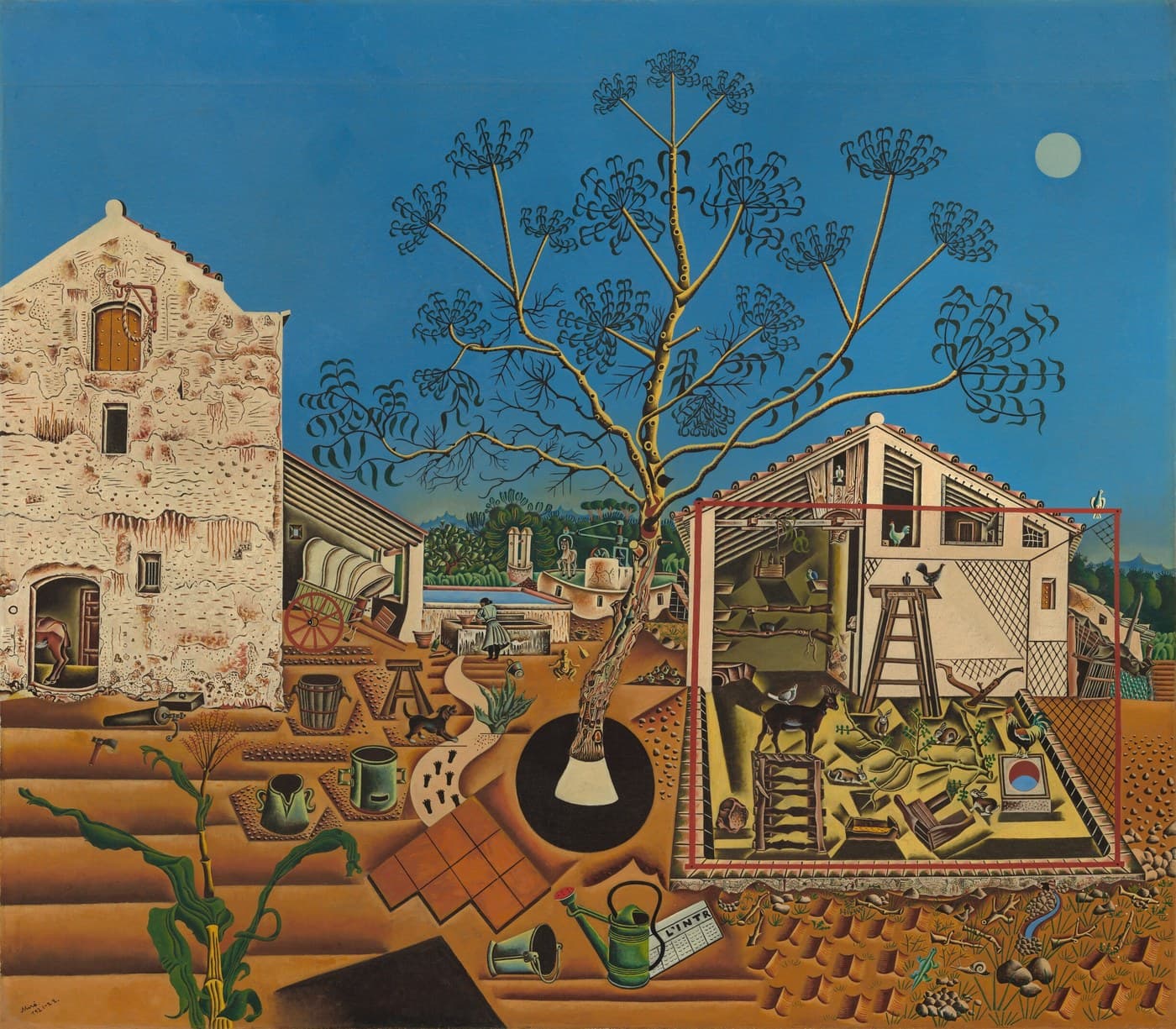
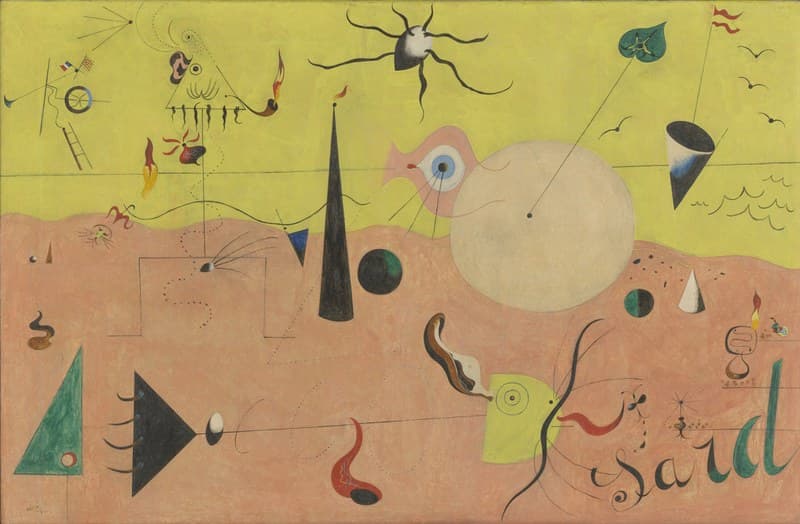
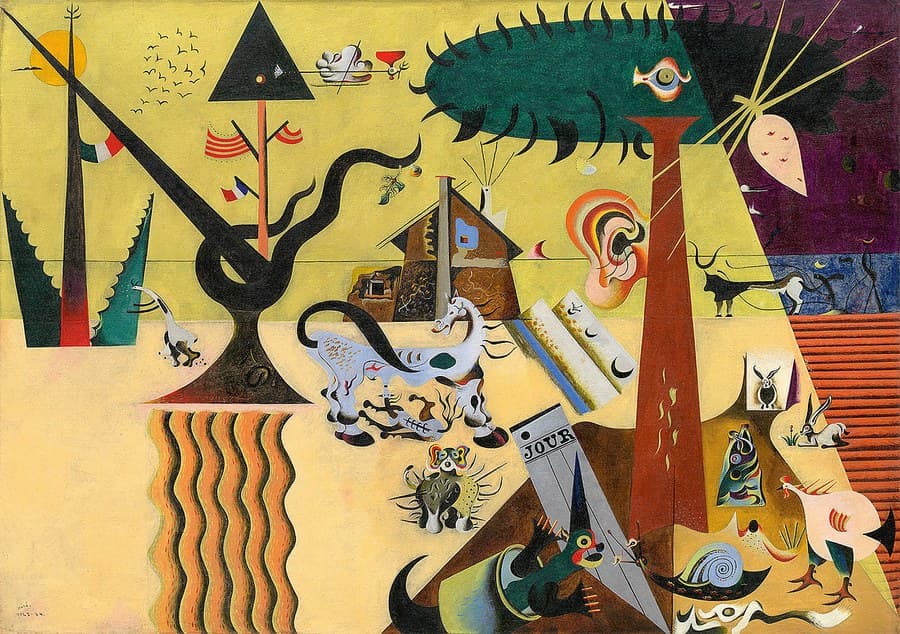
It is by far the largest of Joan Miró's Paris-decade canvases in the atlas: 250.8 by 200 centimetres, which the Museum of Modern Art prints in feet and inches as 8 feet 2 3/4 by 6 feet 6 3/4. The Farm is 123.8 by 141.3 centimetres and The Hunter (Catalan Landscape) is 64.8 by 100.3.
The French title is La naissance du monde, and the Centre Pompidou borrowed it for an exhibition of his work of 1917 to 1934 in 2004. The Catalan is El naixement del món.
Close reading
Reading the work, detail by detail
The Museum of Modern Art describes the making of this canvas in three verbs: Joan Miró poured, brushed and flung paint onto an unevenly primed cloth, so that it soaked in over some areas and rested on top in others. He then added a handful of shapes planned in advance. The close views separate the two operations.
1.The ground was poured, not brushed
The ground shows two behaviours at once. In places the thin paint has soaked into the cloth and dried dark and matte; in others it has sat on the surface and stayed pale and streaked. Long vertical drips run down through the field. The canvas weave is visible through most of it, because nothing covers it.
2.A black triangle on a bent string
The triangle is solid black with hard edges, flat along the top and pointed at the lower right. From that point a thin black line runs down and to the right, bending sharply twice, and simply stops. The Museum of Modern Art names the shape a bird or a kite. Nothing holds the other end of the line.
3.A red disc high on the right
A flat red-orange disc sits high on the right, slightly wider than it is tall and painted opaquely over the stained ground. It is the only saturated colour on the canvas. A pale yellow line leaves its lower edge. The Museum of Modern Art names a balloon among the picture's elements.
4.One yellow thread crosses the canvas
A single pale yellow line wavers down the canvas from the red disc to the lower left. It is hand-drawn, uneven in width, and passes behind the solid black form near the bottom rather than over it. It is the only element that crosses most of the picture's height.
5.A white head on a thin stem
A chalky white circle, slightly flattened, sits over one of the darkest patches of the ground. It is painted opaquely and its edge is soft. A thin black line drops vertically from its base to the black form below. The Museum of Modern Art names a figure with a white head among the picture's elements.
6.A black figure lying along the bottom
A solid black form lies horizontally near the foot of the canvas. It has a raised rectangular step at the left, a long bar running right, and a left end that tapers to a point on the ground. Its edges are flat and hard against the stained field, and it is the largest drawn element in the picture.
7.A black star with five rays
A solid black dot sits low at the left, with five thin straight lines radiating out from it. They are drawn with a fine brush and none of them touches anything else. The Museum of Modern Art names a shooting star among the picture's elements.
8.Four blue verticals at the top right
Four thin pale blue lines waver down from the top edge at the right, each hand-drawn and slightly different in length. None reaches halfway down the canvas. They are the only blue on the picture and the only marks that begin at an edge.
9.Five wavering black lines
Four short black lines are stacked one above another near the top, each waving gently and each a little longer than the one above. A fifth, far longer, runs almost the full width of the canvas beneath them. They sit on the ground rather than describing anything in it.
Timeline
1925
Painted at Mont-roig in the late summer and autumn. The same year André Breton visits the rue Blomet studio, Joan Miró has his first solo exhibition at the Galerie Pierre, and the Galerie Pierre stages the first Surrealist group exhibition.
1948
Joan Miró describes his two-stage method to James Johnson Sweeney in an interview published in Partisan Review in February.
1972
Acquired by the Museum of Modern Art on 3 October as 262.1972, through an anonymous fund and the Slifka and Erpf Funds, and partly by gift of the artist.
2004
The Centre Pompidou borrows the title for Joan Miró 1917–1934: La Naissance du Monde at the Musée national d'art moderne.
2019
The Museum of Modern Art builds Joan Miró: Birth of the World around the painting, 24 February to 15 June.
Where to see it
The Museum of Modern Art
11 West 53 Street, New York, NY 10019, United States
On view in Floor 5, Gallery 517, the Alfred H. Barr, Jr. Galleries, when the museum's record was checked in September 2026.
Plan your visit on the museum’s official website (opens in a new tab)Frequently asked questions
Where is The Birth of the World by Joan Miró?
The Museum of Modern Art in New York, object number 262.1972. It was on view in Floor 5, Gallery 517, the Alfred H. Barr, Jr. Galleries, when the museum's record was checked in September 2026.
How was The Birth of the World painted?
The Museum of Modern Art records that Joan Miró poured, brushed and flung paint onto an unevenly primed canvas, so the paint soaked in over some areas and rested on top in others. He then added lines and shapes he had planned in advance in studies. He described the method as two stages: the first free and unconscious, the second carefully calculated.
What does The Birth of the World show?
A mottled grey-brown poured ground with a handful of drawn signs on it. There are a black triangle on a bent string, a red-orange disc trailing a yellow thread, and a white circle on a stem above a solid black figure. There are also a black star with five rays, four blue verticals, five black wavy lines and three small black dots. Joan Miró said it depicts a sort of genesis, the amorphous beginnings of life.
How big is The Birth of the World?
250.8 by 200 centimetres, which the Museum of Modern Art gives as 8 feet 2 3/4 inches by 6 feet 6 3/4 inches. It is a vertical canvas and much the largest of Joan Miró's Paris-decade paintings.
Did Joan Miró give The Birth of the World to MoMA?
Partly. The credit line records a mixed transaction: acquired through an anonymous fund, the Mr. and Mrs. Joseph Slifka and Armand G. Erpf Funds, and by gift of the artist. The date of acquisition was 3 October 1972, when Joan Miró was seventy-nine.
Is The Birth of the World a Surrealist painting?
It was made in the year André Breton first visited Joan Miró's studio at 45 rue Blomet and the year the Galerie Pierre staged the first Surrealist group exhibition. The Museum of Modern Art reads the poured ground as an attempt to give free rein to the unconscious, as the Surrealists did, while the drawn motifs were planned in studies. Joan Miró exhibited with the movement without submitting to its discipline.
More by Joan Miró
If you like Joan Miró
Explore painters from the same movements and circles.
Jean Arp
Strasbourg-born sculptor and poet — Hans in German, Jean in French, both all his life — who co-founded Dada at the Cabaret Voltaire in 1916, composed collages by dropping torn paper 'according to the laws of chance', and settled at Meudon outside Paris in a house his wife Sophie Taeuber-Arp designed.
View artist
Salvador Dalí
The self-made icon of Surrealism — melting watches and manicured scandal — who arrived in Paris by way of two films written with Buñuel, dreamed together before the movement claimed them.
View artist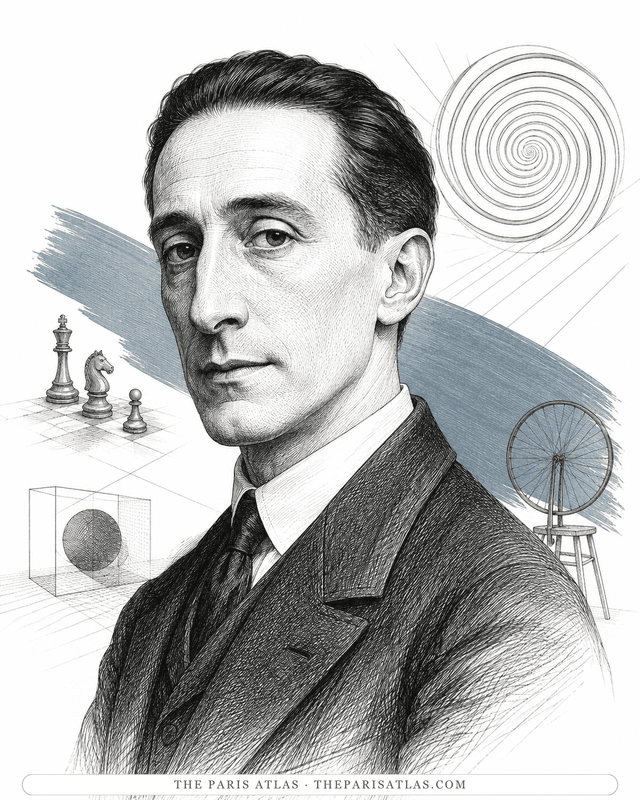
Marcel Duchamp
The century's quietest revolutionary — readymades, the abandonment of painting, chess on a Paris rooftop in Entr'acte, and one anemic film of spinning puns signed Rrose Sélavy.
View artist
References
The sources below include collection records, catalogues, scholarly research, and primary materials that informed this page. They document The Birth of the World, its making, and its place in cultural history.


1Joan Miró, The Birth of the World, Montroig, late summer–fall 1925 — object record, 262.1972
WebsiteThe Museum of Modern Art, New YorkUsed forThe museum's object record: title, date, medium, dimensions, credit line, object number, copyright line, gallery, and its account of the poured ground and the planned motifs.

2The Museum of Modern Art collection dataset (Artworks.csv)
ArchiveThe Museum of Modern Art, New YorkUsed forThe museum's published Artworks dataset, which supplies the same catalogue fields; www.moma.org refuses command-line clients with HTTP 403.
3Joan Miró — artist essay
WebsiteThe Museum of Modern Art, New York, 2017Used forNatalie Dupêcher's artist essay, which sets the painting beside André Breton's definition of automatism.
4Joan Miró: Comment and Interview
PeriodicalPartisan Review 15, no. 2, 1948Used forContemporary reporting or criticism used to document the historical reception and context of The Birth of the World.
5Joan Miró — Biography
WebsiteFundació Joan MiróUsed forThe artist's foundation on 1925: André Breton's visit to rue Blomet and the first Galerie Pierre exhibition.
6Rights and permission — who administers the copyright in Joan Miró's work
Official recordSuccessió Miró CB, Palma de MallorcaUsed forThe estate's own statement of who administers Joan Miró's copyright, checked rather than assumed.
These references provide the documented foundation for this work's history and interpretation. Claim-level citations remain attached to the specific claims they support.
 Explore more resources