The Farm
by Joan Miró
An inventory of a Catalan farm, painted object by object: a whitewashed farmhouse, a eucalyptus, a goat, four rabbits, a lizard, a snail, a watering can standing on a French newspaper. Joan Miró worked on it between Mont-roig, Barcelona and Paris from the summer of 1921 to early 1922. Ernest Hemingway owned it for the rest of his life, and the National Gallery of Art has held it since 1987.
- 1921–1922
- Oil on canvas
- National Gallery of Art, WashingtonWashington, United States
About Joan Miró
What the painting shows
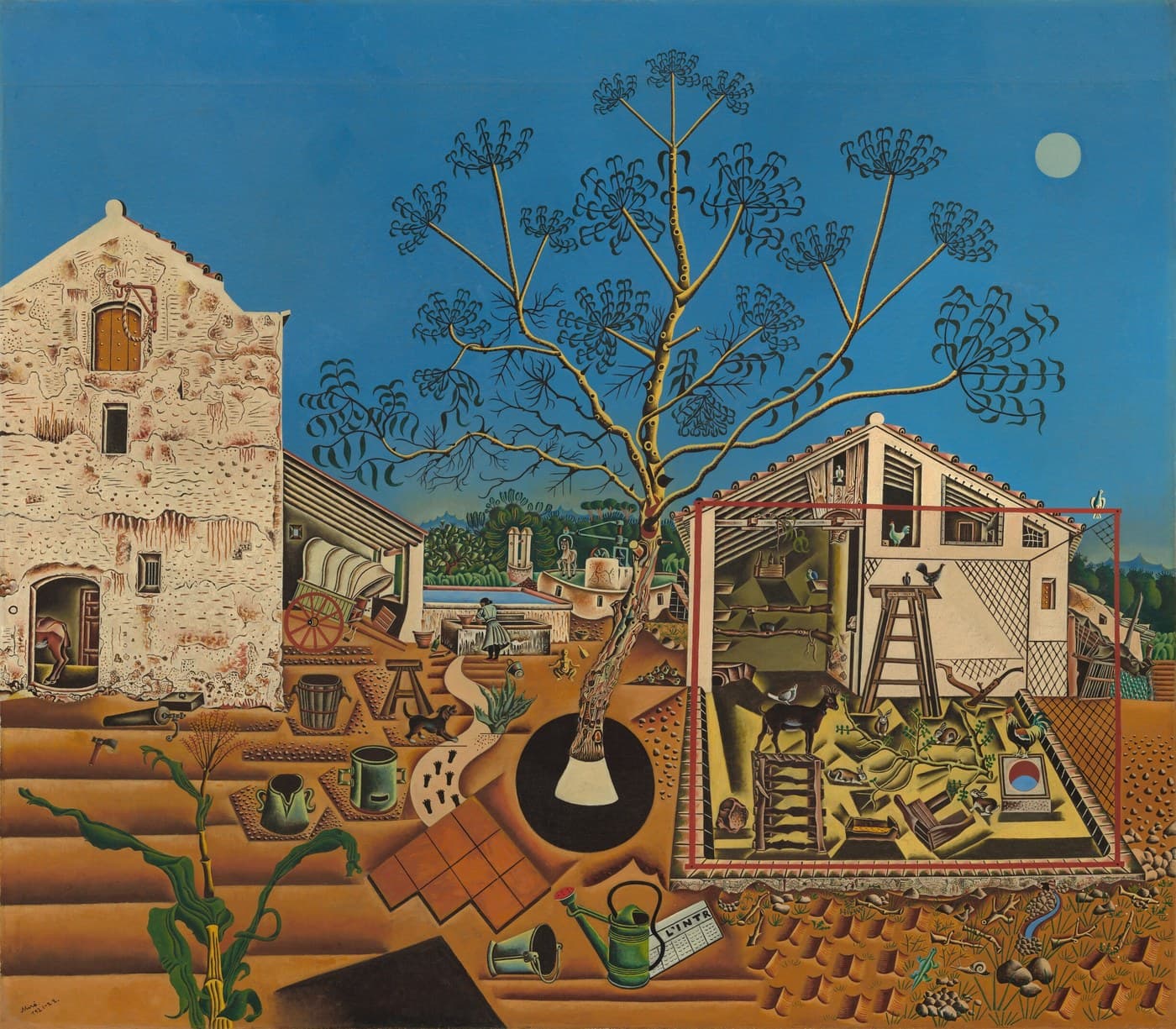
A farmyard fills the canvas under a flat cerulean sky, with a white disc of a moon at the upper right. A whitewashed farmhouse stands at the left, its plaster fallen away in patches to show pink-brown stone, rust-coloured water stains running down the wall. A horse's hindquarters show through the arched ground-floor doorway. Above it sit a barred window, a small dark opening and a studded wooden hatch with an iron winch.
A eucalyptus rises through the middle of the picture, its ochre trunk marked by a line of dark oval scars. The leaves are painted as flat sickle strokes in dark blue-green, gathered into rosettes at the ends of the branches. No leaf overlaps another. The trunk flares into a white base that stands inside a black disc cut into the ground.
On the right an open shed and a wired pen are drawn inside a red rectangle ruled onto the canvas. A dark goat with two upright horns stands on a wooden rack with a white dove on its back. Four rabbits lie and sit on the ochre floor of the pen, a rooster stands on a white-framed dish painted red above and blue below, and a white bird fills the opening in the gable.
The foreground is bare tilled earth in horizontal bands. A single maize stalk with a ribbed yellow stem grows at the lower left, next to a dry rust-coloured umbel. Laid out around it are an axe, a bellows, a small black box, a hooped wooden tub, a trestle, a green two-handled jug, a green measure and a tin pail on its side. A green watering can stands upright on a newspaper printed L'INTR.
A black dog walks along a pale path, and black bird prints cross it in two short rows. Beyond the tree a woman in a blue-grey dress works at a stone trough, with a pale blue cistern behind her and a grey animal turning a mill on a circular track. At the lower right the ground breaks into rows of conical mounds sprouting green, with a turquoise lizard, a snail, pine cones, loose stones and a thin blue thread of water.
Nine months, three places, one canvas
Joan Miró began the painting at Mont-roig del Camp, the village south of Tarragona where his parents had bought a farmhouse in 1911. The Fundació Joan Miró records the rhythm he kept through the decade: Paris during the academic terms, Mont-roig for the rest of each year. The canvas travelled with him.
The Fundació also corrects a detail that circulates loosely. From 1921 he had the use of a studio at 45 rue Blomet in the fifteenth arrondissement, and the studio was the sculptor Pablo Gargallo's, available while Gargallo taught in Barcelona. The Fundació dates the arrangement to 1921, not to his first Paris visit in 1920.
The neighbour at rue Blomet was André Masson, and the corridor between their two doors became the meeting place for a set of writers rather than painters. Through André Masson, the Fundació records, Joan Miró met Michel Leiris and probably Antonin Artaud, Robert Desnos, Paul Éluard, Georges Limbour and Raymond Queneau. The first Surrealist manifesto was still three years away.
The National Gallery of Art dates the finished work 1921–1922 and reads the signature at the lower left as Miro. / 1921-22. It measures 123.8 by 141.3 centimetres, a little wider than it is tall.
Ernest Hemingway, Evan Shipman and a roll of dice
The painting went on consignment to Léonce Rosenberg at the Galerie L'Effort Moderne on 1 June 1922, and stayed there until about the spring of 1924. The National Gallery of Art then records it as possibly consigned to Jacques Viot at the Galerie Pierre, and possibly owned by the poet Evan Shipman by June 1925. Each of those steps carries the museum's own hedge.
It hung as number 1 in Exposition Joan Miró, the artist's first solo show in Paris, at the Galerie Pierre in 1925. The museum's provenance notes suggest the catalogue may have listed it as Evan Shipman's in order to mark it as not for sale.
Ernest Hemingway published his own account in Cahiers d'Art in 1934, and the National Gallery of Art quotes it. Evan Shipman had made the Galerie Pierre put a price on the painting and agree to sell it to him, then reconsidered the same day and decided Ernest Hemingway should have it. The two rolled dice for the right to buy. Ernest Hemingway won and paid the gallery in monthly instalments.
The museum is careful about what that proves. Its note states plainly that although Evan Shipman's name appears in the provenance, it is not certain he ever actually owned the painting. The first owners it records without qualification are Hadley and Ernest Hemingway, in Paris, by 9 November 1925.
One line on the museum's own object page sits awkwardly beside that chain. Its short introduction calls Ernest Hemingway the painting's first owner, where its provenance opens with the artist and two Paris dealers. Both statements come from the National Gallery of Art, and the provenance is the documented one.
It went to Hadley Richardson in the divorce
Hadley Richardson and Ernest Hemingway divided their possessions shortly before their divorce in December 1926, and he delivered the painting to her. The National Gallery of Art cites Carlos Baker's 1969 life of Ernest Hemingway for that. She married Paul Mowrer in 1933 and took the canvas with her to Chicago the following year.
The Mowrers lent it to A Century of Progress at the Art Institute of Chicago, which closed on 1 November 1934, and had it back afterwards. Ernest Hemingway, by then living in Key West, asked to borrow it. The museum cites Jack Hemingway's 1986 memoir for her agreement.
He lent it on to a Miró exhibition at the Pierre Matisse Gallery in New York that opened on 10 January 1935 and closed on 9 February. Pierre Matisse telegraphed on 18 February to say the painting was being shipped to him. It was never returned to Hadley Richardson.
The National Gallery of Art quotes what she told Alice Sokoloff: everyone Ernest married after me thought it belonged to her. After his death in 1961 his fourth wife, Mary Welsh Hemingway, settled with Hadley Richardson out of court through their lawyers, paying her to give up her claims. Mary Welsh Hemingway bequeathed the painting to the National Gallery of Art in 1987.
Where it has been shown
Its first public appearance was the Salon d'Automne in Paris in 1922, as number 1754. The following year the National Gallery of Art records three more Paris outings. There was a two-man show with Francesc Domingo at Au Caméléon in May 1923, and a one-day group show at the same café on 9 April. There was also a one-day hanging at Le Jockey in Montparnasse, on the artist's own account.
After the Galerie Pierre show of 1925 it did not reappear publicly for nine years. The Art Institute of Chicago showed it in 1934, the Pierre Matisse Gallery in 1935, and the Museum of Modern Art in 1959. It was on loan to the Museum of Modern Art's permanent collection from 1960 to 1962.
Since then it has been a fixture of the retrospectives. It hung at the Tate Gallery and the Kunsthaus Zürich in 1964, at the Fundació Joan Miró and the Museum of Modern Art in 1993–94, and at the Galeries nationales du Grand Palais in 2001–02 and again in 2018–19. Joan Miró: The Ladder of Escape travelled from Tate to Barcelona and reached the National Gallery of Art itself in 2011–12.
Jacques Dupin and Ariane Lelong-Mainaud catalogue it in the first volume of their six-volume catalogue raisonné of the paintings. Alex Fernández de Castro devoted a book to its ownership history in 2015, titled La masía, un Miró para Mrs. Hemingway.
Its titles, and where it hangs
The National Gallery of Art titles it simply The Farm. The Catalan form is La masia, a masia being a Catalan farmstead rather than a farm in general, and French catalogues print La ferme. The museum's own displayed date is the hyphenated 1921-1922.
The painting was on view in the East Building, Upper Level, Gallery E415 when the museum's record was checked in September 2026. It carries accession number 1987.18.1 and the credit line Gift of Mary Hemingway.
Close reading
Reading the work, detail by detail
Joan Miró painted the Mont-roig farm object by object, and the National Gallery of Art's own visual description works the same way: crops springing from the ground, animals in the shed, a donkey turning a millstone, a newspaper under a watering can, footprints that suddenly stop. The close views take the yard one corner at a time and count what is actually there.
1.The whitewash has fallen off the wall
The wall is painted as a surface in decay. Cream plaster has flaked away in irregular patches to bare pink-brown stone, and the whole face is stippled with dots and short dashes. Rust-coloured streaks run down from the middle of the wall. A ball finial sits on the gable apex, and terracotta half-tiles with dark round ends line the right slope.
2.A horse stands in the ground-floor doorway
The arch at the foot of the farmhouse opens on a dark green interior with a wooden plank door standing back. A pale pinkish-brown horse stands inside with its hindquarters towards the yard and its head lowered out of sight. A small white circle is painted on the wall to the left of the arch. In front of it lie a long dark bellows and a small black box with a latch.
3.No leaf touches another
The eucalyptus is drawn rather than massed. Ochre-yellow branches carry flat sickle strokes of dark blue-green, gathered into fans at the branch ends, and every leaf is silhouetted separately against the flat blue sky. A row of small dark oval scars runs up the trunk. Bare reddish twig clusters fill the gaps where leaves would overlap.
4.The trunk rises from a black disc
The trunk flares at the bottom into a pale, almost white cone, and that cone stands inside a flat black circle laid into the ochre ground. The disc has no shading and casts no shadow. To its left a grid of terracotta paving squares lies on the earth, and a tin pail rests on its side.
5.A dove stands on the goat's back
A dark brown goat with two straight upright horns stands on a slatted wooden rack raised off the pen floor. A white dove stands on its back, facing left. Neither animal looks at the other. Behind them the open shed is a block of olive darkness with beams and boards ruled across it.
6.Four rabbits share the pen floor
Four rabbits occupy the yellow-ochre floor of the pen. One sits upright facing left, another crouches just to its right, a third lies horizontally with brown-and-white markings, and a fourth sits up at the right. A bare tan branch sprawls across the floor between them carrying small clusters of green leaves. A shallow wooden tray of yellow feed sits at the lower edge.
7.A rooster stands on a red and blue dish
A rooster with a red comb stands on a white-framed rectangular panel set flat on the pen floor. Inside the frame is a disc divided horizontally, red above and blue below. Grey diamond netting is stretched over the pen behind it, and a low stone wall with a red coping runs along the front.
8.A white bird fills the gable opening
A small dark opening sits just under the gable apex, and a white bird stands on its ledge, facing out. The roof carries a ball finial and a line of terracotta half-tiles with dark round ends. Slatted wooden vents fill the wall to the right. The red rule that frames the pen crosses the wall below.
9.The watering can stands on a newspaper
A green metal watering can stands upright on bare earth, its spout fitted with a rose and a handle arching over the top. Its base rests on an open newspaper, white with ruled columns and the black capitals L'INTR across the visible half. A zinc pail lies on its side to the left with its handle flopped forward.
10.A lizard and a snail in the planted rows
The ground at the lower right is thrown up into dozens of small conical mounds, each sprouting green shoots. A bright turquoise-green lizard crawls among them. A snail with a coiled shell sits just to its right, and brown pine cones, a heap of grey pebbles and dry twigs are scattered around. A thin blue thread of water runs down between the rows.
11.A woman works at the stone trough
A woman in a blue-grey dress with dark hair stands at a stone washing trough, bending slightly, with a terracotta bowl on the rim beside her. Water stains streak the trough's front. Behind her a pale blue cistern lies flat, and to the right a grey animal walks a circular track harnessed to a mill beam. Dark green trees and blue mountains close the view.
12.One maize stalk holds the foreground
A single maize stalk rises from the bare earth at the lower left, its stem ribbed and yellow, its long leaves curling away in dark green. Behind it stands a dry rust-coloured umbel on thin stems. Nothing grows near either of them. The earth is painted as flat horizontal bands of ochre and brown running the width of the canvas.
13.A dog on the path, and prints that stop
A black dog with a tan chest walks to the right along a pale path that curves through the yard. Below it, printed on the same pale ground, are two short rows of black three-toed bird prints. They begin and end without reaching anything. A blue-green agave with spiked leaves grows beside the path.
14.The signature sits on bare earth
Joan Miró signed the canvas at the lower left in small dark brown script, Miro. above 1921-22., on an empty band of ochre earth. Nothing is painted around it. The ribbed yellow stem of the maize plant comes into the frame at the right.
Timeline
1911
Joan Miró's parents buy the farmhouse at Mont-roig del Camp, where he convalesces from typhoid fever and commits to painting.
1921–22
Painted between Mont-roig, Barcelona and Paris, and signed at the lower left Miro. / 1921-22.
1922
Shown at the Salon d'Automne, Paris, as number 1754.
1922–24
On consignment to Léonce Rosenberg at the Galerie L'Effort Moderne, Paris, from 1 June 1922 until about spring 1924.
1925
Number 1 in Exposition Joan Miró at the Galerie Pierre, the artist's first Paris solo show. Ernest Hemingway wins a dice roll against Evan Shipman and buys it in monthly instalments; he and Hadley Richardson own it by 9 November.
1926
Goes to Hadley Richardson when the couple divide their possessions before their divorce in December.
1934
Lent by the Mowrers to A Century of Progress at the Art Institute of Chicago, which closes on 1 November.
1935
Borrowed by Ernest Hemingway, lent to the Pierre Matisse Gallery in New York from 10 January to 9 February, and never returned to Hadley Richardson.
1981
Mary Welsh Hemingway settles with Hadley Richardson out of court, paying her to give up her claims to the painting.
1987
Bequeathed to the National Gallery of Art by Mary Welsh Hemingway as 1987.18.1.
2011–12
Number 17 in Joan Miró: The Ladder of Escape at Tate, the Fundació Joan Miró and the National Gallery of Art.
Where to see it
National Gallery of Art, Washington
Constitution Avenue NW, between 4th and 6th Streets, Washington, DC 20565, United States
The West Building entrance is at 6th Street; the East Building entrance is at 4th Street. Check the museum’s current display information for the work’s building and gallery.
On view in the East Building, Upper Level, Gallery E415 when the museum's record was checked in September 2026.
Plan your visit on the museum’s official website (opens in a new tab)Frequently asked questions
Where is Joan Miró's The Farm?
The National Gallery of Art in Washington, accession number 1987.18.1. It was on view in the East Building, Upper Level, Gallery E415 when the record was checked in September 2026. Mary Welsh Hemingway bequeathed it to the museum in 1987.
Did Ernest Hemingway really win The Farm on a dice roll?
He said so himself, in Cahiers d'Art in 1934, and the National Gallery of Art quotes the account. The poet Evan Shipman had made the Galerie Pierre price the painting and agree to sell it to him, then changed his mind the same day. The two rolled dice, Ernest Hemingway won, and he paid the gallery in monthly instalments.
What is in The Farm?
A whitewashed farmhouse with a horse in the doorway, and a eucalyptus with sickle-shaped leaves. A shed and a wired pen hold a goat, a dove, four rabbits and a rooster. A woman works at a stone trough and an animal turns a mill. A dog, a maize stalk, a lizard, a snail and pine cones fill the rest. An axe, a bellows, jugs, a tub, a trestle and a watering can standing on a newspaper are laid out on bare tilled earth.
How big is The Farm?
123.8 by 141.3 centimetres, about 48 3/4 by 55 5/8 inches, and 3.3 centimetres deep. Framed it measures 138.4 by 155.9 centimetres. Oil on canvas, slightly wider than it is tall.
What newspaper is in The Farm?
The sheet under the watering can reads L'INTR in black capitals, the start of L'Intransigeant, a Paris evening paper. It is one of the few printed words on the canvas, and it places a Paris object in a Catalan farmyard.
Where did Joan Miró paint The Farm?
Across three places between the summer of 1921 and early 1922: the family farmhouse at Mont-roig del Camp in Catalonia, Barcelona, and Paris, where he had the use of the sculptor Pablo Gargallo's studio at 45 rue Blomet. The Fundació Joan Miró records that he worked in Paris during the academic terms and at Mont-roig for the rest of each year.
Who owned The Farm before the National Gallery of Art?
The artist, then Léonce Rosenberg's Galerie L'Effort Moderne on consignment from 1922. Then possibly Jacques Viot at the Galerie Pierre and possibly the poet Evan Shipman. Then Hadley and Ernest Hemingway by November 1925, and Hadley Richardson alone after the 1926 divorce. Then Mary Welsh Hemingway, who bequeathed it in 1987. The National Gallery of Art marks the Viot and Shipman steps as uncertain.
More by Joan Miró
If you like Joan Miró
Explore painters from the same movements and circles.
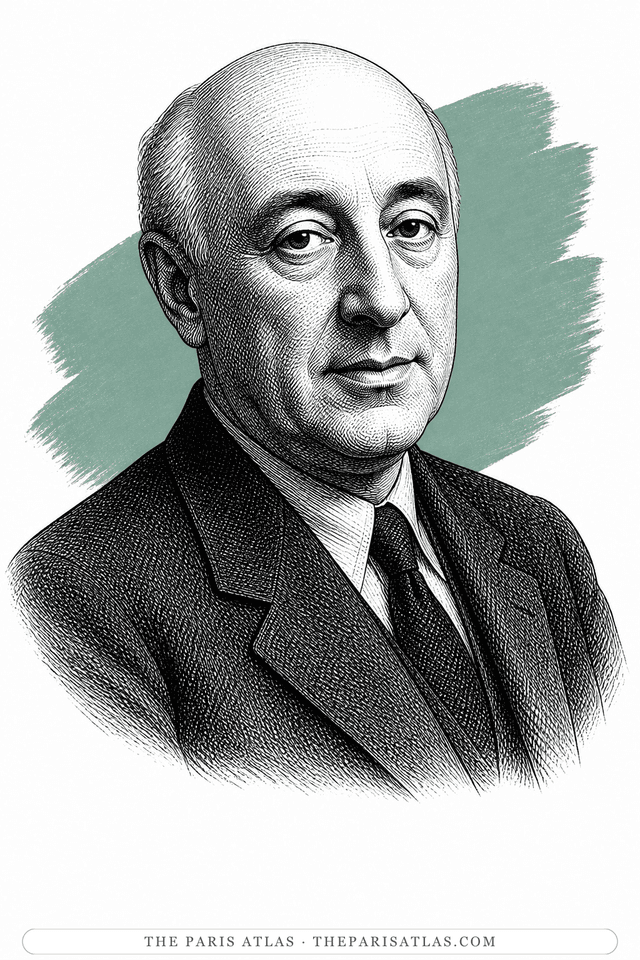
Jean Arp
Strasbourg-born sculptor and poet — Hans in German, Jean in French, both all his life — who co-founded Dada at the Cabaret Voltaire in 1916, composed collages by dropping torn paper 'according to the laws of chance', and settled at Meudon outside Paris in a house his wife Sophie Taeuber-Arp designed.
View artist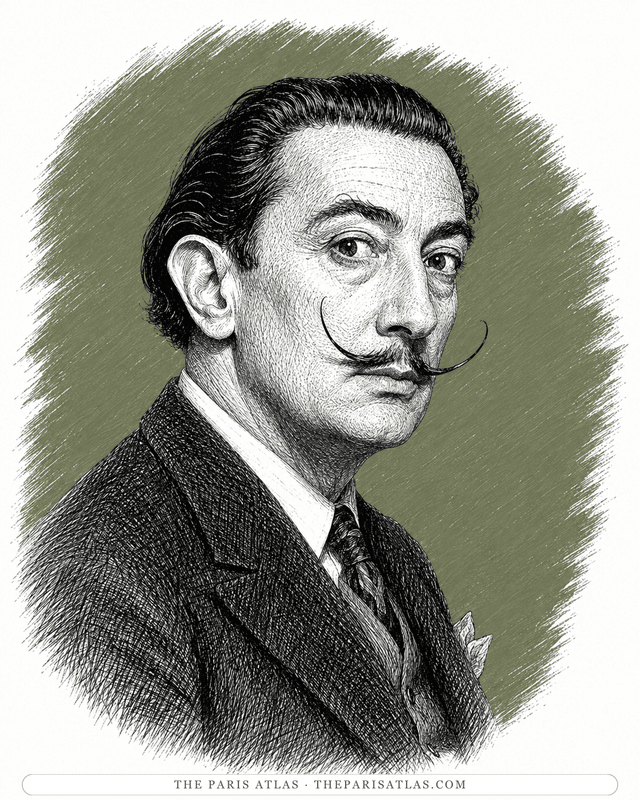
Salvador Dalí
The self-made icon of Surrealism — melting watches and manicured scandal — who arrived in Paris by way of two films written with Buñuel, dreamed together before the movement claimed them.
View artist
Marcel Duchamp
The century's quietest revolutionary — readymades, the abandonment of painting, chess on a Paris rooftop in Entr'acte, and one anemic film of spinning puns signed Rrose Sélavy.
View artist
References
The sources below include collection records, catalogues, scholarly research, and primary materials that informed this page. They document The Farm, its making, and its place in cultural history.

1The Farm, Joan Miró, 1921–1922 (object page with provenance)
WebsiteNational Gallery of ArtUsed forThe museum's object record: title, date, medium, dimensions, inscription, credit line, accession number, visual description, provenance with notes, exhibition history and bibliography.

2Open access collection data — objects.csv and published_images.csv
Official recordNational Gallery of Art, WashingtonUsed forThe museum's published objects.csv and published_images.csv, which supply the same catalogue fields plus the image row marking the reproduction as not open access.
3Joan Miró — Biography
WebsiteFundació Joan MiróUsed forThe artist's foundation on the rue Blomet years, including that the studio was Pablo Gargallo's and available during the academic terms.
4The Farm
PeriodicalCahiers d'Art 9, nos. 1–4, 1934Used forContemporary reporting or criticism used to document the historical reception and context of The Farm.
5Ernest Hemingway: A Life Story
BiographyCarlos Baker, 1969Used forBiographical evidence used to verify chronology, relationships, and historical context connected to The Farm.
6Joan Miró
Exhibition catalogueThe Museum of Modern Art, New York, 1993Used forCatalogue scholarship used to verify attribution, provenance, chronology, and interpretive context for The Farm.

7Joan Miró. Catalogue raisonné. Paintings, 6 vols.
NonfictionDaniel Lelong, Paris, 1999Used forPublished analysis and historical context used in preparing the The Farm page.
8La masía, un Miró para Mrs. Hemingway
NonfictionValència, 2015Used forPublished analysis and historical context used in preparing the The Farm page.
9Rights and permission — who administers the copyright in Joan Miró's work
Official recordSuccessió Miró CB, Palma de MallorcaUsed forThe estate's own statement of who administers Joan Miró's copyright, checked rather than assumed.
These references provide the documented foundation for this work's history and interpretation. Claim-level citations remain attached to the specific claims they support.
 Explore more resources