The Hunter (Catalan Landscape)
by Joan Miró
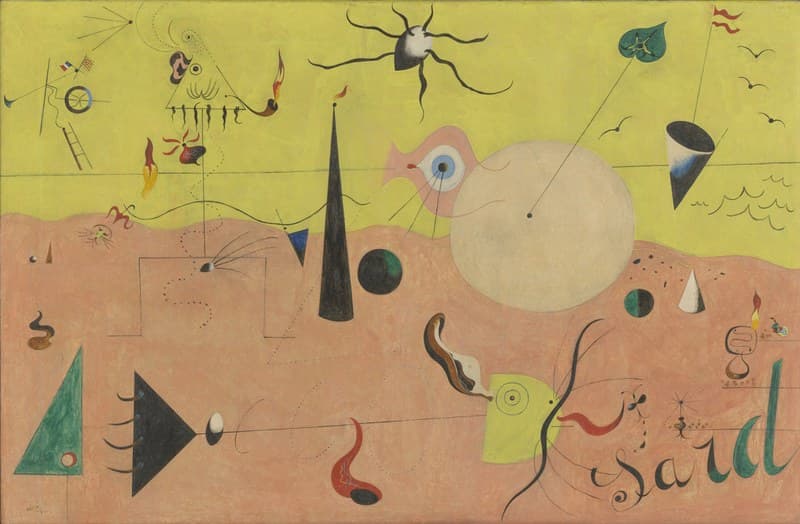
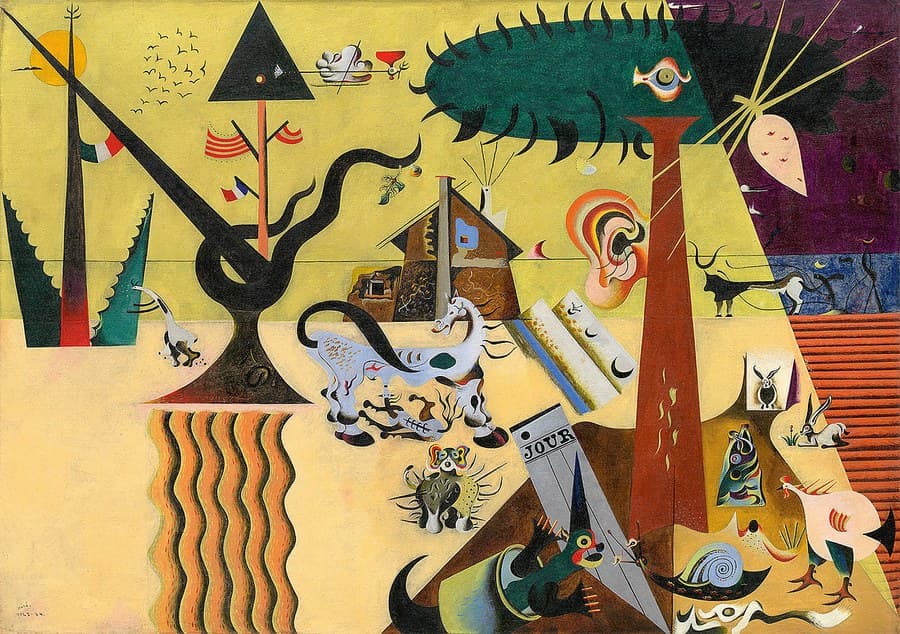
A chartreuse sky over a salmon-pink ground, with a stick-figure hunter at the left, a one-eyed sardine at the centre, a cream disc, a ruled sea at the upper right and the letters sard written large across the lower right. Joan Miró began it at Mont-roig in July 1923 and finished it in the winter of 1924. André Breton owned it before the Museum of Modern Art bought it in 1936.
- Montroig, July 1923–winter 1924
- Oil on canvas
- The Museum of Modern ArtNew York, United States
About Joan Miró

What the painting shows
The canvas divides into two flat fields: a chartreuse-yellow sky above a slightly wavy horizon, and a salmon-pink ground below it. Almost nothing is modelled. The signs sit on the colour like marks on a page.
The hunter occupies the left. His head is a triangle in the yellow sky, carrying a black handlebar moustache with a pink inner flash, a round white eye with a black pupil, and hatched strokes for a beard, with black tapering fingers hanging below. A red-and-yellow flame, a red-orange starburst and a dark speckled lobe float beside him. Below the horizon his body is a large black triangle pointing right, with four curved black claws along its left edge and a white egg set in a dark lens at its point.
The centre holds a flattened pink head with one eye — a white eyeball, a pale blue iris, a dark pupil, a small red barb at the left and four fine whiskers trailing down. Immediately right of it a large cream disc fills the middle of the canvas, with a single black dot near its centre and a thin line running up and away from that dot.
The upper left carries a blue, white and red tricolour on a thin staff, a hatched rectangle, a dark ring with a blue arc inside it, a blue funnel and a wooden ladder. The upper right carries a dark green leaf on a long string, with a white stick figure drawn on its face. Beside it are a red wavy pennant, three small black gull marks and a cone hanging point-down with a black top and a blue band. Rows of small black arcs stand for the sea.
The lower right holds a yellow-green lozenge with a spiral eye, a red tongue, a small black insect, a spidery star, a brown pretzel-shaped form over a crescent bowl with a red-and-yellow flame above it, and the word sard. The s and a are dark; the r and d are teal green and much larger. Joan Miró signed the canvas at the lower left in small dark script.
What the Museum of Modern Art says it is
The museum reads the canvas as a landscape rather than an abstraction. A closer look, it writes, reveals a landscape populated with a rich assortment of human and animal figures and natural forms that together comprise an iconography of the artist's life.
It identifies the hunter directly. He has a stick figure body and a triangular head, with a pipe protruding beside a bushy moustache and a heart floating near his chest. One hand holds a freshly killed rabbit and the other a gun still smoking from the kill. The museum calls the figure a stand-in for Joan Miró, and notes that it appears in many of his other works.
On the flags and the lettering the museum is equally direct. Catalonia is a politically autonomous region near Spain's border with France, with its own parliament, language, history and culture, and Catalan nationalism has been debated for more than a century. The museum reads the French, Catalan and Spanish flags in the background as a hint at that history.
The written fragment carries two jobs at once. Sard is short for the sardana, Catalonia's national dance. The museum also reads the truncated word as a reference to the fragmented letters and words of the Dadaist and Surrealist poetry that Joan Miró had been reading.
The year he stopped painting from the thing in front of him
The Museum of Modern Art frames 1923 as a change of working method rather than a change of address. Moving between Mont-roig and Paris meant a transition from painting directly from nature to working indoors, in a studio. It quotes what Joan Miró said about the effect a few years later.
“I have managed to escape into the absolute nature, and my landscapes have nothing in common anymore with outside reality….”
The Fundació Joan Miró puts the canvas in a group of three begun at Mont-roig that summer, with Tilled Field and Pastoral, and calls the three of them the turning point in his art. The studio was at 45 rue Blomet in Paris, borrowed from the sculptor Pablo Gargallo during the academic terms, with André Masson next door.
Jacques Dupin, Joan Miró's biographer, called the rue Blomet studio an avant-garde laboratory, and the Museum of Modern Art quotes the phrase. The people in it were writers: Michel Leiris, Antonin Artaud, Robert Desnos, Paul Éluard, Georges Limbour, Raymond Queneau.
André Breton bought it in 1925
The Museum of Modern Art states that André Breton, the founder of Surrealism, acquired The Hunter in 1925. That is the same year André Breton first visited the rue Blomet studio and the same year Joan Miró had his first Paris solo exhibition at the Galerie Pierre. The first Surrealist manifesto had appeared in 1924.
The museum also records what André Breton later wrote about the arrival that produced the painting. He deemed Joan Miró's arrival in Paris in the early 1920s an important stage in the development of surrealist art, in the essay Artistic Genesis and Perspective of Surrealism of 1941, collected in Surrealism and Painting.
A more famous line is usually put in André Breton's mouth at this point, to the effect that Joan Miró was the most Surrealist of them all. None of the museums holding his paintings prints it, and none supplies a page for it. The expectation that André Breton wrote it went unverified, so it is not quoted. The statement he demonstrably made is the one above, which the Museum of Modern Art cites to page 70.
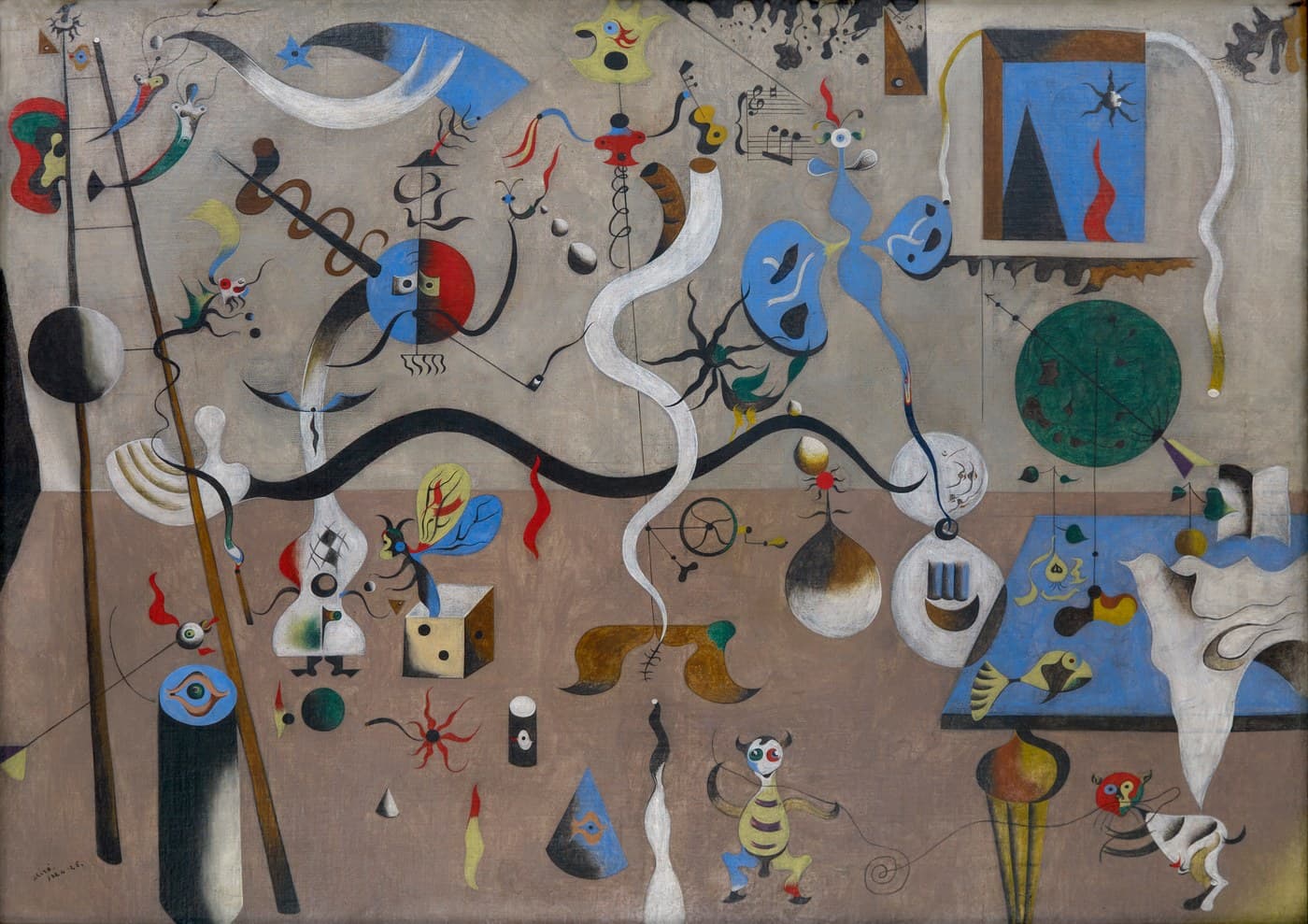
André Breton also owned Carnaval d'Arlequin, the 1924–25 canvas now at the Buffalo AKG Art Museum, from 1926. Two of the five Miró paintings in the atlas passed through his hands.
New York bought it in 1936
The Museum of Modern Art acquired the painting on 27 December 1936, under the plainest credit line it has: Purchase. Its object number is 95.1936, and it belongs to the Department of Painting and Sculpture.
That date puts it among the museum's earliest Miró purchases, five years before it gave him his first major retrospective, organized by James Johnson Sweeney in 1941. The museum's own artist essay opens with this canvas rather than with any later one. It calls the painting the one that brings together the real and the imaginary, abstraction and figuration, and image and text, in a way that would characterize much of his work to come.
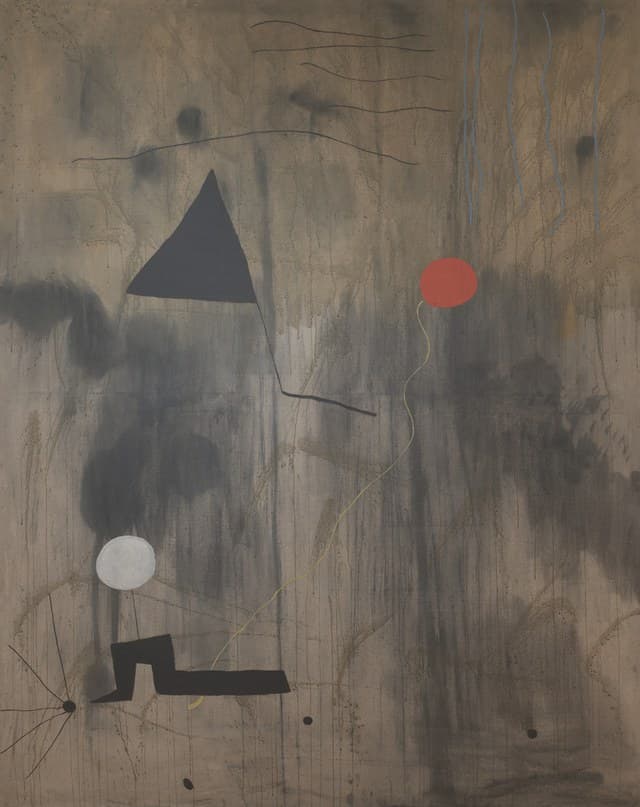
The museum listed the painting as not on view when its record was checked in September 2026. Its companion in the same collection, The Birth of the World of 1925, was on view in Gallery 517.
The title, and the dates
The Museum of Modern Art titles it The Hunter (Catalan Landscape), English first with the descriptive title in parentheses. The Fundació Joan Miró inverts the order and writes Catalan Landscape (The Hunter). The Catalan form is Paisatge català (El caçador), and French catalogues print Paysage catalan (Le chasseur).
The date is not a year but a span with a place attached. The museum prints Montroig, July 1923–winter 1924, which records where the canvas started and how long it took. The National Gallery of Art, cataloguing The Farm, spells the same village Montroig without a hyphen, while the Fundació Joan Miró writes Mont-roig.
Close reading
Reading the work, detail by detail
The Museum of Modern Art reads the canvas as a landscape rather than an abstraction — an iconography of the artist's life, with a stick-figure hunter standing in for Joan Miró himself. The close views follow the museum's inventory across a picture in which almost nothing is modelled and almost everything is a mark.
1.The head is a triangle with a moustache
The hunter's head is a plain triangle in the yellow sky. A black handlebar moustache with a pink inner flash crosses its left side, a round white eye with a black pupil sits to the right of it, and short hatched strokes hang below for a beard. Beneath the triangle, four black tapering strokes hang down like fingers.
2.A pipe, a flame and a spark
Three small marks cluster below the hunter's head: a red flame with a yellow tip, a red-orange starburst of about seven arms, and a dark blue-black lobe speckled with red. The Museum of Modern Art identifies a pipe protruding beside the moustache; what the paint gives is this cluster of fire and dark bowl. A thin ruled horizon crosses behind them.
3.The body is a black triangle with four claws
The hunter's body is a solid black triangle pointing right. Four curved black claws trail from its left edge. At its point sits a white egg set inside a dark lens, and a thin line runs away from it to the right across the pink ground. The triangle casts no shadow and stands on nothing.
4.A sardine with one blue eye
A flattened pink form at the centre of the canvas carries one large eye: a white eyeball, a pale blue iris and a dark brown pupil. A small red barb points out at the left, and four fine black lines trail down and away from the pupil like whiskers. The form has the silhouette of a fish head seen side-on.
5.A cream disc with a dot at its centre
The largest shape on the canvas is a flat ivory disc, unshaded and unoutlined, set just right of centre. One small black dot sits near its middle, and a single thin line runs from that dot up and to the right. The disc straddles the horizon, half in the yellow sky and half on the pink ground.
6.The letters read sard
The word is written in lowercase cursive across the lower right, at the scale of a signature rather than a caption. The s and a are dark grey-black and small; the r and d are much larger and filled in teal green, the d swelling into a broad flourish. The Museum of Modern Art reads it as short for sardana, the Catalan national dance.
7.A tricolour and a ladder
A small blue, white and red tricolour hangs from a thin staff, joined at a black dot to a hatched rectangle like a net. Below it a dark ring holds a blue arc on its inner right edge and a few spokes. A plain wooden ladder leans away at the lower left, drawn in outline with five rungs and touching nothing.
8.A cone, three gulls and a ruled sea
A cone hangs point-down from a thin line, its open top a black ellipse and a blue band crossing its middle. Three small black gull marks fly to its right. Below and right of them, rows of small black arcs stand in for waves. The sea is drawn, not coloured, on the same yellow as the sky.
9.A leaf on a string with a figure drawn on it
A dark teal leaf shaped like a heart hangs high in the sky, tethered by a long thin line that runs down to the left. A small white stick figure is drawn on its face. A red wavy pennant flies from a second line above it. Both are held to the ground by string rather than resting in the picture.
10.A green triangle with a red half-moon
A flat green triangle points right from the left edge, its surface faintly brushed and its edges hard. A white circle near its base holds a red half-moon, like a marker set into a hillside. A small dark brown and black S-shape, a snake, lies on the pink ground above it.
11.A brazier at the right edge
A brown loop shaped like a pretzel encloses a zigzag line, and sits directly above a shallow brown crescent bowl. A red flame with a yellow core rises just beyond it. A row of tiny red marks runs off to the left along a ruled line. The group reads as a grill over a fire, drawn in outline.
Timeline
1923
Begun at Mont-roig in July, alongside Tilled Field and Pastoral. The Fundació Joan Miró calls the three canvases the turning point in his art.
1924
Finished in the winter. André Breton publishes the first Surrealist manifesto that October.
1925
Acquired by André Breton, in the year he first visited the rue Blomet studio and the year of Joan Miró's first Paris solo exhibition at the Galerie Pierre.
1936
Bought by the Museum of Modern Art on 27 December as 95.1936, credited simply as Purchase.
1941
The Museum of Modern Art gives Joan Miró his first major retrospective, organized by James Johnson Sweeney.
2019
Shown in Joan Miró: Birth of the World at the Museum of Modern Art, 24 February to 15 June.
Where to see it
The Museum of Modern Art
11 West 53 Street, New York, NY 10019, United States
Listed as not on view when the museum's record was checked in September 2026.
Plan your visit on the museum’s official website (opens in a new tab)Frequently asked questions
Where is The Hunter (Catalan Landscape) by Joan Miró?
The Museum of Modern Art in New York, object number 95.1936, bought on 27 December 1936. The museum listed it as not on view when its record was checked in September 2026.
What does sard mean in The Hunter?
It is short for sardana, Catalonia's national dance. The Museum of Modern Art also reads the truncation itself as a reference to the fragmented letters and words of the Dadaist and Surrealist poetry Joan Miró had been reading at the rue Blomet studio. The letters are painted large across the lower right, the s and a dark and the r and d in teal green.
Who is the hunter in The Hunter (Catalan Landscape)?
Joan Miró himself. The Museum of Modern Art calls the figure a stand-in for the artist and notes that it recurs across his work. It gives him a stick-figure body, a triangular head, a pipe beside a bushy moustache, a heart floating near his chest, a freshly killed rabbit in one hand and a smoking gun in the other.
Did André Breton own The Hunter?
Yes. The Museum of Modern Art states that André Breton, the founder of Surrealism, acquired the painting in 1925 — the same year he first visited Joan Miró's studio at 45 rue Blomet. André Breton also owned Carnaval d'Arlequin, now at the Buffalo AKG Art Museum, from 1926.
How big is The Hunter (Catalan Landscape)?
64.8 by 100.3 centimetres, which the Museum of Modern Art gives as 25 1/2 by 39 1/2 inches. Oil on canvas, in landscape format.
Did André Breton call Joan Miró the most Surrealist of us all?
The line is attached to him constantly, and none of the museums holding his paintings prints it or gives a page for it. What André Breton demonstrably wrote, in Artistic Genesis and Perspective of Surrealism in 1941, is that Joan Miró's arrival in Paris in the early 1920s was an important stage in the development of surrealist art. The Museum of Modern Art cites that to page 70 of the 1972 translation of Surrealism and Painting.
What is the big cream circle in The Hunter?
The largest single shape on the canvas, a flat ivory disc set just right of centre with one black dot near its middle and a thin line running off that dot to the upper right. The Museum of Modern Art does not name it in its object text. It sits directly beside the pink one-eyed head that the museum's literature has long read as a sardine.
More by Joan Miró
If you like Joan Miró
Explore painters from the same movements and circles.
Jean Arp
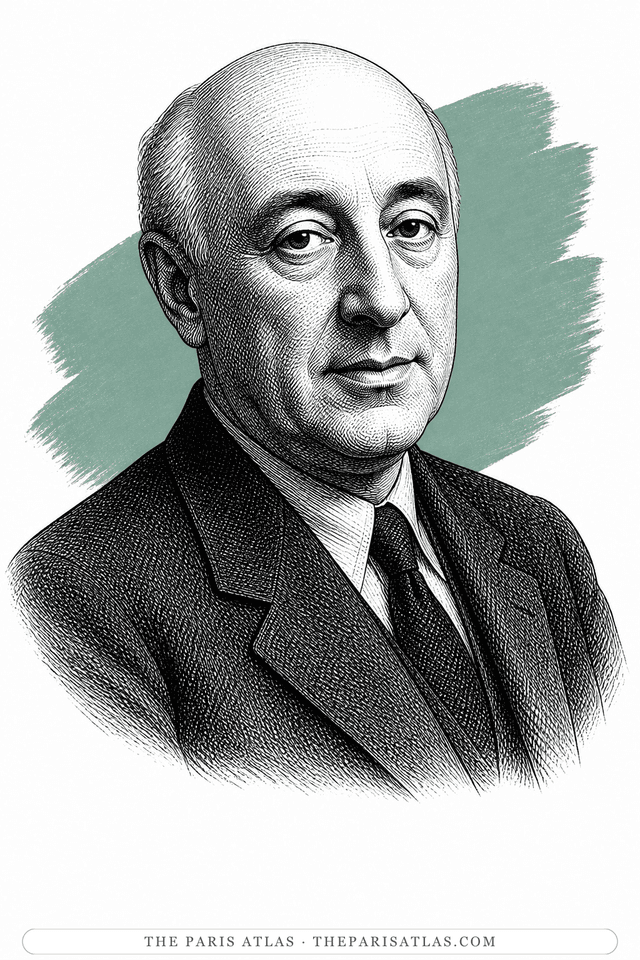
Strasbourg-born sculptor and poet — Hans in German, Jean in French, both all his life — who co-founded Dada at the Cabaret Voltaire in 1916, composed collages by dropping torn paper 'according to the laws of chance', and settled at Meudon outside Paris in a house his wife Sophie Taeuber-Arp designed.
View artist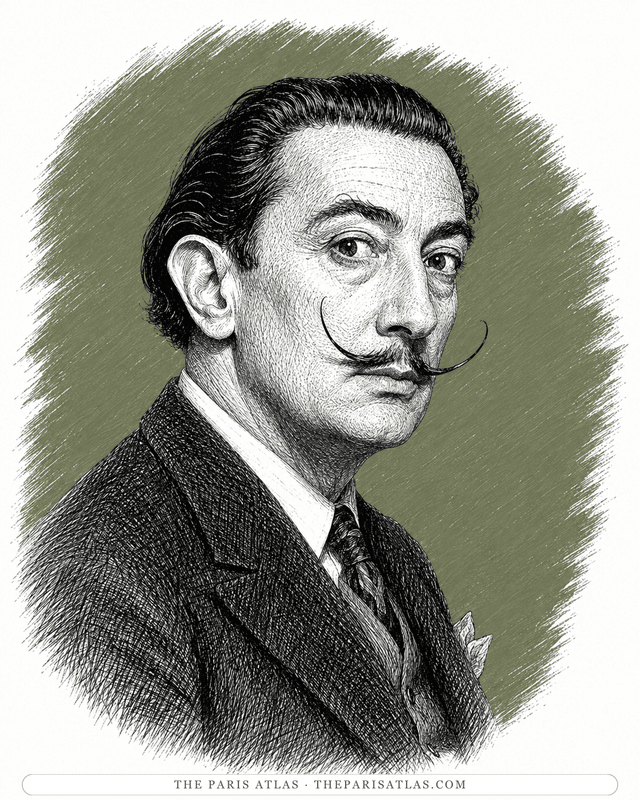
Salvador Dalí
The self-made icon of Surrealism — melting watches and manicured scandal — who arrived in Paris by way of two films written with Buñuel, dreamed together before the movement claimed them.
View artist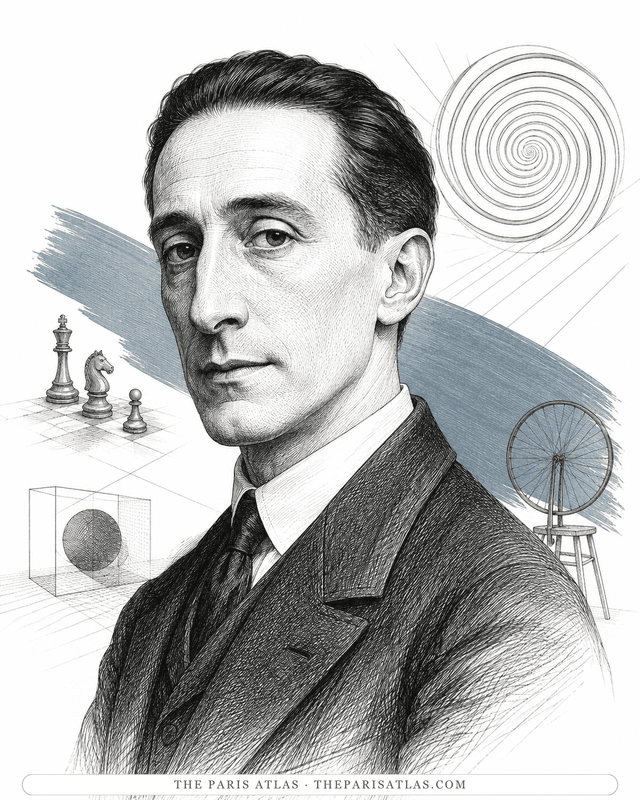
Marcel Duchamp
The century's quietest revolutionary — readymades, the abandonment of painting, chess on a Paris rooftop in Entr'acte, and one anemic film of spinning puns signed Rrose Sélavy.
View artist
References
The sources below include collection records, catalogues, scholarly research, and primary materials that informed this page. They document The Hunter (Catalan Landscape), its making, and its place in cultural history.


1The Hunter (Catalan Landscape), Joan Miró, Montroig, July 1923–winter 1924
WebsiteMuseum of Modern ArtUsed forThe museum's object record: title, date, medium, dimensions, credit line, object number, copyright line and the reading of the hunter, the flags and the word sard.

2The Museum of Modern Art collection dataset (Artworks.csv)
ArchiveThe Museum of Modern Art, New YorkUsed forThe museum's published Artworks dataset, which supplies the same catalogue fields; www.moma.org refuses command-line clients with HTTP 403.
3Joan Miró — artist essay
WebsiteThe Museum of Modern Art, New York, 2017Used forNatalie Dupêcher's artist essay, which records André Breton's 1925 acquisition and cites his 1941 statement about Joan Miró's arrival in Paris.
4Surrealism and Painting
EssaysHarper & Row, 1972Used forPublished analysis and historical context used in preparing the The Hunter (Catalan Landscape) page.
5Joan Miró, Life and Work
BiographyHarry N. Abrams, 1962Used forBiographical evidence used to verify chronology, relationships, and historical context connected to The Hunter (Catalan Landscape).
6Joan Miró — Biography
WebsiteFundació Joan MiróUsed forThe artist's foundation on the Mont-roig summer of 1923 and André Breton's visit to the rue Blomet studio in 1925.
7Joan Miró, Carnaval d'Arlequin (Carnival of Harlequin), 1924–25 — object record with provenance, RCA1940:8
WebsiteBuffalo AKG Art MuseumUsed forFor André Breton's 1926 ownership of the other Miró canvas he held.
8Rights and permission — who administers the copyright in Joan Miró's work
Official recordSuccessió Miró CB, Palma de MallorcaUsed forThe estate's own statement of who administers Joan Miró's copyright, checked rather than assumed.
These references provide the documented foundation for this work's history and interpretation. Claim-level citations remain attached to the specific claims they support.
 Explore more resources