Carnaval d'Arlequin (Carnival of Harlequin)
by Joan Miró
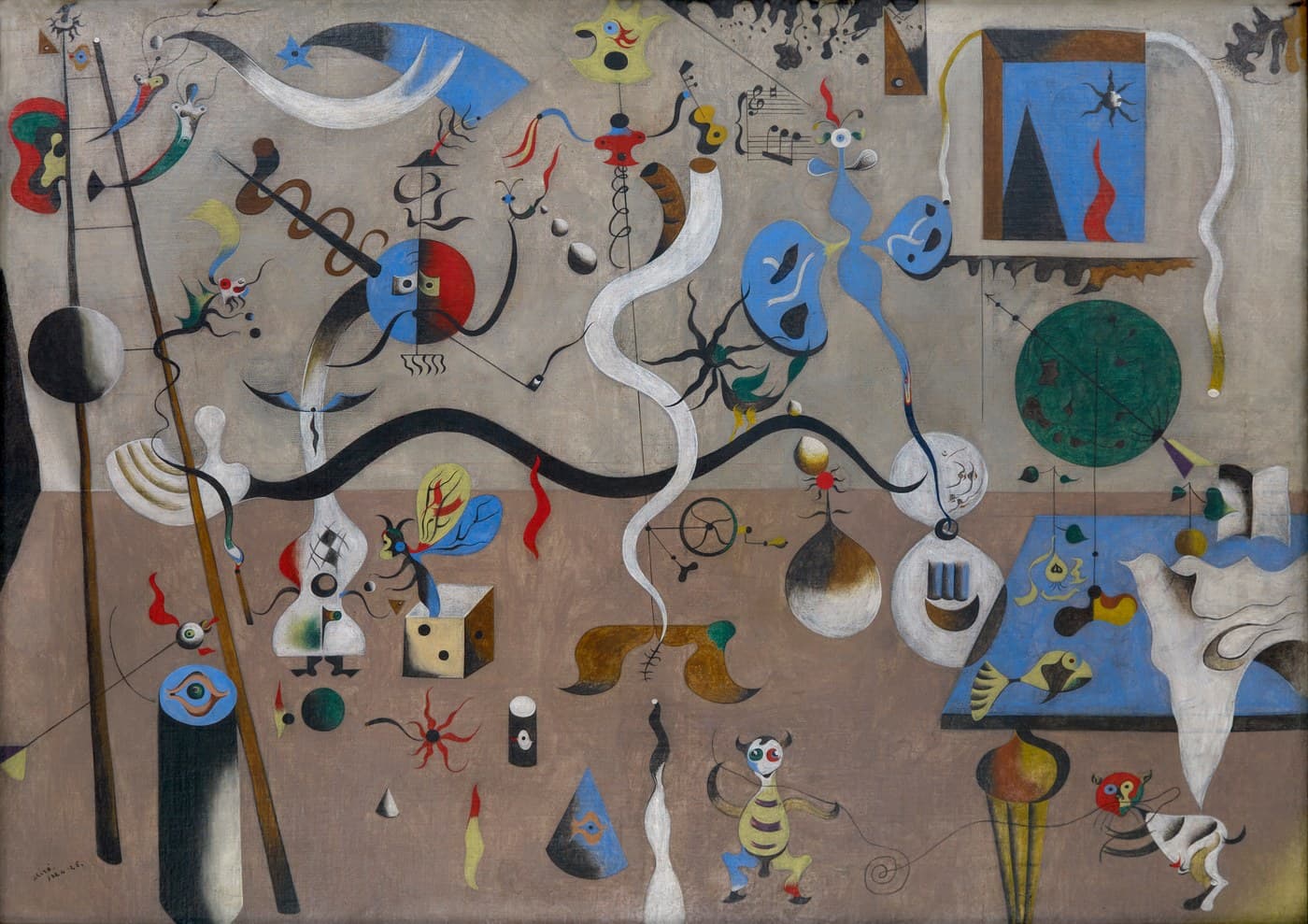
A room crowded with dancing creatures, musical instruments, a guitar, a die, a cat, a fish and a window on a blue sky. A masked head split down the middle, blue on one side and red on the other, hangs at the centre-left above a white body with a hole cut through its stomach. Joan Miró painted it at 45 rue Blomet in 1924–25. André Breton owned it in 1926, and the Buffalo AKG Art Museum bought it in 1940.
- 1924–25
- Oil on canvas
- Buffalo AKG Art MuseumBuffalo, United States
About Joan Miró

What the painting shows
The setting is a room. A grey-green wall fills the upper half and a warm brown floor the lower, meeting in a straight line across the canvas, with a long black wavy line snaking above the join. Everything else floats.
The head hangs at the centre-left: a circle split vertically, blue on the left and red on the right, carrying two lozenge eyes — one silver-white, one olive — and a long black handlebar moustache. Four wavy strokes hang below it for a beard, and two black plumes rise from a stem above. The Buffalo AKG Art Museum identifies the half-red, half-blue mask and the diamond pattern on the tunic as references to the commedia dell'arte.
The body stands below and to the left. It is a white bottle-shaped form latticed with black diamonds across the chest, one of them filled solid. A red flame marks the shoulder and a green smudge the hem. Two black feet stand in pointed shoes. A black ring is cut through the middle of it, and the brown floor shows through the hole.
The floor carries a moth with a yellow upper wing veined in black and a blue lower wing. Its tail dips into an open white die, which shows two black pips on its top face and one on its brown side. Near them lie a dark green sphere, a black bead throwing out wavy red arms and a cylinder half black and half white with an eye on it. A small grey cone, a blue cone with an orange-ringed eye and a white wavering column stand further right. Between them a creature dances in blue cuffs and black shoes, its yellow body banded in purple, one eye green and one red.
At the upper right a window framed in brown opens on a flat blue field holding a black mountain, a red flame and a black spiky star with a white centre. A torn black and ochre frill hangs beneath the sill. To the left of it a yellow figure-of-eight guitar with a black neck sits beside a stave carrying a treble clef, a natural sign and a group of beamed notes.
The right-hand side holds a blue table with a black front edge. A single fish with a striped fan tail and a red-and-white eye lies on it, with a yellow face-like form, a hanging black bead and green leaves on strings above. A large white cloth shape drapes over the table's right corner. Below it a cat runs off with a dark thread in its mouth, its face red and green, one eye blue and one yellow, its whiskers long and its tail curled black. Joan Miró signed and dated the canvas at the lower left: Miró. 1924-25.
Radishes for dinner
The Buffalo AKG Art Museum's own notice supplies the circumstances. At the time Joan Miró made the painting he had so little money that all he could afford to serve a friend for dinner were radishes.
The museum records his account of the picture's origin: coming home at the end of a day without food and, in a kind of trance, drawing the forms that became its genesis. It then connects that to a specific mark on the canvas — the hole in Harlequin's stomach, which may allude to Joan Miró's own poverty and hunger.
The hole is a small black ring near the middle of the white body, with the brown floor visible through it. It is the only element in a crowded canvas that is an absence rather than a thing.
The museum sets the hunger against the rest of the room. The other characters throughout the composition, it writes, seem to be having a wonderful time.
The harlequin, and the week before Lent
The Buffalo AKG Art Museum places the figure in a theatrical tradition. In the commedia dell'arte the Harlequin is a foolish stock character, perpetually unsuccessful in love, and artists often used him as a stand-in for themselves. The museum records that Joan Miró came to know the tradition through the work of Pablo Picasso.
It also reads the title as a season rather than a person. The museum states that the title is believed to refer to Mardi Gras, the celebration that precedes the fasting of Lent in the Catholic liturgical calendar. A carnival is the last eating before a fast, which puts the hole in the stomach in a second light.
The creatures are hybrids by design. Many revellers have characteristics of both humans and animals, the museum writes, and some are anthropomorphized objects — the ladder with an eye and an ear among them. They are playing, singing, dancing and celebrating, with music literally in the air, in the form of a stave of notes above the guitar.
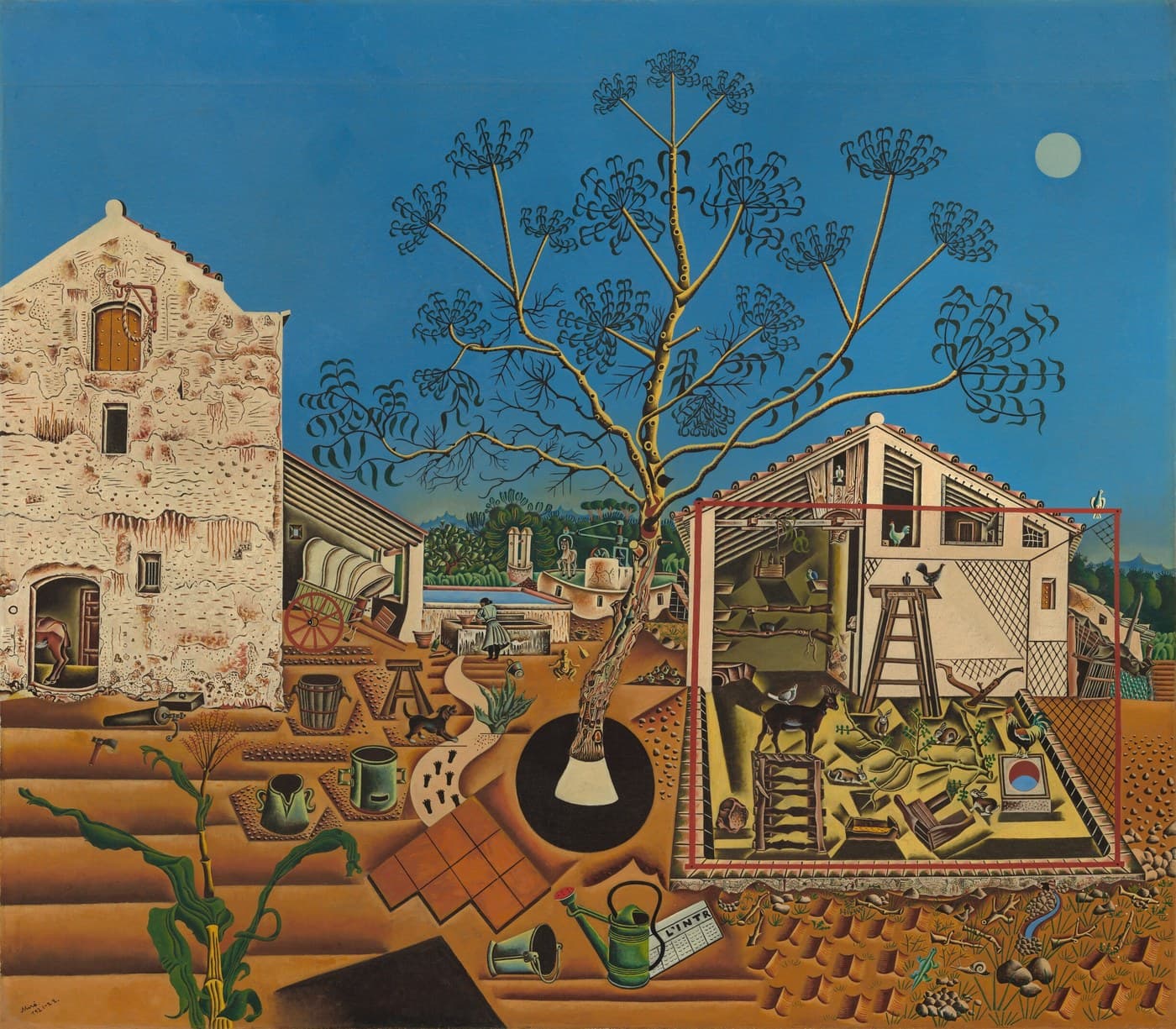
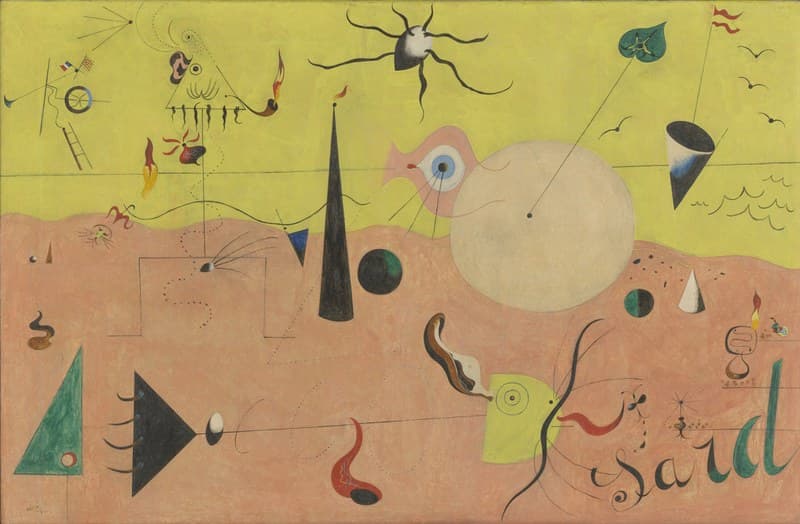
The museum calls the canvas a climactic work in a series of paintings Joan Miró infused with the colour scheme and landscape of his native Catalonia. It comes at the end of the run that began with The Farm in 1921 and passed through The Tilled Field and The Hunter (Catalan Landscape) in 1923–24.
André Breton owned it, and then a Belgian collector
The Buffalo AKG Art Museum's provenance opens with an abbreviation and a guess: by November 1925, collection M. P. E., Paris, which the museum annotates as possibly Monsieur Paul Éluard. The poet Paul Éluard belonged to the same circle, and the museum does not resolve the initials further.
The next owner is not hedged. André Breton held the painting in Paris from 1926, the year after he first visited the rue Blomet studio. He had bought The Hunter (Catalan Landscape) in 1925. Two of Joan Miró's Paris-decade canvases therefore passed through the hands of the man who wrote the Surrealist manifesto.
From André Breton it went to René Gaffé, the Belgian collector and journalist, by June 1929, and then into the London trade: the Zwemmer Gallery in July 1936, Mr. and Mrs. Jonathan Griffin on 22 July 1936, and through Zwemmer again to Douglas Cooper at the Mayor Gallery in 1937.
It reached the Pierre Matisse Gallery in New York on 5 March 1937 and was sold to the Albright Art Gallery in Buffalo on 9 March 1940. The museum records the purchase under the Room of Contemporary Art Fund, 1940, and the accession number RCA1940:8.
The museum changed its name, and the painting has three titles
The institution that owns the picture is now the Buffalo AKG Art Museum. It was the Albright Art Gallery when it bought the canvas in 1940 and the Albright-Knox Art Gallery for most of the time since. The current name dates from the 2023 opening of the new campus.
Both names still appear on the museum's own object page. The catalogue block reads Collection Buffalo AKG Art Museum; the full caption printed above it reads Collection Albright-Knox Art Gallery, Buffalo, New York.
The title is equally layered. The museum's own heading is Carnaval d'Arlequin (Carnival of Harlequin), French first with the English in parentheses, and its body text calls the work Carnival of Harlequin. Its own events archive carries a 2016 director's lecture on the same painting titled Harlequin's Carnival, which is the form most books use. The Catalan is El carnaval d'Arlequí.
Joan Miró signed and dated the canvas twice. On the front, at the bottom left: Miró. / 1924-25. On the back, more fully: Joan Miró / Carnaval d'Arlequin / 1924-25.
The sixth painting, and why it is not here
One more canvas belongs to this run and has no page of its own in the atlas. Dog Barking at the Moon was painted at Mont-roig in 1926, oil on canvas, 73 by 92.1 centimetres. The Philadelphia Museum of Art holds it as 1952-61-82, in the A. E. Gallatin Collection.
The museum bars a reproduction in plain terms. Its object record states that a downloadable image is unavailable for this object due to copyright, trademark or related rights, under a copyright line reading © Successió Miró / Artists Rights Society (ARS), New York / ADAGP, Paris 2025.
The record is worth having anyway for two facts it supplies. Its provenance runs from the Galerie Pierre directly, and A. E. Gallatin bought it there on 10 March 1929 after it had been sold once and come back on the market. And the museum notes what the preparatory drawing carried. The dog's bow wow was written out rising upward, and the moon replied in a cartoon speech balloon that it did not give a damn. Joan Miró crossed the words out in the drawing and left them out of the painting.
Close reading
Reading the work, detail by detail
The Buffalo AKG Art Museum reads the canvas as a room at Mardi Gras: hybrid revellers playing, singing and dancing, with music literally in the air, and a harlequin whose hole in the stomach may allude to Joan Miró's own hunger. The close views count what is in the room, from the mask at the centre to the cat leaving with a thread in its mouth.
1.The mask is half blue and half red
The head is a circle divided down the middle, blue on the left and red on the right. Two flat lozenge eyes sit either side of the division, one silver-white and one olive-green, each with a black ring and pupil. A long black handlebar moustache curls out and down on both sides. Four wavy strokes hang below the chin, and two black plumes rise from a stem above.
2.A hole is cut through the stomach
The harlequin's body is a white bottle-shaped form. A lattice of black diamond lines crosses its chest with one diamond filled solid — the tunic the Buffalo AKG Art Museum names. At the waist a black ring is cut clean through, and the brown floor shows inside it. A red flame marks the left shoulder, a green smudge the hem, and two black feet stand in pointed shoes.
3.A moth dips into an open die
A white cube stands open on the floor, showing two black pips on its top face and one on its brown right face. The black body of a moth dips into the opening. Its upper wing is yellow, veined in black with a red streak through it; its lower wing is flat blue. Its head carries a dark green cap, two black horns, a red-and-yellow face and a blue-ringed eye.
4.A yellow guitar beside four bars of music
The guitar is a yellow figure of eight with two round holes and a black neck carrying three tuning pegs. Beside it a stave is ruled onto the wall, opened by a black brace and a treble clef, with a natural sign after them and a group of beamed notes below. The museum's phrase for the room, music literally in the air, is this: notation painted on the wall with nothing playing it.
5.The window holds a mountain and a flame
A rectangular window framed in brown opens on a flat blue field. Inside it a black triangle rises from the lower left, a red wavy flame stands at the centre right, and a black spiky star with a white centre hangs at the upper right over a faint grey disc. A torn black and ochre frill hangs below the sill. It is the only depth in the room.
6.One fish on a blue table
A flat blue table with a black front edge occupies the right of the floor. One fish lies on it: pale yellow-cream, with a striped fan tail, a black patch across the body and a red-and-white eye. A yellow face-like form with two black eyes sits behind it, and green leaves hang on strings above with an orange sphere among them.
7.A cat with a thread in its mouth
A cat crosses the floor at the lower right. Its face is red on the left and green on the right, with one blue eye and one yellow, pointed ears and long black whiskers. Its body is white with dark grey and yellow-ochre markings, and its tail curls up to a black point. A dark thread runs from its mouth away to the left.
8.A striped creature dancing in red shoes
A creature dances alone on the brown floor. Its body is yellow-green and banded three times in purple, its head white with two black horns, one green eye and one red. A long striped tail curls up behind it. Blue cuffs sit at its ankles above black shoes, one of them showing a red sole. One arm is raised.
9.A ladder under a star with an eye
Two thin black rails with rungs between them rise diagonally across the wall, drawn in outline and leaning on nothing. Above the top rung hangs a black spiky star with a blue and white eye at its centre. A small brown triangle with a white dot and a yellow square carrying a blue-and-red eye sit beside them.
10.A black bead with wavy red arms
A solid black bead sits on the floor and throws out a ring of wavy red arms all round it, with one black tail curving away to the left. Beside it stands a small cylinder, white in its upper half and black in its lower, carrying a white oval with a black dot on its front. Neither object is attached to anything.
11.The signature reads Miró. 1924-25
Joan Miró signed the canvas at the bottom left, in small dark script, Miró. above 1924-25. It sits on the empty brown floor with nothing painted around it. The Buffalo AKG Art Museum records a second, fuller inscription on the back of the canvas: Joan Miró / Carnaval d'Arlequin / 1924-25.
Timeline
1924–25
Painted at 45 rue Blomet, and signed at the lower left on the front and again in full on the back.
1925
In the collection of M. P. E., Paris — possibly Paul Éluard — by November. The same year André Breton visits the rue Blomet studio and Joan Miró shows at the Galerie Pierre.
1926
In the collection of André Breton, Paris.
1929
In the collection of René Gaffé by June.
1936
Sold to the Zwemmer Gallery in July, and on to Mr. and Mrs. Jonathan Griffin on 22 July.
1937
Sold through the Zwemmer Gallery, London, to Douglas Cooper at the Mayor Gallery, and reaches the Pierre Matisse Gallery in New York on 5 March.
1940
Sold to the Albright Art Gallery, Buffalo, on 9 March, under the Room of Contemporary Art Fund, as RCA1940:8.
2011–12
Shown in The Long Curve: 150 Years of Visionary Collecting at the Albright-Knox Art Gallery, 4 November to 4 March.
2023
The museum opens its new campus as the Buffalo AKG Art Museum, having been the Albright-Knox Art Gallery since 1962.
Where to see it
Buffalo AKG Art Museum
1285 Elmwood Avenue, Buffalo, NY 14222, United States
The museum marks the painting a collection highlight and gave no gallery on its record when it was checked in September 2026.
Plan your visit on the museum’s official website (opens in a new tab)Frequently asked questions
Where is Joan Miró's Carnival of Harlequin?
The Buffalo AKG Art Museum in Buffalo, New York, accession number RCA1940:8. It was bought by the museum's predecessor, the Albright Art Gallery, on 9 March 1940 under the Room of Contemporary Art Fund. The museum has been called the Buffalo AKG Art Museum since its new campus opened in 2023.
Why is there a hole in Harlequin's stomach?
The Buffalo AKG Art Museum suggests it alludes to Joan Miró's own poverty and hunger. It records that when he made the painting he had so little money that all he could serve a friend for dinner were radishes. He described coming home at the end of a day without food and drawing the first forms in a kind of trance. The hole is a small black ring in the white body with the floor visible through it.
What does the title Carnival of Harlequin mean?
The Buffalo AKG Art Museum states that the title is believed to refer to Mardi Gras, the celebration preceding the fasting of Lent. Harlequin is the foolish stock character of the commedia dell'arte, perpetually unlucky in love, whom artists often used as a stand-in for themselves; the museum records that Joan Miró came to the tradition through the work of Pablo Picasso.
Is it called Carnival of Harlequin or Harlequin's Carnival?
The Buffalo AKG Art Museum titles it Carnaval d'Arlequin (Carnival of Harlequin) and uses Carnival of Harlequin in its own text. Harlequin's Carnival is the form most books use, and the museum's events archive carries a 2016 lecture under that title. The Catalan is El carnaval d'Arlequí.
Did André Breton own Carnival of Harlequin?
Yes. The Buffalo AKG Art Museum's provenance places the painting in André Breton's collection in Paris in 1926. He had bought The Hunter (Catalan Landscape) the year before. Before him the museum records a collection listed only as M. P. E., Paris, by November 1925, which it annotates as possibly Monsieur Paul Éluard.
How big is Carnival of Harlequin?
The Buffalo AKG Art Museum gives the support as 26 by 36 5/8 inches, 66.04 by 93.0275 centimetres, and the framed dimensions as 36 3/4 by 47 by 3 1/8 inches. Oil on canvas, in landscape format.
What is on the table in Carnival of Harlequin?
One fish, pale yellow-cream with a black patch, a red-and-white eye and a striped fan tail, lying on a flat blue table with a black front edge. Beside it are a yellow face-like form with two black eyes, a hanging black bead over an orange and yellow shape, and green leaves suspended on strings. A large white cloth drapes over the table's right corner.
More by Joan Miró
If you like Joan Miró
Explore painters from the same movements and circles.
Jean Arp
Strasbourg-born sculptor and poet — Hans in German, Jean in French, both all his life — who co-founded Dada at the Cabaret Voltaire in 1916, composed collages by dropping torn paper 'according to the laws of chance', and settled at Meudon outside Paris in a house his wife Sophie Taeuber-Arp designed.
View artist
Salvador Dalí
The self-made icon of Surrealism — melting watches and manicured scandal — who arrived in Paris by way of two films written with Buñuel, dreamed together before the movement claimed them.
View artist
Marcel Duchamp
The century's quietest revolutionary — readymades, the abandonment of painting, chess on a Paris rooftop in Entr'acte, and one anemic film of spinning puns signed Rrose Sélavy.
View artist
References
The sources below include collection records, catalogues, scholarly research, and primary materials that informed this page. They document Carnaval d'Arlequin (Carnival of Harlequin), its making, and its place in cultural history.


1Joan Miró, Carnaval d'Arlequin (Carnival of Harlequin), 1924–25 — object record with provenance, RCA1940:8
WebsiteBuffalo AKG Art MuseumUsed forThe museum's object record: title, date, materials, measurements, credit, accession number, both inscriptions, the full provenance, the copyright lines and its reading of the harlequin, the radishes and Mardi Gras.
2Joan Miró, Dog Barking at the Moon, 1926 — object record with provenance, 1952-61-82
WebsitePhiladelphia Museum of ArtUsed forThe 1926 canvas checked as a sixth candidate and dropped: the museum bars a downloadable reproduction on copyright grounds. Cited here for its provenance and for the crossed-out speech balloons in the preparatory drawing.
3Joan Miró — Biography
WebsiteFundació Joan MiróUsed forThe artist's foundation on the rue Blomet years, the 1925 Galerie Pierre exhibition and André Breton's visit.
4Joan Miró — artist essay
WebsiteThe Museum of Modern Art, New York, 2017Used forNatalie Dupêcher's artist essay, for André Breton's 1925 purchase of The Hunter (Catalan Landscape).

5Rights and permission — who administers the copyright in Joan Miró's work
Official recordSuccessió Miró CB, Palma de MallorcaUsed forThe estate's own statement of who administers Joan Miró's copyright, checked rather than assumed.
These references provide the documented foundation for this work's history and interpretation. Claim-level citations remain attached to the specific claims they support.
 Explore more resources