The Tilled Field
by Joan Miró
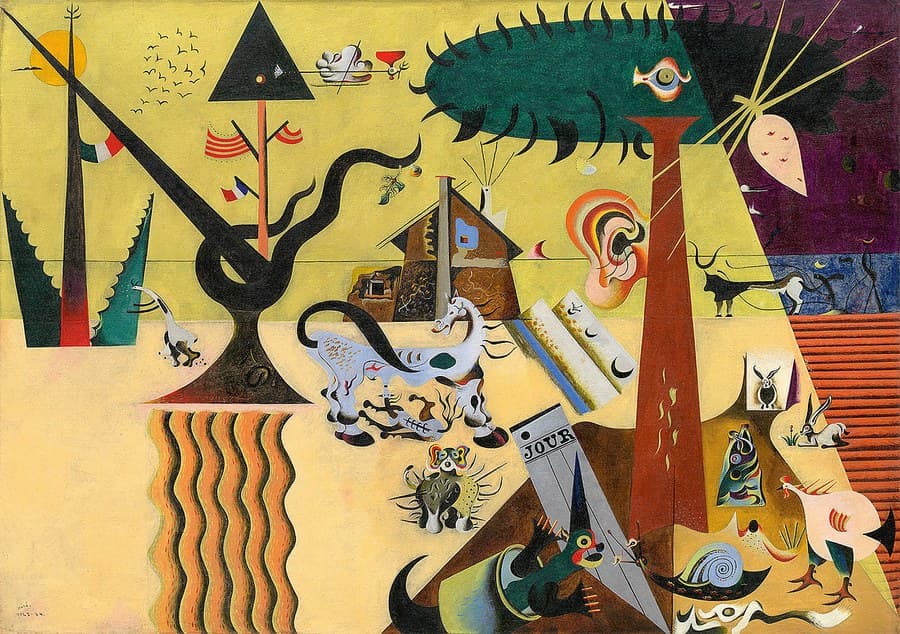
The same Catalan farm Joan Miró had inventoried in The Farm, repainted as emblems. A pine holds a human eye in its foliage and a human ear on its trunk. Six wavy furrows, a horse, a hare, a hen and a snail fill the field, and three flags stand on a black border post. He began it at Mont-roig in the summer of 1923 and finished it in 1924. The Solomon R. Guggenheim Museum in New York owns it.
- 1923–24
- Oil on canvas
- Solomon R. Guggenheim Museum, New YorkNew York, United States
About Joan Miró
What the painting shows
The ground is a flat pale cream, divided by a thin horizon from an olive-yellow sky. A purple field occupies the top right corner, a dark blue band runs below it, and the right edge breaks into parallel orange-red bands of ploughed earth.
A pine fills the upper centre: a dark teal oval fringed all round with black hooked needles, carried on a tall red-brown trunk striped with pale diagonals. At the right end of the foliage sits a single painted eye, a blue iris around a dark pupil in a white eyeball, rimmed in orange with pale lashes. A flesh-pink human ear, ringed in orange and dark red with a black inner whorl, is fixed to the left side of the trunk.
At the left a yellow sun disc hangs above a black spire; a black diagonal beam crosses the canvas carrying a band of green, white and red. Two red-and-white striped pennants and a blue, white and red tricolour hang from a black crossbar under a black triangle on a salmon pole. A scatter of about twenty black tick marks stands for a flock of birds.
Six wavy orange furrows run downhill from the black flared foot of a second tree, each edged in dark green with red dashes along its crest. A pale blue-white horse with a long black mane swept over its back stands at the centre-left, a dark green patch on its flank and pink under its black hooves. A folded grey cone of newspaper printed JOUR stands below it.
The right half holds the livestock. A black ox with long curved horns stands on the horizon, a running black-and-white dog beside it on the blue band, where a yellow crescent moon hangs. A grey-white hare with very long ears lies beside a tuft of grass, next to a white-framed picture containing a black rabbit. A pale pink hen with a red comb, black tail and red feet stands lower down, and a snail with a lavender spiral shell rests near the bottom edge.
What the Solomon R. Guggenheim Museum reads in it
The museum's catalogue entry is by Nancy Spector, and it treats the painting as a threshold. Thematically it connects the canvas to Joan Miró's earlier quasi-realistic, Fauvist-coloured rural views such as Prades, The Village, and then calls it the first example of his Surrealist vision.
It reads the iconography as a set of borrowings rather than inventions. The muted contrasting tones recall Catalan Romanesque frescoes. The flatness — space suggested by three horizontal bands of sky, sea and earth — and the decorative scattering of coloured animals were most likely inspired by medieval Spanish tapestries. The creatures themselves derive from the Catalan ceramics Joan Miró collected and kept in his studio, and the stylized figure with a plough from the prehistoric cave paintings at Altamira.
The museum traces the eye and the ear to early Christian art, in which angels' wings were covered with many tiny eyes. It reads the ear on the trunk as a statement of belief: that every object contains a living soul.
It also quotes what Joan Miró wrote while working on the canvas.
“I have managed to escape into the absolute of nature.”
Three flags and a dictatorship
The Solomon R. Guggenheim Museum reads the flags as French, Catalan and Spanish, and reads them politically. Miguel Primo de Rivera took power in Spain in 1923 and banned the Catalan language and the Catalan flag. By setting the Catalan and French flags together on one side of the border post and the Spanish flag across it, the museum argues, Joan Miró declared his allegiance to the Catalan cause.
The claim is the museum's, not an inference from the canvas alone. What is visible is a black beam carrying a band of green, white and red, two red-and-white striped pennants on a crossbar, and a blue, white and red tricolour hanging below them.
Nothing else in the painting is topical. The same summer Joan Miró was living among writers in Paris and reading their poetry, and the flags are the only element that dates the picture to a particular month rather than to a farm.
One summer, three paintings
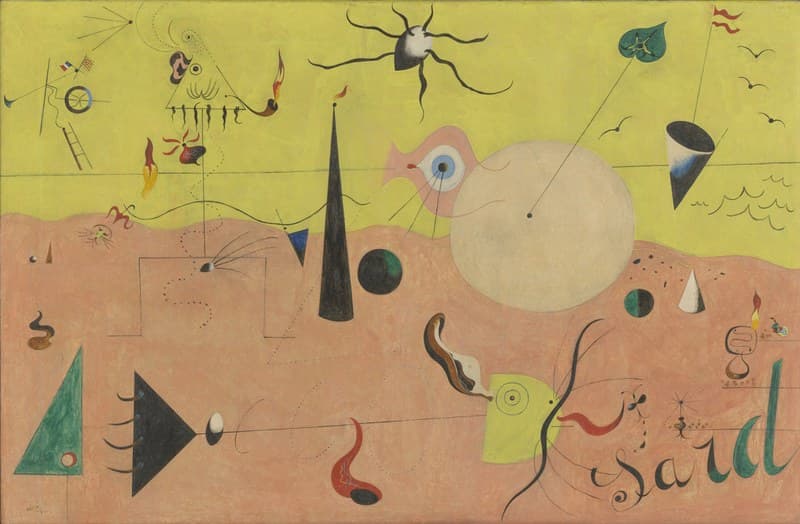
The Fundació Joan Miró puts the canvas in a group. In 1923 at Mont-roig he began Tilled Field, Catalan Landscape (The Hunter) and Pastoral, and the foundation calls the three of them the turning point in his art. Two of them were finished in 1924.
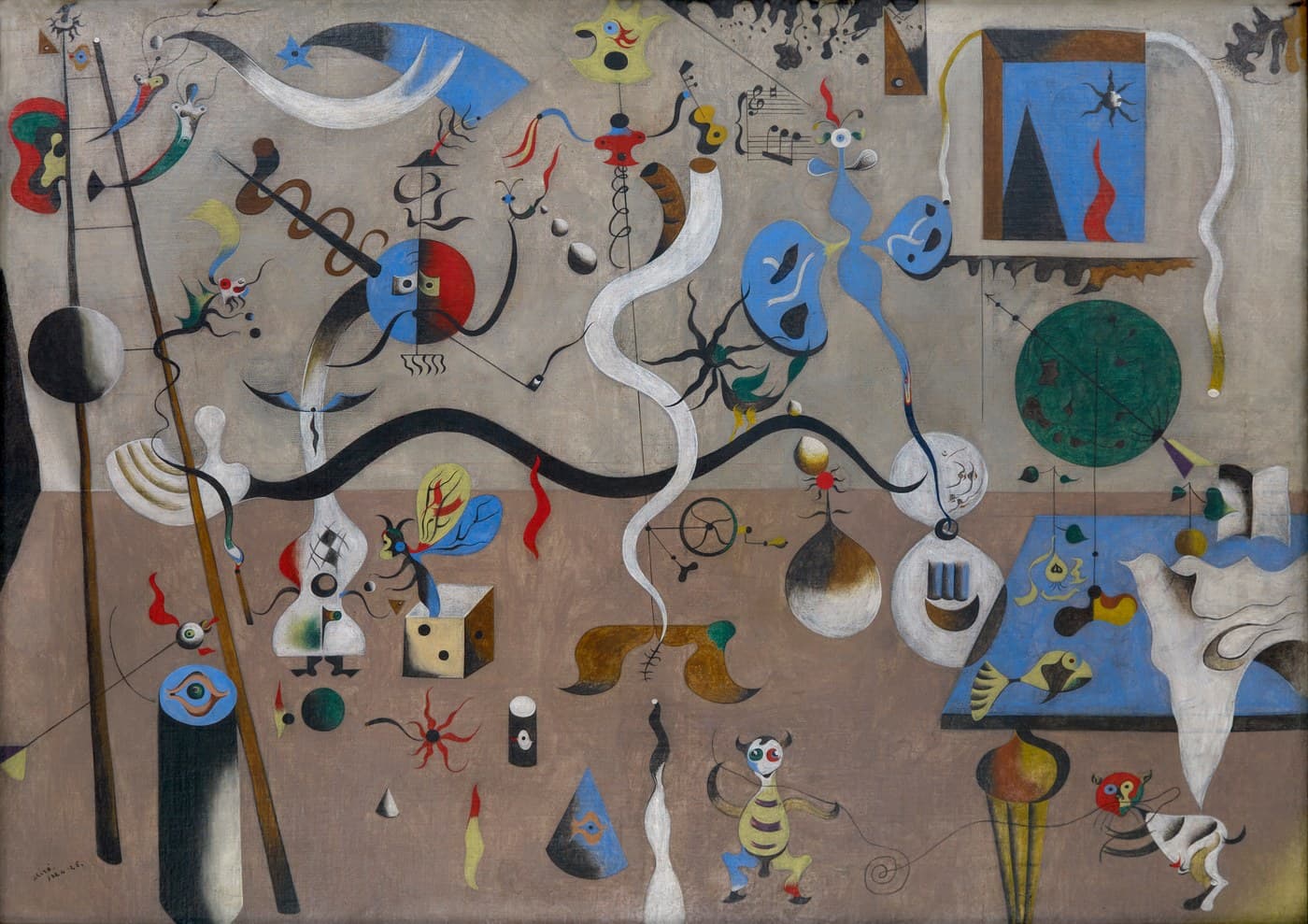
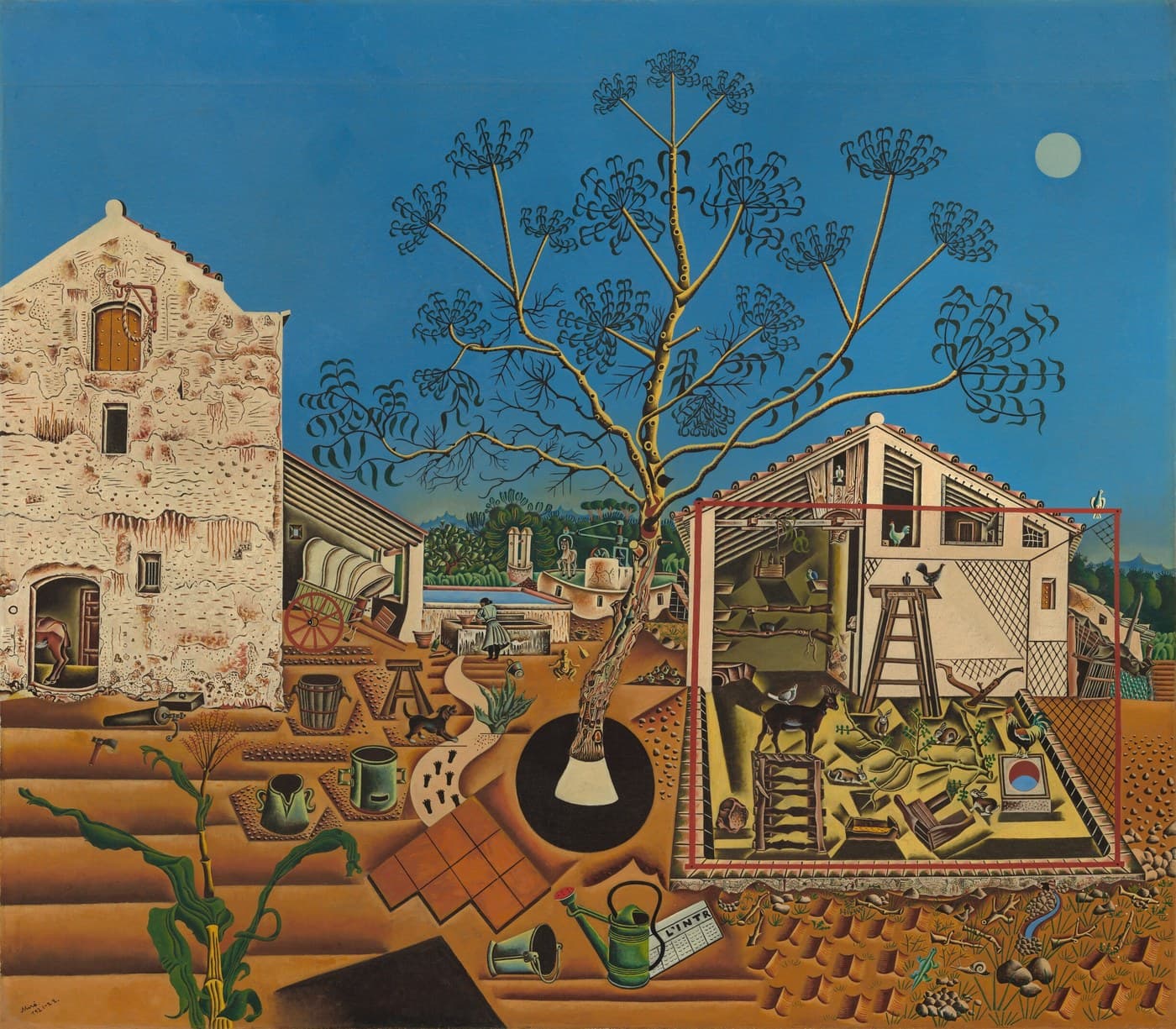
The mechanism is visible if the three are set beside The Farm of 1921–22. The farm's inventory of objects does not disappear. The horse, the hare, the hen, the snail, the furrows, the pine and the newspaper are all still there, and each has been reduced to one sign that stands for it.
Joan Miró was working in the rue Blomet studio in Paris during the terms and at Mont-roig for the rest of the year. The company at rue Blomet was literary: André Masson next door, and through him Michel Leiris, Robert Desnos, Paul Éluard, Georges Limbour and Raymond Queneau. The compression of the farm into signs happened among poets and before Surrealism had a manifesto.
Its titles, and what the museum prints
The Solomon R. Guggenheim Museum prints the title as The Tilled Field (La terre labourée) — English first, with the French beneath it in parentheses. The Catalan form, Terra llaurada, is the one used in Catalonia, and the Fundació Joan Miró drops the article altogether and writes Tilled Field.
The painting is 66 by 92.7 centimetres, which the museum gives as 26 by 36 1/2 inches. Its accession number is 72.2020 and its credit line is simply Solomon R. Guggenheim Museum, New York.
Close reading
Reading the work, detail by detail
The Solomon R. Guggenheim Museum reads the canvas as the first appearance of Joan Miró's Surrealist vision, and names its sources one by one: Catalan Romanesque frescoes, medieval Spanish tapestries, the Catalan ceramics he collected, the cave paintings at Altamira, and early Christian angels whose wings were covered with eyes. The close views find the eye, the ear and the flags on the canvas itself.
1.An eye is set into the pine
The pine crown is a flat dark teal oval fringed all round with black hooked needles. At its right end sits a fully modelled eye: a white eyeball, a pale blue iris, a dark pupil, an orange-red rim and pale yellow lashes above and below. It is the only naturalistic passage in the painting, and it is embedded in the foliage rather than floating over it.
2.An ear is fixed to the trunk
A large human ear, flesh-pink and ringed in orange and dark red, is fixed to the left side of the red-brown trunk. Its inner whorl is solid black and its folds are drawn with fine white lines. It overlaps the trunk rather than growing from it. The Solomon R. Guggenheim Museum reads it as Joan Miró's belief that every object contains a living soul.
3.Six wavy furrows run downhill
Six wavy orange bands run down the canvas from the flared black foot of a tree. Each is edged in dark green shading and carries a line of short red dashes along its crest. They are the ploughed furrows, turned through ninety degrees and seen as if from above, with the rest of the field left flat and empty.
4.Three flags on a border post
A long black beam crosses the sky diagonally, carrying a painted band of green, white and red. Two red-and-white striped pennants with dotted edges hang from a black crossbar on a salmon-pink pole, under a black triangle. A small blue, white and red tricolour hangs below. The Solomon R. Guggenheim Museum identifies the three as French, Catalan and Spanish, and reads the arrangement as an allegiance to Catalonia.
5.A flat sun and a scatter of birds
The sun is a flat orange-yellow disc with no rays and no glow, and a single small black bird glides across its lower edge. To its right about twenty small black tick marks stand in for a flock, each a pair of strokes meeting at an angle. Nothing in the sky is shaded.
6.A horse with a black mane over its back
The horse is pale blue-white with a long black mane swept up and over its back like a tail. Its mouth is open and red with white teeth showing. A dark green oval sits on its flank, brown speckles on its rump, and its black hooves have pink soles. A smaller white-and-black animal stands behind it.
7.The newspaper reads JOUR
A folded cone of newspaper stands upright on a brown ploughed patch. It is grey-white and ruled with vertical column lines, and the black capitals JOUR are printed across its top beside a solid black dot. The lettering is the only printed word on the canvas.
8.A hare beside a framed rabbit
A grey-white hare with very long ears lies on the flat yellow ground beside a small tuft of green grass. Just above and to its left, a white-bordered rectangle is set into the field like a hung picture, and inside it stands a black rabbit with long black-and-white ears. One animal is in the landscape and the other is in a frame.
9.A pink hen with a red comb
The hen is drawn far larger than the hare beside it. Its body is a smooth pale pink lobe, its comb and wattle red, its tail a spray of black, and three red-orange bars mark the wing. Its long red feet stand on the flat yellow ground with the toes spread.
10.A snail with a lavender shell
The snail's shell is a flat spiral in pale blue-lavender, wound anticlockwise from a small centre. It rides on a dark green and black body dotted with red. Below it a wavy white band outlined in black runs across the ground. The shell is the only cool blue note in the lower half of the painting.
11.Night occupies the right edge
A dark blue band crosses the right of the canvas, holding a small yellow crescent moon and a few faint stars. A solid purple field sits above it. A black ox with long curving horns stands on the horizon just to the left, tethered by a thin line, and a black-and-white dog runs to the right along the blue. Day and night share the same picture without a transition.
Timeline
1923
Begun at Mont-roig in the summer, alongside Catalan Landscape (The Hunter) and Pastoral. Miguel Primo de Rivera takes power in Spain that September and bans the Catalan flag and language.
1924
Finished. The Solomon R. Guggenheim Museum dates the work 1923–24.
1925
Joan Miró has his first Paris solo exhibition at the Galerie Pierre, and André Breton visits the rue Blomet studio.
1972
Accessioned by the Solomon R. Guggenheim Museum as 72.2020.
1986–87
The Solomon R. Guggenheim Museum is the final venue of Joan Miró: A Retrospective, after the Kunsthaus Zürich and the Kunsthalle Düsseldorf.
Where to see it
Solomon R. Guggenheim Museum, New York
New York, United States
A public viewing address has not yet been confirmed for this holding.
The museum's collection record gave no gallery when it was checked in September 2026. Check before travelling.
Frequently asked questions
Where is Joan Miró's The Tilled Field?
The Solomon R. Guggenheim Museum in New York, accession number 72.2020. The museum's credit line is simply Solomon R. Guggenheim Museum, New York. Check the museum's collection record before travelling, since a collection number is not a promise of display.
Why is there an eye in the tree in The Tilled Field?
The Solomon R. Guggenheim Museum traces both the eye in the pine and the eye-covered pine cone below it to early Christian art, in which angels' wings were shown covered with many tiny eyes. The eye itself is painted realistically: a blue iris around a dark pupil, rimmed in orange, set into the right end of the dark green foliage.
What is the ear on the tree in The Tilled Field?
A large flesh-pink human ear, ringed in orange and dark red with a black inner whorl, fixed to the left side of the red trunk. The Solomon R. Guggenheim Museum reads it as an expression of Joan Miró's belief that every object contains a living soul.
What do the flags mean in The Tilled Field?
The Solomon R. Guggenheim Museum identifies them as the French, Catalan and Spanish flags and reads them as a political statement. Miguel Primo de Rivera took power in Spain in 1923 and banned the Catalan language and flag. By placing the Catalan and French flags together across a border post from the Spanish one, the museum argues, Joan Miró declared his allegiance to Catalonia.
How big is The Tilled Field?
66 by 92.7 centimetres, which the Solomon R. Guggenheim Museum gives as 26 by 36 1/2 inches. Oil on canvas, in landscape format.
What is The Tilled Field called in Catalan and French?
Terra llaurada in Catalan and La terre labourée in French. The Solomon R. Guggenheim Museum prints the title as The Tilled Field (La terre labourée), pairing the English with the French. The Fundació Joan Miró writes it without the article, as Tilled Field.
How does The Tilled Field relate to The Farm?
It is the same farm at Mont-roig, painted two years later with almost everything turned into a sign. The horse, the hare, the hen, the snail, the newspaper, the pine and the furrows all survive from The Farm of 1921–22, each reduced to a single emblem. The Fundació Joan Miró counts the Mont-roig canvases of 1923–24 as the turning point in his art.
More by Joan Miró
If you like Joan Miró
Explore painters from the same movements and circles.
Jean Arp
Strasbourg-born sculptor and poet — Hans in German, Jean in French, both all his life — who co-founded Dada at the Cabaret Voltaire in 1916, composed collages by dropping torn paper 'according to the laws of chance', and settled at Meudon outside Paris in a house his wife Sophie Taeuber-Arp designed.
View artist
Salvador Dalí
The self-made icon of Surrealism — melting watches and manicured scandal — who arrived in Paris by way of two films written with Buñuel, dreamed together before the movement claimed them.
View artist
Marcel Duchamp
The century's quietest revolutionary — readymades, the abandonment of painting, chess on a Paris rooftop in Entr'acte, and one anemic film of spinning puns signed Rrose Sélavy.
View artist
References
The sources below include collection records, catalogues, scholarly research, and primary materials that informed this page. They document The Tilled Field, its making, and its place in cultural history.
1Joan Miró, The Tilled Field (La terre labourée), 1923–24 — collection online, 72.2020
WebsiteSolomon R. Guggenheim Museum, New YorkUsed forThe museum's object record and Nancy Spector's catalogue entry: title, date, medium, dimensions, credit line, accession number, copyright line and the reading of the iconography.
2Joan Miró — Biography
WebsiteFundació Joan MiróUsed forThe artist's foundation on the Mont-roig summer of 1923 and the rue Blomet circle.
3The Farm, Joan Miró, 1921–1922 (object page with provenance)
WebsiteNational Gallery of ArtUsed forFor The Farm, the 1921–22 canvas this painting reduces to signs.
4Joan Miró — artist essay
WebsiteThe Museum of Modern Art, New York, 2017Used forNatalie Dupêcher's essay for the Museum of Modern Art, on the rue Blomet studio and André Breton's attention to the Mont-roig landscapes.

5Rights and permission — who administers the copyright in Joan Miró's work
Official recordSuccessió Miró CB, Palma de MallorcaUsed forThe estate's own statement of who administers Joan Miró's copyright, checked rather than assumed.
These references provide the documented foundation for this work's history and interpretation. Claim-level citations remain attached to the specific claims they support.
 Explore more resources