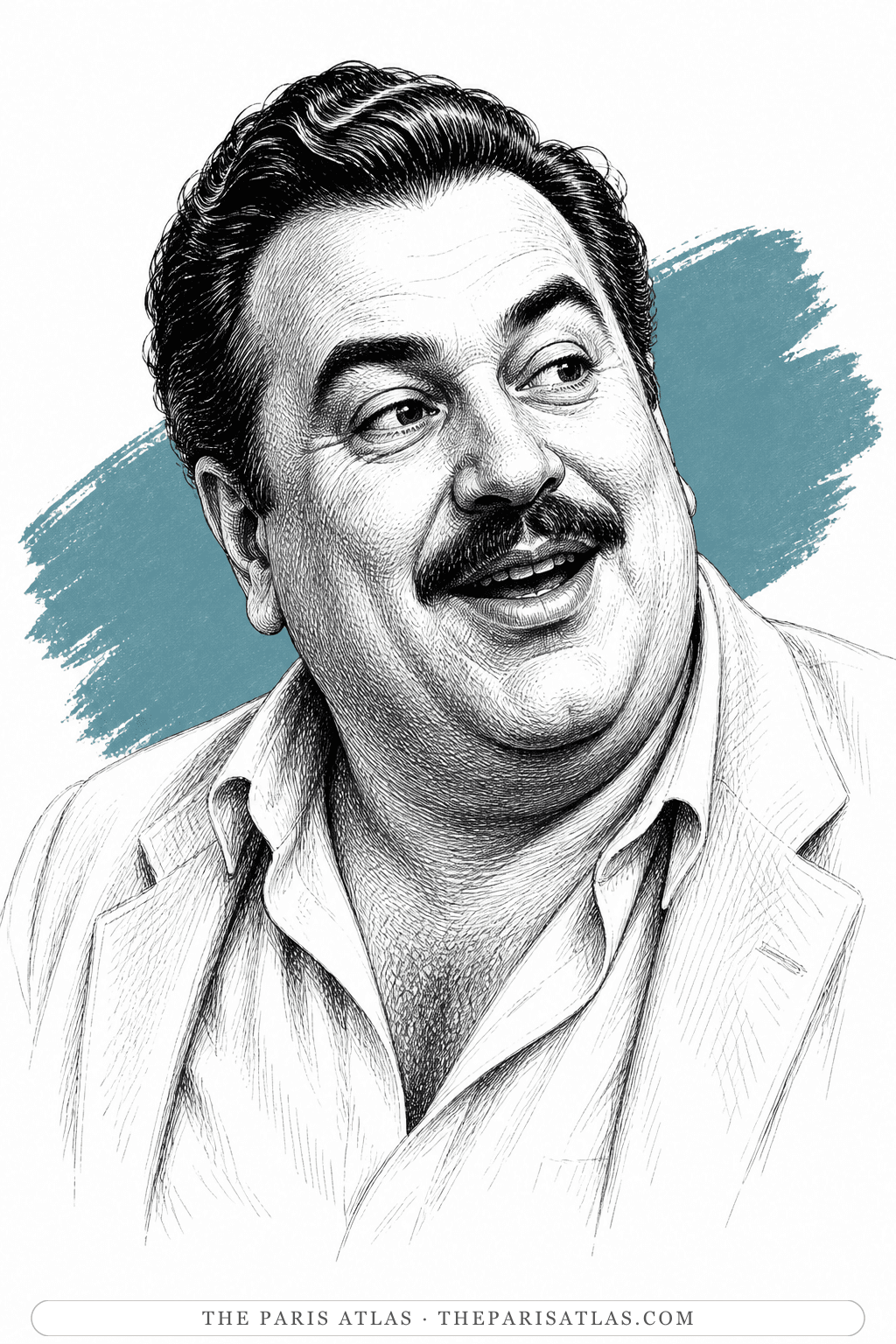
George Katsimbalis
The Greek talker of the title. A real man from Amaroussion, a town outside Athens, whose monologues Henry Miller followed around Greece in 1939. Miller says he wrote the book for him.
An audience: someone who will sit still while he talks a story all the way out.
The book

At a glance
- Miller's friend and guide in Greece, and the man he says he wrote it for
- Amaroussion, a town outside Athens
- Married to Aspasia; his father's line came from Leonidion, in the Peloponnese
- Served on the Balkan front in the First World War; a hotel keeper on Spetsai recognised him as his old captain
- A gambling casino at Loutraki
- George Katsimbalis · Amaroussion, outside Athens
Who they are in the book
Spoiler-freeGeorge Katsimbalis was a real man, and this was a real trip. The Colossus of Maroussi is a travel book, the American writer Henry Miller's account of the months he spent in Greece in 1939, the last year before the war reached the country. Katsimbalis lived at Amaroussion, a town outside Athens that the title spells Maroussi. Miller met him one evening in the city, and spent most of the rest of his stay listening to him.
What Katsimbalis did was talk. Miller heard him in a taverna at Piraeus, on the deck of coastal steamers, on the road to Mycenae, and on the high verandah of his own house at Amaroussion, and the book treats those monologues as the thing worth crossing Europe for. Everyone around him assumed the stories were partly invented and that he was entitled to invent them. "He was regarded as a virtuoso, a virtuoso who played only his own compositions and had therefore the right to alter them as he pleased."
He complained about his health constantly: arthritis, migraine, his liver, his memory. He complained about his taxes and his marriage too, usually in the same breath as a story about the Balkan front, a casino he had once owned, or a plot of land his lawyers had turned up. Miller treats the complaints as a way of warming up.
Near the end Miller admits that he has made the man larger than he is. Katsimbalis, he writes, will have to forgive him for blowing his proportions up to those of a colossus, because there is nothing grand about him or about the town he lives in. The claim Miller makes instead is a plainer one: "A more human individual than Katsimbalis I have never met."
This profile is drawn from the New Directions text, read in the Internet Archive's scan of the 1958 printing.
How George Katsimbalis Is Portrayed
- The evening they metMiller ran into him one evening in Athens as Katsimbalis was heading home to Amaroussion, and says only two other first meetings in his life stood comparison: with the writer Blaise Cendrars, and with the English novelist Lawrence Durrell. Miller barely spoke. He had already decided the man was made for the monologue.
- How he ate and drankFood mattered to him enormously. His father had been a serious gourmet and he kept up the family line, taking great carnivorous gulps, pounding his chest like a gorilla between them, and washing it all down with retsina, which he maintained was good for the lungs, the liver and everything else that ailed a man.
- The complaint that he was finishedAt a taverna in Piraeus, with his wife Aspasia and Lawrence Durrell and his wife Nancy at the table, he announced that marrying had been a mistake, that he had not been cut out for it, and that it was ruining him: he could no longer sleep, smoke or drink. "I'm finished," he said. His wife listened and smiled. Months later he was still listing his ailments and still talking without pause.
- The morning he got off at the wrong placeHe and Miller took a boat for the island of Spetsai, went ashore in a small boat, walked along the quay and found themselves in front of a war monument he did not recognise. He started to laugh. "I'm crazy," he said, "this isn't Spetsai, this is Ermioni—we're on the mainland."
- The crossing to Spetsai in a galeTo finish the journey they had to cross open water in a storm. The usual fare was a hundred drachmas; they offered three hundred, which Miller works out at about two dollars, and were told nobody would take them. Someone finally did. Waves broke over the boat, and Katsimbalis shouted "Homeric, what?" into the spray. Only afterwards did Miller learn that Katsimbalis was frightened of the sea, being a highlander rather than an islander, and had never mentioned it.
- Redrawing the cities of the worldClimbing the steps of the island of Hydra one evening he explained his private mania: taking the map of a large city, London or Constantinople, studying it exhaustively, then redesigning it to suit himself. Monuments came down and statues by unheard-of men went up. Some cities he rearranged so completely that he later had trouble finding his way about his own plan. Working on Constantinople, he would be seized by an urge to alter Shanghai.
- The boy crying over three drachmasWalking from the station to the ruins at Mycenae on a Sunday morning, the two of them came on a small boy sobbing in a field beside the road. Katsimbalis went over and asked him what was wrong. His sister had stolen his money: three drachmas.
- The war he had come throughMiller first heard the name from Theodore Stephanides, a doctor on Corfu who had been in the trenches with Katsimbalis on the Balkan front in the First World War. At the underground stair at Mycenae he was ready to go down on his belly if he had to, and Miller lists why: he had played the mole on that front, worked his way through mud and blood, danced like a madman out of fear, killed everyone in sight including men of his own, and been blown into the air clinging to a tree. On Spetsai a hotel keeper read his name in the register and asked what regiment he had served in, then whether he was not his old captain.
- How a story startedHe never began in the professional way. He fumbled about for an opening, tweaked his nose, and said something like "look here, did you never notice that..." without waiting for an answer, and then went backwards into whatever the story came out of before climbing back up with it.
Miller left Greece at the end of 1939 and finished writing in New York. The book's final pages are not his: they are a letter from Lawrence Durrell dated 10 August 1940, written on a boat leaving Athens and printed in full to close the portrait.
Durrell describes a night on the Acropolis when the group, drunk on wine and cognac, sat on the steps outside the big gate. Katsimbalis leapt up, demanded to know whether they wanted to hear the cocks of Attica, and without waiting for an answer walked to the edge of the precipice, threw back his head, wedged his walking stick into his wounded arm and crowed. The sound carried over the city and under the walls of the Parthenon. After a pause a cock answered from somewhere in the dark, then another, then another. He crowed again, and kept crowing until the veins stood out on him and the whole valley was answering, and his friends had to ask him to stop. Durrell signed the letter LARRY and told Miller the story was his to write.
If you like The Colossus of Maroussi


If you like Henry Miller
Explore authors with a similar voice, perspective, and influence.

Louis-Ferdinand Céline
Miller's acknowledged master at making literature out of the gutter. Journey gave him permission; Cancer is what he did with it.
View author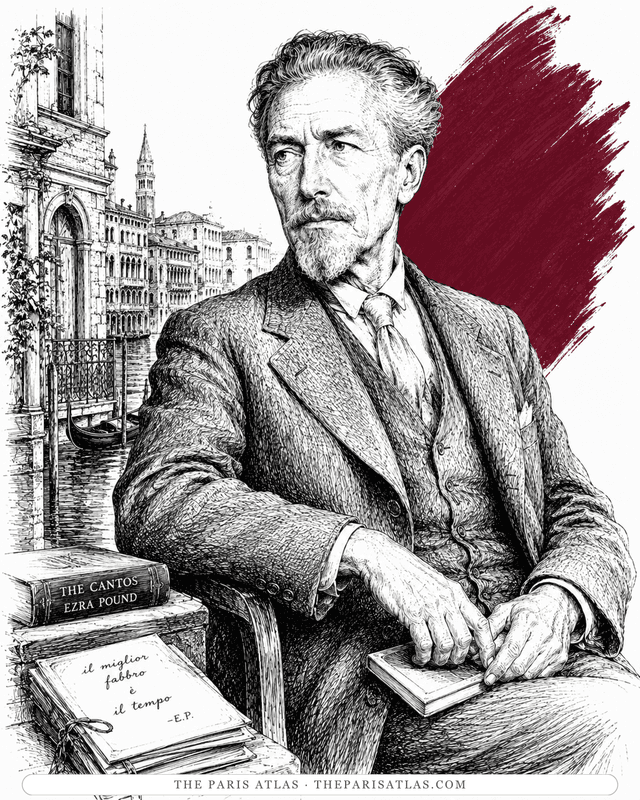
Ezra Pound
Pound read Cancer and sent Miller a famously backhanded postcard. Both believed literature's job was to wake the reader by any means necessary.
View author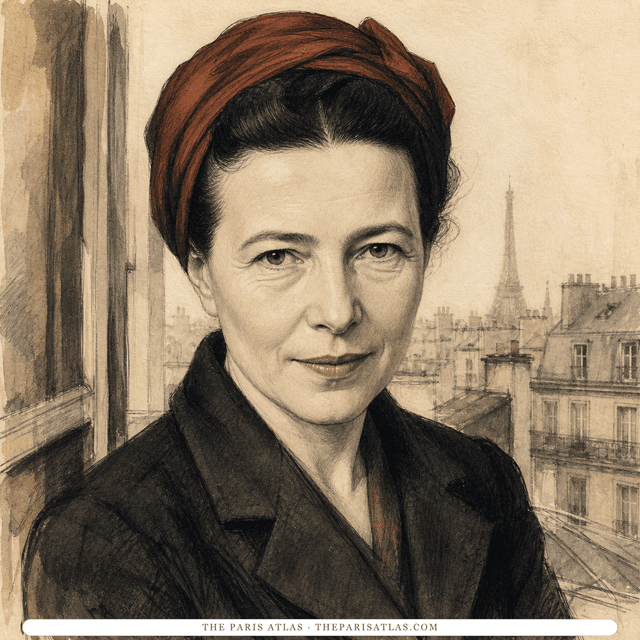
Simone de Beauvoir
French writer and philosopher whose novels, memoirs, and social analysis examined freedom, gender, responsibility, aging, and the material conditions that shape a life.
View author