About Max Ernst
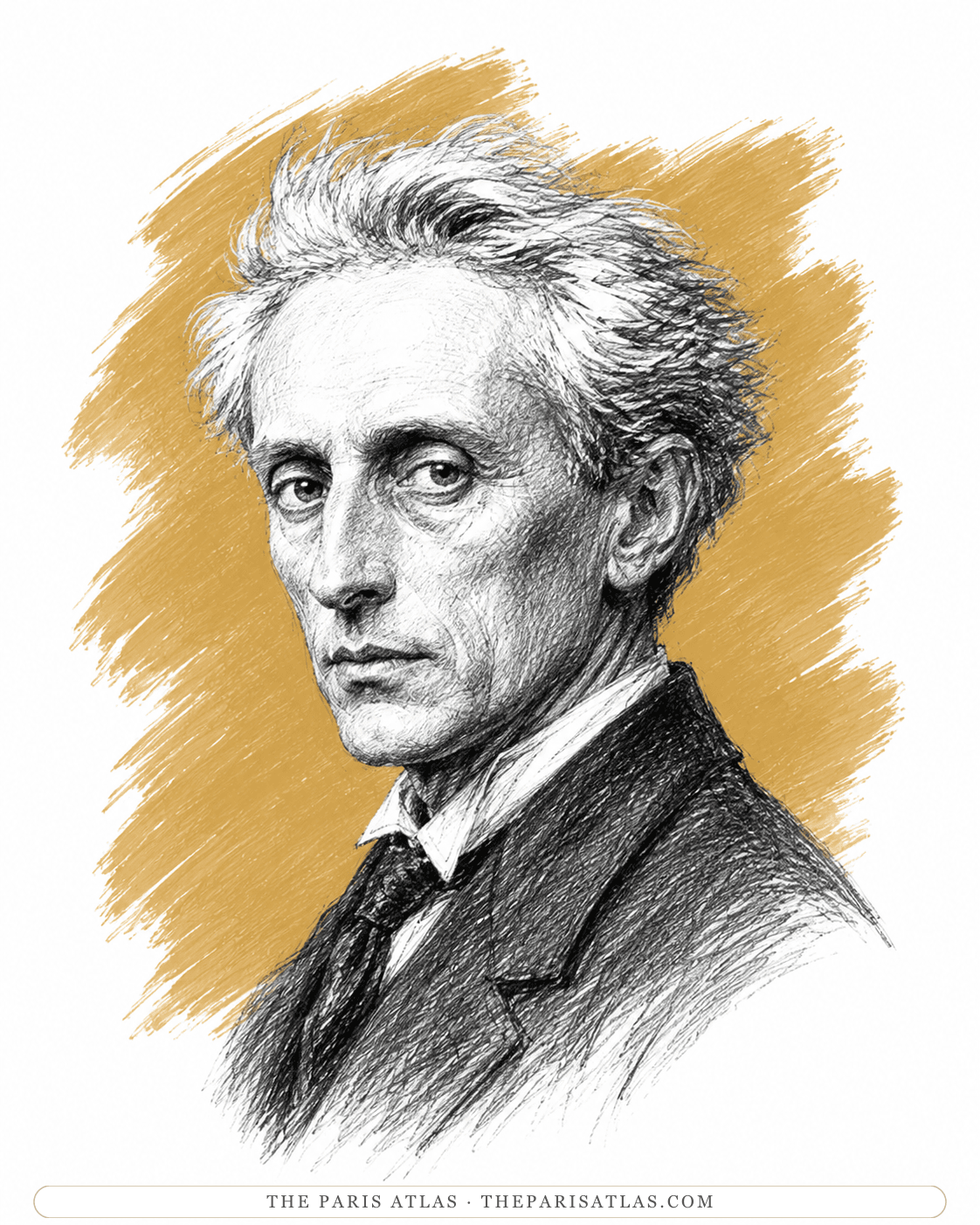
A millinery catalogue remade
Ernst began with a printed page advertising women's hats in an orderly grid. He painted over it and pasted in more hat images, building upright stacks that behave less like merchandise than peculiar bodies or plants.
The materials keep both stages visible. Commercial printing supplies the repeated units; gouache, pencil, oil, ink, cutting, and pasting interrupt the catalogue's original order.
A visual and verbal pun
The familiar saying that clothes make the man becomes unstable when women's hats form phallic, anthropomorphic towers. MoMA connects the joke to Ernst's interest in Sigmund Freud's writing about jokes and the unconscious, as well as to the hat as a possible symbol of repressed desire.
A nonsense inscription moves between German and French and ends with versions of two clichés: the hat makes the man, and style is the tailor. The words do not explain the forms; they make their gender and identity less secure.
Dada transformation
MoMA places the work within Dada's resistance to cultural conformity after the First World War. Ernst's method starts with banal mass-produced material and changes its relationships until an advertisement becomes strange.
The collage therefore depends on reuse rather than a blank beginning. A page designed to sell standardized accessories is made to produce irrational bodies and ambiguous desire.
Close reading
Reading the work, detail by detail
Ernst recombines printed hat advertisements into impossible standing figures, then binds them with drawing and paint. The details show commercial repetition becoming bodily, comic, and faintly menacing.
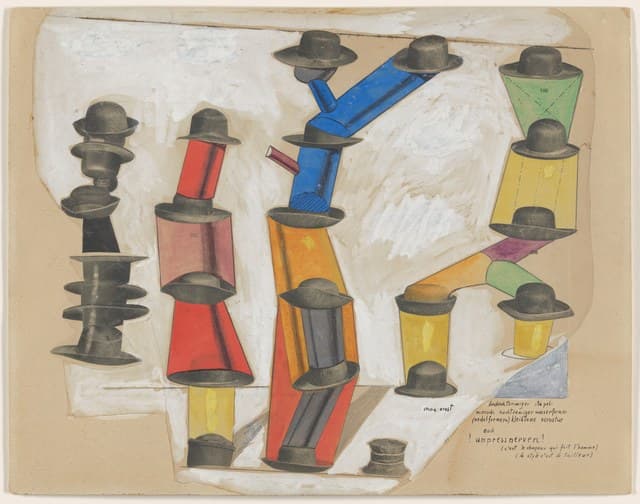
1.A blue figure branches into three hats
A single blue column splits into raised limbs, each capped by an identical dark hat. Repetition converts fashionable accessories into anatomy and gives the figure the logic of both mannequin and machine.
2.The left stack turns merchandise into a spine
Hat crowns and brims alternate vertically until the catalogue fragments resemble vertebrae. The body's apparent solidity comes entirely from repeating the commodity that is supposed to complete it.
3.Red cylinders make an awkward torso
Printed hats are rotated and stacked into a swelling red body with dark brims at its joints. The construction is visibly absurd, yet its upright posture preserves the swagger of a dressed man.
4.The central body refuses to stand straight
Alternating printed sections kink sharply instead of aligning into a stable column. The bend turns serial manufacture into slapstick movement, as though the figure is buckling under its own formal clothes.
5.The smaller figures rehearse social gestures
Two compact bodies face across linked green and pink forms, each topped by a bowler. Their almost conversational arrangement makes etiquette look like a repeatable diagram assembled from products.
6.The handwritten caption destabilises the advertisement
A line of handwriting enters beside the crisp reproductions and painted forms. Its cramped, personal scale counters the catalogue's mass-produced imagery and turns the title into another visual fragment to decipher.
Where to see it
Museum of Modern Art, New York
11 West 53 Street, New York, NY 10019, United States
Displays and loans can change. Check whether this work is on view before making a special trip.
Plan your visit on the museum’s official website (opens in a new tab)Frequently asked questions
What is The Hat Makes the Man made from?
Gouache, pencil, oil, and ink on cut-and-pasted printed paper mounted on board. It measures 35.2 by 45.1 centimeters.
Where did the hat images come from?
Ernst reused a page from a commercial millinery catalogue and added more cutout hats, paint, drawing, and writing.
What does the title mean?
It translates the French cliché C'est le chapeau qui fait l'homme. Ernst turns the phrase into a visual and linguistic joke about dress, gender, identity, and desire.
Why is The Hat Makes the Man a Dada work?
It repurposes commercial print, joins unrelated materials, and uses absurdity and wordplay to disrupt conventional images and social clichés.
Where is The Hat Makes the Man?
It belongs to the Museum of Modern Art in New York, object 242.1935. Check the official object page for current display information.
More by Max Ernst
If you like Max Ernst
Explore artists from the same movements and circles.
Jean Arp
Strasbourg-born sculptor and poet — Hans in German, Jean in French, both all his life — who co-founded Dada at the Cabaret Voltaire in 1916, composed collages by dropping torn paper 'according to the laws of chance', and settled at Meudon outside Paris in a house his wife Sophie Taeuber-Arp designed.
View artist
Salvador Dalí
The self-made icon of Surrealism — melting watches and manicured scandal — who arrived in Paris by way of two films written with Buñuel, dreamed together before the movement claimed them.
View artist
Marcel Duchamp
The century's quietest revolutionary — readymades, the abandonment of painting, chess on a Paris rooftop in Entr'acte, and one anemic film of spinning puns signed Rrose Sélavy.
View artist
References
The sources below include collection records, catalogues, scholarly research, and primary materials that informed this page. They document The Hat Makes the Man, its making, and its place in cultural history.

1Max Ernst, The Hat Makes the Man
WebsiteMuseum of Modern ArtUsed forOfficial collection record for the date, materials, dimensions, catalogue source, inscription, and interpretation of the work's visual and verbal puns.
2Max Ernst in Germany: Artistic Beginnings and Dada in Cologne
WebsiteModerna MuseetUsed forWeb source consulted for documented facts and historical context presented on the The Hat Makes the Man page.
3Max Ernst — artist profile
WebsiteThe Museum of Modern ArtUsed forWeb source consulted for documented facts and historical context presented on the The Hat Makes the Man page.
4Dada
WebsiteMuseum of Modern ArtUsed forWeb source consulted for documented facts and historical context presented on the The Hat Makes the Man page.
These references provide the documented foundation for this work's history and interpretation. Claim-level citations remain attached to the specific claims they support.
 Explore more resources