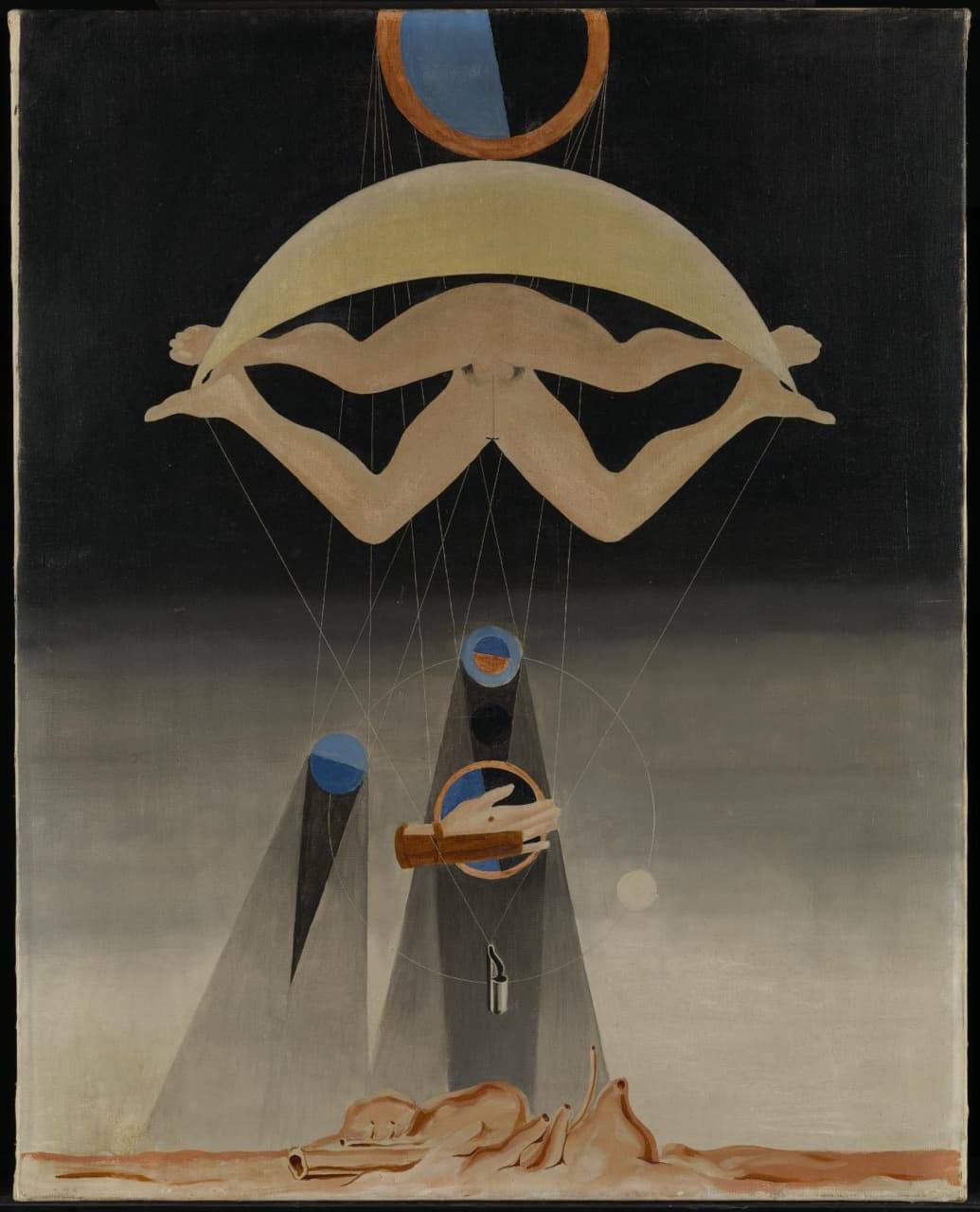
A sun split in two hangs at the top of a black sky. Below it, the lower halves of a naked man and woman float joined together under a yellow crescent, and fine threads run down to planets, a gloved hand over the earth and a heap of flesh-coloured shapes on the ground. Max Ernst painted it in 1923 and gave it to André Breton, with a poem on the back that explains it in riddles. Tate has owned it since 1960.
The top half of the painting is a black sky. At the very top hangs a copper-coloured ring, half filled with a blue half-disc, which Max Ernst's poem calls the sun. Below it curves a huge pale yellow crescent, like an open parachute.
Under the crescent float the lower halves of two naked bodies, a man's and a woman's, joined at the hips. Their legs bend out to both sides, making a shape like the letter W, and their feet press against the two tips of the crescent. Tate's catalogue describes them plainly as a man and a woman having sex in space. Their upper bodies are missing.
Fine pale threads run down from the sun through the whole picture. Lower down, where the black sky fades to a grey mist, two tall grey cones rise from the ground, each topped by a round disc. In the middle a hand with a brown leather cuff lies across a copper ring holding a half-blue, half-black disc, which the poem calls the earth. A thin circle is drawn around it, with a small pale moon on it. A little silver tube with a curved spout hangs on a thread below.
At the bottom lies a dry reddish plain covered in soft pinkish shapes, like guts, folds of skin and stones, with an open tube and a few pear-shaped forms with holes at their tips. Tate's catalogue calls it an arid desert of viscera and stones.
A poem on the back
On the back of the canvas Max Ernst wrote a short prose poem in French, under the title LES HOMMES N'EN SAURONT RIEN. He confirmed to Tate's cataloguer Ronald Alley in February 1970 that he wrote it himself.
The poem explains the picture in riddles. In Tate's translation, the yellow crescent, like a parachute, stops the little whistle from falling to the ground. The whistle thinks it is climbing to the sun, because people are paying attention to it. The sun is divided in two so that it can turn better. The model lies in a dreaming pose with the right leg bent. The hand hides the earth, and so the earth takes on the importance of a sexual organ. The moon runs through its phases and eclipses at full speed.
The poem ends by saying that the picture is curious because of its symmetry, and that the two sexes balance each other. Under it, Max Ernst wrote a dedication: à André Breton, très amicalement, max ernst.
Sigmund Freud and Judge Schreber
Max Ernst studied philosophy and psychology at the University of Bonn from 1909 to 1914. Tate's catalogue says he read Sigmund Freud's The Interpretation of Dreams in 1913, and at one time wanted to be a psychiatrist. André Breton, whom he met in 1921, had trained in medicine. During the First World War André Breton worked at a neurological centre in Nantes and then at a psychiatric centre at Saint-Dizier.
In 1975 the art historian Geoffrey Hinton showed in the Burlington Magazine that this painting draws on a case Sigmund Freud wrote about in 1911 and again in 1923. The case was Daniel Paul Schreber, a senior judge in Dresden, who described his own mental illness in a book called Memoirs of My Nervous Illness. Sigmund Freud never met him and worked from the book.
Daniel Paul Schreber believed that the sun and God stood at the centre of the world, and that rays from them were changing and taking apart his body. He imagined himself as a man and a woman in one person. Geoffrey Hinton linked these ideas to the sun with its threads, the floating male and female halves, and the two cones, which Tate describes as looking like the sexual organs of both sexes at once.
Geoffrey Hinton found more links. Daniel Paul Schreber thought rays were removing his intestines, and that stones stood for children, which may explain the guts and stones on the ground. His father, D. G. M. Schreber, wrote about bringing up children and designed braces to stop them slouching or favouring one side of the body. The father's braces may explain the poem's interest in symmetry and a crescent that stops something from falling. Geoffrey Hinton also pointed to old alchemical signs: a couple joined in the sky, and an upside-down crescent standing for an eclipse.
André Breton's picture
Max Ernst gave the painting to André Breton, who kept it in Paris. André Breton reproduced it in his book Nadja, published in Paris in 1928. The painting hung in the Exposition Internationale du Surréalisme at the Galerie Beaux-Arts in Paris in January and February 1938.
Tate lists two later owners: Señora Eva Sulzer, at "San Angelo, Mexico", as Tate prints it, and the painter Gordon Onslow-Ford, at Inverness, California. Tate bought the painting from Gordon Onslow-Ford through the Richard Feigen Gallery in Chicago in 1960, and showed it in its Max Ernst exhibition the next year.
Men Shall Know Nothing of This looks at first like a diagram of the sky: a sun, a moon, planets and fine threads. Up close there are two bodies joined in mid-air, a gloved hand covering the earth, a little whistle on a string and a heap of flesh-coloured shapes on the ground. Max Ernst gave it to André Breton, with a poem on the back explaining it in riddles.
1.The sun, split in two
At the top hangs the sun: a copper-coloured ring, half filled with blue and half left black. Max Ernst's poem on the back of the canvas says the sun is divided in two so that it can turn better. The art historian Geoffrey Hinton linked the sun to Daniel Paul Schreber, a German judge whose memoir of his mental illness put the sun at the centre of his delusions. Sigmund Freud wrote about Daniel Paul Schreber in 1911 and again in 1923.
2.A crescent like a parachute
Below the sun hangs a huge pale yellow crescent, curved like an open parachute. The poem calls it a crescent, yellow and like a parachute, which stops the little whistle from falling to the ground. Geoffrey Hinton pointed out that an upside-down crescent was an old alchemists' sign for an eclipse, when the sun and moon come together.
3.Two bodies joined in the air
Under the crescent float the lower halves of two naked bodies, a man's and a woman's, joined at the hips. Their legs bend out to both sides and make a shape like a W. Tate's catalogue describes them simply as a couple having sex in space. Their upper bodies are missing, so we never see a face. The poem says the picture is curious for its symmetry, and that the two sexes balance each other.
4.Where the threads meet
At the point where the two bodies join, a single fine thread drops straight down to a small dark mark. Many of the painting's threads cross near here. Geoffrey Hinton read the joined couple as an alchemical sign, the union of opposites, often shown with the sun and moon. Daniel Paul Schreber, in his memoir, imagined himself as a man and a woman in one body.
5.Feet braced on the crescent
On the left two bare feet press against the tip of the crescent, as if bracing against it. The legs hold the crescent up, or the crescent holds them. Nothing in the picture says which.
6.Feet on the right
The right side repeats the left almost exactly: two bare feet against the other tip of the crescent. The poem says the right leg is bent, a pleasant, exact movement. Geoffrey Hinton linked this interest in exact, balanced poses to Daniel Paul Schreber's father, D. G. M. Schreber, who wrote about bringing up children and designed braces to stop them slouching or using one side more than the other.
7.Threads falling from the sun
Fine pale threads run from the sun down through the whole picture, like strings holding up a puppet show. Tate's catalogue calls them rays. Daniel Paul Schreber believed that rays from the sun and from God were changing and taking apart his body. The threads tie every part of the picture to the sun.
8.A planet on top of a cone
In the middle a round disc, half blue and half orange, sits on top of a tall grey cone. A black disc hangs below it inside the cone. Tate's catalogue describes two strange growths rising from the ground here. Geoffrey Hinton placed this disc where the sun and moon meet in the zodiac.
9.A second cone and a blue planet
On the left a blue disc tops a second, narrower grey cone. The cones could be beams of light, or shadows, or solid shapes growing out of the ground. Tate's catalogue calls both of them strange growths that look like phalluses of both sexes at once. Geoffrey Hinton saw the left disc as a planet in the place of Mercury, and also as a pendulum.
10.A gloved hand covers the earth
A hand with a brown leather cuff on its wrist lies across a copper ring that holds a half-blue, half-black disc. The poem says the hand hides the earth, and that this makes the earth as important as a sexual organ. Geoffrey Hinton thought the half-gloved hand might point to Sigmund Freud's reading of Daniel Paul Schreber's case in terms of castration. The hand has no arm or body attached.
11.An orbit drawn in a thin line
A thin pale circle is drawn around the hand and the earth, like the orbit in a school diagram of the planets. A small pale moon sits on the circle to the right. The poem says the moon runs through its phases and eclipses at full speed. Here it is stopped at one point on its track.
12.A small white moon
The small moon is a plain pale disc, the quietest thing in the picture. Geoffrey Hinton linked Mercury with the moon, noting that in astrology Mercury rules Gemini, the heavenly twins. He described Mercury as having a double, male and female nature. So even the little moon may belong to the painting's theme of two in one.
13.The little whistle on a string
A small silver tube with a curved spout hangs from a thread. The tube is the little whistle of Max Ernst's poem. The poem says that because people are paying attention to it, the whistle imagines it is climbing to the sun. The line is a joke about vanity, and perhaps about the painter too.
14.A desert of flesh and stones
At the bottom lies a dry reddish plain covered in soft pinkish shapes, like guts, folds of skin and stones. Tate's catalogue calls it an arid desert of viscera and stones, meaning internal organs. Geoffrey Hinton linked the guts to Daniel Paul Schreber's belief that rays were removing his intestines. He linked the stones to Daniel Paul Schreber's idea that stones stood for children.
15.Pear-shaped stones with holes
On the right of the heap stand rounded pear-shaped forms with small holes at their tips, and one long thin stalk rising up. The pear shapes could be stones, gourds or parts of a body. Max Ernst paints them with the same soft shading as the floating bodies above, which links the ground to the sky.
16.An open tube on the ground
At the lower left an open-ended tube lies on the ground, pink like the rest of the heap. The tube could be a pipe or a length of gut. The open end of the tube faces us like a mouth or an eye.
17.Night above, mist below
The black sky at the top fades into a grey mist lower down. The joined bodies float in darkness, and the planets and cones stand in the mist. Max Ernst studied psychology at the University of Bonn and read Sigmund Freud's The Interpretation of Dreams in 1913. Max Ernst once wanted to be a psychiatrist. André Breton, who owned this picture, had worked in wartime psychiatric hospitals.
Timeline
1913
Max Ernst reads Sigmund Freud's The Interpretation of Dreams while a student at the University of Bonn.
1923
Paints Men Shall Know Nothing of This, writes a prose poem on the back and gives it to André Breton.
1928
André Breton reproduces it in his book Nadja.
1938
Shown at the Exposition Internationale du Surréalisme at the Galerie Beaux-Arts in Paris.
1960
Tate buys it from the painter Gordon Onslow-Ford through the Richard Feigen Gallery, Chicago.
1961
Shown in the Max Ernst exhibition at the Tate Gallery.
1970
Max Ernst confirms to Ronald Alley that he wrote the poem on the back.
1975
Geoffrey Hinton links the painting to the Schreber case in the Burlington Magazine.
Where to see it
Tate
London, United Kingdom
Tate has several galleries. A specific viewing address has not been confirmed here; check which venue, if any, is displaying this work before travelling.
Listed by Tate as not on display in September 2026. Displays change, so check Tate's page before a visit.
The title is also the title of the prose poem Max Ernst wrote on the back of the canvas. Neither the poem nor any source quoted by Tate explains what it is that men shall know nothing of.
What is written on the back?
A short prose poem in French that explains the picture in riddles, about the crescent and the whistle, the split sun, the hand hiding the earth and the balance of the two sexes. The poem ends with a dedication to André Breton. Max Ernst confirmed in 1970 that he wrote it.
What does it have to do with Sigmund Freud?
Geoffrey Hinton showed in 1975 that much of the picture draws on the case of Daniel Paul Schreber, a Dresden judge whose memoir of his mental illness Sigmund Freud analysed in 1911 and again in 1923. The sun, the rays, the man and woman in one body, the guts and the stones all have parallels in that memoir.
Who owned it?
André Breton, who received it from Max Ernst, then Eva Sulzer in Mexico and the painter Gordon Onslow-Ford in California. Tate bought it in 1960.
Where can I see it?
At Tate, reference T00336. Tate listed it as not on display in September 2026, so check its page before a visit.
In the atlas
What the graph records about this work — every claim carries its citation.
The back of the canvas carries Max Ernst's prose poem and the dedication "à André Breton / très amicalement / max ernst". Tate's catalogue records that Ernst gave the painting to André Breton, who reproduced it in his book Nadja in 1928.
— Max Ernst, Men Shall Know Nothing of This, 1923 (T00336), T00336; catalogue entry (Ronald Alley, 1981)
Explore painters from the same movements and circles.
Jean Arp
Strasbourg-born sculptor and poet — Hans in German, Jean in French, both all his life — who co-founded Dada at the Cabaret Voltaire in 1916, composed collages by dropping torn paper 'according to the laws of chance', and settled at Meudon outside Paris in a house his wife Sophie Taeuber-Arp designed.
The self-made icon of Surrealism — melting watches and manicured scandal — who arrived in Paris by way of two films written with Buñuel, dreamed together before the movement claimed them.
The century's quietest revolutionary — readymades, the abandonment of painting, chess on a Paris rooftop in Entr'acte, and one anemic film of spinning puns signed Rrose Sélavy.
The sources below include collection records, catalogues, scholarly research, and primary materials that informed this page. They document Men Shall Know Nothing of This, its making, and its place in cultural history.
1Max Ernst, Men Shall Know Nothing of This, 1923 (T00336)
Website
Tate
Used for
The holding museum's record: date, medium, size, the poem and dedication on the back with Tate's translation, owners, exhibitions and literature, Geoffrey Hinton's Schreber reading as Tate summarises and quotes it, and the image the close-reading views were cropped from.
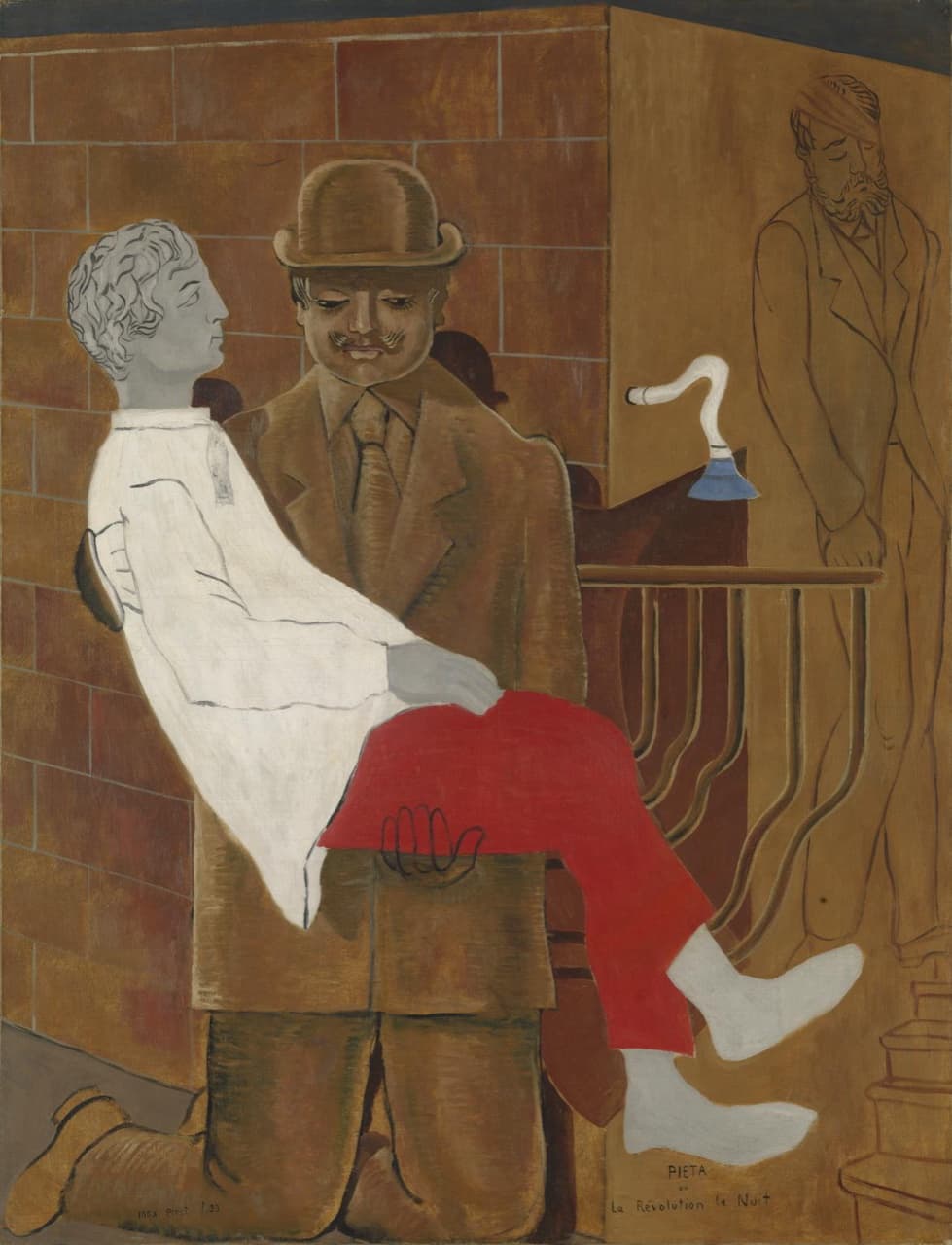
2Max Ernst, Pietà or Revolution by Night, 1923 (T03252)
Website
Tate
Used for
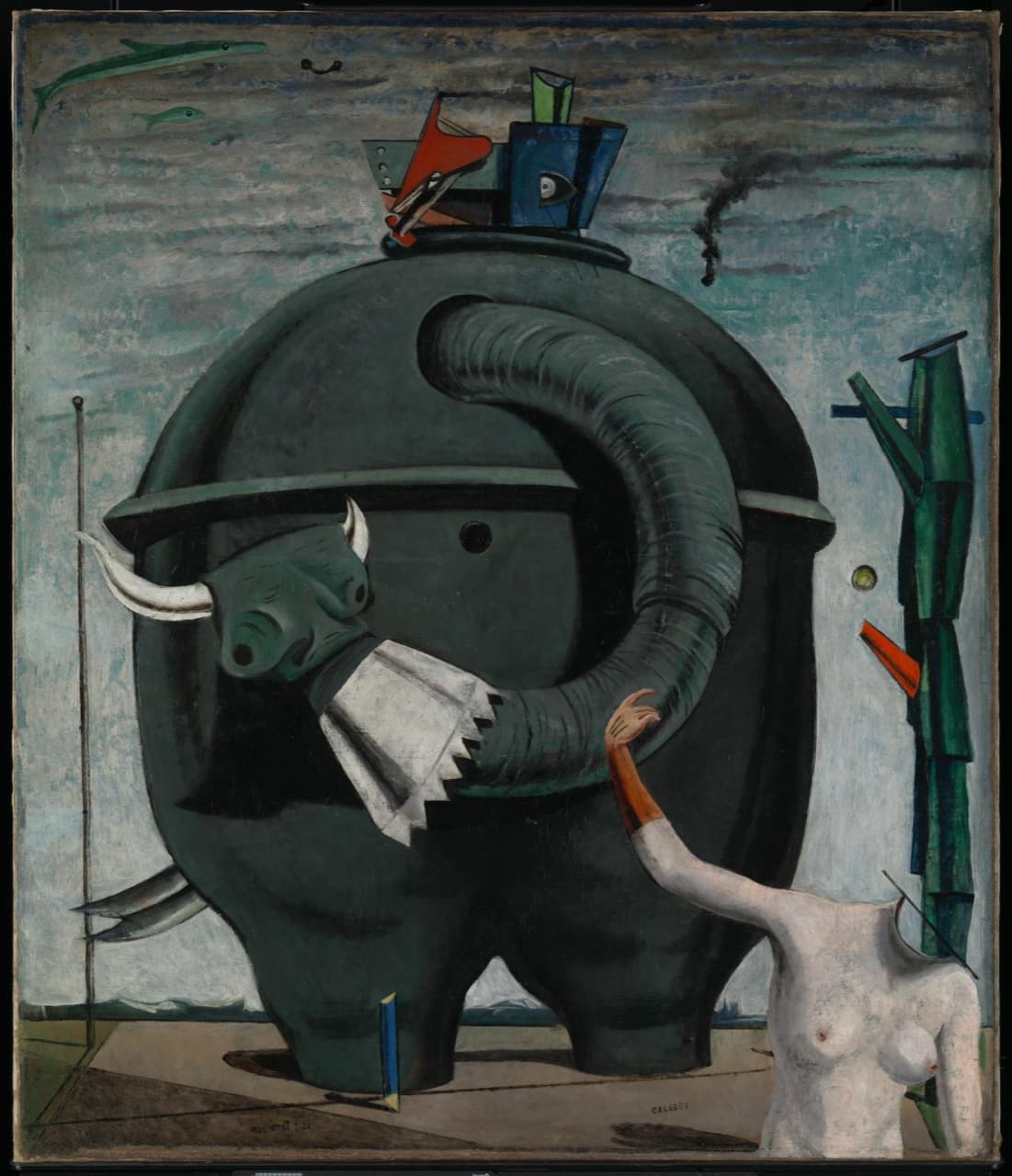
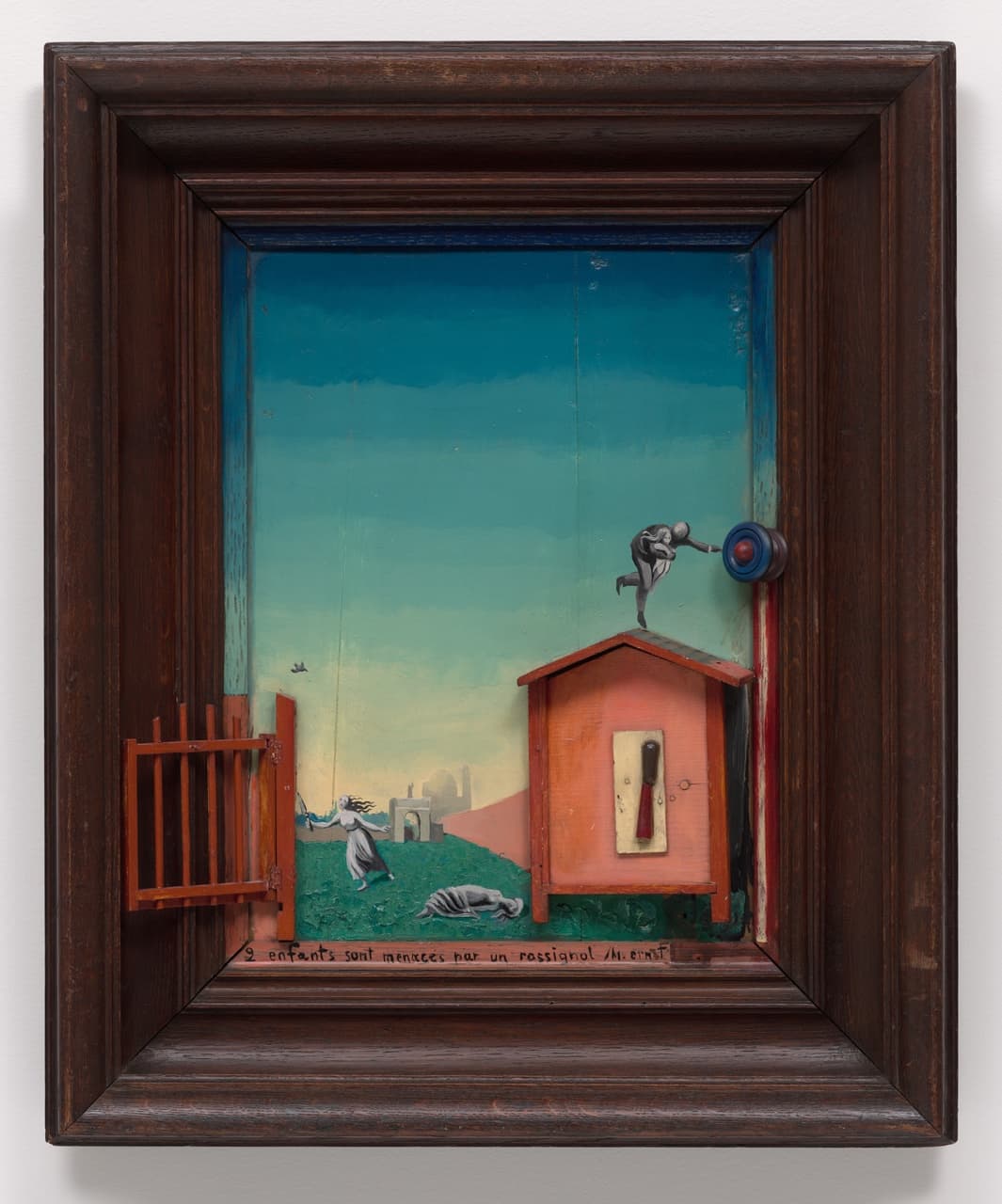
Tate's statement that Max Ernst saw his early Surrealist masterpieces as running from Celebes to Two Children Are Threatened by a Nightingale, and that Geoffrey Hinton tied this painting to Sigmund Freud's case histories.
These references provide the documented foundation for this work's history and interpretation. Claim-level citations remain attached to the specific claims they support.


 View source