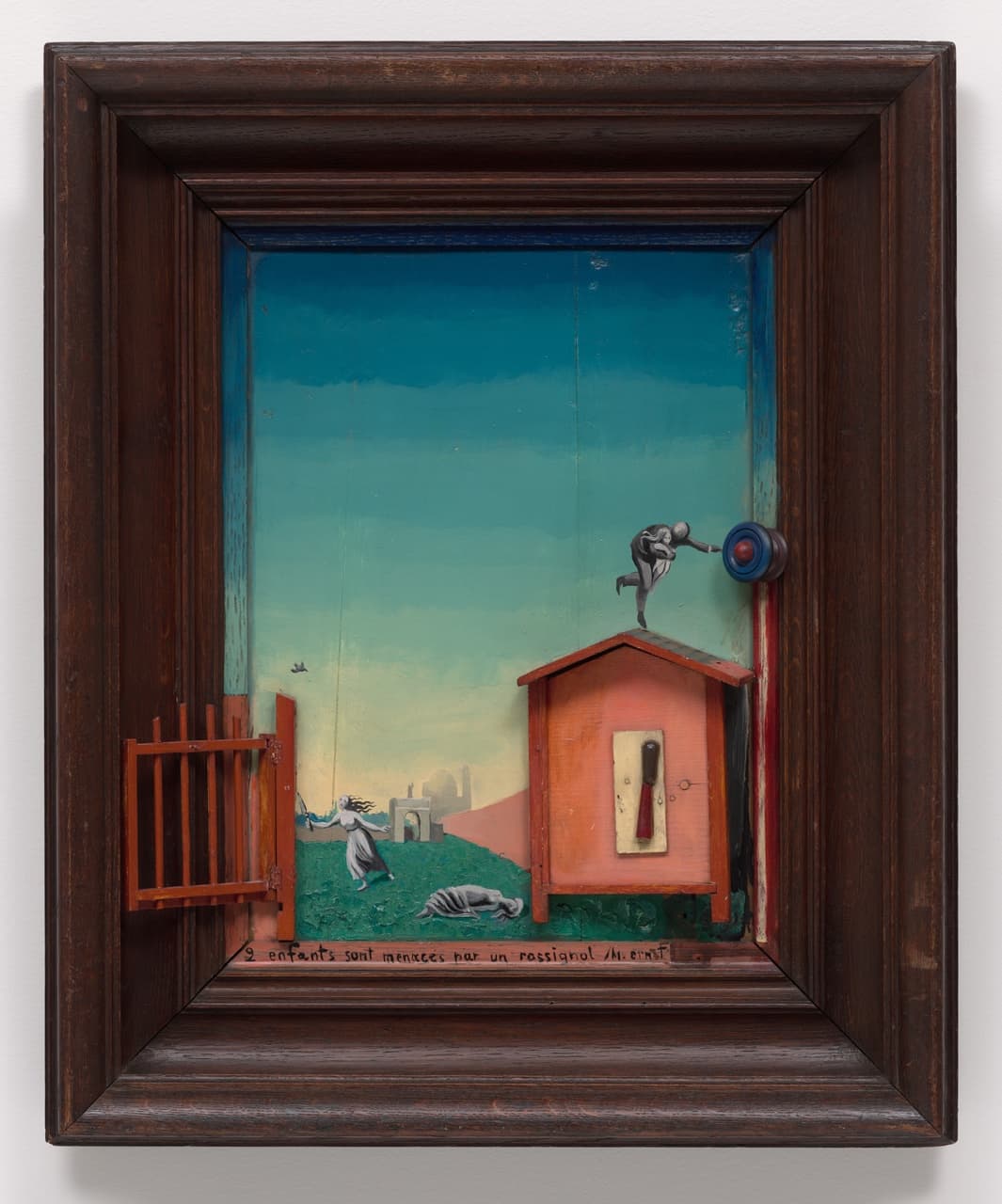
Two Children Are Threatened by a Nightingale
by Max Ernst
A tiny bird in a blue sky frightens two girls: one runs at it with a knife and the other lies fainted on the grass. A man on the roof of a toy house carries off a child and reaches for a knob fixed to the frame. The gate, the house and the knob are real wooden objects. Max Ernst made it in 1924, the year Surrealism was founded, and traced it to a fever he had as a child. Paul Éluard owned it in Paris, and the Museum of Modern Art bought it from him in 1937.
- 1924
- Oil with painted wood elements and cut-and-pasted printed paper on wood with wood frame
- The Museum of Modern ArtNew York, United States
About Max Ernst
What the work shows
A painted landscape sits deep inside an old-fashioned dark wooden frame. Most of the picture is sky, deep blue at the top and fading to green and pale yellow at the horizon. Far away stand a stone arch, a domed building and a thin tower, and a pink wall runs back into the distance.
On the grass below, a girl in a long pale dress runs toward a tiny dark bird, holding up a knife. A second girl lies face down on the grass. Both are painted in greys, like figures from an old print.
On the right stands a small wooden house, painted pink with a red roof and no windows. On its roof a grey man balances on one foot. He holds a limp child with long hair in one arm and stretches the other hand toward a round wooden knob, blue with a red centre, fixed to the side of the frame. On the left a small red wooden gate hangs open on real hinges.
Along the bottom Max Ernst wrote the title in French, 2 enfants sont menacés par un rossignol, followed by his name.
A painting you could open
Three things in the work are real objects, not paint: the gate, the house and the knob. The Museum of Modern Art calls them three-dimensional additions to the canvas, and suggests the orange-red house and the red gate may come from the same toy set. The museum's Department of Painting and Sculpture holds it, and describes its materials as oil with painted wood elements and cut-and-pasted printed paper on wood.
MoMA's highlights book notes that the gate makes sense in the picture, as the way in, but that the knob does not. The critic John Russell called the knob the button of an alarm bell, swollen to the size of a beach ball as things are in dreams, and still just out of reach.
John Russell also pointed out how much the work borrows from the Old Masters: the deep perspective, the soft sky, the formal poses, and the dome, tower and triumphal arch in the distance. The Museum of Modern Art compares it to early Renaissance panel paintings. Then the real gate and knob break out of the frame. In John Russell's words, we are both in, and out of, painting.
A fever and a nightingale
Max Ernst said the scene came from a fever vision he had as a child, when he was ill with measles. Writing about himself in the third person, he said the vision was provoked by an imitation-mahogany panel opposite his bed. The grooves in the wood took on, one after another, the look of an eye, a nose, a bird's head, a menacing nightingale and a spinning top.
Max Ernst gave a second source for the nightingale: the death of his sister in 1897. Shortly before making the work he wrote a poem, and the Museum of Modern Art quotes its first line: at nightfall, at the edge of the village, two children are threatened by a nightingale.
Wood grain turning into pictures became a method the next year. Tate says Max Ernst developed frottage in drawings made from 1925, after an old wooden floor whose grain had been deepened by years of scrubbing suggested strange images to him. He laid paper on the floor and rubbed over it with a soft pencil.
A farewell to collage
Max Ernst later described the work as the last consequence of his early collages, and a kind of farewell to a technique. In his Dada years in Cologne he had cut up printed pictures and glued them together. In this work the added pieces are real bits of painted wood instead of glued paper.
The Museum of Modern Art says the work was made in 1924, the year of Surrealism's founding, when André Breton published his manifesto. The museum finds in it the concerns that would come to define the movement: dreams and the unconscious, sexuality, which it sees in the girl's knife, and strange combinations of things that do not belong together.
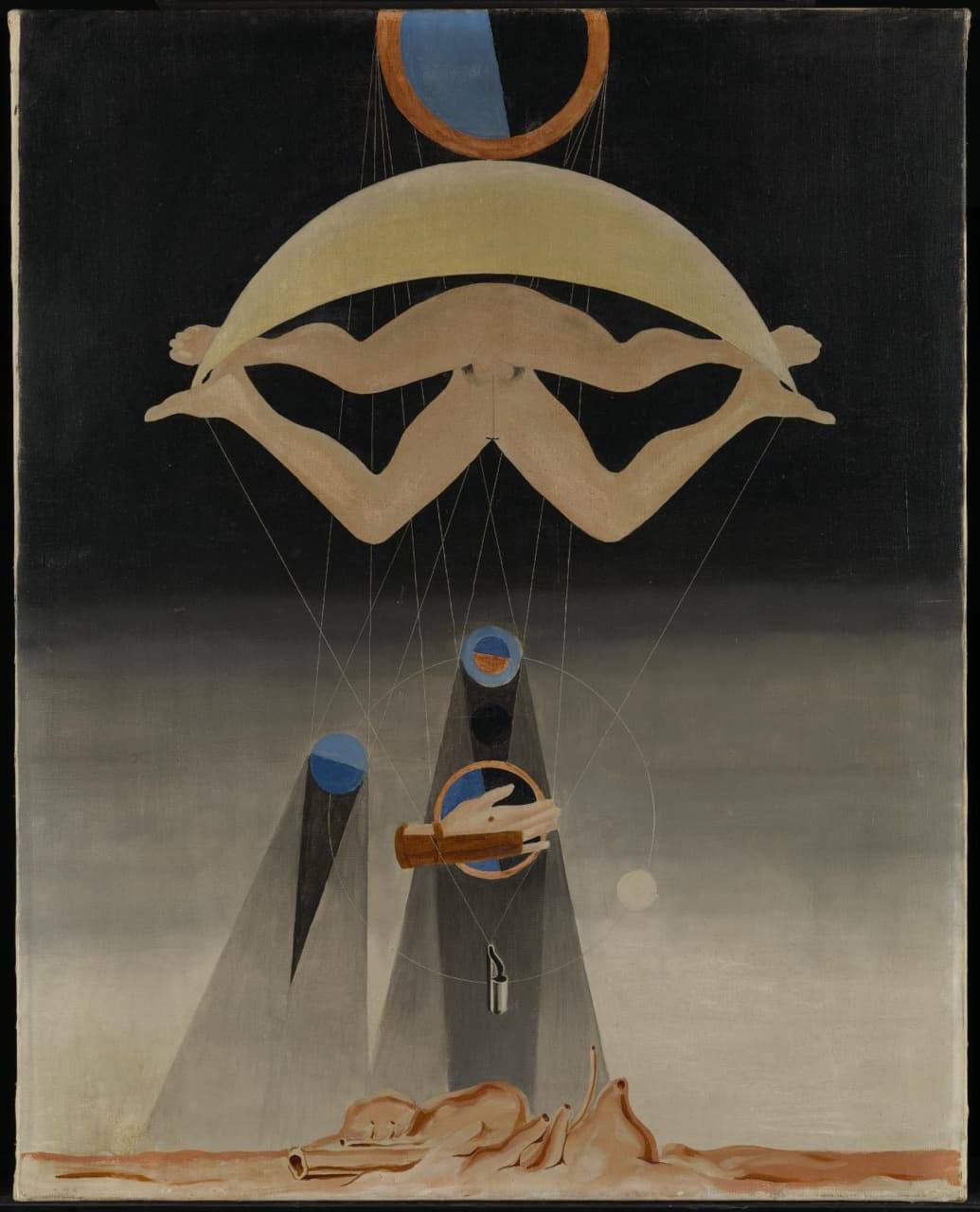
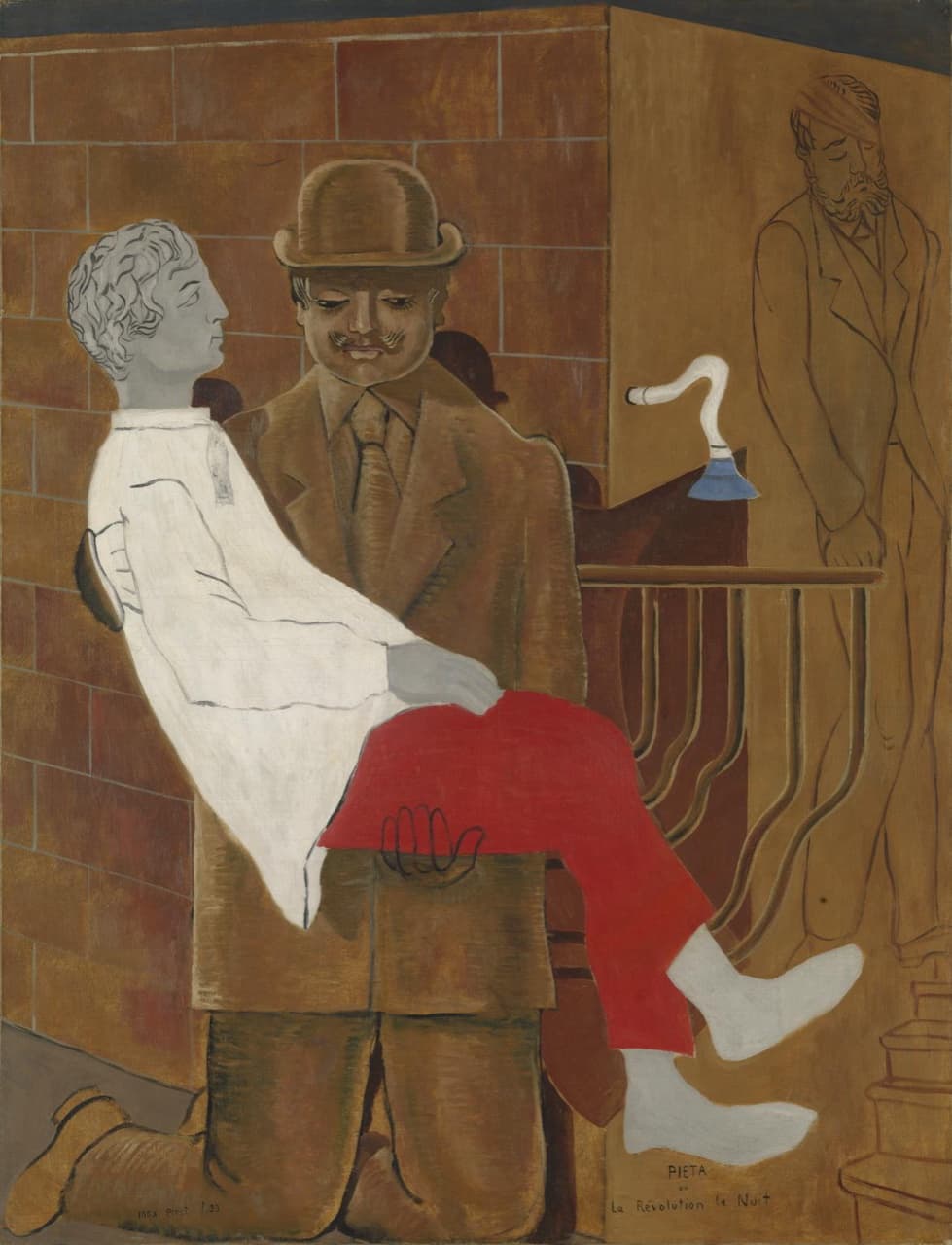
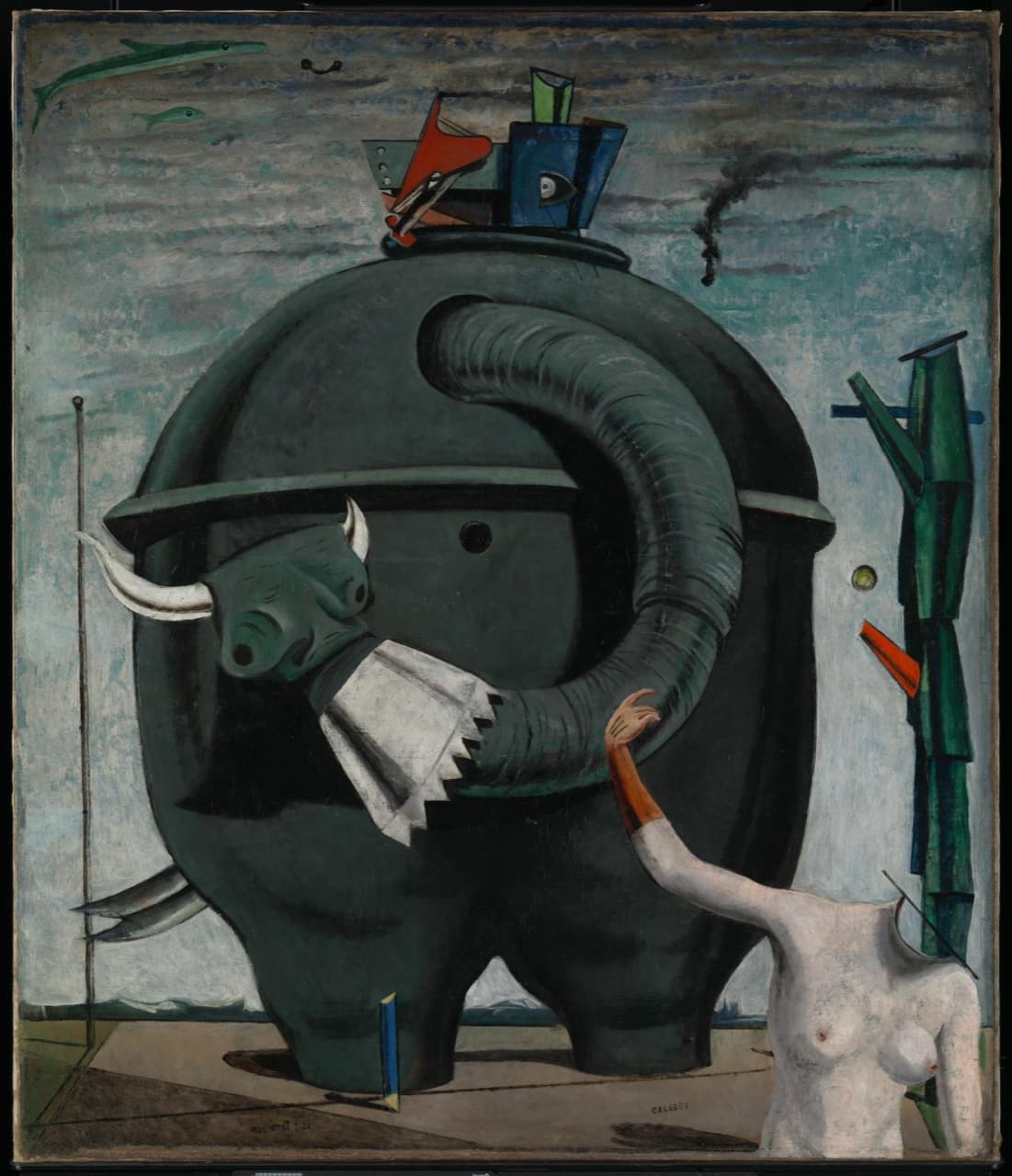
Max Ernst himself counted it as the last of a small group of early Surrealist masterpieces, according to Tate's catalogue entry for Pietà or Revolution by Night. The group began with Celebes in 1921.
From Paris to New York
The poet Paul Éluard bought the work from Max Ernst and owned it in Paris. The Museum of Modern Art bought it from Paul Éluard in 1937. Paul Éluard had also owned Celebes and Pietà or Revolution by Night.
The Museum of Modern Art showed it in Dada in 2006 and in Max Ernst: Beyond Painting from 23 September 2017 to 1 January 2018. From 2019 to 2025 it hung in the museum's gallery of Surrealist objects, gallery 517. In September 2026 the museum listed it on view in gallery 517, on the fifth floor in the Alfred H. Barr, Jr. Galleries.
Close reading
Reading the work, detail by detail
Two Children Are Threatened by a Nightingale is a painting that has started to turn into an object. A real wooden gate swings off its left side, a toy house stands out from the surface, and a real knob sticks out from the frame. Up close the painted parts are tiny, and the real parts are close enough to touch.
1.A painting built out into the room
The picture is painted on a wooden panel set deep inside an old-fashioned frame. Three things are real objects rather than paint: the red gate on the left, the toy house on the right and the round knob fixed to the frame. The Museum of Modern Art calls them three-dimensional additions to the canvas. Max Ernst later called the work a kind of farewell to a technique, meaning the collage he had used in his Dada years.
2.A real gate on real hinges
On the left a small red wooden gate hangs open on real metal hinges. The gate swings out past the edge of the picture and into our space. The Museum of Modern Art suggests it and the house may come from the same toy set. MoMA's highlights book notes that the gate at least makes sense in the picture, as the way in.
3.The nightingale
The nightingale that gives the painting its name is tiny, a dark speck in the sky above the gate. The bird is so small that it is hard to see why anyone would be afraid of it. The critic John Russell wrote that only in dreams can a little songbird scare us like this. Max Ernst gave two sources for the bird: the death of his sister in 1897, and a fever he had as a child.
4.A girl running with a knife
A girl in a long pale dress runs across the grass with her hair flying out behind her. She holds a knife up in one hand, as if to fight off the bird. The Museum of Modern Art reads her knife as a sexual symbol, one of the themes the Surrealists took from dreams. She is painted in greys, like a figure from an old engraving, while the grass around her is bright green.
5.The second girl has fainted
The second girl lies face down on the grass. The Museum of Modern Art says she has fainted. Her body is painted in the same greys as the running girl, and her long dress spreads around her. Nothing in the picture says whether she will get up.
6.An arch, a dome and a tower
Far behind the girls stand a stone arch and, in the haze, a domed building with a thin tower. John Russell pointed to this dome, tower and triumphal arch as a borrowing from the Old Masters, along with the deep perspective and the soft sky. The Museum of Modern Art compares the whole scene to early Renaissance panel paintings.
7.A pink wall running into the distance
Behind the house a flat pink shape narrows sharply toward the horizon. The pink shape reads as a long wall seen in steep perspective, pulling the eye back into the distance. The painted pink matches the real painted wood of the toy house in front of it. So the painted wall and the real house seem to belong to the same building.
8.The toy house
The house is a real wooden object, painted pink with a red roof. The house has no windows. John Russell called it blind-walled. The Museum of Modern Art's highlights book calls it a hut and notes that the man on its roof is standing on a real thing, not a painted one.
9.A handle on the house
A cream-coloured plaque with a dark red handle is fixed to the front of the house. A small round fitting sits beside the handle. It is not clear what the handle is for. The handle could be a door latch or a bell pull, or just a bit of a toy that Max Ernst kept. Since the house has no door, the handle opens nothing.
10.A man on the roof carries a child
A man balances on one foot on the peak of the roof. He holds a limp child with long hair in one arm, and stretches the other hand toward the round knob on the frame. The Museum of Modern Art suggests he is looking for a way out of the scene. One MoMA label says he is carrying off a third figure, so the child may be a third girl rather than one of the two in the title.
11.The knob he cannot reach
The knob is a real turned wooden knob, blue with a red centre, fixed to the side of the frame. The man's painted hand reaches toward it but does not touch it. MoMA's highlights book says the gate makes sense in the picture but the knob does not. John Russell called it the button of an alarm bell, swollen in a dream and always just out of reach.
12.A red post under the knob
Under the knob a narrow red post runs down the right edge of the scene, between the toy house and the dark frame. The post seems to be part of the construction that holds the knob in place. The red of the post matches the gate on the left, so the two real objects frame the painted scene like a pair of doorposts.
13.The sky and a line down the middle
Most of the picture is sky, deep blue at the top and fading to green and pale yellow at the horizon. The Museum of Modern Art calls the blue sky the main part of the composition. A thin vertical line runs straight down through it. The line is probably the join between two boards of the wooden panel, which Max Ernst left showing.
14.Thickly painted grass
The grass is painted thickly, in ridged strokes of green that stand up from the panel. Everywhere else the paint is smooth. So even the paint itself moves a little toward the real, raised world of the gate and the house.
15.The title written along the bottom
Along the bottom of the scene Max Ernst wrote the title in French, in plain handwriting: 2 enfants sont menacés par un rossignol, followed by his name. The Museum of Modern Art quotes a poem he wrote shortly before, which begins: at nightfall, at the edge of the village, two children are threatened by a nightingale. The title is the poem's first line.
16.The sky painted onto the frame
In the top corner the blue of the sky carries on past the edge of the panel and onto the inside of the frame. The frame is an ordinary dark wooden picture frame. MoMA's 2008 label calls it old-fashioned. By painting across the join, Max Ernst makes the frame part of the picture instead of a border round it.
Timeline
1897
Max Ernst's sister dies, one of the two sources he later gave for the nightingale.
1924
Max Ernst makes Two Children Are Threatened by a Nightingale, the year André Breton launches Surrealism.
1925
Max Ernst begins frottage, rubbing pencil over paper laid on an old wooden floor.
1937
The Museum of Modern Art buys it from Paul Éluard. Object number 256.1937.
2017–18
Shown in Max Ernst: Beyond Painting at the Museum of Modern Art, 23 September 2017 to 1 January 2018.
2019–25
Hangs in Gallery 517, Surrealist Objects, at the Museum of Modern Art, 21 October 2019 to 26 September 2025.
Where to see it
The Museum of Modern Art
11 West 53 Street, New York, NY 10019, United States
On view on the fifth floor, gallery 517, in September 2026. Displays change, so check the museum's page before a visit.
Plan your visit on the museum’s official website (opens in a new tab)Frequently asked questions
Which parts are real objects?
The red gate on the left, the pink house with its red roof, and the round blue and red knob fixed to the frame are real wooden objects. The Museum of Modern Art suggests the gate and house may come from the same toy set. The rest is painted on a wooden panel inside an old dark wooden frame.
What inspired it?
Max Ernst said it came from a fever vision he had as a child with measles. The grain of an imitation-mahogany panel by his bed seemed to become an eye, a nose, a bird's head, a menacing nightingale and a spinning top. He also linked the nightingale to the death of his sister in 1897.
Why is it called Two Children Are Threatened by a Nightingale?
The title is the first line of a poem Max Ernst wrote shortly before making the work. He also wrote it in French along the bottom of the scene.
Who owned it?
Paul Éluard bought it from Max Ernst and owned it in Paris. The Museum of Modern Art bought it from Paul Éluard in 1937.
Where can I see it?
At the Museum of Modern Art in New York, object number 256.1937. In September 2026 it was on view on the fifth floor, gallery 517, in the Alfred H. Barr, Jr. Galleries. Check the museum's page before a visit.
More by Max Ernst
If you like Max Ernst
Explore painters from the same movements and circles.
Jean Arp
Strasbourg-born sculptor and poet — Hans in German, Jean in French, both all his life — who co-founded Dada at the Cabaret Voltaire in 1916, composed collages by dropping torn paper 'according to the laws of chance', and settled at Meudon outside Paris in a house his wife Sophie Taeuber-Arp designed.
View artist
Salvador Dalí
The self-made icon of Surrealism — melting watches and manicured scandal — who arrived in Paris by way of two films written with Buñuel, dreamed together before the movement claimed them.
View artist
Marcel Duchamp
The century's quietest revolutionary — readymades, the abandonment of painting, chess on a Paris rooftop in Entr'acte, and one anemic film of spinning puns signed Rrose Sélavy.
View artist
References
The sources below include collection records, catalogues, scholarly research, and primary materials that informed this page. They document Two Children Are Threatened by a Nightingale, its making, and its place in cultural history.

1Max Ernst, Two Children Are Threatened by a Nightingale, 1924 (256.1937)
WebsiteThe Museum of Modern ArtUsed forThe holding museum's record, read in a browser: date, materials, size, credit, copyright notice, gallery location, owners, exhibition photographs, Max Ernst's own words on the fever vision and the farewell to collage, and the image the close-reading views were cropped from.
2Max Ernst, Pietà or Revolution by Night, 1923 (T03252)
WebsiteTateUsed forTate's statement that Max Ernst saw his early Surrealist masterpieces as ending with this work.
3Frottage (art term)
WebsiteTateUsed forTate on Max Ernst developing frottage from 1925 after the grain of an old wooden floor suggested images to him.
4Tate — Surrealism (art term)
WebsiteUsed forTate on André Breton launching Surrealism with his manifesto in 1924.
These references provide the documented foundation for this work's history and interpretation. Claim-level citations remain attached to the specific claims they support.
 Explore more resources