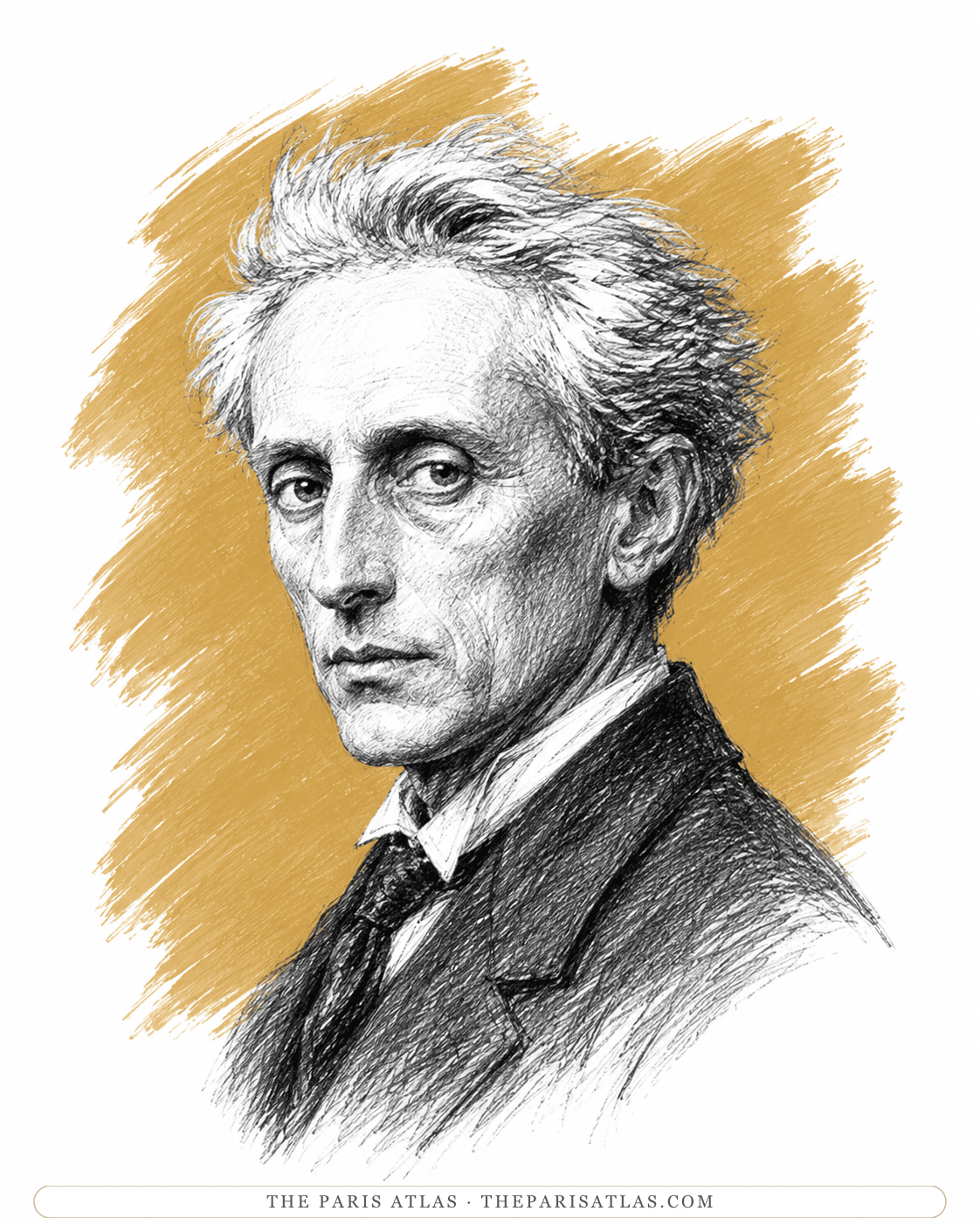
Depicts · 1923
Max Ernst
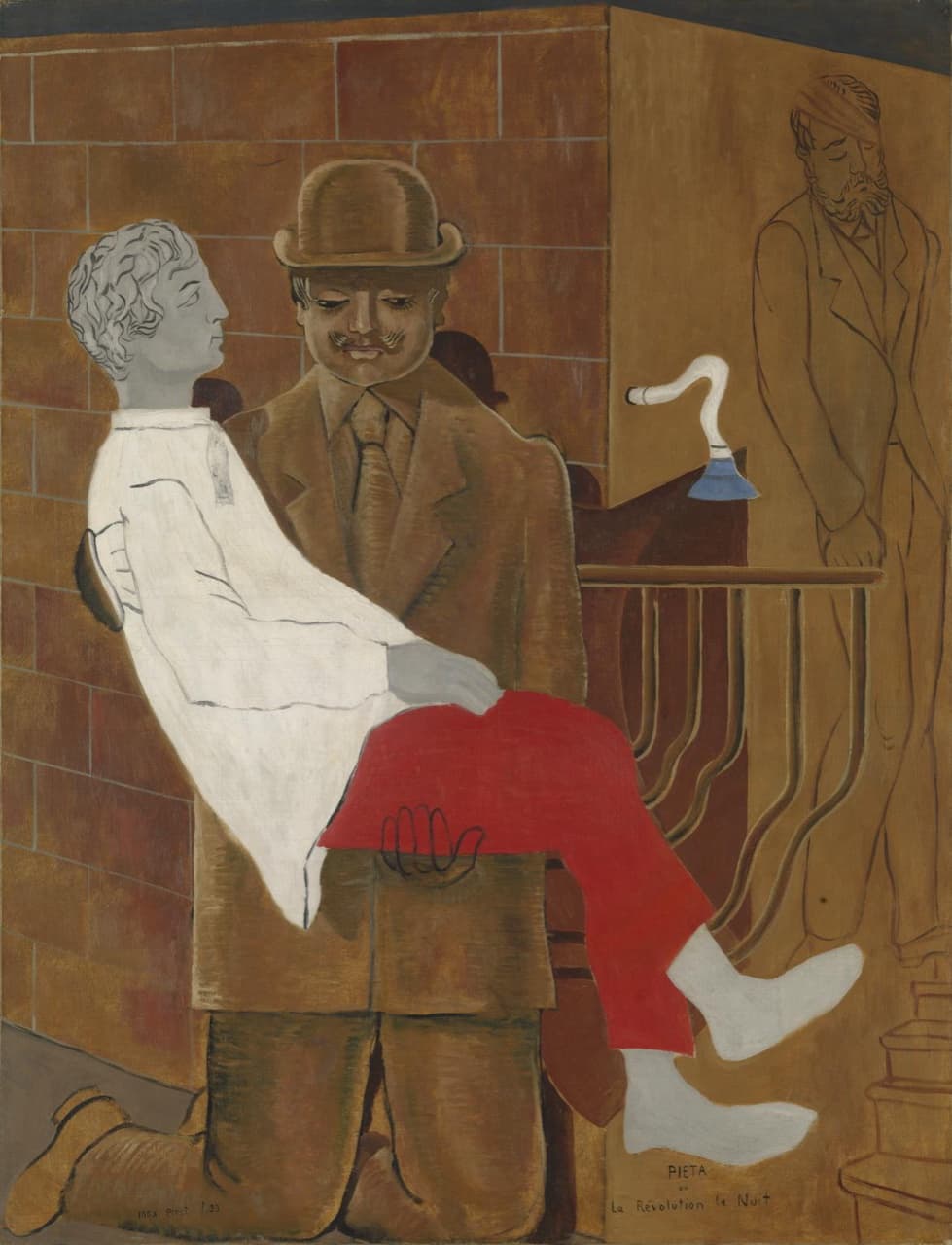
Tate's display caption says the painting shows the artist himself, held by his father, in the place of Christ in a Pietà. Tate's catalogue entry adds that the son's head is painted like a classical Greek statue.
by Max Ernst
A man in a bowler hat kneels and holds a stiff young man in a white shirt across his lap, like the Virgin Mary holding the dead Christ. The young man has the grey head of a Greek statue, and Tate says he is Max Ernst himself, held by his father. A man with a bandaged head is sketched on the wall behind them. Max Ernst painted it in 1923 at Saint-Brice, outside Paris, in the house of the poet Paul Éluard. Tate has owned it since 1981.
A man in a brown suit and a brown bowler hat kneels on a grey floor. Across his knees he holds a young man in a long white shirt and red trousers. The young man's body is stiff and straight, like a plank, and his feet stick out at the end, grey and blank.
The young man's head is grey, with tight curls and a blank eye, like the head of a Greek statue. The father's eyes are half closed under heavy lids, and his moustache and whiskers are painted in quick pale flicks. The son's grey hand rests on his red trousers. Just below it, the father's hand is drawn only as a black outline, with the trousers showing through it.
Behind them is a corner of big red-brown bricks, with a black band along the top of the picture. A white pipe comes out of the wall on the right, bends like a swan's neck and ends in a blue flared nozzle. Beside the pipe, a bearded man with a cloth wrapped round his head is drawn on the wall in thin lines, with his eyes closed. A handrail with curving bars runs behind the father, and steps are drawn in outline in the bottom right corner.
Max Ernst wrote both titles at the bottom right, PIETA, ou, La Révolution la Nuit. He signed and dated it at the bottom left.
A Pietà is the old religious scene of the Virgin Mary holding the dead Christ across her lap. Tate's display caption says Max Ernst replaced it with an image of himself, held by his father. The father kneels in the Virgin's pose, and takes the caring role that paintings usually give to mothers.
Tate's catalogue compares the father to the moustached father in Giorgio de Chirico's painting The Child's Brain, of 1914. André Breton owned that painting at the time. The son's head, painted like a classical statue, may be another nod to Giorgio de Chirico, whom Max Ernst admired.
The son wears what Tate calls a medical shirt, like a hospital gown. Tate's catalogue suggests that the white pipe on the wall, which it calls a shower-head device, probably stands for castration or impotence. The castration reading comes from Tate. The painting itself does not explain the pipe.
Max Ernst left Germany in August 1922 and went to live with the poet Paul Éluard. Tate's catalogue says he painted this picture there, at Saint-Brice, a suburb of Paris.
In the winter of 1922 to 1923, the Surrealists held evening sessions at Paul Éluard's house. Tate calls them sommeils, meaning sleeps. The poets tried to fall into trances, brought on by drugs or hypnosis, and to speak and write whatever came into their heads. Max Ernst took part.
Tate's catalogue quotes the art historian Dawn Ades, who wrote in 1978 that the painting is filled with the atmosphere of these sessions. Death is a constant theme in it, she wrote. All three figures in the painting seem to be asleep, dead or in a trance.
In 1981 the art historian Malcolm Gee argued in Arts Magazine that Max Ernst built the painting on a case history by Sigmund Freud, the one known as the Wolf Man, first published in 1918. In Malcolm Gee's reading, the painting turns Sigmund Freud's case into a picture of Max Ernst's own hard relationship with his father. Tate notes that Werner Spies, one of the authors of the catalogue of Max Ernst's works, does not share that view.
Nobody knows who the bearded man with the bandaged head is. Malcolm Gee suggested he mixes Sigmund Freud with Ivan Karamazov, who wraps a towel round his head against a nightmare in Fyodor Dostoevsky's novel The Brothers Karamazov. Gabrielle Keiller suggested the poet Guillaume Apollinaire, who was wounded in the head in the First World War. Tate adds that the bandage and the closed eyes could also recall Oedipus, who blinded himself in the Greek myth.
Fyodor Dostoevsky was on Max Ernst's mind. In December 1922, shortly before this painting, he had painted himself sitting on Fyodor Dostoevsky's knee, in his painting Au Rendez-vous des amis.
Paul Éluard owned the painting from 1923. The painting was reproduced in the Surrealists' magazine La Révolution surréaliste on 15 July 1925. In March 1926 it was number 1 in Max Ernst's exhibition at the Galerie van Leer in Paris. André Breton reproduced it in his book Le Surréalisme et la Peinture in 1928, and the poet Robert Desnos wrote about it in Cahiers d'Art in 1926.
The painting went to Roland Penrose in London in 1938, and to the collector Gianni Agnelli in Turin in 1971. Tate bought it from Gianni Agnelli through Marlborough Fine Art in 1981.
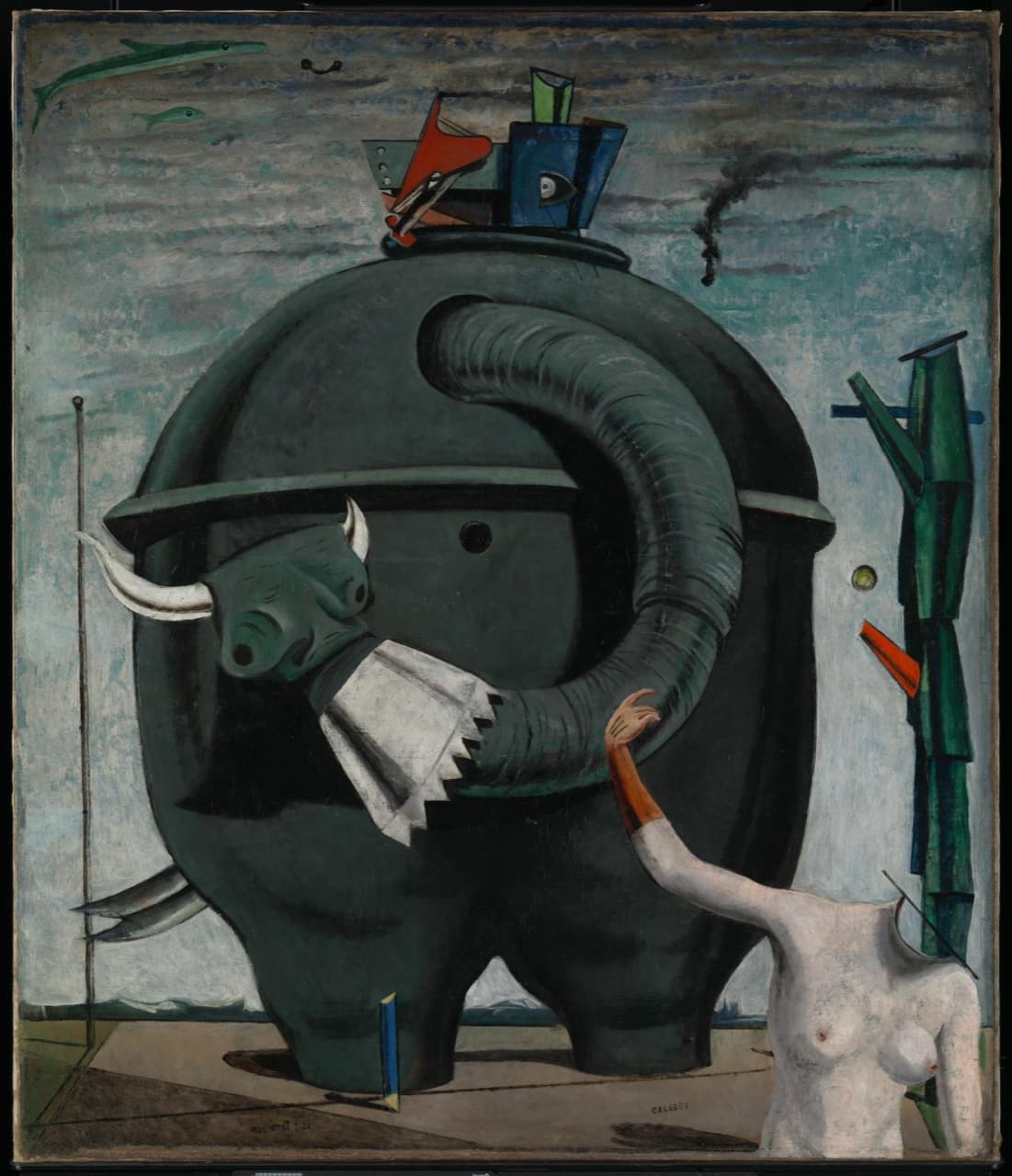
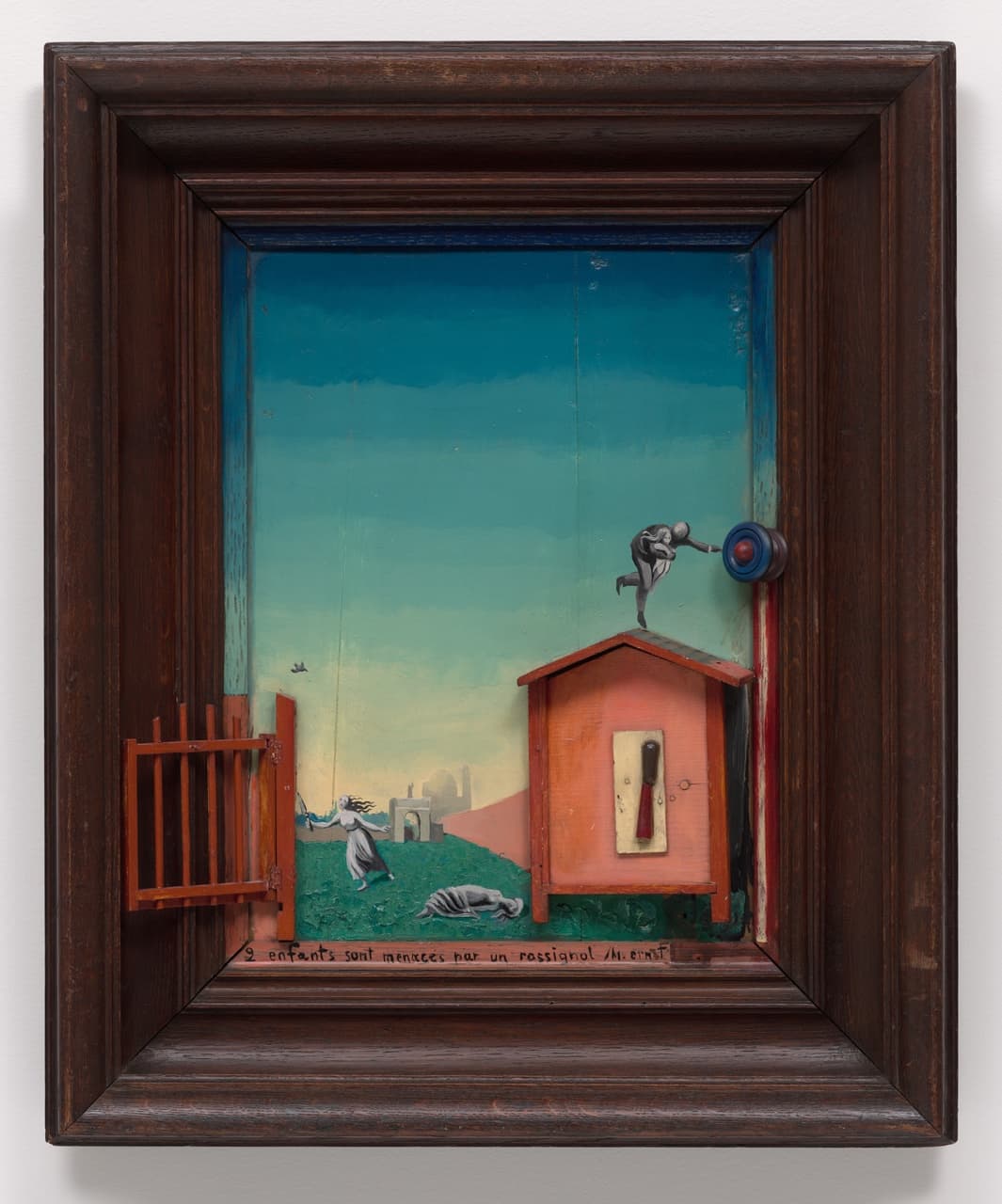
Max Ernst counted it among a small group of early Surrealist masterpieces that began with Celebes, of 1921, and ended with Two Children Are Threatened by a Nightingale, of 1924.
Close reading
Pietà or Revolution by Night is an old religious picture played out by a father and son. Up close there are a stone-grey head, a moustache painted in white flicks, a hand drawn only in outline, a pipe sticking out of the wall and a man sketched on the wall with his head wrapped in a bandage. Everyone in it seems asleep.
1.The son's head is a statue
The young man in the father's arms has a grey head like a Greek statue, with tight curls and a blank eye. Tate says the young man is Max Ernst himself, taking the place of Christ in a traditional Pietà. The statue head may be a nod to the painter Giorgio de Chirico, whom Max Ernst admired and who often painted classical heads.
2.The father's face
The father looks down with heavy, drooping eyelids, as if he were asleep. His moustache and whiskers are painted in quick pale flicks. Tate's catalogue compares him to the moustached father in Giorgio de Chirico's The Child's Brain of 1914, a painting that André Breton owned at the time.
3.A bowler hat instead of a veil
In a Pietà, the Virgin Mary usually wears a veil. Here the figure in her place wears a brown bowler hat and a business suit. Tate's display caption says Max Ernst swapped the mother for a father, giving a man a caring role usually painted as a mother's.
4.A second bowler hat in the dark
Behind the father's shoulder there is a dark shape like a second bowler hat. The dark shape might be the father's shadow on the wall, thrown by a light from the left. Or it might be the top of a second man standing behind him. It is not clear, and neither the Tate display caption nor its catalogue entry mentions it.
5.A white shirt like a hospital gown
The son wears a long loose white shirt. Tate's catalogue calls it a medical shirt, like a hospital gown. His body under it is stiff and straight, like a plank. Tate's catalogue notes that its whiteness is picked up by the white pipe on the wall behind.
6.A dark hand at the son's back
Against the son's back there is a dark rounded shape. The shape is probably the father's other hand, holding the son up. The hand is painted so dark and so simply that it is hard to be sure. In a traditional Pietà the mother's hand supports Christ's back in just this place.
7.One hand painted, one only drawn
Two hands meet on the son's red trousers. The son's grey hand is painted solidly, like the rest of his statue body. Below it, the father's hand is drawn only as a black outline, with the trousers showing through it. So the father's hand holds the son and is barely there at the same time.
8.Stiff grey feet
The son's feet stick out at the end of his red trousers, grey and blank like the feet of a statue. The feet are rigid, not relaxed. Tate's catalogue quotes the art historian Dawn Ades: death is a constant theme in this painting. Everyone in it looks asleep, dead or in a trance.
9.The father kneels
The father kneels on a grey floor, one foot bent back behind him. Kneeling is the pose of the Virgin in many Pietà paintings. Here it is a man in a brown suit and ordinary shoes, which makes the old pose look strange and a little comic.
10.A white pipe coming out of the wall
A white pipe comes out of the wall, bends like a swan's neck and ends in a blue flared nozzle. The pipe looks like a shower head or the horn of an old gramophone. Tate's catalogue calls it a shower-head device and suggests it may stand for castration or impotence, fears that Sigmund Freud wrote about. The castration reading is Tate's. The picture itself does not explain it.
11.A man with a bandaged head
On the wall at the right, drawn only in thin lines, is a bearded man with a cloth wrapped round his head and his eyes closed. No one knows who he is. The art historian Malcolm Gee suggested he mixes Sigmund Freud with Ivan Karamazov, who wraps a towel round his head against a nightmare in Fyodor Dostoevsky's novel. Gabrielle Keiller suggested the poet Guillaume Apollinaire, who was wounded in the head in the First World War.
12.The man on the wall stands and waits
The bandaged man is drawn full length on the wall, in a suit, with his hands together in front of him. He stands like someone waiting outside a room. Because he is only an outline, he could be a drawing on the wall, a ghost or a memory. Tate's catalogue notes that the bandage and closed eyes could also recall Oedipus, who blinded himself in the Greek myth.
13.A wall of large bricks
Behind the figures is a wall of big red-brown bricks with pale mortar lines. The wall turns a sharp corner, and a black band runs along the top of the picture. The wall and the dark band make the scene feel like a closed courtyard at night, which fits the second half of the title, Revolution by Night.
14.A railing with bent bars
Behind the father runs a handrail with a row of bars that bend and curve downward. The rail looks like the banister of a staircase. The bars are drawn with pale outlines and seem to sag, as if they were soft.
15.Steps drawn in outline
In the bottom right corner there is a stepped shape drawn only in thin lines. The stepped shape could be the bottom of a staircase, going with the banister above, or the base of a column. Like the bandaged man, it is only an outline, as if part of the room had not been finished.
16.Pietà, or the Revolution by Night
Max Ernst wrote the double title at the bottom: PIETA, ou, La Révolution la Nuit. Tate records it as inscribed bottom right. The second title may come from the Surrealists' evening sessions at Paul Éluard's house in the winter of 1922 to 1923. At those sessions the poets tried to speak and write while in a trance.
17.Signed max ernst, '23
The signature, max ernst, and the date 23 are written small at the bottom left. Max Ernst painted the picture at Saint-Brice, just outside Paris, in Paul Éluard's house. Max Ernst had gone to live there after leaving Germany in August 1922. Paul Éluard owned the painting from 1923 until 1938.
1922
In August Max Ernst leaves Germany and goes to live in Paul Éluard's house at Saint-Brice, outside Paris.
1922
In December he paints Au Rendez-vous des amis, with himself on Fyodor Dostoevsky's knee.
1923
Paints Pietà or Revolution by Night at Saint-Brice. Paul Éluard owns it from this year.
1925
Reproduced in La Révolution surréaliste, number 4, 15 July.
1926
Number 1 in the Exposition Max Ernst at the Galerie van Leer, Paris, in March.
1928
André Breton reproduces it in Le Surréalisme et la Peinture.
1936
Shown in Fantastic Art, Dada, Surrealism at the Museum of Modern Art in New York.
1938
Passes to Roland Penrose in London.
1971
Passes to Gianni Agnelli in Turin.
1981
Tate buys it from Gianni Agnelli through Marlborough Fine Art.
Tate
London, United Kingdom
Tate has several galleries. A specific viewing address has not been confirmed here; check which venue, if any, is displaying this work before travelling.
On display at Tate Modern in Media Networks: Monsieur Vénus in September 2026. Displays change, so check Tate's page before a visit.
Plan your visit on the museum’s official website (opens in a new tab)Tate says the young man is Max Ernst himself, and the kneeling man in the bowler hat is his father, in the places of Christ and the Virgin Mary in a Pietà. Nobody knows who the bearded man with the bandaged head is. Suggestions include Sigmund Freud mixed with Ivan Karamazov, Guillaume Apollinaire, and Oedipus.
Max Ernst did not explain the second title in any source quoted by Tate. Tate links the painting's night-time mood to the Surrealists' trance sessions at Paul Éluard's house in the winter of 1922 to 1923.
At Saint-Brice, a suburb of Paris, in the house of the poet Paul Éluard, where Max Ernst went to live after leaving Germany in August 1922.
The fitting looks like a shower head on a bent white pipe. Tate's catalogue calls it a shower-head device and suggests it probably stands for castration or impotence. The painting itself gives no explanation.
At Tate, reference T03252. In September 2026 it was on display at Tate Modern in London, in the room Media Networks: Monsieur Vénus. Displays change, so check Tate's page before a visit.
Depicts · 1923
Tate's display caption says the painting shows the artist himself, held by his father, in the place of Christ in a Pietà. Tate's catalogue entry adds that the son's head is painted like a classical Greek statue.
Explore painters from the same movements and circles.
Strasbourg-born sculptor and poet — Hans in German, Jean in French, both all his life — who co-founded Dada at the Cabaret Voltaire in 1916, composed collages by dropping torn paper 'according to the laws of chance', and settled at Meudon outside Paris in a house his wife Sophie Taeuber-Arp designed.
View artist
The self-made icon of Surrealism — melting watches and manicured scandal — who arrived in Paris by way of two films written with Buñuel, dreamed together before the movement claimed them.
View artist
The century's quietest revolutionary — readymades, the abandonment of painting, chess on a Paris rooftop in Entr'acte, and one anemic film of spinning puns signed Rrose Sélavy.
View artistThe sources below include collection records, catalogues, scholarly research, and primary materials that informed this page. They document Pietà or Revolution by Night, its making, and its place in cultural history.

The holding museum's record: date, medium, size, inscriptions, owners, exhibitions and literature, the readings by Malcolm Gee, Gabrielle Keiller and Dawn Ades, and the image the close-reading views were cropped from.
Tate on Max Ernst's and André Breton's interest in Sigmund Freud and psychiatry in the early 1920s.
The painting that Max Ernst counted as the first of this group, owned by Paul Éluard and Roland Penrose before this one.
Tate on automatism and André Breton's definition of Surrealism, the background to the trance sessions at Paul Éluard's house.
These references provide the documented foundation for this work's history and interpretation. Claim-level citations remain attached to the specific claims they support.
 Explore more resources