Celebes
by Max Ernst
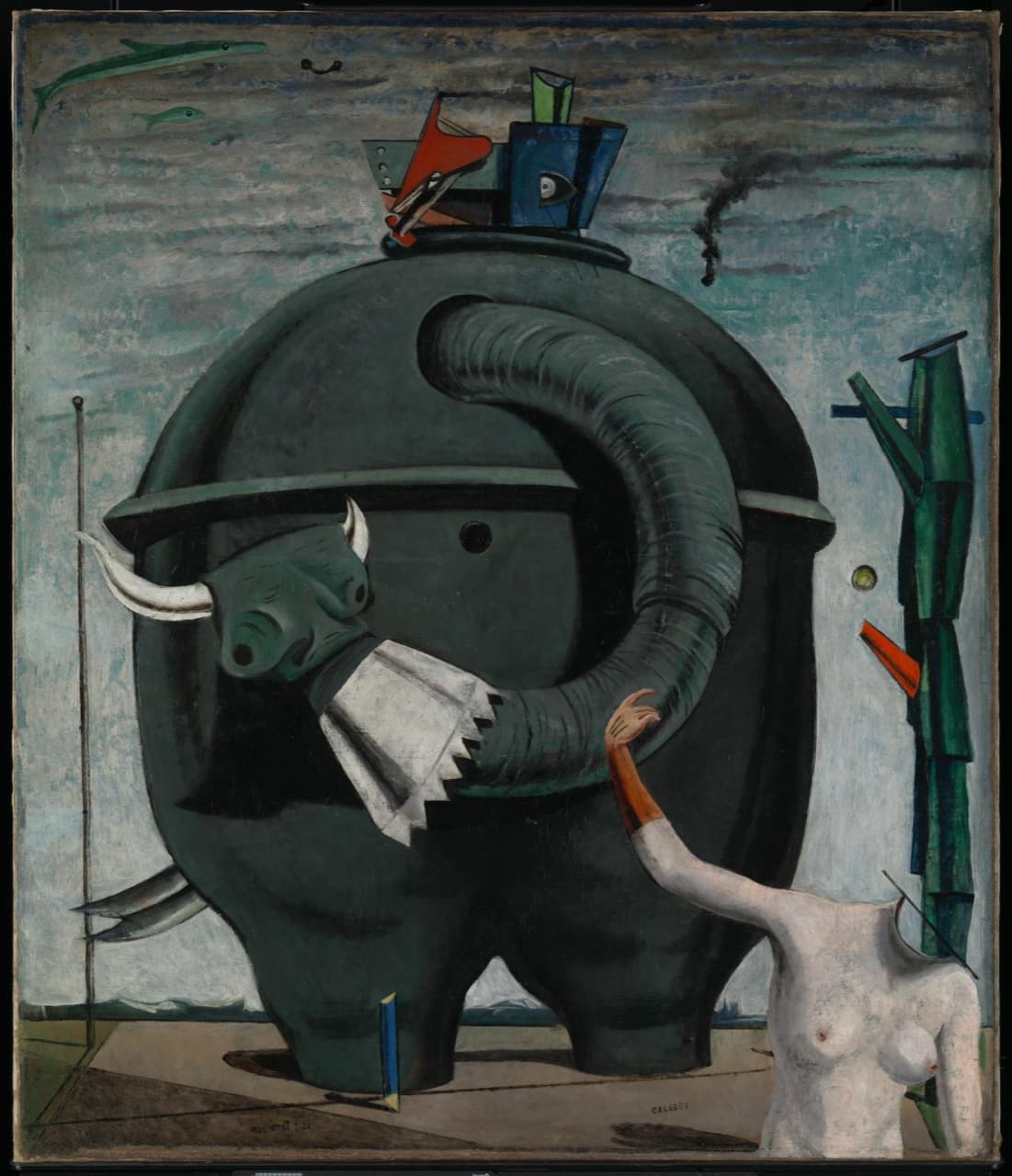
A huge round creature with a bull's head and a hose for a trunk stands on a bare floor, while fish swim in the sky and a headless woman beckons from the corner. Max Ernst painted it in Cologne in 1921, and it was his first large painting. The body began as a photograph of a clay corn-bin from the southern Sudan. The poet Paul Éluard bought it soon after it was finished. Tate has owned it since 1975.
- 1921
- Oil paint on canvas
- TateLondon, United Kingdom
About Max Ernst
What the painting shows
A huge dark creature fills the middle of the canvas. The creature's body is round and smooth, like a boiler or a giant pot, with a raised band running round its middle and a small round hole below the band. The creature stands on two short, thick legs on a flat, bare floor.
A ribbed grey hose comes out of an opening high on the body and loops down and round. At its end, behind a stiff white collar with a jagged edge, hangs a green head with two white horns, more like a bull's head than an elephant's. On top of the body sits a stack of flat coloured shapes, red, grey, blue and green, and a single eye is painted on the blue one.
The sky is painted in long wavy streaks, like water, and two green fish swim across it at the top left. A thin twist of black smoke rises on the right. Three upright things stand around the creature: a thin pole on the left, a blue pencil balanced on its point by the creature's feet, and a tall green structure at the right edge.
In the bottom right corner stands the upper half of a naked woman with no head. She raises one arm, red-orange from the elbow to the wrist like a long glove, and her open hand almost touches the hose. Tate's catalogue reads the gesture as beckoning the monster toward her.
A corn-bin becomes a monster
Max Ernst painted Celebes in Cologne in 1921. Tate's catalogue calls it his first large painting. He made no collages or sketches for it first. The idea came straight onto the canvas and changed very little as he worked.
The creature's body comes from a photograph. The painter John Craxton noticed the source first, and Max Ernst later confirmed it. The photograph was printed in an English anthropology journal and showed a huge communal corn-bin made by the Konkombwa people of the southern Sudan.
Max Ernst painted the corn-bin from the same angle as the photograph, and the shape is very close. But he made the clay look like metal, and he added the hose, the head, the tusks and the coloured blocks. Those additions turned a store for grain into something between an animal and a machine.
From collage to paint
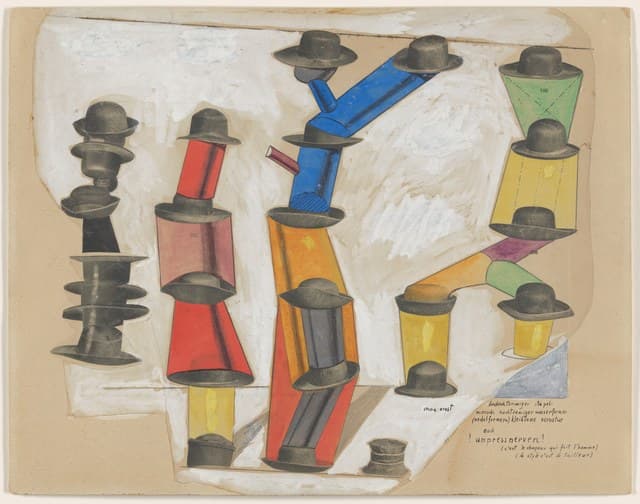
Tate's catalogue says the painting grew directly out of the collages Max Ernst had been making since 1919. In those he cut up printed pictures and glued them together into strange new combinations. His collage The Hat Makes the Man, of 1920, is one of them.
Celebes does the same thing with oil paint. Each part of the creature looks as if it came from a different picture. The white collar at the neck hides the join between the hose and the head, just as a glued edge would hide a cut.
Tate's catalogue calls the whole picture highly ambiguous. A pair of pale tusks sticks out from behind the body on the left, which suggests a second head on the far side. The creature seems to stand in open space, and yet it also seems to be sunk into something solid, while fish swim over it.
A rude rhyme
Max Ernst told the artist and collector Roland Penrose where the title came from. The source was a rude rhyme that German schoolboys told each other. Tate prints the German and an English version.
The first couplet, in Tate's translation, says that the elephant from Celebes has sticky, yellow bottom grease. Two more couplets follow, about elephants from Sumatra and from India, and they are too rude to print here.
Max Ernst lettered the title on the painted floor in small capitals, CELEBES, and signed the painting at the bottom left, max ernst 1921. On the back of the canvas he wrote No. 1. MAX ERNST CELEBES. He also covered the back with cartoon doodles. The collector Gabrielle Keiller noticed two golfers among them, with the word GOLF beside them, watched by a grotesque head saying HA HA.
Paul Éluard's painting
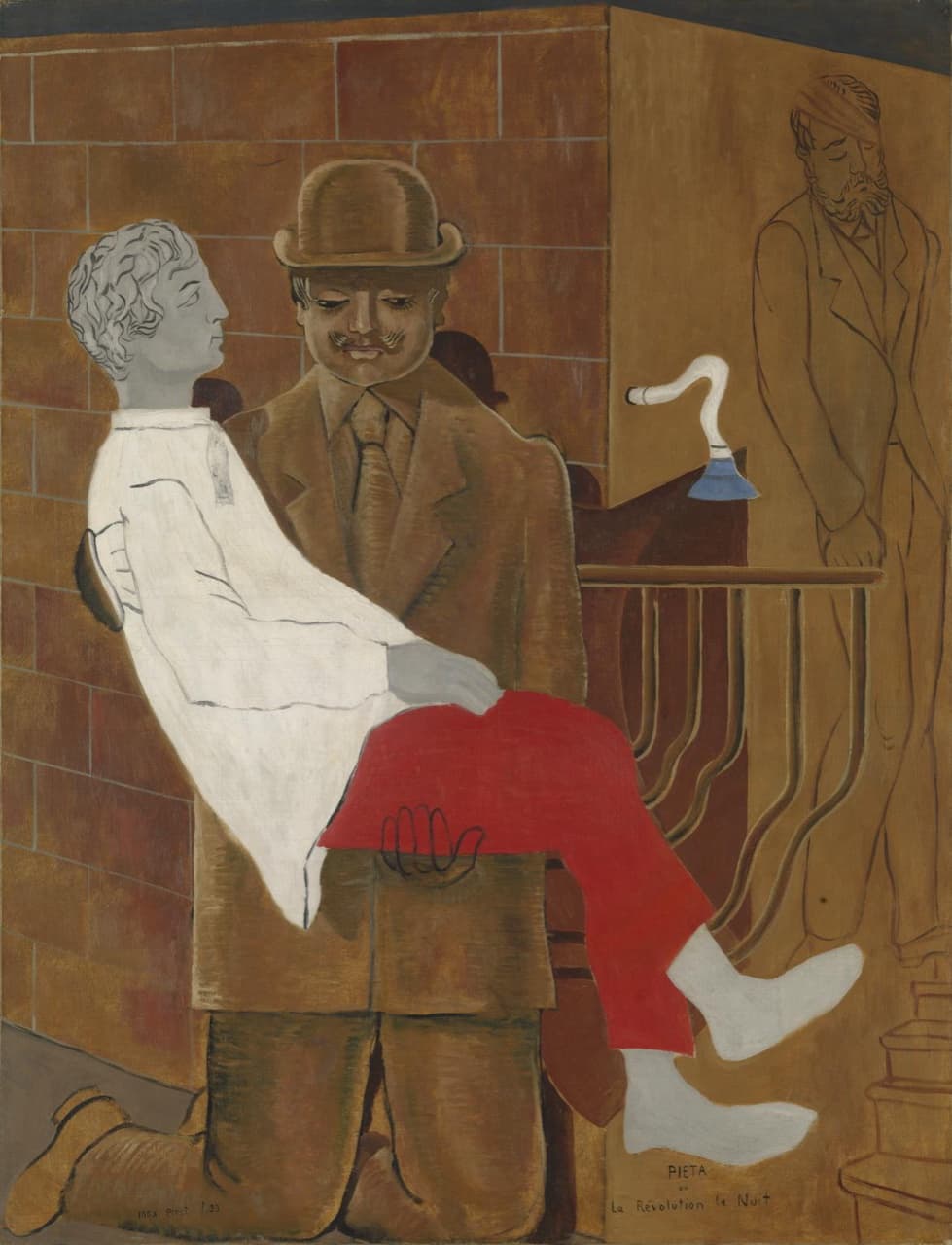
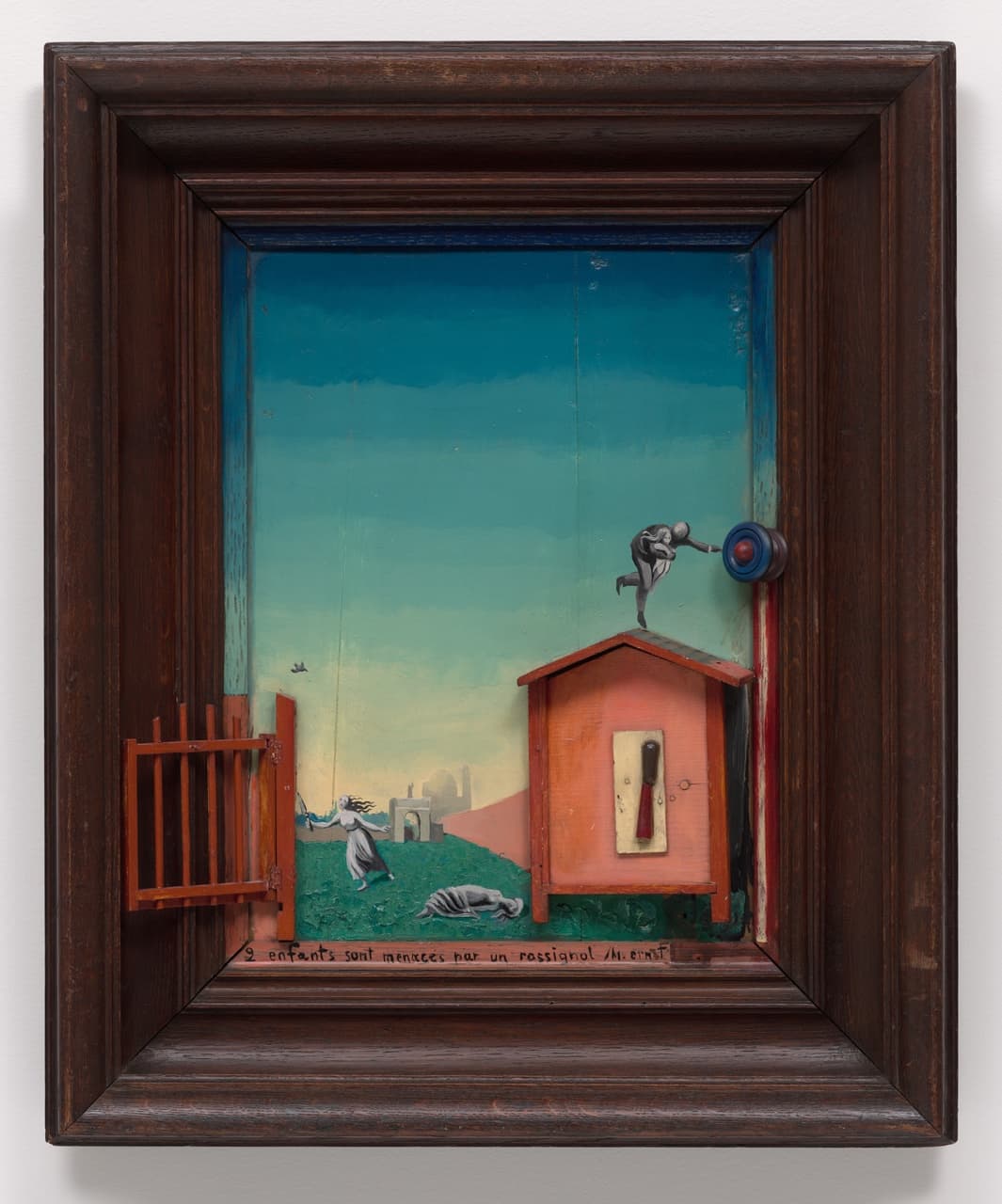
The poet Paul Éluard bought Celebes soon after it was finished, and Tate lists him as its owner in Paris from 1921. Paul Éluard owned two more of the paintings in this group, Pietà or Revolution by Night and Two Children Are Threatened by a Nightingale.
In 1938 the painting passed from Paul Éluard to Roland Penrose in London. Roland Penrose kept it until 1975, and gave the most detailed study of it in a lecture published in 1972. In 1975 Roland Penrose gave the painting to be sold for the benefit of the Institute of Contemporary Arts in London. Tate bought it from the Elephant Trust in 1975.
Celebes has been shown all over the world. The painting hung in the International Surrealist Exhibition in London in 1936 and in Fantastic Art, Dada, Surrealism at the Museum of Modern Art in New York that winter. Celebes was in the Venice Biennale of 1954, the year Max Ernst won the Biennale's grand prize for painting. The painting came back to Paris for his retrospectives at the Musée National d'Art Moderne in 1959, the Orangerie des Tuileries in 1971 and the Grand Palais in 1975.
The first of four
Max Ernst saw Celebes as the first of a small group of early Surrealist masterpieces, according to Tate's catalogue entry for Pietà or Revolution by Night. The group ends with Two Children Are Threatened by a Nightingale, made in 1924, the year André Breton launched Surrealism with his manifesto.
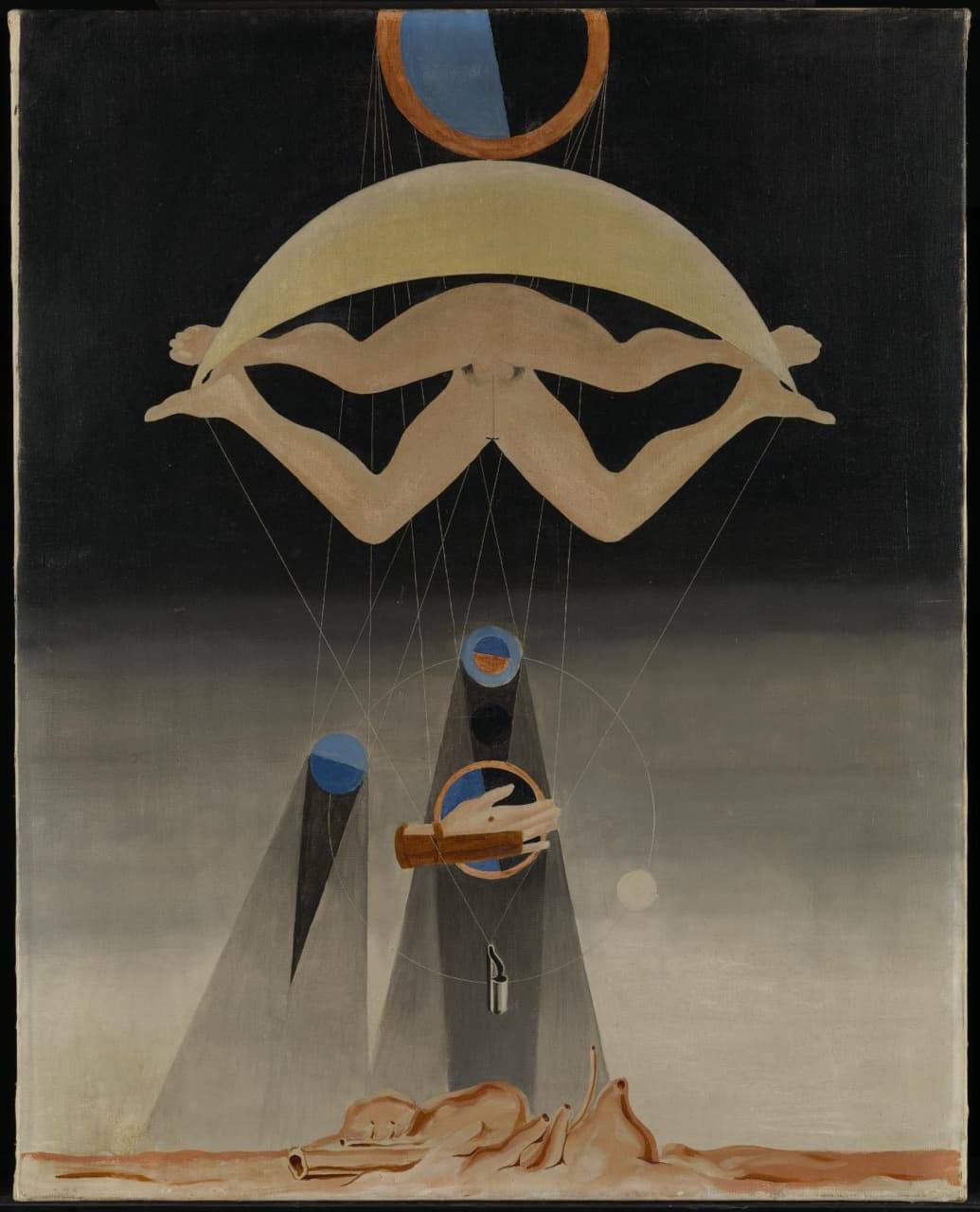
Pietà or Revolution by Night and Men Shall Know Nothing of This, both of 1923, belong to the same run. By then Max Ernst had left Germany. Tate says he went to live in Paul Éluard's house outside Paris in August 1922.
Close reading
Reading the work, detail by detail
Up close, Celebes is a pile of borrowed parts. A metal-looking body with a bull's head, a hose for a trunk, a stack of coloured blocks on top, fish in the sky and a headless woman in the corner. Max Ernst painted it in Cologne in 1921, and each part looks as if it came from a different picture.
1.A bull's head on the end of a hose
The creature's head is more like a bull's than an elephant's. Two white horns curve out from it, and two dark round holes sit at the front. The holes could be nostrils or eyes. Tate's catalogue calls them sightless eyes. The head hangs low, as if the creature were sniffing the ground or bowing.
2.A white cuff with a torn edge
Where the hose meets the head, Max Ernst painted a stiff white collar with a jagged edge, like torn paper or a shirt cuff. The collar hides the join, so we never see how the head is fixed on. The white collar is a painter's version of a collage trick. Max Ernst had spent the two years before cutting up printed pictures and gluing them together, and here the seam is painted instead of cut.
3.The trunk is a ribbed hose
The elephant's trunk comes out of a dark opening high on the body and loops down and round. The trunk is ribbed like a vacuum-cleaner hose or a length of drainpipe. Tate's catalogue calls it a long snake-like coil that works as the creature's neck. Max Ernst painted the ribs with quick pale strokes, so the hose looks soft and heavy at once.
4.A stack of coloured blocks on top
On top of the body sits a crown of flat shapes: a red wedge like a folded wing, a grey plate with a row of holes, a blue box and a green tube. None of them is anything in particular. The shapes look like parts of a machine, or the pieces of a child's building set. Tate's catalogue simply calls it a brightly coloured construction.
5.An eye painted on the blue box
A single eye, looking left, is painted on the side of the blue box. The eye on the box is the only one in the picture that seems to see. Tate's catalogue calls it a mysterious eye. The eye makes the stack on top look like a small second head keeping watch while the main head looks down.
6.A seam and a round hole in the body
A raised band runs round the middle of the body, like the seam on a boiler or the lip where a lid would sit. Below it there is one small round hole. The body began as a photograph of a huge clay corn-bin made by the Konkombwa people of the southern Sudan, printed in an English anthropology journal. Max Ernst kept its shape and angle but made the clay look like metal.
7.Two fish swimming in the sky
In the top left corner two green fish swim across the sky. One is long and thin, like a garfish, and the other is small. The sky is painted in long wavy streaks, more like water than air. So the fish tell us that the sky might be the sea, and the creature might be standing on the bottom of it. Tate's catalogue points out that the creature seems to stand in open space and yet to be sunk in something solid.
8.Black smoke rising
To the right of the creature a thin twist of black smoke rises into the sky. The smoke does not come from anything we can see. The smoke might come from a ship's funnel over the horizon, or a chimney, or from inside the creature itself. The smoke is one more sign that the body is a machine rather than an animal.
9.A tall green post on the right
At the right edge stands a tall green structure, built from angled blocks with a blue bar across the top. It is not clear what it is. The structure could be a totem pole, a scarecrow, or a pile of tubes. Tate's catalogue counts it as one of three upright objects standing round the creature.
10.A small ball and a red cone
Beside the green post a small yellow-green ball floats in the air, and below it a bright red-orange cone points down to the left. Neither is held up by anything. The ball could be a marble or a distant planet. The red cone is the brightest colour in this part of the picture, and it leads the eye down toward the woman's raised hand.
11.The woman's hand touches the trunk
The headless woman raises one arm toward the creature. Her forearm is red-orange, like a long glove, and her open hand almost touches the hose. Tate's catalogue reads the gesture as beckoning, as if she were calling the monster toward her. The touch of hand and hose is the only moment of contact in the painting.
12.A headless woman in the corner
In the bottom right corner stands the upper half of a naked woman with no head. She is pale and smooth, like a shop mannequin or a plaster cast. A thin dark rod crosses the place where her neck should be. Tate's display caption links figures like this to dream images, and to the free association that Sigmund Freud used in his treatments.
13.A thin pole on the left
On the far left a thin pole rises from the ground, with a small round knob on top. The pole might be a flagpole with no flag, or a lightning rod. The pole is the second of the three upright things around the creature, and the plainest.
14.Two tusks behind the body
Two pale curved points stick out from behind the lower left side of the body. The two points look like tusks. Tate's catalogue notes that they hint at a second head on the far side, and wonders whether that hidden head is the real one. If so, the bull's head in front might be something else, such as a tail.
15.A blue pencil standing on its point
In front of the creature's feet a blue pencil stands upright on its sharpened point. A real pencil could not balance like that. The pencil is the third upright object, and the smallest. A pencil is a drawing tool, so it may be a small joke by Max Ernst about the act of making the picture.
16.A snowy peak between the legs
The creature stands on two short, thick legs on a flat, bare floor. Through the gap between the legs we see a white snowy peak and a strip of blue sea far away. The floor is drawn with straight lines that run back into the distance, like a stage. So the monster seems to stand on a stage set in front of a real landscape.
17.Signed and dated 1921
Max Ernst signed the painting small, in the brown floor at the bottom left: max ernst 1921. Tate's catalogue records it there. The back of the canvas carries a second inscription, No. 1. MAX ERNST CELEBES, and a set of cartoon sketches, among them two golfers and a grotesque head saying HA HA.
18.The title written on the floor
Max Ernst also lettered the title on the floor, in small capitals: CELEBES. Max Ernst told the artist and collector Roland Penrose that the name came from a rude German schoolboys' rhyme. The first lines, in Tate's translation, say that the elephant from Celebes has sticky, yellow bottom grease. Two more verses, about elephants from Sumatra and India, are too rude to print here.
Timeline
1921
Max Ernst paints Celebes in Cologne, his first large painting, with no sketches or collages first.
1921
The poet Paul Éluard buys it soon after it is finished and keeps it in Paris.
1936
Shown in the International Surrealist Exhibition at the New Burlington Galleries in London, then in Fantastic Art, Dada, Surrealism at the Museum of Modern Art in New York.
1938
Passes from Paul Éluard to Roland Penrose in London.
1954
Shown at the Venice Biennale, where Max Ernst wins the grand prize for painting.
1959
Shown in the Max Ernst retrospective at the Musée National d'Art Moderne in Paris.
1972
Roland Penrose's lecture Max Ernst's Celebes is published in Newcastle upon Tyne.
1975
Roland Penrose gives it to be sold for the Institute of Contemporary Arts. Tate buys it from the Elephant Trust. The painting is shown at the Grand Palais in Paris the same year.
Where to see it
Tate
London, United Kingdom
Tate has several galleries. A specific viewing address has not been confirmed here; check which venue, if any, is displaying this work before travelling.
On display at Tate Modern in In the Studio: International Surrealism in September 2026. Displays change, so check Tate's page before a visit.
Plan your visit on the museum’s official website (opens in a new tab)Frequently asked questions
Why is it called Celebes?
Max Ernst told Roland Penrose that the title came from a rude rhyme told by German schoolboys. The first couplet, in Tate's translation, says that the elephant from Celebes has sticky, yellow bottom grease. The painting is often called The Elephant Celebes for that reason.
What is the elephant made from?
A photograph of a huge clay corn-bin made by the Konkombwa people of the southern Sudan, printed in an English anthropology journal. The painter John Craxton spotted the source and Max Ernst confirmed it. He made the clay look like metal and added a hose, a horned head and a stack of coloured blocks.
Where was it painted?
In Cologne, in 1921, before Max Ernst moved to France. Tate calls it his first large painting.
Who owned Celebes?
The poet Paul Éluard bought it soon after it was finished and owned it in Paris until 1938. Roland Penrose owned it in London from 1938 to 1975. Tate bought it in 1975.
Where can I see it?
At Tate, reference T01988. In September 2026 it was on display at Tate Modern in London, in the room In the Studio: International Surrealism. Displays change, so check Tate's page before a visit.
More by Max Ernst
If you like Max Ernst
Explore painters from the same movements and circles.
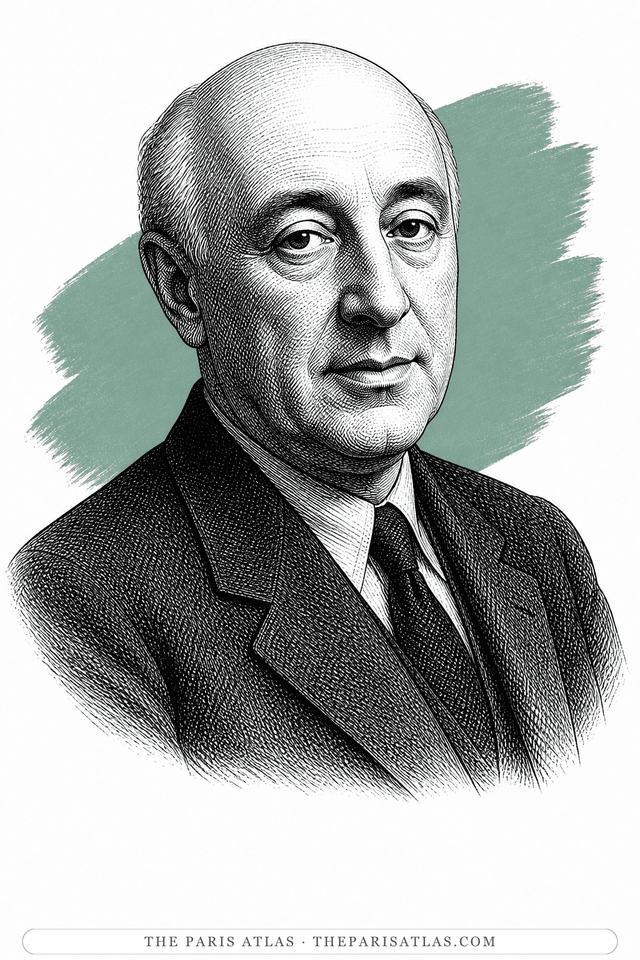
Jean Arp
Strasbourg-born sculptor and poet — Hans in German, Jean in French, both all his life — who co-founded Dada at the Cabaret Voltaire in 1916, composed collages by dropping torn paper 'according to the laws of chance', and settled at Meudon outside Paris in a house his wife Sophie Taeuber-Arp designed.
View artist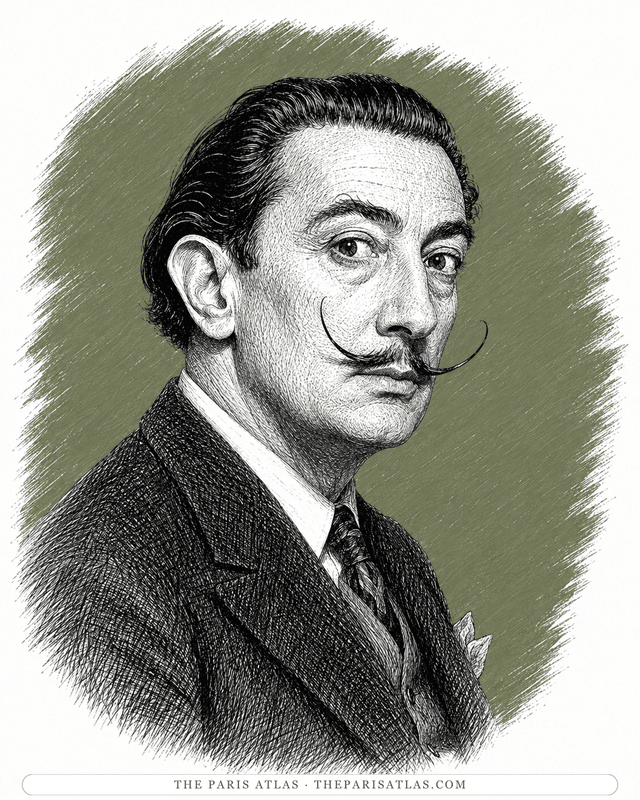
Salvador Dalí
The self-made icon of Surrealism — melting watches and manicured scandal — who arrived in Paris by way of two films written with Buñuel, dreamed together before the movement claimed them.
View artist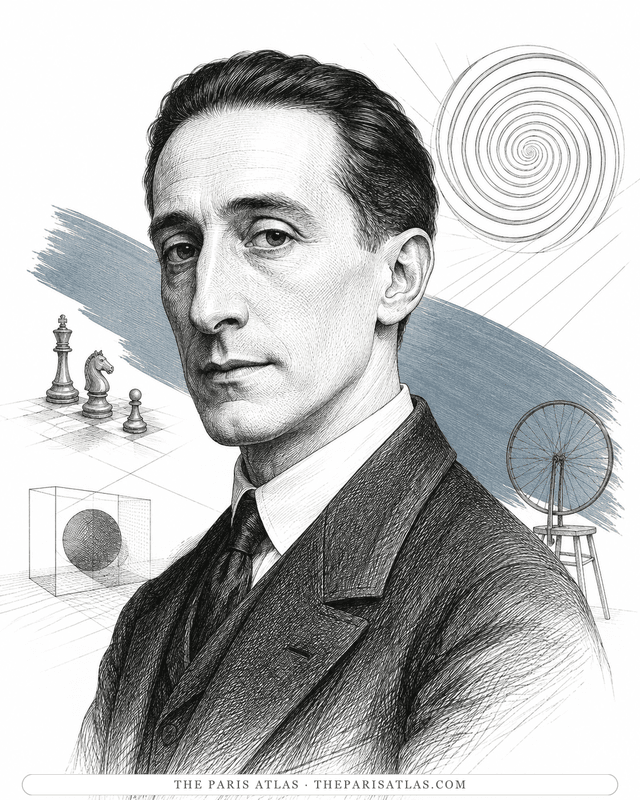
Marcel Duchamp
The century's quietest revolutionary — readymades, the abandonment of painting, chess on a Paris rooftop in Entr'acte, and one anemic film of spinning puns signed Rrose Sélavy.
View artist
References
The sources below include collection records, catalogues, scholarly research, and primary materials that informed this page. They document Celebes, its making, and its place in cultural history.


1Max Ernst, Celebes, 1921 (T01988)
WebsiteTateUsed forThe holding museum's record: date, medium, size, inscriptions, owners and exhibitions, the corn-bin source, the schoolboys' rhyme, the back of the canvas, and the image the close-reading views were cropped from.
2Max Ernst, Pietà or Revolution by Night, 1923 (T03252)
WebsiteTateUsed forTate's statement that Max Ernst saw his early Surrealist masterpieces as beginning with Celebes and ending with Two Children Are Threatened by a Nightingale.
3Max Ernst — Peggy Guggenheim Collection
WebsitePeggy Guggenheim Collection, VeniceUsed forThe Peggy Guggenheim Collection on Max Ernst's grand prize for painting at the 1954 Venice Biennale.
4Tate — Surrealism (art term)
WebsiteUsed forTate on André Breton launching Surrealism with his manifesto in 1924.
These references provide the documented foundation for this work's history and interpretation. Claim-level citations remain attached to the specific claims they support.
 Explore more resources