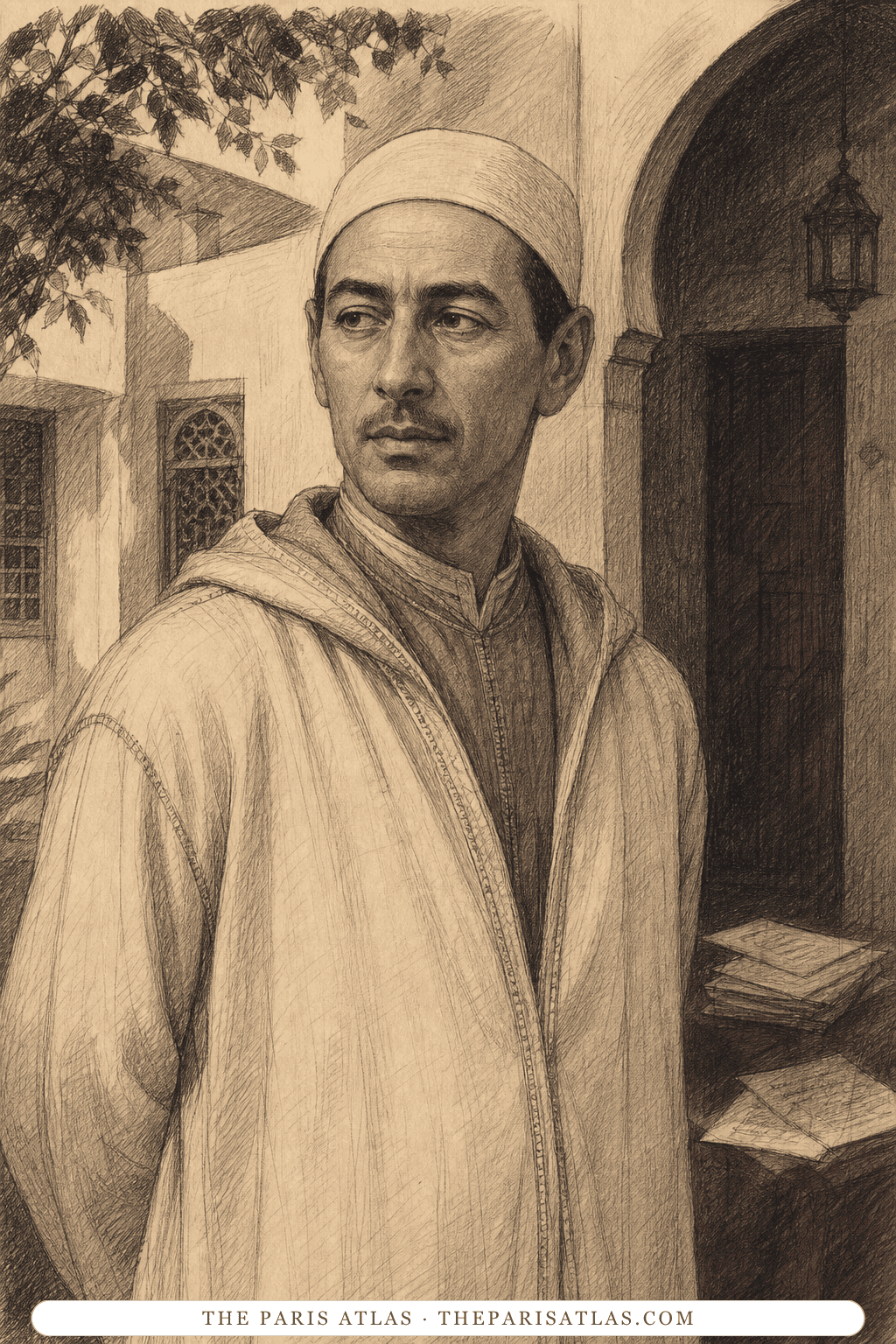
Moulay Ali
A nationalist organizer whose protected house first impresses Amar and then teaches him that political authority and religious integrity are not the same thing.
To protect and advance the nationalist network in Fez, even when secrecy requires treating frightened individuals as possible tools or threats.
The book

At a glance
- Nationalist organizer in Fez
- Connected to the campaign against French rule
- First detains him, later finds news of his family
- A guarded house and orchard in Fez
Who they are in the book
Spoiler-freeMoulay Ali is a Fez nationalist organizer. Amar encounters his network by accident after fleeing a fight at the pottery and entering an orchard connected to him. The men around Moulay Ali suspect the unknown boy may be spying for the French and hold him while they decide what to do.
To Amar, the house first appears powerful and secure. It contains men with information, plans, money, and access to the independence movement. Their behavior troubles him. Moulay Ali uses religious language and works against French rule, yet he does not live according to the strict standards Amar has inherited from his father.
Their paths cross again after Amar’s family leaves Fez. Moulay Ali does obtain news that the boy’s mother and sister are with an older married sister in Meknes, which makes him more than a simple villain. He also allows his people to escape before a raid while Amar remains behind. That mixture of help, manipulation, courage, and self-protection destroys Amar’s simple picture of political leadership.
How Moulay Ali Is Portrayed
- The guarded houseHis home functions as a political shelter, with followers, private conversations, and controlled access. Amar experiences its apparent security before discovering how quickly it can fail.
- Suspicion as a habitAmar’s accidental arrival is treated as a possible police operation. The reaction shows the danger of informers and the movement’s readiness to frighten an innocent boy.
- A leader Amar cannot admireMoulay Ali opposes French rule, but his conduct does not match Amar’s religious idea of justice. Political agreement is not enough to earn the boy’s trust.
- Useful connectionsWhen Amar’s family disappears from Fez, Moulay Ali’s network finds out that the women have reached relatives in Meknes.
- The flute before the raidAmar plays music for the gathering in the house while waiting. The ordinary pleasure makes the sudden collapse of safety more severe.
- Gone before the police arriveWarned of a raid, the organizer and his associates slip away. Amar is left inside to face the consequences of an operation he did not create.
If you like The Spider’s House


If you like Paul Bowles
Explore authors with a similar voice, perspective, and influence.

Louis-Ferdinand Céline
The doctor of the Paris slums who wrote the century's blackest, funniest novel — and changed the sound of French prose.
View author
Henry Miller
The Brooklyn dropout who arrived in Paris broke at thirty-eight and wrote the exuberant, banned books that ended American censorship.
View author
Martha Gellhorn
War correspondent who covered the Spanish Civil War, D-Day, and conflicts across five more decades; Hemingway's third wife, 1940–1945.
View author