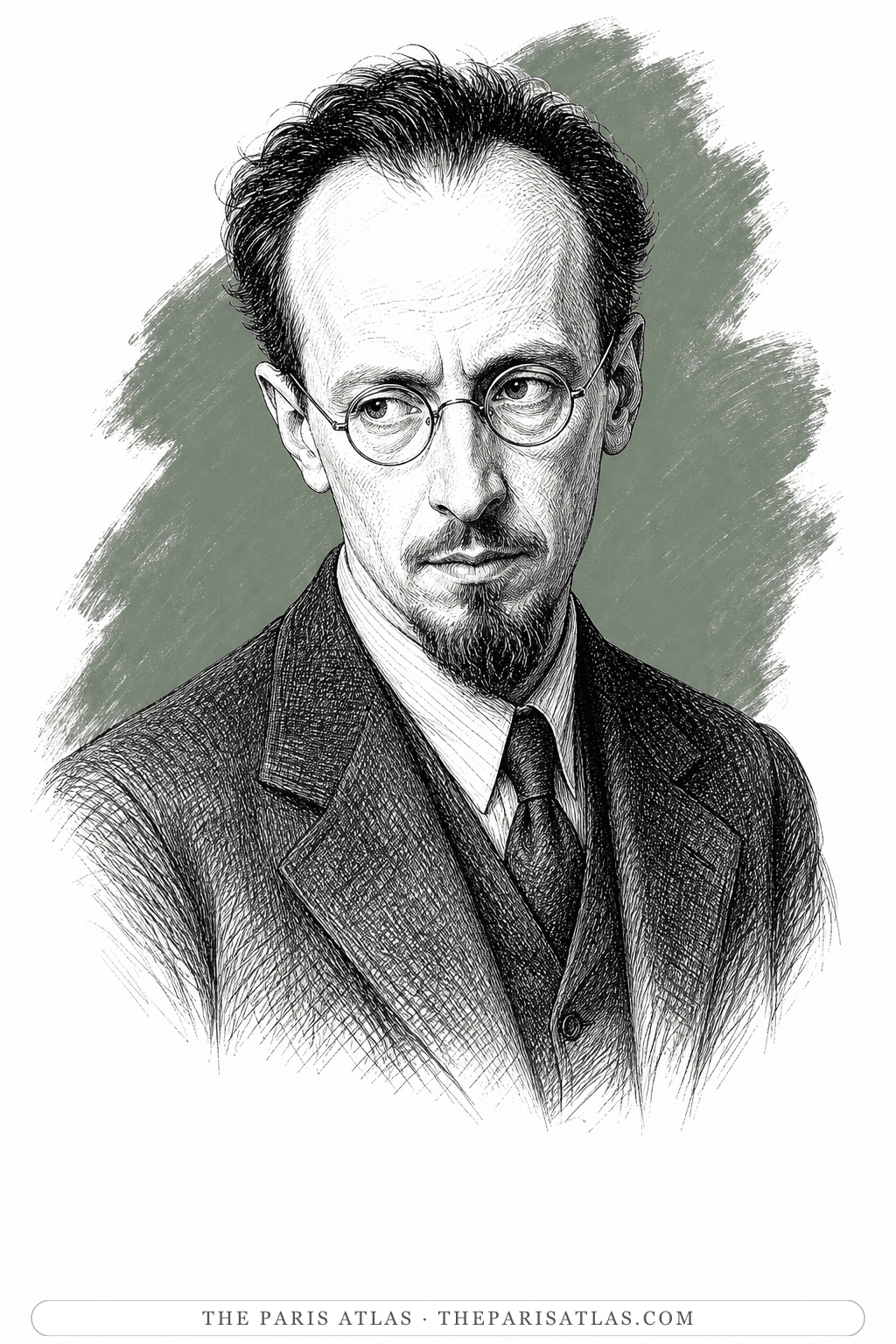
Michael Fraenkel
The other correspondent — writer, Carrefour publisher, and the original of Boris in Tropic of Cancer. His death-haunted philosophy is the position every Miller letter pushes against.
To get the argument out of talk and onto paper — he proposed the letters himself, and said from the start that he would pay to print them.
The book

At a glance
- One of the two correspondents — the man every letter here is addressed to
- Miller's only. This 1988 edition selects twenty of his twenty-two letters, all edited to some extent; none of Fraenkel's own letters appear.
- November 1935 to October 1938, with few exceptions in Paris
- The terrace of the Cafe Zeyer, Place d'Orleans, Paris
- The ground floor of 18 Villa Seurat, with Miller upstairs
- Werther's Younger Brother, written under the influence of Goethe's The Sorrows of Young Werther, and Bastard Death, for which Miller wrote the preface
- Fraenkel himself, at his own expense, under his Carrefour imprint, in editions of 500 copies
- Michael Fraenkel · 1896–1957 · Lithuania, by way of New York
Who they are in the book
Spoiler-freeMichael Fraenkel was an American writer and publisher who lived in Paris between the wars. He is one of the two men whose letters make up this book. From November 1935 to October 1938 he and the American novelist Henry Miller wrote each other long letters on an agreed subject, Shakespeare's play Hamlet, and Fraenkel's own small press printed the result in two volumes, in 1939 and 1941. The letters leave the subject almost immediately and spend most of their length on death, art, money, and the state of the world.
Most readers will only ever see half of that exchange. The edition in print is Henry Miller's Hamlet Letters, published by Capra Press in 1988 and edited by Michael Hargraves, and it contains twenty letters by Miller and none by Fraenkel. Hargraves gives his reasons in the introduction: the complete correspondence was too long for any publisher to take, and Fraenkel was too obscure a writer to carry it. He hoped this selection would do well enough to justify a companion volume of Fraenkel's letters. That volume has never appeared.
Fraenkel is visible in this edition only through Miller's descriptions of him and Miller's arguments with him. He never answers back on the page. Miller is affectionate about him in some letters and savage in others, and a reader has only his word for any of it.
The fullest description of the man comes from a short preface by Miller that Hargraves first published in 1981, the year after Miller died. In it Miller remembers meeting Fraenkel in Paris in the early 1930s, when Miller was broke and unpublished and Fraenkel was not.
Anyone who has read Miller's first novel, Tropic of Cancer, has met Fraenkel already without being told. Hargraves makes the identification plainly in his introduction: Fraenkel was the model for Boris, the friend who does most of the talking in the novel's opening pages and keeps announcing that the weather will stay bad. Miller aims the same joke at him repeatedly in these letters.
How Michael Fraenkel Is Portrayed
- He let a broke Henry Miller sleep on his floorMiller's preface remembers being down and out in Paris in the early 1930s while Fraenkel was comfortable. Fraenkel had recently come back from the Philippines, where he had sold a quantity of books that the American publisher Doubleday had remaindered, and he was playing the stock market and doing well at it. He was already living at 18 Villa Seurat. There was no spare bed or couch, so Miller slept on the floor for a few nights: 'I was damn glad to have a roof over my head.'
- The neighbour on the ground floorBy the time Tropic of Cancer was published in 1934, Miller had a place of his own at 18 Villa Seurat and found Fraenkel occupying the ground floor of the same building. Miller assumed Fraenkel owned it, then corrects himself in the same paragraph: before he left for Greece the building belonged to a Madame Guisbourg.
- He came upstairs for breakfast and stayed until midnightOnce Miller had moved in, Fraenkel visited daily. He would arrive in time for breakfast, stay through lunch and dinner, and go back down to his own flat around midnight, and the two of them talked the whole time. Miller writes that he seemed to get nothing out of these days, was fascinated by them anyway, and ended each one exhausted.
- Miller called his mind rabbinical, and said he could not speak plainlyThe preface gives the sharpest portrait of him in the book. 'He had what you could call a "rabbinical" mind, which meant sharp as a razor blade.' Miller adds that it never wore out from use, that two people could hardly be more unalike than the two of them, and that 'Talk was his meat.' Underneath the compliment is the complaint Miller then spends three years repeating: 'He simply could not utter a plain, declarative sentence.'
- Miller and Alfred Perlès took banknotes from his walletAlfred Perlès was an Austrian writer and one of Miller's closest friends in Paris. Miller writes that Perlès never took part in the talks except when the two of them were desperate for cash. Then they would call on Fraenkel in his apartment downstairs, engage him in a heated argument about any old thing, and help themselves to some of the banknotes in his wallet while he argued.
- He suggested they stop talking and write letters insteadThe book exists because of a remark Fraenkel made in a cafe. After a few months of daily talk, sitting on the terrace of the Cafe Zeyer on the Place d'Orleans in Paris, he proposed that he and Miller write to each other rather than keep talking. The correspondence that followed ran from November 1935 to October 1938 and, with few exceptions, was written in Paris.
- He owned the press, and paid to print the book himselfMiller says Fraenkel made it clear from the start that he would publish the book at his own expense, with royalties split between them. Miller was surprised to discover that Fraenkel owned a small press somewhere in Belgium, which he believed Fraenkel had originally set up with the poet Walter Lowenfels. Volume One appeared in June 1939 in an edition of 500 copies, printed in Belgium and missing about a hundred pages of letters; Volume Two followed from Mexico in 1941, also in 500 copies.
- The argument between them was about deathFraenkel's position, which every Miller letter pushes against, was that the modern world was already spiritually dead. He had published a book on it, Bastard Death, for which Miller wrote the preface, and Miller's letters keep returning to that book. Late in the correspondence Miller states the disagreement flatly: 'I saw it in you, because you had raised Death to pre-eminence. You had introduced Death with a capital D.'
- Miller told him his idea of death was too abstractIn one letter Miller turns Fraenkel's own subject back on him as practical advice. 'I want you to have a clean death, in the flesh, not these anonymous deaths which you enter presumably in microbe fashion.' What follows is blunter: 'No more death in a room. Make it an outdoor death.'
- Miller called him a weathercock stuck on bad weatherThe image runs across several letters. 'You are a fancy weathercock, but the weather is always bad.' Miller extends it later: 'You're an imperishable weathercock, variable and true as the weather itself, variable and true as God Almighty, variable and true as the tides.' And in the middle of a fine spring day he asks the question that could serve as a description of Boris in Tropic of Cancer: 'Listen, are you up in your attic praying for rain?'
- Miller said he explained everything and revealed nothingThe complaint Miller makes most often is that Fraenkel buries himself in terminology. Hundreds of pages in, Miller still does not know who a woman Fraenkel keeps referring to actually was: 'We don't know yet who Mathilda was, or why. You tell us everything — and nothing.' His advice is to drop the apparatus: 'Some day you will find it in your own interest to just be Michael Fraenkel and take the full consequences for being such.'
- Miller told him he could look ridiculous, and kept writing to himAfter describing a Yiddish film about an over-serious religious student, Miller applies the comparison directly. 'Often, when you are at your best, your "noblest," I have sensed something ridiculous about your attitude.' He says he has no wish to make fun of him personally. Elsewhere he calls Fraenkel pestiferous and cantankerous, in the same breath as the English novelist D. H. Lawrence, and then explains why he does not walk away: 'It's precisely because I see you whole that I don't run out on you.'
Neither man concedes. Hargraves's introduction quotes the one line of Fraenkel's that reaches this edition: in his last letter Fraenkel tells Miller that 'you have broken all the rules of the game.' Hargraves agrees with the charge, and thinks breaking the rules is exactly why Miller's half comes off the better of the two.
The friendship did not survive the book. Hargraves writes that Miller had little to do with Fraenkel after 1938, and attributes that mainly to Fraenkel refusing to let their joint venture be reprinted. Miller did write a short tribute to him for the Gotham Book Mart catalogue 'We Moderns' in 1940. Years later he told Hargraves he thought the book as a whole was a white elephant and a joke, while still feeling that his own letters contained some of his clearest and most substantial thinking.
The quarrel outlived Fraenkel. He died in 1957, and his widow Daphne inherited the rights and brought out a British edition, for which Miller received neither a copy of the book nor a penny in royalties. He said so to Hargraves in writing. 'My feeling about Daphne hasn't changed over the years. I always regarded her as a rather astute horse's ass.' And in another letter: 'She cheated me out of royalties on that handsome British edition. More, she treated me in her blurbs as if I were the fifth wheel on a wagon.' Daphne eventually sold the copyright to Hargraves, which is how this American edition came to exist at all.
If you like Hamlet


If you like Henry Miller
Explore authors with a similar voice, perspective, and influence.

Louis-Ferdinand Céline
Miller's acknowledged master at making literature out of the gutter. Journey gave him permission; Cancer is what he did with it.
View author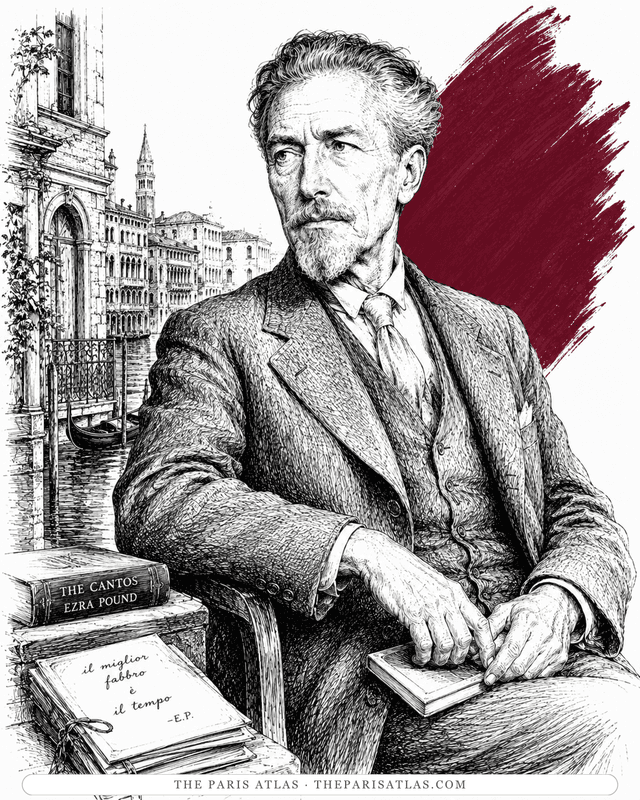
Ezra Pound
Pound read Cancer and sent Miller a famously backhanded postcard. Both believed literature's job was to wake the reader by any means necessary.
View author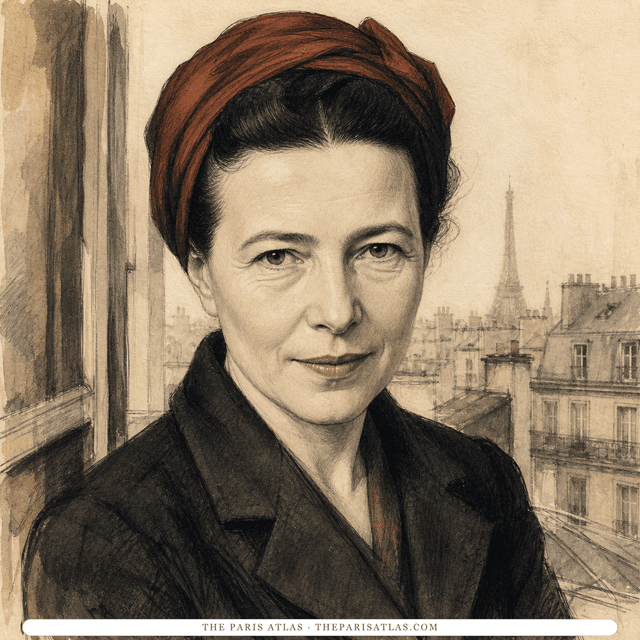
Simone de Beauvoir
French writer and philosopher whose novels, memoirs, and social analysis examined freedom, gender, responsibility, aging, and the material conditions that shape a life.
View author