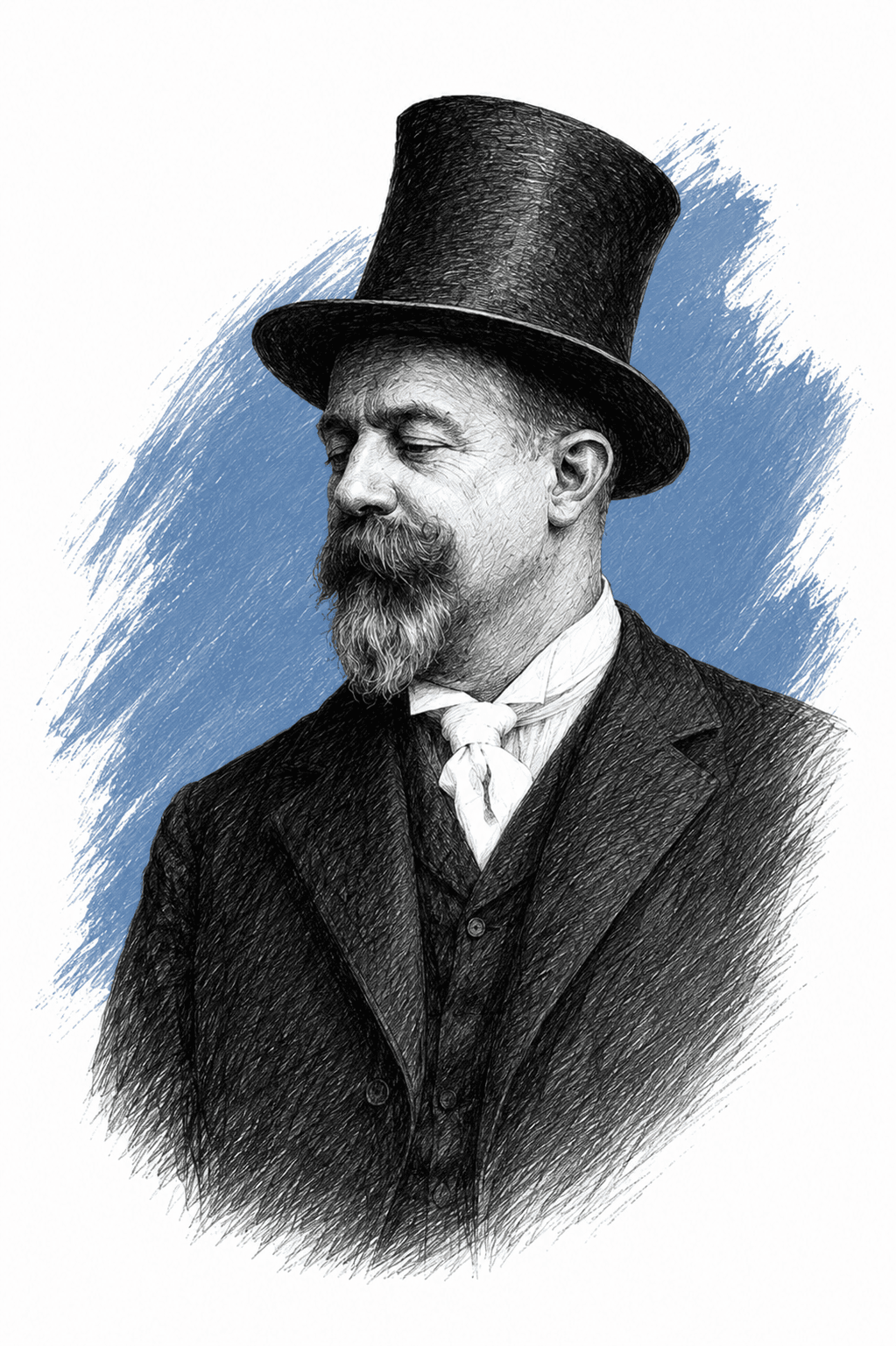
Willy
Henry Gauthier-Villars, Colette's first husband — writer, impresario, and the name under which the Claudine novels appeared, who kept her writing and kept the credit.
Money coming in, and his own name on whatever brought it. The sentence she says he repeated for thirteen years was that there was nothing left in the house, and the letters of his that survive are mostly columns of figures.
The book

At a glance
- Colette's first husband and the subject of the memoir; she calls him Monsieur Willy throughout, as her mother did
- Henry Gauthier-Villars. Willy was the byline, and the name the books were sold under
- Music criticism, publicity, and the signing of other people's novels. His concert column in the newspaper L'Écho de Paris was itself written by hired hands, among them the composers Claude Debussy and Vincent d'Indy
- Fifteen years older, by Colette's reckoning in the book. She was twenty at the wedding in 1893
- The four Claudine novels, Minne and Minne's Misadventures. She refused him The Sentimental Retreat
- A bachelor flat on the quays, then rue Jacob, then two apartments on the rue de Courcelles as the Claudine money came in
- Henry Gauthier-Villars, who published as Willy · 1859–1931
Who they are in the book
Spoiler-freeWilly was the pen name of Henry Gauthier-Villars (1859–1931), a Paris music critic and literary businessman. He married Colette in 1893, when she was twenty and he was in his mid-thirties. He did not write the books that carried his name. He thought of them, commissioned them, edited them, signed them and kept the money, paying a rotating staff of young writers to produce the pages. Colette was one of that staff and the most profitable member of it: she wrote the four Claudine novels, a bestselling series about a Burgundy schoolgirl, published between 1900 and 1903 as the work of Willy.
My Apprenticeships is her account of him. It came out in 1936, five years after he died, thirty years after the marriage ended, and long after she had become one of the most admired writers in France. She is clear about what that distance does to the telling. What she feels now, she writes, is a cold pity and a laugh with no kindness in it, aimed at her younger self as much as at him.
The book gives real evidence for much of what it says. It quotes his letters, the instructions he sent to the men writing his novels, and the remarks he wrote in the margins of her manuscripts. It also gives judgement, and Colette does not disguise the difference between the two. That he took the credit and the money is documented on the page. Her explanation for why is only her theory: she believed he was physically unable to sit down in front of a blank sheet of paper, for reasons she never identified.
How Willy Is Portrayed
- What he looked likeColette describes a man built out of curves: a big bald head that caught the lamplight, eyes set level with the brow, a short nose, low cheeks, and a small neat mouth under heavy blond-grey moustaches he dyed for years. He grew a beard to cover a chin he thought too small. People said he resembled Edward VII; she writes that the closer likeness was Queen Victoria.
- The sentence she heard for thirteen yearsHis standing line to everyone who wrote for him was 'Vite, mon petit, vite, il n’y a plus un sou dans la maison !' — quick, my dear, quick, there is not a penny left in the house. She says it was the daily refrain of the whole marriage, varied endlessly but never dropped, and that it started the secretaries running to the post office.
- The heap of gold on the deskOne evening he turned out his pockets onto the desk and left a pile of gold coins there. He told her to take as much as her closed hands could hold and count it afterwards. She counted eight hundred and twenty francs. He then said he assumed she would not be asking him for housekeeping money for two months.
- He asks her to write down her schooldaysAbout a year into the marriage he told her she should put some memories of her village school on paper, not to be shy of the spicy details, and that he might be able to get something out of it. Money was short, he said. She bought school exercise books from a stationer and filled them. He read them and told her he had been wrong, they were no use to anyone.
- The day he found the notebooks againYears later, tidying out his desk, he came across them and said he thought he had thrown them away. He opened one and said it was nice. He opened a second, a third and a fourth, said nothing, then swore at himself, grabbed the lot, grabbed his hat and went straight to a publisher. That manuscript became Claudine at School.
- His instructions for the rewriteHe sent her back to the manuscript with directions: warm it up a little, put a too-tender friendship between Claudine and one of her schoolfriends, add dialect, add schoolgirl mischief. Colette says she understood him perfectly, and did it.
- How he described her in publicOnce the books were selling he made a habit of calling her over to hear people praising him, laying a hand on her head and saying that the child had been precious to him, that she had told him charming things about her village school. She was bound to silence and said nothing.
- Pictures of himself, everywhereShe lists the publicity he generated for himself: caricatures by half the illustrators in Paris, a portrait by Giovanni Boldini, statuettes, models in cardboard and rubber, cut-out wooden silhouettes, an inkwell made from an upturned top hat, and a marble cross carrying a life-size sculpture of his own severed head with rays coming off it. Postcards of these went out by the thousand. His writing paper was stamped with his moustached head in six sizes. He took to calling himself the father of Claudine.
- How his novels were madeShe sets out the production line. An idea went to one writer with a note asking him to sketch fifty pages, came back typed, went out again under a fresh cover to a second writer with a brief for the setting, then to a third with a letter about migraines and sleepless nights and an appeal to his lightness of touch. Sometimes it went round the circuit twice. Willy's own view of authorship, she notes, was that ten pages of frantic letters were preferable to writing a fifteen-line column himself.
- The notes he wrote in her marginsHis praise for her work was thin and automatic. His criticism was not. The notes he left down the margins of her manuscripts were short and exact — not clear, too early, if they had agreed it between them then say so. When she handed in pages she thought were poetic he threw them back across the table and said he had not known he was marrying the last of the lyric poets. She calls the remark harsh, probably fair, and useful to her.
- The key in the lockShe says plainly that he shut her in a room to make her work and let her out four hours later, and that what bought her release was blackened pages. She does not enjoy telling it and says so. It is also, in her account, where she learned the patience that later got her out.
- Dressed as twins with the actress PolaireAfter she cut her hair short, at his suggestion, he noticed that she now resembled Polaire, the actress playing Claudine on stage. He had three identical outfits made for the two women and took them out dressed alike, telling them to wear the white dresses because he would look as if he were walking his two children. When Polaire began avoiding the evenings, he recruited a drama student as a stand-in twin.
The break comes in a flat, administrative voice, and Colette says she recognised it at once. He suggested she might enjoy acting on a real stage, that a series of engagements could be arranged, that Brussels was interested in that sort of thing. Then he suggested getting rid of the apartment and finding an arrangement better suited to a slightly different way of living. Nothing urgent, he said.
She understood that she was being given notice. What galled her, she writes, was that she had spent years imagining her own escape and was now being put out of the door by someone else, quietly, with no scene at all. She moved to a small ground-floor flat on the rue de Villejust with a trunk, a few pieces of furniture, the dog and the cat.
The letters followed her there, pushed under the door most days. She quotes them: a line about resentment being the burning reverse of his gratitude, a complaint about her withholding a manuscript, and the sentence that they had been business partners and should not become enemies. None of them, she notes, ever asked her to come back. Colette and Willy separated in 1906 and divorced in 1910; he died in 1931.
If you like My Apprenticeships


If you like Colette
Explore authors with a similar voice, perspective, and influence.

Henry Miller
The Brooklyn dropout who arrived in Paris broke at thirty-eight and wrote the exuberant, banned books that ended American censorship.
View author
Louis-Ferdinand Céline
The doctor of the Paris slums who wrote the century's blackest, funniest novel — and changed the sound of French prose.
View author
Martha Gellhorn
War correspondent who covered the Spanish Civil War, D-Day, and conflicts across five more decades; Hemingway's third wife, 1940–1945.
View author