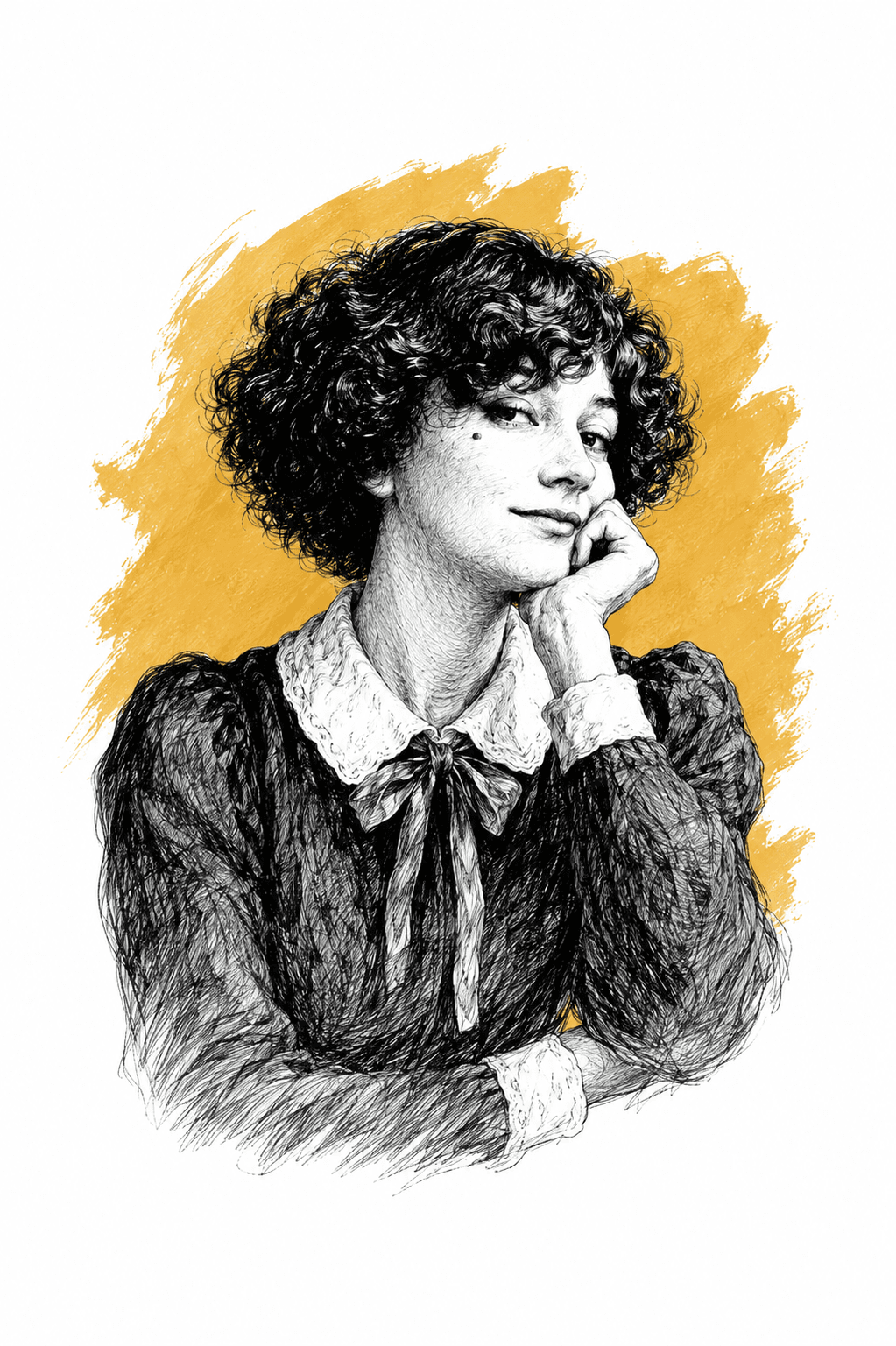
The young Colette
The provincial girl absorbed into Willy's Paris literary machine — learning her craft and, slowly, the shape of her own captivity.
To keep her mother from finding out what the marriage was really like. She says she did her best for thirteen years to make Sido believe she was happy, and that the present she gave her most often was a lie: 'Je lui faisais présent surtout d’un mensonge : l’imitation du bonheur.' — the imitation of happiness.
The book

At a glance
- The author between the ages of twenty and thirty-three, remembered by herself in her sixties
- Born Sidonie-Gabrielle Colette. Her husband's family called her Gabrielle; her published name in these years was Colette Willy
- Rue Jacob, then two apartments on the rue de Courcelles, with summers at Monts-Boucons in Franche-Comté
- Her mother Sido at Châtillon-Coligny, her father, and her elder brother Achille, a country doctor she rode out with on his rounds
- Claudine at School, Claudine in Paris, Claudine Married and Claudine and Annie, all signed Willy; Minne and Minne's Misadventures; then Animal Dialogues and The Sentimental Retreat under her own name
- The scholar Marcel Schwob, the civil servant and practical joker Paul Masson, the writer Jean Lorrain, the actress Polaire, and the writer Marcel Boulestin
- Colette · 1873–1954 · Saint-Sauveur-en-Puisaye, Burgundy
Who they are in the book
Spoiler-freeThe young Colette is the author herself, thirty-odd years earlier. She was born Sidonie-Gabrielle Colette in 1873, in a village in Burgundy, and she married the Paris writer Willy in 1893 at twenty. The book covers the thirteen years that followed. In them she wrote the four Claudine novels, which sold in enormous numbers under her husband's name, and was eventually given a monthly allowance for the work.
She writes about that girl in the third person as often as the first, and she is not kind to her. She grants her courage, a good deal of physical toughness and a real talent for waiting. She also says the marriage began in what she calls a guilty intoxication, and that plenty of barely grown girls dream of being an older man's toy and his libertine masterpiece. That admission is the ground the rest of the book stands on: she is describing something done to her that she partly walked into.
The other person in the room throughout is her mother, whom Colette calls Sido from first page to last. For thirteen years the young Colette wrote to her two or three times a week and lied. Keeping her mother from finding out is the strongest motive the book gives her, stronger than love, money or ambition, and it is also the main reason she gives for not leaving sooner.
How The young Colette Is Portrayed
- A village girl at twentyShe came from Saint-Sauveur-en-Puisaye, a village in Burgundy, to a bachelor flat on the Paris quays furnished in bottle green and chocolate brown, with filing boxes for furniture and German postcards lying about. She writes that swapping a country girl's life for that one was enough to break a twenty-year-old if it did not go to her head, and that at first it went to her head.
- Winter without a coatIn the winter of 1894 or 1895 her mother came up to Paris and noticed that her daughter had no coat. Sido said nothing, looked hard at her son-in-law, took Colette to the Magasins du Louvre department store and bought her a black one for a hundred and twenty-five francs. Colette thought it luxurious. Breakfast in those years was a croissant dipped in cheap chocolate at a dairy shop across the river, taken standing among the packers from a nearby department store.
- Her hairShe wore two plaits as long as she was tall. In cold weather she unbraided them and warmed herself underneath; at night, when the ends caught between her toes, she dreamed about snakes. Years later she cut them off at Willy's suggestion and enjoyed it. Sido's letter about it was severe: 'Tes cheveux ne t’appartenaient pas, ils étaient mon œuvre, l’œuvre de vingt ans de soins.' Your hair was not yours, her mother wrote — it was mine, twenty years of my work, and you gave away something I had left in your keeping.
- The afternoon she went to the other woman's flatAn anonymous note sent her across Paris to an address where she found her husband with Charlotte Kinceler, the woman he was involved with. They were not in bed; they were bent over an account book, and he was holding the pencil. Kinceler, who was under five feet tall, had a pair of scissors in her hand and was waiting for an excuse to use them. Colette did not shout. She made a polite remark and let herself be steered out, and was pleased afterwards that she had not trembled. What she regretted was not having heard the other woman speak.
- Two months in bedAt twenty-one she nearly died of an illness the book never names. Her doctor wrote to Sido that he probably could not save her, and Sido came and slept in the dining room. A copper bath was carried up the stairs once a week and filled by hand. Marcel Schwob, the scholar and translator, climbed the three flights two or three times a day to read aloud to her: Dickens, Mark Twain, Jerome K. Jerome, and Daniel Defoe's Moll Flanders, which he had not yet translated. She says she took it as her due, the way you do at twenty.
- How she actually wroteFor the first Claudine book she went to a stationer and bought exercise books like the ones she had used at school, with black cloth spines and a red margin rule. Handling them, she says, gave her the old itch to do homework. She wrote at the corner of a desk with the window behind her, shoulder twisted and knees askew, carefully and without interest, and handed in a tightly written text that respected the margins.
- Lying to her motherVisits home meant an evening she had to survive. Sido would sit by the bed, ask for news, and watch her with what Colette calls a frightening shrewdness, and Colette would tell a hundred stories about a Paris she barely knew. The danger was the goodnight. If her mother tucked her in, put her thin soft hair against her cheek and called her my shining sun, it was all over — so she lay rigid and produced a sleepy grunt until Sido said it was eleven o'clock and left with the cat and the lamp.
- Three hundred francs a monthOnce the books were selling she was given an allowance of three hundred francs a month, with the summer months deducted, separate from the money the books earned. She was dazzled by it. She spent it on presents her mother chose herself: bars of pure cocoa from Hédiard, a padded bed jacket, fine wool stockings, books.
- The room she worked inBy the third apartment he had set her up properly, having worked out what she was worth. A good table, a lamp with a green shade, sheets of ruled and laid paper, Flament nibs, scented glue and a pair of long Strasbourg scissors shaped like a stork. She calls the room, with its dull green walls, her little parlour-cell, and says that having failed to love her life she loved its furniture.
- The summers in Franche-ComtéFor three or four years she spent June to November alone at Monts-Boucons, a small estate in eastern France that Willy appeared to give her and then took back. She was outdoors by six or seven. She had a bulldog, an angora cat and a stray, and she bought a beaten, half-starved horse covered in sores, nursed it and rode it astride in checked cycling breeches, taking a week of lessons at the army riding school at Saint-Claude first. There she wrote The Sentimental Retreat and the first version of Minne, and she says the point of those summers was that she was learning to live. You can learn to live, she adds, if you do it without happiness.
- The gymnasium in the atticAbove the rue de Courcelles flat there was a studio, and the only things she put in it were rings, a bar, a trapeze and a knotted rope. She hung, turned, stretched, nearly in secret and with no particular skill. Looking back she compares it to prisoners who cut up a sheet and plait it, or sew coins into a lining, without exactly admitting to themselves that they are planning to get out.
- What she thinks of the Claudine booksShe judges them harshly. They play the child and the madcap without restraint, she says, and the youth in them shows mainly as a lack of craft. What she dislikes most is her own compliance: the readiness to deliver whatever was asked, the neat dodges around effort, and a carelessness about hurting real people who were recognisable in the caricatures.
- Signing the books awayWilly sold the Claudine novels outright to two publishers, and she put her signature under his on both contracts. She calls it the most inexcusable thing fear ever got out of her, and says she has never forgiven herself for it. She learned only by hearsay, afterwards, that the series went on selling through hundreds of printings.
- Why she stayedShe owned nothing in her own name and would not go back to her mother and admit the marriage had failed. She also records the phrase used on her, delivered with a shrug: after all, you are perfectly free. And she is honest about the mechanism. Open the cage door, she writes, and the squirrel or the bird you expected to bolt very often backs away from it.
- The thirteen greyhoundsSomeone once offered her a ready-made music-hall act: thirteen trained Russian greyhounds, tour dates and contracts included, the woman who owned and trained them dying in hospital. It would suit her, he said. She shrugged and refused to so much as look at the dogs. She was still regretting it thirty years later, and says that when you let thirteen greyhounds go past you do not get another thirteen.
The marriage does not end with her walking out. She is dismissed, in a level, businesslike voice, and she says the humiliation of that is what she remembers most clearly. He proposed that she might like to act on a real stage, that engagements could be arranged, that Brussels was interested in that sort of performer, and that the apartment could be given up in favour of an arrangement better suited to a slightly different way of living. Nothing urgent, he said.
She heard it for what it was. Having spent years imagining an escape — the train, the farewell letter, the scarf taken by the wind — she found she had no picture at all of what being thrown out would look like. She waited weeks longer, more shamefully, she writes, than in the whole preceding decade, then moved to a small ground-floor flat on the rue de Villejust with a trunk, a few pieces of furniture, the dog and the cat.
The book ends there, on the first hours of a new life and an old fear that had come with her. She jumped at the doorbell, which usually meant another letter pushed under the door, and she opened each one having sworn not to open the next. She was thirty-three. The Vagabond, her novel about the music-hall years that followed, was four years away, and so was the divorce.
If you like My Apprenticeships


If you like Colette
Explore authors with a similar voice, perspective, and influence.

Henry Miller
The Brooklyn dropout who arrived in Paris broke at thirty-eight and wrote the exuberant, banned books that ended American censorship.
View author
Louis-Ferdinand Céline
The doctor of the Paris slums who wrote the century's blackest, funniest novel — and changed the sound of French prose.
View author
Martha Gellhorn
War correspondent who covered the Spanish Civil War, D-Day, and conflicts across five more decades; Hemingway's third wife, 1940–1945.
View author