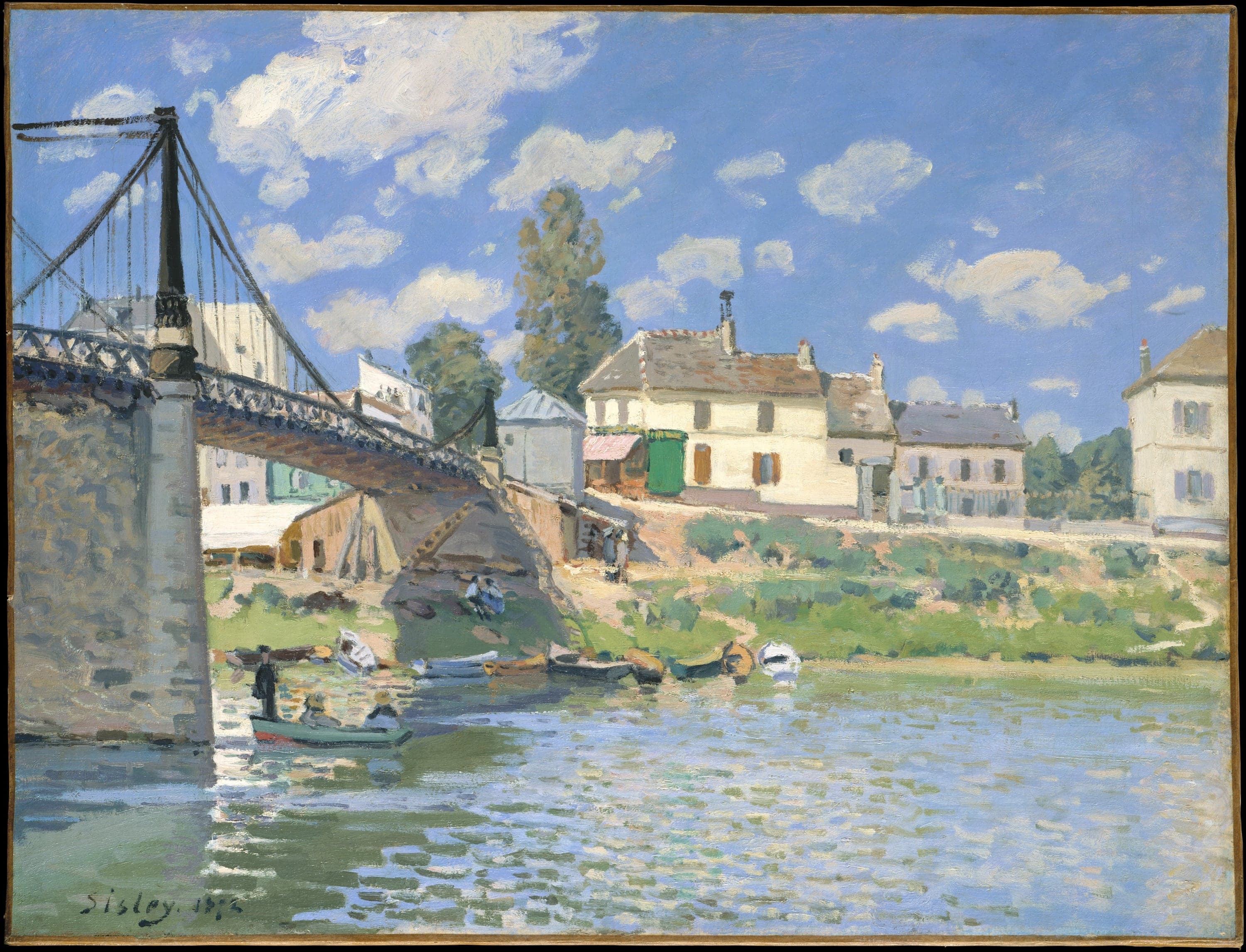
The Bridge at Villeneuve-la-Garenne
A suspension bridge crosses the Seine at Villeneuve-la-Garenne, a village downstream of Paris, with a rowing boat passing beneath it and the village houses along the far bank. Alfred Sisley painted it in 1872, two years before the first Impressionist exhibition opened. The Metropolitan Museum of Art has held it since 1964.
- 1872
- Oil on canvas
- The Metropolitan Museum of ArtNew York, United States
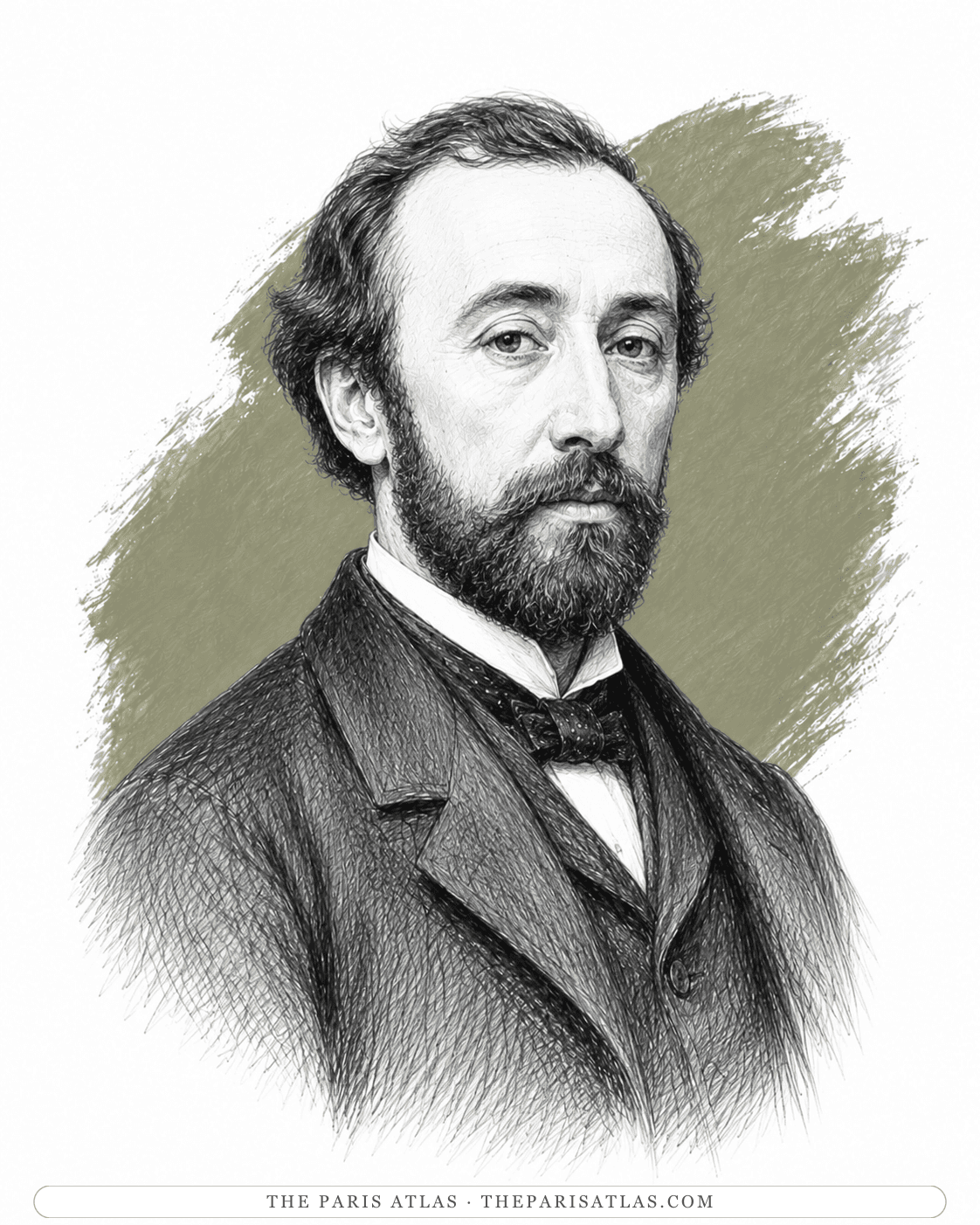
About Alfred Sisley
What the painting shows
A suspension bridge enters at the left edge and runs out toward the middle of the canvas. Its dark iron pylon stands on a stone pier that rises straight out of the river, and the cables drop from the top of the pylon to the deck. Below the span the bank is pale and sandy, with a low shed under the bridge and two small figures sitting on the grass beside it.
A green rowing boat crosses the foreground. A man in dark clothes stands at its left end, and two passengers sit to his right, each under a straw hat. Along the bank a line of moored boats runs to the right past the center of the canvas, ending in a small white hull drawn up against the grass beside an ochre-lined one.
The far bank is the village. Cream and white houses stand behind a green slope, under roofs of grey-brown tile and grey slate. A tall green painted door near the middle of the row is the strongest color on that side of the river. Water fills the bottom quarter of the canvas in short horizontal dashes of olive green and cream over pale blue. Two more figures in pale dress stand on the sandy slope below the houses, beside a masonry wall. Sisley signed and dated the picture in dark paint at the lower left.
The village and its bridge
Villeneuve-la-Garenne sits on the Seine north of Paris. The cast-iron suspension bridge in the painting was built on stone abutments in 1844, linking what was then a fishing village and small river port to Saint-Denis. The Metropolitan Museum of Art records that Sisley set up his easel on the island of Saint-Denis, where the river passes under the bridge.
None of it survives. The museum's account of the site is blunt: Villeneuve-la-Garenne has been completely taken over by urban development, and almost nothing from the 1800s remains. The painting is the record of the place rather than a guide to it.
The bridge is not treated as scenery. Sisley gives it the sharpest edges in the picture and lets it cut across the sky, while the clouds behind it stay loose and the water below is barely drawn at all. Bridges recur throughout his work for this reason: a span gives a landscape a horizontal to measure everything else against.
Sold twice within a year
The dealer Paul Durand-Ruel bought the painting directly from Sisley on 24 August 1872 for 200 francs, and sold it on 15 April 1873 for 360 francs. The buyer was Jean-Baptiste Faure, an operatic baritone who became one of the most important early collectors of Impressionist painting. Faure kept it until his death in 1914.
Those two numbers are worth stating plainly, because they are what a working Impressionist landscape was actually worth in 1872. When the picture came up at auction in Paris in March 1920 it sold for 37,200 francs.
Where Sisley was in 1872
Alfred Sisley was thirty-two when he painted this. He had been born in Paris in 1839 to British parents, kept British citizenship all his life, and had met Claude Monet, Pierre-Auguste Renoir and Frédéric Bazille in Charles Gleyre's studio in 1862. The Franco-Prussian War of 1870 had ended his family's money, and from then on he painted for a living.
In 1872 the group had no name yet. The first of the independent exhibitions that gave them one opened in April 1874, in the former studio of the photographer Nadar on the boulevard des Capucines, and Sisley exhibited in it. By then he had settled on the subjects he kept for the next twenty-seven years: rivers, bridges, roads, weather and the villages along the Seine.
Where it is, and the other one
The Metropolitan Museum of Art in New York, accession number 64.287, number 37 in François Daulte's 1959 catalogue of Sisley's paintings. It came to the museum in 1964 as a gift from Mr. and Mrs. Henry Ittleson Jr. At the last check of the museum's record it was on view in Gallery 957.
A second painting of the same subject, with the same title and the same year, is at the Harvard Art Museums: oil on canvas, 51.8 by 61 centimetres, accession 1942.206, given by Grenville L. Winthrop. It is signed but not dated. Sisley worked at Villeneuve-la-Garenne repeatedly in the summer of 1872, and the Metropolitan Museum of Art counts three canvases painted on the spot that summer, one of them now in the State Hermitage Museum in St Petersburg.
The Met publishes the painting as an Open Access object, which means the museum's own photograph of it is released for reuse without restriction. Sisley died in 1899, so the painting itself has been out of copyright worldwide for over a century.
Close reading
Reading the work, detail by detail
Sisley builds the picture on one piece of engineering. The suspension bridge enters at the left, crosses toward the middle, and sets the height of everything else — the village roofs, the moored boats, the line of the far bank.
1.The iron pylon holds the picture open
The dark tower is painted almost as a silhouette against the sky, and the cables drop from its top in thin straight lines. Sisley gives the ironwork crisp edges while the clouds behind it stay loose, so the bridge reads as the hardest thing in the picture.
2.The pier meets the water without ceremony
The masonry is laid in short blocks of grey-blue, ochre and pale pink. Where the stone enters the river Sisley does not draw a line; the reflection starts in the same strokes as the pier, which is how the bridge ends up standing in the water rather than on it.
3.A rowing boat crosses under the span
A man in dark clothes stands at the boat's left end. Two passengers sit to his right, and each wears a straw hat, one pale cream and one a brighter yellow. The boat sits directly under the span, so the crossing on the water and the crossing overhead fall in the same part of the canvas.
4.The village is a row of roofs and one green door
The houses are blocked in as flat cream and white walls under roofs of grey-brown tile and grey slate. A tall green painted door near the center is the strongest color on the bank, and it stops the row of buildings from running together into one pale band.
5.Moored hulls mark the far bank
The moored boats are laid in as short horizontal bars of ochre, dark blue and white. They fix the waterline across the middle of the canvas. At the right end of the line a small white hull sits against the grass, hard beside a hull whose interior is lined with ochre.
6.The river is built from separate strokes
Close up, the water is a field of short horizontal dashes in olive green and cream, laid over a continuous ground of pale blue that leaves no canvas bare. At a normal viewing distance the same marks read as light moving on a current. Sisley keeps every dash separate rather than blending them into a tone.
Where to see it
The Metropolitan Museum of Art
1000 Fifth Avenue, New York, NY 10028, United States
Displays and loans can change. Check whether this work is on view before making a special trip.
Plan your visit on the museum’s official website (opens in a new tab)Frequently asked questions
Where is The Bridge at Villeneuve-la-Garenne?
The Metropolitan Museum of Art in New York, accession number 64.287. It was given to the museum in 1964 by Mr. and Mrs. Henry Ittleson Jr., and the museum's record last listed it in Gallery 957.
When did Alfred Sisley paint it?
In 1872, and he signed and dated it that year at the lower left. That is two years before the first Impressionist exhibition of April 1874, in which Sisley took part.
How big is the painting?
49.5 by 65.4 centimetres, or about 19 1/2 by 25 3/4 inches. It is a small canvas by the standards of nineteenth-century exhibition painting, which is typical of Sisley's work outdoors.
Where is Villeneuve-la-Garenne?
On the Seine a short way downstream of Paris, on the reach of the river running north-west out of the city. In Sisley's day it was a riverside village rather than part of the built-up area.
What is the bridge in the painting?
A suspension bridge, of the light iron kind built along that stretch of the Seine in the nineteenth century to connect the riverside communes. Sisley paints its pylon and cables with sharper edges than anything else in the picture.
Is there more than one Sisley called The Bridge at Villeneuve-la-Garenne?
Yes. The Harvard Art Museums hold a second canvas with the same title and the same year, 1872, measuring 51.8 by 61 centimetres, accession 1942.206. Sisley worked at Villeneuve-la-Garenne repeatedly that summer, and the Metropolitan Museum of Art counts three canvases painted on the spot, one of which is now in the State Hermitage Museum.
Was this painting in an Impressionist exhibition?
No. It was not shown in any of the eight Impressionist group exhibitions held between 1874 and 1886. Its first recorded exhibition was a Sisley show at the Galerie Georges Petit in Paris in 1917, and it later travelled with the 1992 to 1993 Sisley retrospective in London, Paris and Baltimore.
What did it sell for in Sisley's lifetime?
Paul Durand-Ruel bought it from the artist on 24 August 1872 for 200 francs and sold it in April 1873 for 360 francs to the singer Jean-Baptiste Faure. At auction in Paris in March 1920, twenty-one years after Sisley's death, it made 37,200 francs.
Can I reuse the image of this painting?
Yes. Alfred Sisley died in 1899, so the painting is in the public domain worldwide, and the Metropolitan Museum of Art publishes its photograph of the work as Open Access under a CC0 dedication.
More by Alfred Sisley
If you like Alfred Sisley
Explore painters from the same movements and circles.
Gustave Caillebotte
Painter of Haussmann's geometry and the group's organizer-financier; his bequest of Impressionist paintings forced the French state to take the movement in.
View artist
Mary Cassatt
Mary Cassatt was an American painter and printmaker known for her depictions of women and children. Based in France for the last fifty-two years of her life, she was the only American to exhibit with the original French Impressionist group, participating in four of its eight exhibitions. Edgar Degas invited her to exhibit with the group in 1877 after the Salon jury rejected her submissions.
View artist
Paul Cézanne
Painter between Impressionism and everything after — shown in the independents' exhibitions, emulated by the Cubists, and present at the Orangerie through 15 works in the Walter-Guillaume collection.
View artist
References
The sources below include collection records, catalogues, scholarly research, and primary materials that informed this page. They document The Bridge at Villeneuve-la-Garenne, its making, and its place in cultural history.


1The Bridge at Villeneuve-la-Garenne (Alfred Sisley, 1872) — The Metropolitan Museum of Art
WebsiteThe Metropolitan Museum of ArtUsed forWeb source consulted for documented facts and historical context presented on the The Bridge at Villeneuve-la-Garenne page.

2Alfred Sisley: catalogue raisonné de l'œuvre peint
NonfictionDurand-Ruel, Lausanne, 1959Used forPublished analysis and historical context used in preparing the The Bridge at Villeneuve-la-Garenne page.

3Alfred Sisley
Exhibition catalogueRoyal Academy of Arts, London, and Yale University Press, 1992Used forCatalogue scholarship used to verify attribution, provenance, chronology, and interpretive context for The Bridge at Villeneuve-la-Garenne.
4The Bridge at Villeneuve-La-Garenne (Alfred Sisley, 1872) — Harvard Art Museums
WebsiteHarvard Art MuseumsUsed forWeb source consulted for documented facts and historical context presented on the The Bridge at Villeneuve-la-Garenne page.
5Alfred Sisley 1839–1899
WebsiteTateUsed forWeb source consulted for documented facts and historical context presented on the The Bridge at Villeneuve-la-Garenne page.
61874: The Birth of Impressionism
WebsiteNational Gallery of Art, WashingtonUsed forWeb source consulted for documented facts and historical context presented on the The Bridge at Villeneuve-la-Garenne page.
7Impressionism: Art and Modernity — The Metropolitan Museum of Art
WebsiteThe Metropolitan Museum of ArtUsed forWeb source consulted for documented facts and historical context presented on the The Bridge at Villeneuve-la-Garenne page.
8Sisley
BiographyG. Crès et Cie, 1927Used forBiographical evidence used to verify chronology, relationships, and historical context connected to The Bridge at Villeneuve-la-Garenne.
These references provide the documented foundation for this work's history and interpretation. Claim-level citations remain attached to the specific claims they support.
 Explore more resources