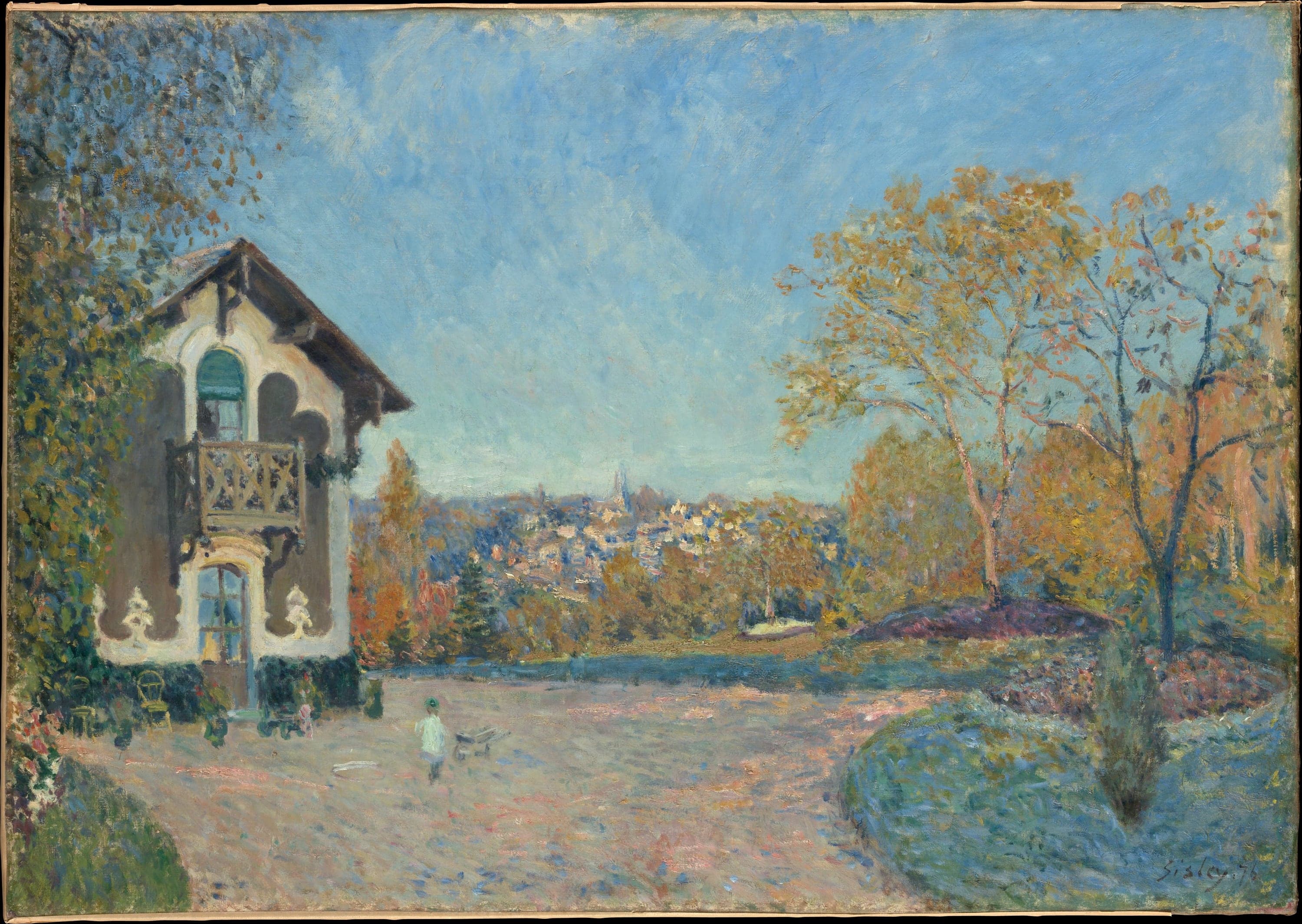
View of Marly-le-Roi from Coeur-Volant
A chalet-style house stands at the left of a wide stretch of open ground, with a group of slender trees in gold autumn foliage at the right and the village of Marly-le-Roi on the hillside beyond. Alfred Sisley painted it in 1876, during the years he lived in the villages west of Paris. It is at the Metropolitan Museum of Art.
- 1876
- Oil on canvas
- The Metropolitan Museum of ArtNew York, United States
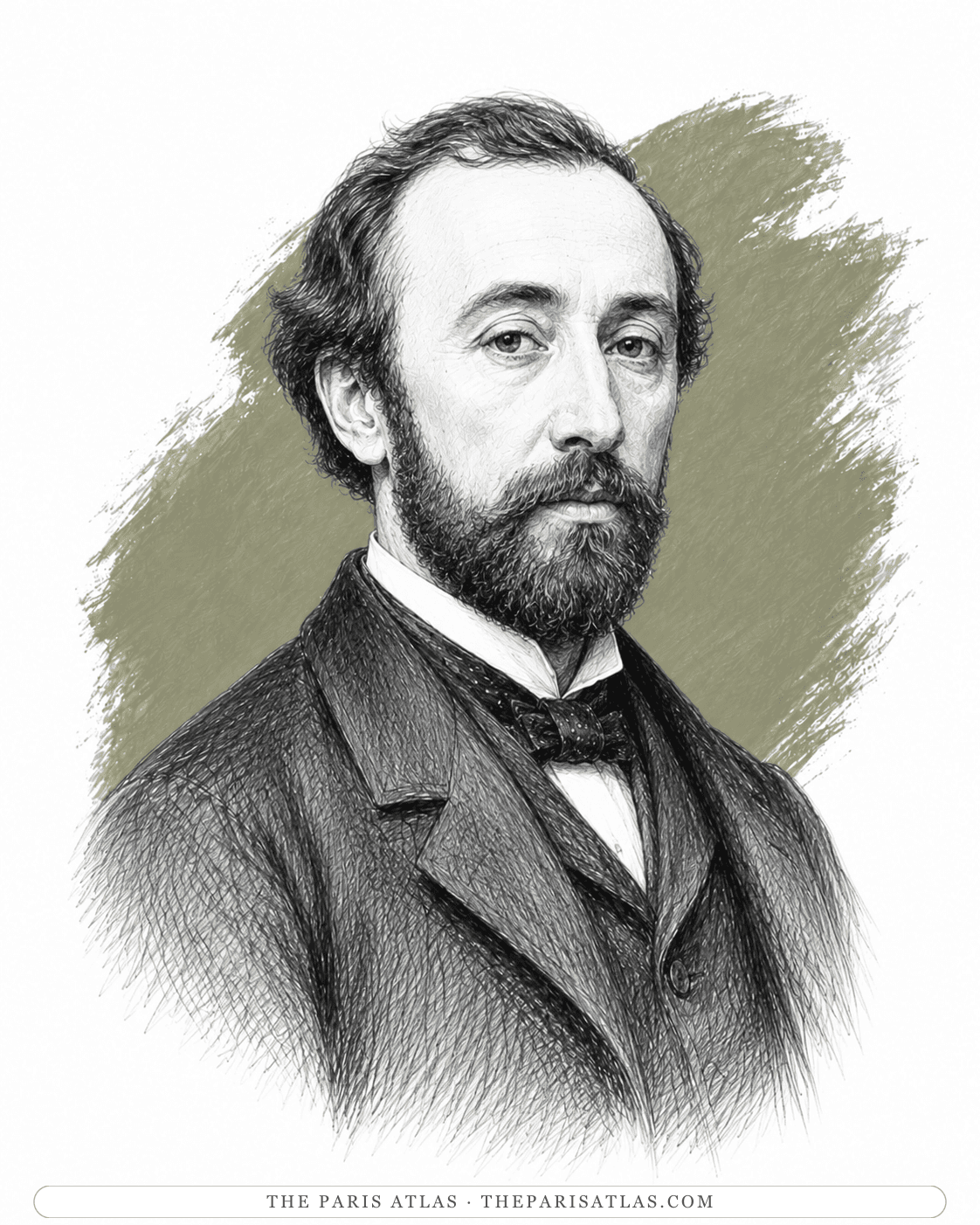
About Alfred Sisley
What the painting shows
The left of the canvas is taken up by a house with a steep gable and deep overhanging eaves, built in the Swiss chalet manner then fashionable in the countryside outside Paris. A wooden balcony with a criss-cross lattice railing runs across the gable front, above a tall arched glazed door. Dark ivy and flowering shrubs bank up against the base of the wall, and a yellow garden chair stands in their shade to the left of the door.
The right of the canvas is a group of slender trees in autumn color. At least four trunks rise through the foliage, pale pink and blue-grey, carrying orange and gold leaves with blue sky showing between them. Between the house and the trees lies a wide stretch of bare open ground. One small child in a bright green hat stands in the left half of that ground beside a little wheelbarrow, and no other figure can be made out with any confidence.
The village the title names is in the distance, on a hillside across the middle of the canvas: pale house fronts set among rust-colored trees, with a thin church spire rising behind them. Sisley signed and dated the picture at the lower right.
The bare ground is the subject
The bare ground runs from the foot of the house across the middle of the canvas, as far as the blue-green hedge in the lower right corner, and it fills the bottom quarter of the picture. It is not painted brown. Sisley builds it from short flecks of pink, lavender, blue and cream laid side by side, so that the surface changes color as it recedes without any drawn feature to mark the distance.
The technique was developed to record daylight on water and foliage, and here it is turned on packed earth in low autumn sun. The village the title names, which a conventional landscape would have made the centerpiece, is compressed into a narrow band near the horizon.
Marly-le-Roi, 1876
Marly-le-Roi lies west of Paris, near Louveciennes and Port-Marly, in the country along the Seine that Sisley painted for most of the 1870s. The town had grown up to serve the Château de Marly, the palace Louis XIV built there and which was demolished in 1806; its park and waterworks remained. Coeur-Volant, named in the title, is a hamlet near the entrance to the former royal grounds, on the hillside between Louveciennes and Marly.
Sisley and his family were living at Marly-le-Roi in 1876, when he was thirty-six. The Metropolitan Museum of Art records that the house and the garden in the picture are two separate properties, divided by a road. The garden belonged to an estate held by Robert Le Lubez, an amateur singer who was a patron of Charles-François Gounod and Camille Saint-Saëns.
The same year he painted the flood at Port-Marly, the group of canvases showing water standing in a village street that is usually counted among the movement's best work. He exhibited at the second Impressionist exhibition that spring, and again in 1877.
He also never changed direction. Claude Monet took up figures and then the long serial subjects, and Pierre-Auguste Renoir moved toward portraits and the nude. Sisley painted landscape, and only landscape, from the 1860s until his death in 1899.
Probably the third Impressionist exhibition
The Metropolitan Museum of Art identifies this canvas as a painting shown at the third Impressionist exhibition in April 1877, at 6 rue Le Peletier. It hung there as Le Chalet; gelée blanche, meaning the chalet under hoarfrost, lent by a Monsieur H. The museum's own exhibition list qualifies the entry as possibly this picture. Its provenance likewise opens with a hedge: possibly Ernest Hoschedé, whose Impressionist collection was sold at the Hôtel Drouot in June 1878.
The hedge is worth keeping. A painting sold in 1878 as Chalet dans un parc matches the description, and Hoschedé is a documented lender to the 1877 show, but no record ties this canvas to that loan outright.
The picture has carried at least five titles since. It was View at Louvecennes in Saint Louis in 1895, Vue de Louveciennes through the 1920s, and La Maison de l'Artiste à Louveciennes in New York in 1958 — a title that wrongly made it Sisley's own house.
Where it is
The Metropolitan Museum of Art in New York, accession number 67.187.103. It entered the collection in 1967 through the bequest of Adelaide Milton de Groot, a New York collector who left the museum a large group of nineteenth- and twentieth-century paintings. At the last check of the museum's record it was on view in Gallery 824.
The Met publishes the painting as an Open Access object, so the museum's own photograph of it may be reused without restriction.
Close reading
Reading the work, detail by detail
The painting is made of two halves that barely touch: a house at the left, a stand of slender trees at the right, and a wide empty ground between them. Sisley paints late autumn, and the details show how much work the color of that bare ground is doing.
1.A chalet gable, painted against the light
The house has a steep gable and deep overhanging eaves in the Swiss chalet manner then fashionable outside Paris. Sisley paints its shaded wall in brown-grey and keeps the trim white, so the building holds the left edge without competing with the sky.
2.The balcony is drawn, not blurred
The criss-cross railing is picked out stroke by stroke, one of the few places in the picture where Sisley draws a repeating pattern. The precision is local: lower down the same wall, the ivy and shrubs at its base are a mass of green with no drawing in them at all.
3.A child and a small barrow set the scale
The child is a few strokes of pale paint under a bright green hat, standing beside a small wheelbarrow. It is the one figure that can be made out, and it establishes how wide the open ground actually is. Sisley placed it low and to the left of center, where nothing else competes for attention.
4.The trees carry the season
The foliage is dabbed in orange, gold and rust around slender branches of pale pink and blue-grey, with blue sky showing through the gaps. At least four trunks stand in this group rather than one. Sisley lets the branch structure stay visible rather than painting a solid crown.
5.Marly-le-Roi sits on the far hillside
The village is the subject the title names, and it occupies a narrow band in the far distance. Pale house fronts are set among rust-colored trees, and a thin spire rises behind them. Sisley keeps the whole passage light in tone so it stays back.
6.Bare ground painted in pink, blue and cream
The empty ground fills the bottom quarter of the canvas, and it is not brown. Sisley builds it from short flecks of pink, lavender, blue and cream laid side by side. The color of bare earth in low autumn light is what this stretch of painting records.
Where to see it
The Metropolitan Museum of Art
1000 Fifth Avenue, New York, NY 10028, United States
Displays and loans can change. Check whether this work is on view before making a special trip.
Plan your visit on the museum’s official website (opens in a new tab)Frequently asked questions
Where is View of Marly-le-Roi from Coeur-Volant?
The Metropolitan Museum of Art in New York, accession number 67.187.103. It came to the museum in 1967 with the bequest of Adelaide Milton de Groot, and the museum's record last listed it in Gallery 824.
What is Coeur-Volant?
A locality on the slope between Louveciennes and Marly-le-Roi, west of Paris, from which the village of Marly-le-Roi can be seen. Sisley names his vantage point in the title rather than the view itself.
When did Alfred Sisley paint it, and how big is it?
In 1876, and he signed and dated it that year at the lower right. The canvas measures 65.4 by 92.4 centimetres, about 25 3/4 by 36 3/8 inches, which makes it one of his larger landscapes.
Who is the figure in the painting?
The painting does not identify anyone. A small child in a bright green hat stands in the left half of the open ground beside a wheelbarrow, painted in a few strokes. No other figure in the picture can be made out with any confidence.
What else was Sisley painting in 1876?
The flood at Port-Marly, a group of canvases showing floodwater standing in a village street, which are generally counted among the strongest Impressionist paintings. He showed at the second Impressionist exhibition in spring 1876.
Was it shown at an Impressionist exhibition?
Probably, though the identification is not certain. The Metropolitan Museum of Art matches it to Le Chalet; gelée blanche at the third Impressionist exhibition of April 1877, lent by a Monsieur H., and marks the entry possibly this picture. Its provenance likewise opens with a qualified attribution to the collector Ernest Hoschedé.
Who owned the painting before the museum?
The dealer Paul Durand-Ruel handled it twice. Between those sales it belonged to Potter Palmer of Chicago, from 1892 to 1894. From 1928 it belonged to Adelaide Milton de Groot of New York, who lent it to the Metropolitan Museum of Art from 1936 and left it to the museum on her death in 1967.
Can I reuse the image of this painting?
Yes. Alfred Sisley died in 1899, so the painting is in the public domain worldwide, and the Metropolitan Museum of Art publishes its photograph of the work as Open Access under a CC0 dedication.
More by Alfred Sisley
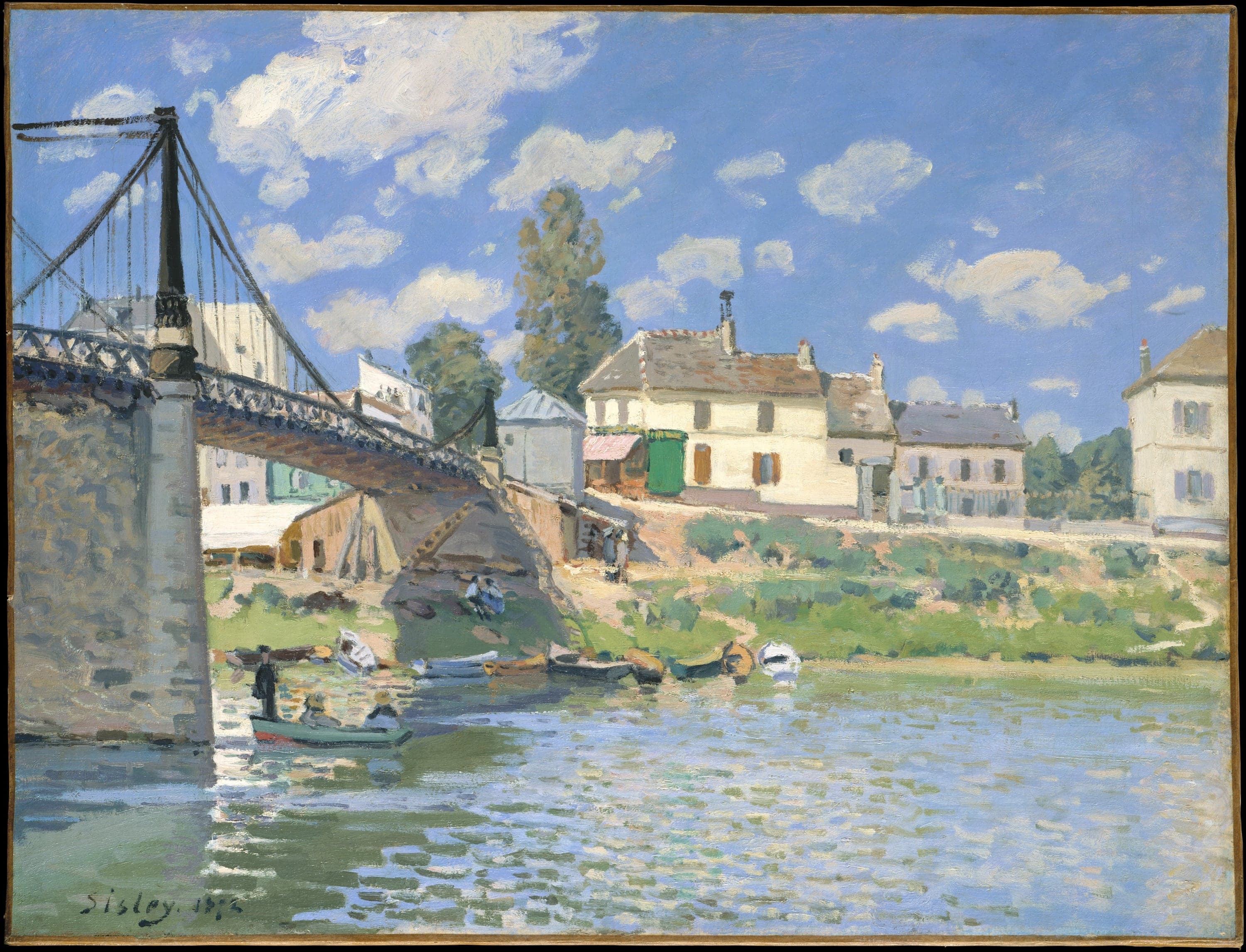
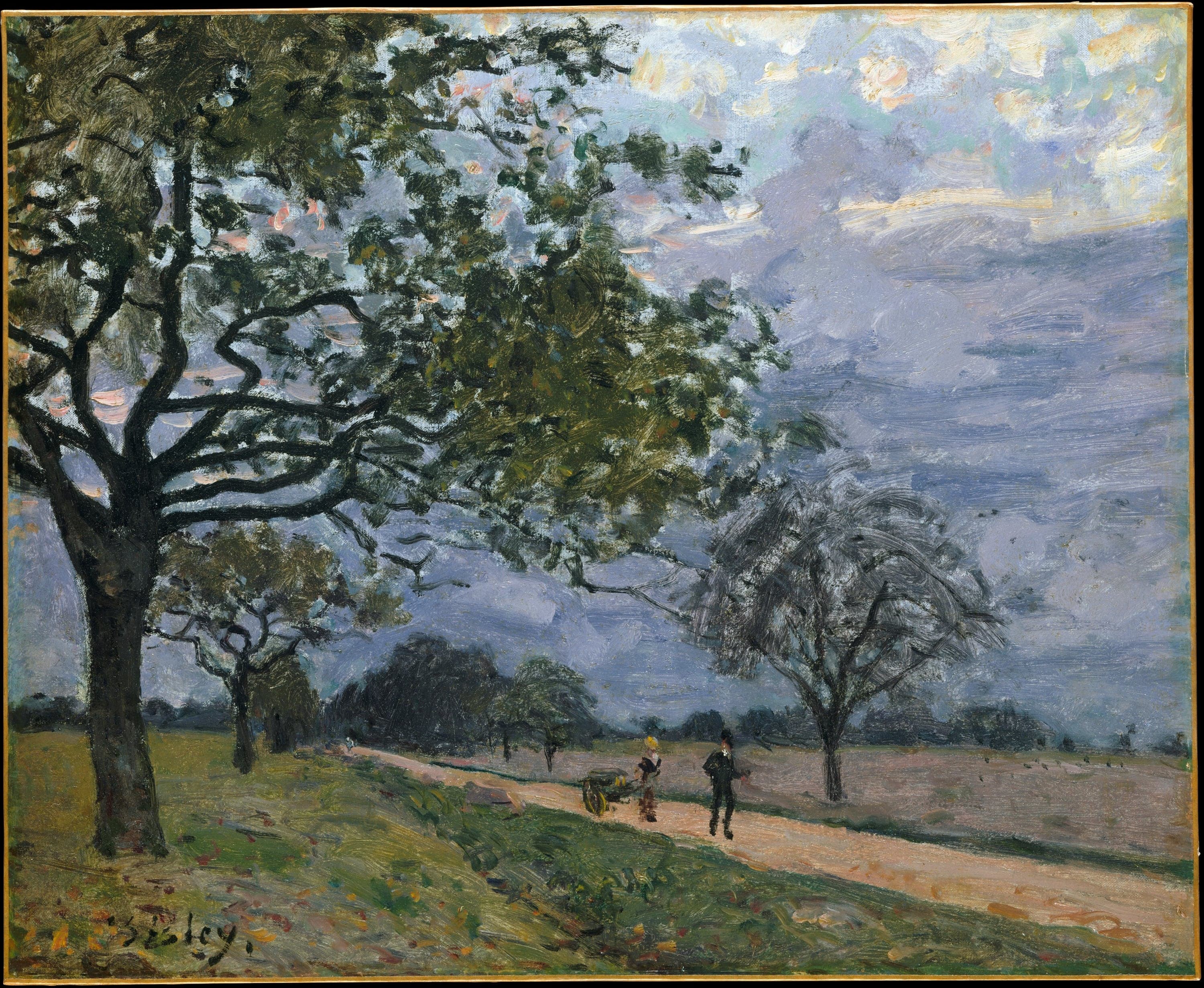
If you like Alfred Sisley
Explore painters from the same movements and circles.
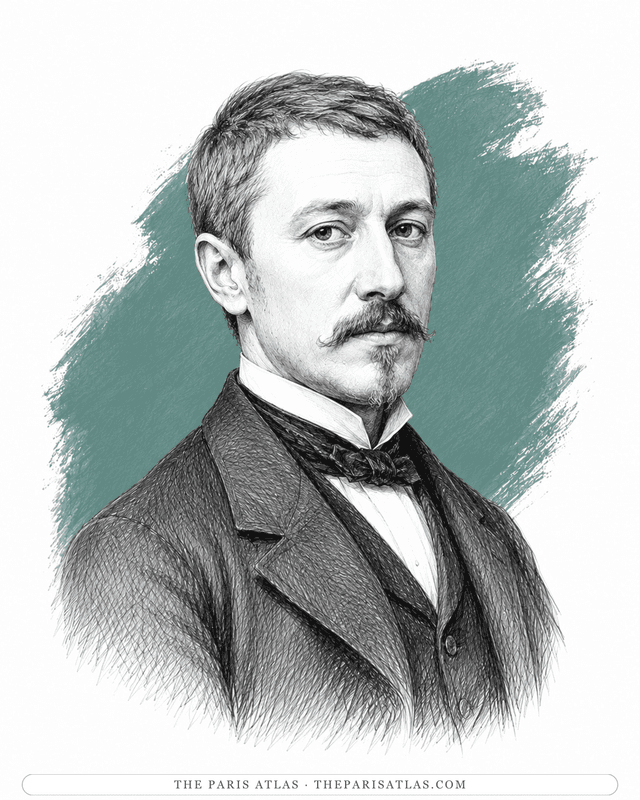
Gustave Caillebotte
Painter of Haussmann's geometry and the group's organizer-financier; his bequest of Impressionist paintings forced the French state to take the movement in.
View artist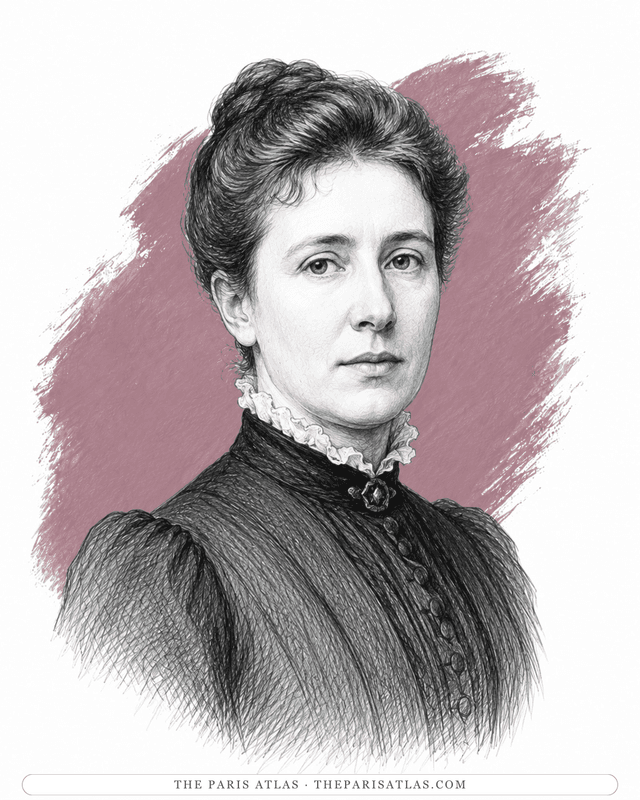
Mary Cassatt
Mary Cassatt was an American painter and printmaker known for her depictions of women and children. Based in France for the last fifty-two years of her life, she was the only American to exhibit with the original French Impressionist group, participating in four of its eight exhibitions. Edgar Degas invited her to exhibit with the group in 1877 after the Salon jury rejected her submissions.
View artist
Paul Cézanne
Painter between Impressionism and everything after — shown in the independents' exhibitions, emulated by the Cubists, and present at the Orangerie through 15 works in the Walter-Guillaume collection.
View artist
References
The sources below include collection records, catalogues, scholarly research, and primary materials that informed this page. They document View of Marly-le-Roi from Coeur-Volant, its making, and its place in cultural history.


1View of Marly-le-Roi from Coeur-Volant (Alfred Sisley, 1876) — The Metropolitan Museum of Art
WebsiteThe Metropolitan Museum of ArtUsed forWeb source consulted for documented facts and historical context presented on the View of Marly-le-Roi from Coeur-Volant page.

2Alfred Sisley: catalogue raisonné de l'œuvre peint
NonfictionDurand-Ruel, Lausanne, 1959Used forPublished analysis and historical context used in preparing the View of Marly-le-Roi from Coeur-Volant page.

3Alfred Sisley
Exhibition catalogueRoyal Academy of Arts, London, and Yale University Press, 1992Used forCatalogue scholarship used to verify attribution, provenance, chronology, and interpretive context for View of Marly-le-Roi from Coeur-Volant.
4Alfred Sisley 1839–1899
WebsiteTateUsed forWeb source consulted for documented facts and historical context presented on the View of Marly-le-Roi from Coeur-Volant page.
5Lydia Crocheting in the Garden at Marly (Mary Cassatt, 1880) — The Metropolitan Museum of Art
WebsiteThe Metropolitan Museum of ArtUsed forWeb source consulted for documented facts and historical context presented on the View of Marly-le-Roi from Coeur-Volant page.
6Impressionism: Art and Modernity — The Metropolitan Museum of Art
WebsiteThe Metropolitan Museum of ArtUsed forWeb source consulted for documented facts and historical context presented on the View of Marly-le-Roi from Coeur-Volant page.
7Sisley
BiographyG. Crès et Cie, 1927Used forBiographical evidence used to verify chronology, relationships, and historical context connected to View of Marly-le-Roi from Coeur-Volant.
These references provide the documented foundation for this work's history and interpretation. Claim-level citations remain attached to the specific claims they support.
 Explore more resources