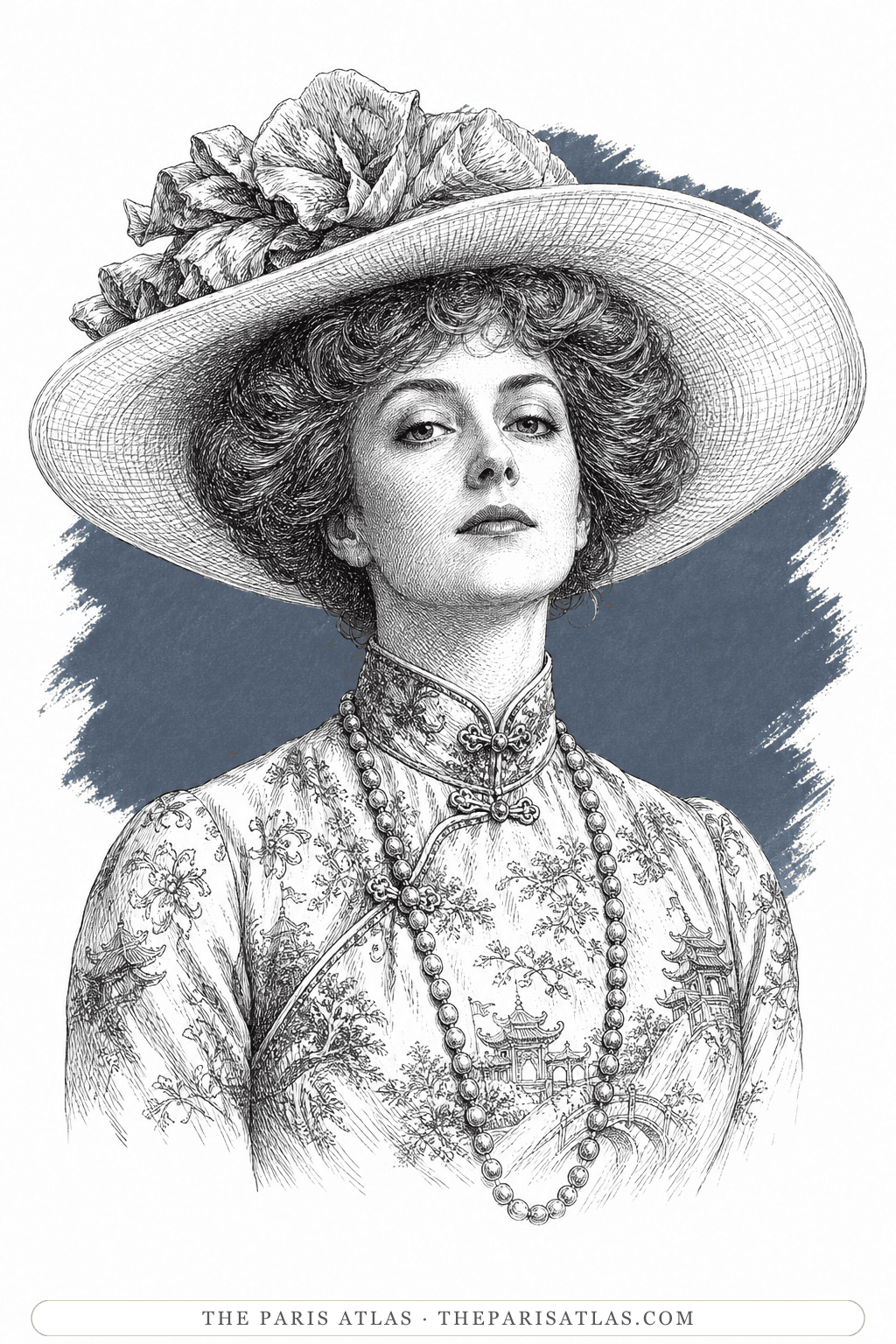
Florence Dowell
The narrator's wife — an American heiress from Connecticut whose weak heart sets every rule of the marriage, and who wants a place in English county society more than she wants anything else.
A European establishment and a place in English county society, paid for by a husband who will not ask much of her. Before the marriage she set out the specification: a gentleman of leisure, an English accent, fifty thousand dollars a year from real estate, no ambition to increase it. "And—she faintly hinted—she did not want much physical passion in the affair."
The book

At a glance
- Mrs John Dowell — American, thirty when the four meet at the spa in 1904
- Florence Hurlbird of Stamford, Connecticut; a graduate of Poughkeepsie
- John Dowell at about four in the morning on 4 August 1901, before a minister they knocked up on the way
- A heart said to have been damaged by a storm at sea, which forbids her to cross the Channel or to be excited
- Her own, plus a large share of her Uncle John Hurlbird's fortune, made in a Waterbury factory that changed its product every year
- 4 August — her birthday, her wedding day, and the day of nearly every turn in her life
- Connecticut, the Paris flat, Nauheim, Provence, and the German castle at M——
Who they are in the book
Spoiler-freeFlorence Dowell is the narrator's wife in The Good Soldier, the 1915 novel by Ford Madox Ford. She was born Florence Hurlbird of Stamford, Connecticut, into a family that backed the losing side in the American Revolution and had not got over it, and she was educated at Poughkeepsie. John Dowell met her at a tea party in New York, moved to Stamford and sat in her parlour every afternoon for a month, and married her at four in the morning on 4 August 1901, having climbed a rope ladder to her bedroom window at one. Not ten minutes out from Sandy Hook, on the crossing to Europe, her heart gave way in a gale, and it governs everything after that.
The heart is the engine of the marriage. Her doctors — and a sallow young American painter called Jimmy, who then lives in the Dowells' Paris flat for two years — set the rules: she must not be excited, must not be contradicted, must never cross the Channel, and must sleep behind a locked door her husband may not open without knocking several times, loudly. He is issued an axe in case she fails to answer. He keeps to all of it for twelve years and never touches her.
Outside that arrangement Dowell shows a woman who does not stop talking. She lectures Edward Ashburnham on Hamlet, on the form of a symphony, on the difference between Arminians and Erastians, on the early history of the United States. She reads Ranke and Motley before an excursion so that she can guide it properly. "She always wanted to leave the world a little more elevated than she found it." She is also the only one of the four who knows what all the others are doing.
How Florence Dowell Is Portrayed
- How her husband remembers herIn one dress. Blue figured silk in a Chinese pattern, a broad white Leghorn hat, coral beads at the throat, copper-coloured hair, heels so high she walked on the points of her toes. He cannot remember a single other thing she owned.
- The smile at the bathhouse doorEvery morning she looked back at him over her shoulder as the door opened, mockingly and invitingly, in a way she never once used on him anywhere else. He has never worked out who it was for. "Ah, she was a riddle; but then, all other women are riddles."
- What she talks aboutWilliam the Silent, Paris frocks, how the poor dressed in 1337, Fantin-Latour, the Paris–Lyons–Mediterranée express, whether it was worth getting off at Tarascon. "It was, as I have said, wonderful what she could make conversation out of." She saw each place exactly once and never wanted to go back.
- The lesson she gives in a German castle towerOn an excursion to a German castle she shows the party the pencil draft of the Protest that gave Protestants their name, and tells Edward Ashburnham what it did for him: "It's because of that piece of paper that you're honest, sober, industrious, provident, and clean-lived." Then she lays one finger on his wrist. Everyone at the table understands it except her husband, who takes nine more years.
- The heart, as she administers itA locked bedroom door, a bell-cord tied to her wrist, an axe for her husband, and a standing prohibition on the Channel crossing. "Why, I would as soon have thought of entering her room without her permission as of burgling a church."
- What she wants out of EnglandFordingbridge, in Hampshire, which her ancestors left in 1688 and where the Ashburnhams' estate now stands. She had spent seven weeks touring Britain and one as a paying guest with an impoverished but stately family near Ledbury, and came home with her mind made up.
- How her husband writes about her nowWith no charity whatever. "For I hate Florence. I hate Florence with such a hatred that I would not spare her an eternity of loneliness." She was never real to him, he decides — just talk out of guidebooks and drawings out of fashion plates. "She just went completely out of existence, like yesterday's paper."
The heart is an invention. She produced it on the boat, having asked Dowell at the foot of the ladder, hours before the wedding, whether he was quite certain the ship sailed at four. His reconstruction, assembled years later, is that she needed a permanent reason to keep her husband out of her bedroom: she had been the mistress of the young painter Jimmy since 1900, a house guest named Bagshawe had seen her leaving Jimmy's bedroom at five in the morning, and having watched Dowell beat a servant on the ferry she had decided he might kill her if he ever learned. Jimmy went on living in the Paris flat for two years after the marriage.
For the last nine years of her life she is Edward Ashburnham's mistress, and spends a good deal of that time urging Leonora Ashburnham to forgive him and take him back. Dowell, in the same hotels throughout, sees nothing and is told nothing until a week after Edward's funeral, two years on.
On the night of 4 August 1913 she follows Edward and Nancy Rufford into the dark park at the spa, hears Edward tell the girl she is the person he cares most for in the world, and runs back to the hotel — where Bagshawe himself is sitting in the lounge talking to her husband. She goes upstairs, arranges herself carefully on the bed, and . Dowell, finding her with the flask in her hand, assumes her heart has failed and goes on assuming it for two years. Only Leonora, the Grand Duke, the chief of police and the hotel proprietor knew that night. Edward never knew at all, which is why he felt no remorse: he was certain she would have left him a letter.
If you like The Good Soldier


If you like Ford Madox Ford
Explore authors with a similar voice, perspective, and influence.

Ernest Hemingway
Ford published Hemingway's earliest Paris work and let him subedit the transatlantic review; Hemingway put him in The Sun Also Rises as Braddocks and settled accounts again in A Moveable Feast.
View author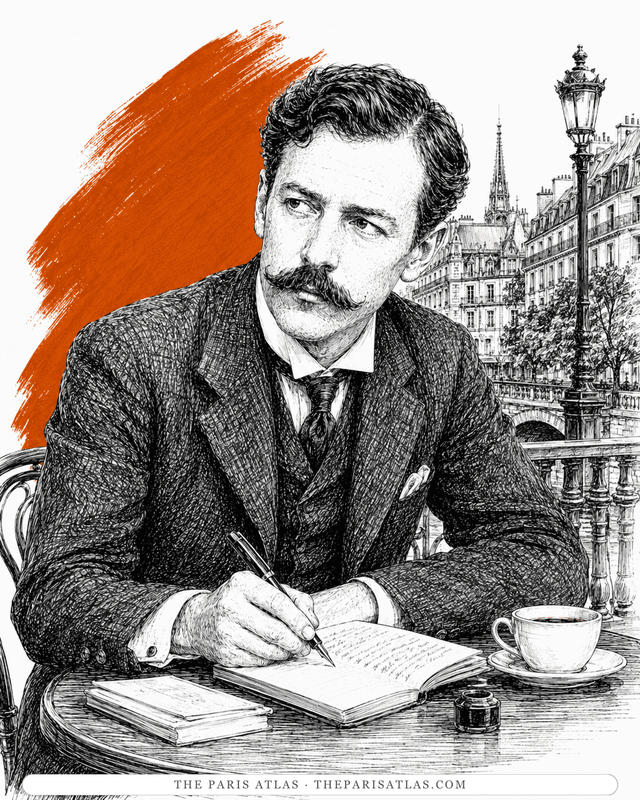
Sisley Huddleston
Fellow witness and friend — Huddleston's memoir catches Ford live: the studio parties, the bal musette, Conrad reminiscences on the Closerie terrace.
View author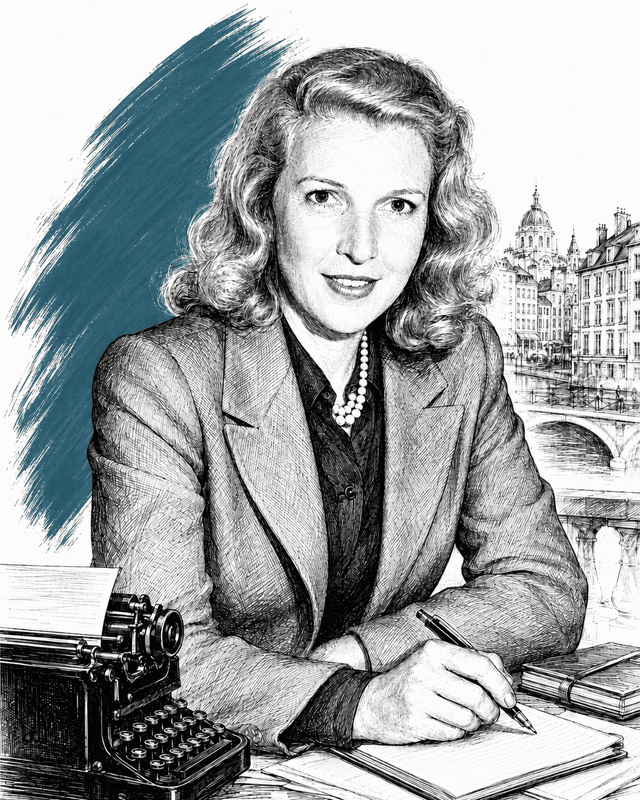
Martha Gellhorn
War correspondent who covered the Spanish Civil War, D-Day, and conflicts across five more decades; Hemingway's third wife, 1940–1945.
View author