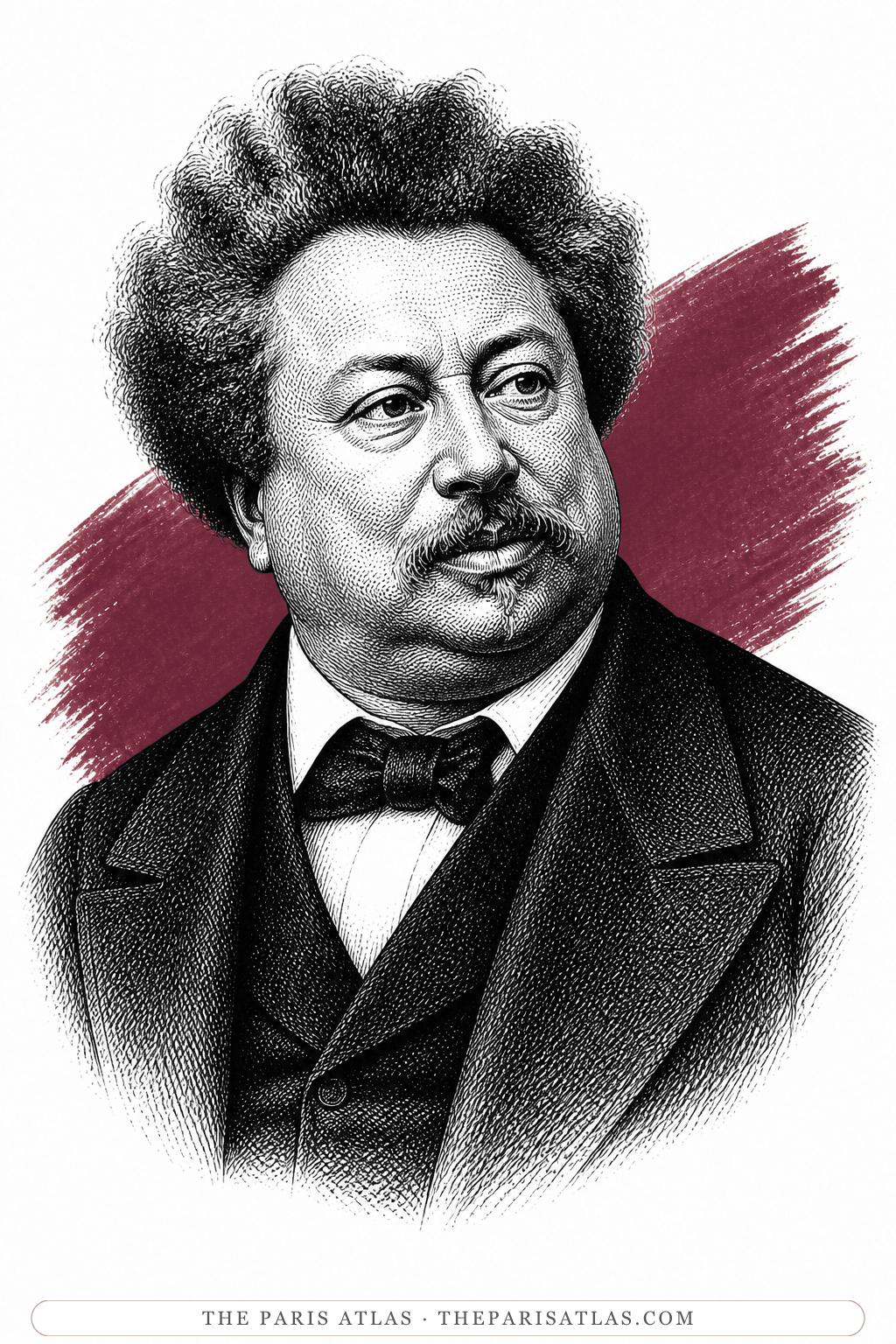
The Three Musketeers
Alexandre Dumas
The Three Musketeers
Where the four friends meet in 1625; every death here answers a scene there.
Read our takeThe Man in the Iron Mask
Alexandre Dumas
The last of the musketeer novels: Aramis puts a twin on the throne of France, and the four friends pay for it one by one.
The Man in the Iron Mask is the final section of Le Vicomte de Bragelonne, the third and longest of Alexandre Dumas's novels about d'Artagnan and the musketeers. Dumas published the whole novel in daily parts in the Paris newspaper Le Siècle from October 1847 to January 1850. English publishers cut it into three or four volumes and gave the last one this title. The story opens in the Bastille in 1661. Aramis, now Bishop of Vannes and secret general of the Jesuits, visits a young prisoner who is the twin brother of Louis XIV. Aramis plans to swap the brothers during a great party that the finance minister Nicolas Fouquet is giving for the king at his new château of Vaux-le-Vicomte. Porthos helps him without understanding what he is doing. D'Artagnan, captain of the king's musketeers, watches Aramis and cannot work out what he is planning. Athos and his son Raoul de Bragelonne live apart from the court, because the king has taken Raoul's fiancée Louise de La Vallière. The book ends the story of all four friends.[1][2]
Le Vicomte de Bragelonne is one novel of 269 chapters, and Dumas never gave any part of it the title The Man in the Iron Mask. The name comes from the English trade. Project Gutenberg's transcriber explains that English editions split the book into three, four or five volumes, and that the four-volume split calls the last one The Man in the Iron Mask. That volume runs from chapter 209 to chapter 269 of the French. Oxford World's Classics, Penguin Classics and Signet all sell the same last section under this title. Readers who pick it up expecting a self-contained book arrive in the middle of a long story, with Louise de La Vallière already the king's mistress and Fouquet already in trouble.[1]
The title points at a real mystery. A prisoner whose face nobody was allowed to see was held at Pignerol, at Exilles, for eleven years on the island of Sainte-Marguerite off Cannes, and then in the Bastille, where he died in 1703. The same jailer, Bénigne Dauvergne de Saint-Mars, a former musketeer, guarded him for the whole of that time. Voltaire told the story in Le Siècle de Louis XIV, gave the prisoner a mask with steel springs at the chin, and turned him into a puzzle that writers argued over for two centuries. Dumas had already written about the case in 1839 and 1840, in a long essay for his collection Les Crimes célèbres, years before he made the prisoner the king's twin.[3][4][5]
Dumas wrote the Musketeers novels with Auguste Maquet, a former schoolteacher whom Gérard de Nerval introduced to him in 1839. Larousse credits Maquet with the research and preparatory work for the whole trilogy, and the Société des Amis d'Alexandre Dumas lists him as the collaborator on Le Vicomte de Bragelonne. The partnership ended in 1856 after Maquet sued Dumas over money he was owed. The history the two men worked from is real. Fouquet gave his party at Vaux on 17 August 1661, d'Artagnan arrested him at Nantes on 5 September, and Fouquet died in the fortress of Pignerol in 1680. The real d'Artagnan was killed at the siege of Maastricht in 1673. Everything about a royal twin is invention.[6][7][8][9]
Aramis, the Bishop of Vannes, enters the Bastille at night with its governor, Baisemeaux, and goes alone into the cell of a young man called Marchiali. The prisoner is Philippe, twin brother of Louis XIV, taken from his mother Anne of Austria at birth and hidden for the safety of the crown. Aramis has just been elected general of the Jesuits, and he offers Philippe the throne. With a forged release order he takes Philippe out of the fortress in a carriage, through the gate on the Rue Saint-Antoine and down the Melun road. On the night of 15 August, in the park at Vaux-le-Vicomte, he and Philippe agree on terms. Philippe will be king. Aramis will be cardinal, then prime minister, then pope. Meanwhile Porthos has been fitted for the party by the king's tailor Percerin, in the Rue Saint-Honoré, in a scene where Molière takes his measure.[1]
Fouquet's party for the king fills the château. Colbert, the king's new intendant, hands Louis a letter from the dead Cardinal Mazarin that seems to show Fouquet has kept thirteen million francs. The king goes to bed angry in a room painted with the god of sleep. During the night the whole bed sinks through the floor into a hidden vault where Aramis and Philippe have been watching him through the dome. Aramis and a masked Porthos drive Louis to the Bastille and hand him to Baisemeaux as the madman Marchiali. Philippe wakes in the royal bed and plays the king through his morning audience with his mother and his brother. D'Artagnan, who has been ordered to arrest Fouquet, has spent the night in Fouquet's room instead, warning him and guarding him at once. Aramis then tells Fouquet what he has done, expecting gratitude.[1]
Fouquet refuses to owe his safety to a crime against his guest. He rides to the Bastille, forces the governor to release the true king, and brings Louis back to Vaux. He gives Aramis four hours' start and his fastest horses. In the royal bedroom the two identical men face their mother, and Anne of Austria cannot speak. Louis tears the curtains open and calls on d'Artagnan to say which of them is the paler. D'Artagnan lays his hand on Philippe's shoulder and arrests him. The king's written order sends the prisoner to the island of Sainte-Marguerite, his face covered with an iron visor he may never lift. Fouquet, Aramis, Porthos, Athos and Raoul all go their separate ways, and the last third of the book follows each of them to the end.[1]
Every thread ends in death or defeat, and the book says so plainly. D'Artagnan delivers Philippe to Sainte-Marguerite in a fishing boat; Athos and Raoul, on their way to Africa, see the masked man from the fort's gallery, and Athos makes the governor call him monseigneur. The king summons d'Artagnan to Nantes, where Fouquet is arrested after a chase on horseback along the Loire in which both horses die. Fouquet is sentenced, and the king commutes banishment to life imprisonment at Pignerol. D'Artagnan is then sent to take Belle-Île, where Aramis and Porthos are waiting. In the sea cave of Locmaria, Porthos throws a barrel of powder among the king's soldiers, brings the roof down, and dies holding up the rock with the words "Too heavy!" Aramis escapes on a royal frigate by showing the lieutenant the ring of his order, and sails for Corunna.
Raoul is killed at Gigelli in North Africa under the Duc de Beaufort, with eight wounds and a lock of Louise's hair in his hand. Athos, who has dreamed the death at Blois, asks Grimaud one question, receives the answer, and dies the same night. D'Artagnan arrives to report Porthos's death and finds two coffins in the hall. In the Epilogue, four years later, Aramis returns as the Duc d'Almeda, ambassador of Spain, and Louise de La Vallière rides alone behind the king and Madame de Montespan. D'Artagnan is made a marshal of France at the siege of Maastricht. A cannonball kills him as he opens the box that holds his baton. His last words are for Athos, Porthos and Aramis, and the closing sentence counts the four friends down to one.
The volume opens at chapter 209 of the French novel, in the middle of a supper at the Bastille. Baisemeaux, the governor, lights a lantern himself and leads Aramis up the Bertaudière tower to the second floor. Aramis stops him at the door with the rule that a governor may not hear a confession, takes the lantern, and goes in alone. Nothing is explained. A reader who starts here has to work everything out from the dialogue. The young man on the green serge bed has been in this cell for six years, has found a note in his bread, and already knows who Aramis is. Dumas wrote the scene as one more day's instalment for readers who had followed the story since October 1847. The English publishers who cut the novel here turned that instalment into a first chapter, which is why the book feels like walking into a room where a conversation is already under way.
The mask itself appears late and is not quite iron. The king's order in Chapter XXIV says d'Artagnan will cover the prisoner's face with an iron visor. When Athos and Raoul finally see the man in Chapter XXXII, on the fort's gallery during a thunderstorm, he wears a visor of polished steel soldered to a helmet that covers his whole head. Voltaire's version, the one Dumas grew up with, describes a mask whose chin-piece had steel springs so the prisoner could eat without removing it. Dumas keeps the steel and drops the springs. He also adds a detail from Voltaire: the prisoner scratches a message on a silver plate and throws it from his window toward a boat. In Voltaire the plate reaches a fisherman who cannot read. In Dumas it lands at the feet of Raoul de Bragelonne, and the message names the writer as the king's brother.
The kidnapping is built on a real road out of Paris, and Dumas names each stage. In Chapter VIII the carriage carrying Aramis and Philippe leaves the Bastille by the gate in the Rue Saint-Antoine, trots through the faubourg, gathers speed past Bercy, changes horses at Villeneuve-Saint-Georges and takes the Melun road toward Vaux. In Chapter XVII the same carriage goes back the other way with the true king inside, Porthos holding a musket to his chest. The Bastille is drawn from the inside: the Bertaudière tower, the second-floor cell, the register in which Baisemeaux writes the name Marchiali, the drums and bell rung to clear the courtyards when a secret prisoner passes. The rest of the city appears in small, exact touches. Percerin the royal tailor keeps his house in the Rue Saint-Honoré near the Rue de l'Arbre-Sec. Planchet's grocery is in the Rue des Lombards. Raoul walks to the Luxembourg to find the Comte de Guiche. The king, freed from his cell, says he will stop at the Louvre to change before facing the court.
Dumas stages the swap as a piece of theatre machinery, which is what he had built his first career on. The king's bedroom at Vaux has a ceiling painted by Charles Le Brun with the god Morpheus. In Chapter XVII the sleeping Louis feels the bed move, watches the painted dome and its golden crown draw away above him, and sinks into a stone vault where the only light comes from the room he has left. Chapter XX repeats the movement in reverse, with Philippe rising into the royal bed and finding the sheets still warm and a handkerchief wet with his brother's tears. Each chapter closes on a hard turn. Chapter XVII ends with the king locked in the cell that was Philippe's. Chapter XXIII ends with Fouquet's release order and the king's signature under it. Chapter XXIV closes on the order for the iron visor, and on d'Artagnan's remark that this king lacked only Fouquet and himself. The novel appeared in daily parts, and those chapter endings were the points at which readers were left overnight.
The hinge of the book is not a sword fight. In Chapter XXIII Fouquet, told by Aramis that the king has been replaced, goes to the Bastille and frees Louis with his own authority, then argues with the man he has just saved. Louis will not pardon Aramis or Porthos; Fouquet says he expected that and has already given Aramis four hours' start and his best horses. He tells the king that Belle-Île cannot be taken. That sentence ends his career. Dumas gives Fouquet the finest manners in the book, and the text says so. At the end of the horse chase in Chapter XL it is Fouquet who kneels in the sand and bathes d'Artagnan's temples with river water from his hat. D'Artagnan, coming round, calls him the true king. The real Fouquet was a financier who mixed the state's money with his own. Larousse records that his party at Vaux on 17 August 1661 humiliated the young king, and that d'Artagnan arrested him at Nantes on 5 September. In December 1664 a court sentenced him to banishment, and Louis XIV changed the sentence to prison for life.
Dumas and Auguste Maquet moved the record where the story needed it. The novel dates the night in the park to 15 August and the party to the days after, two days early. The arrest becomes a chase on two horses, a white and a black, both ridden to death along the Loire. The Gutenberg edition's own notes list other liberties. The novel has Anne of Austria dead by 1665, when she lived until 1666. It also hands d'Artagnan the campaign of the Epilogue several years before the real siege of Maastricht in 1673. Larousse credits Maquet with the documentation for the trilogy, and the Société des Amis d'Alexandre Dumas names him as the collaborator on this novel. Its entry also observes that the book is longer than The Three Musketeers and Twenty Years After put together, and that scenes of court conversation, the kind Maquet researched, take up much of it.
Dumas kills his heroes one at a time and gives each death a different shape. Porthos goes first, in Chapter L, under the collapsing cave at Locmaria. Dumas prepares the scene in Chapter XLV, where Porthos explains that the men of his family feel their legs weaken just before they die, and that his grandfather Antoine and his father Gaspard both went that way. He has felt it himself. When the rock comes down he holds it up long enough to say two words. Raoul's death in Chapter LIX is told secondhand, in a letter from the Duc de Beaufort with an officer's report attached. The report is careful. A surgeon says three of the eight wounds are mortal but the patient might live if he does not move. He is found on the floor. D'Artagnan reads the report and murmurs the word suicide. Athos dies in Chapter LVIII in his bed at Blois, smiling, after a vision of Raoul's death that the narrative had already given him.
D'Artagnan's death is held back into an Epilogue set four years later, and Dumas makes him wait for it. He is a count now, has just ridden five hundred and twenty leagues to see Fouquet at Pignerol and back, and defends the prisoner against a courtier who sneers at him. Aramis reappears as a white-haired Spanish duke. Then the book jumps to the siege of Maastricht. Colbert's messenger brings a box with a marshal's baton in it; a cannonball breaks the box and strikes d'Artagnan in the chest, and the baton rolls under his hand. The Gutenberg text records that Dumas revised the closing line in later editions. The earlier version said that of the four valiant men there now remained but one single body, and God had resumed the souls. The revised version, the one most readers know, says that there now remained but one, and that Heaven had taken to itself three noble souls.
The whole universe is our own; for me the minds of men, for you their bodies.
I am the brother of the king of France—a prisoner to-day—a madman to-morrow. French gentlemen and Christians, pray to God for the soul and the reason of the son of your old rulers.
I have conspired against the king; that conspiracy has failed, and, at this moment, I am doubtless pursued.
Dumas closes the cycle he began in 1844. Athos, Porthos and d'Artagnan each get a death scene, and the last sentence counts the four friends down to one.
A forged release order, a bed that sinks through a painted ceiling, a twin rehearsed from written notes. The swap at Vaux is the most carefully engineered set piece in Dumas, and Chapters XVII to XXIV run it in real time.
The finance minister who frees the king that is about to ruin him, then bathes the temples of the man who has arrested him, is the character the book most admires. Dumas says so through d'Artagnan.
The 1929, 1939, 1962 and 1998 films keep the twin and the mask. None keeps Belle-Île, Locmaria, the deaths at Blois or the marshal's baton at Maastricht, which is where the book's weight sits.
Captain of the king's musketeers, sixty years old, ordered to arrest the friend who is hiding him from the plot and then to besiege the two friends who made it.
Bishop of Vannes and secret general of the Jesuits, who plans to put the king's twin on the throne and make himself pope.
Baron du Vallon, the strongest of the four, who follows Aramis into treason believing he is serving the king, and dies holding up a mountain.
The Comte de La Fère, retired to Blois with his son Raoul, who ages ten years in a week when the boy sails for Africa.
Athos's son, who gives the novel its French title and goes to Africa to die after the king takes Louise de La Vallière.
The king, twenty-three, who spends a night in the Bastille as a madman called Marchiali and comes out determined that no one will ever be his equal again.
The king's twin, taken at birth and kept six years in the Bastille as Marchiali, who reigns for one morning and wears the mask for the rest of his life.
Superintendent of finances and master of Vaux-le-Vicomte, who saves the king that is ruining him and is arrested after a chase along the Loire.
The queen mother, who gave one twin to the state and cannot speak when both stand in front of her.
Anne of Austria's old friend, who sold Mazarin's letter to Colbert and is the first person Philippe threatens as king.
D'Artagnan's former servant, a grocer in the Rue des Lombards who sells up for a house and twenty acres at Fontainebleau.
Athos's silent servant, who goes to Africa with Raoul and rides back to Blois to answer one question.
Porthos's intendant, called Mouston, too fat to be his master's dummy and left forty-seven suits in his will.
Governor of the fort on Sainte-Marguerite and the masked prisoner's keeper; the real Saint-Mars guarded the real prisoner for nearly forty years.
Son of an old adversary of the four friends, who leads the king's soldiers into the cave at Locmaria and is the first man Porthos's iron bar kills.
Mazarin's former clerk, now the king's intendant, who brings down Fouquet with a dead cardinal's letter and sends d'Artagnan his baton.
Governor of the Bastille, in Aramis's debt and Aramis's power, who twice hands over the wrong prisoner.
Raoul's former fiancée and the king's mistress, who comes to the double grave at Blois and is riding alone behind the king by the Epilogue.
The prince Athos once helped escape from Vincennes, who takes Raoul to Africa and writes the letter that reaches a dead man.
1703
An unnamed masked prisoner, guarded for nearly forty years by Bénigne de Saint-Mars at Pignerol, Exilles, Sainte-Marguerite and the Bastille, dies in the Bastille. Voltaire later tells the story in Le Siècle de Louis XIV.
1839–1840
Alexandre Dumas publishes a long study of the masked prisoner, L'homme au masque de fer, in his collection Les Crimes célèbres, with Auguste Arnould.
October 1847
Le Vicomte de Bragelonne begins in daily parts in the Paris newspaper Le Siècle, written with Auguste Maquet.
January 1850
The serial ends after 269 chapters and an Epilogue. English publishers later cut the novel into three, four or five volumes and title the last one The Man in the Iron Mask.
1856
The collaboration with Auguste Maquet ends after Maquet sues Dumas over money owed.
1929
The Iron Mask, directed by Allan Dwan with Douglas Fairbanks, is released in the United States; a sound version follows in 1954.
1939
James Whale's The Man in the Iron Mask, with Louis Hayward and Joan Bennett, is released.
1962
Henri Decoin's Le Masque de fer, with Jean Marais as d'Artagnan, is released in France and Italy.
1998
Randall Wallace's The Man in the Iron Mask, with Leonardo DiCaprio, Jeremy Irons and John Malkovich, reaches cinemas; United Artists' copyright is dated 1997.
2003
Penguin Classics publishes Joachim Neugroschel's new translation, the first modern English version of this section.
2008
Oxford World's Classics publishes the volume edited by David Coward, 626 pages.


The Three Musketeers
Alexandre Dumas
Where the four friends meet in 1625; every death here answers a scene there.
Read our takeTwenty Years After
Alexandre Dumas
The middle novel, in which Mazarin rules and Raoul de Bragelonne first appears.
Read our takeThe Count of Monte Cristo
Alexandre Dumas
Dumas's other great prisoner, written in the same years; the Château d'If and the Bastille are the two dungeons of his work.
Read our takeQueen Margot
Alexandre Dumas
Dumas and Maquet's Louvre of 1572, three generations before the Louvre of this book.
Read our takeNo. It is the last section of Le Vicomte de Bragelonne, the third musketeer novel, which Dumas published in daily parts from October 1847 to January 1850. English publishers split that novel into three or four volumes and gave the final one this title. Project Gutenberg's edition, ebook 2759, covers chapters 209 to 269 of the French plus the Epilogue.
In the Bastille, in 1661, with Aramis being led by the governor Baisemeaux up the Bertaudière tower to the cell of a prisoner called Marchiali. Louise de La Vallière is already the king's mistress, Fouquet is already in trouble, and Athos has already broken his sword before the king; all of that happened in the earlier sections.
Yes, though nobody knows who he was. A prisoner whose face was hidden was held at Pignerol, Exilles, the island of Sainte-Marguerite and the Bastille under the same jailer, Saint-Mars, and died in the Bastille in 1703. Voltaire made him famous. The idea that he was the king's twin brother is fiction; Dumas built the novel on it.
The king's order says an iron visor. When the prisoner is seen, in Chapter XXXII, he wears a visor of polished steel soldered to a helmet covering his whole head. The mask appears in only a few pages; most of the book is about Fouquet, Aramis and the king.
Yes, and Twenty Years After and the earlier parts of Le Vicomte de Bragelonne as well. This volume assumes you know who the four friends are, why Athos has retired, and why Raoul is in despair. Read alone, it still works as a story, but the deaths at the end mean little without the earlier books.
Oxford World's Classics, edited by David Coward, prints the traditional translation with notes and is the edition listed here. Penguin Classics has Joachim Neugroschel's 2003 translation, the only modern one; it is in copyright. Project Gutenberg's free text is the old anonymous translation and is the text quoted here.
No. Dumas ends the story of all four friends here, and the plot section below tells the endings in full. The Epilogue is set four years after the main story and closes at the siege of Maastricht.
The Iron Mask (1929) with Douglas Fairbanks, James Whale's The Man in the Iron Mask (1939), Henri Decoin's Le Masque de fer (1962) with Jean Marais, and Randall Wallace's The Man in the Iron Mask (1998) with Leonardo DiCaprio. All keep the twin and the swap and drop Belle-Île, Locmaria and Maastricht.
Explore authors with a similar voice, perspective, and influence.

The doctor of the Paris slums who wrote the century's blackest, funniest novel — and changed the sound of French prose.
View author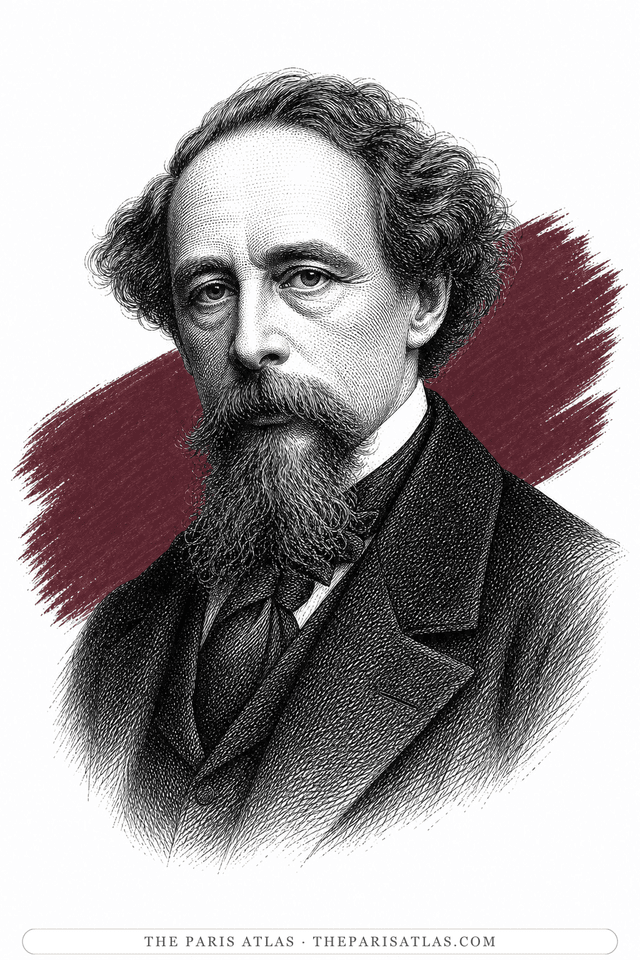
The most popular English novelist of the nineteenth century, who was never a Paris resident in the ordinary sense but kept coming back for twenty-five years: one winter in a rented mansion on the rue de Courcelles, a second winter on the Champs-Élysées writing Little Dorrit, repeated compulsive visits to the Paris Morgue — the riverside building where the city displayed its unidentified dead to the public — and a novel of the French Revolution, A Tale of Two Cities, that has shaped how English readers picture Paris ever since.
View author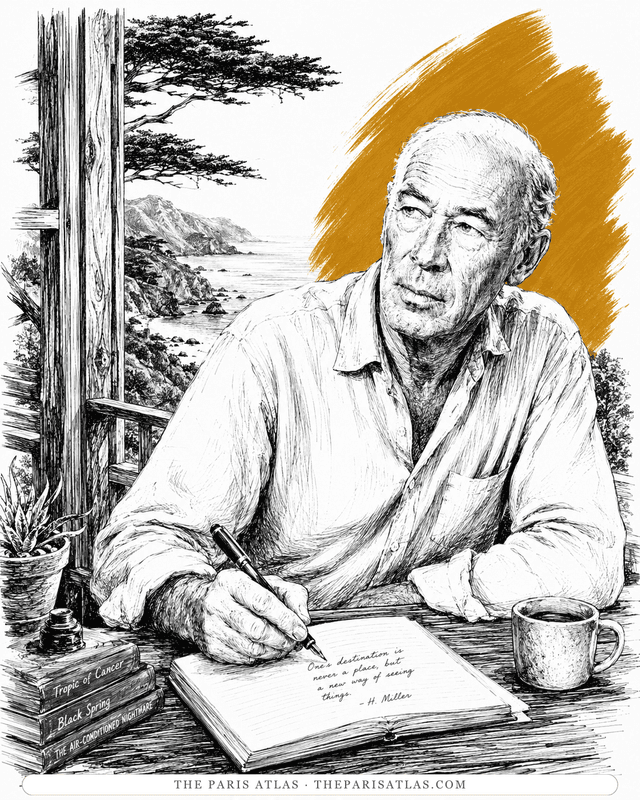
The Brooklyn dropout who arrived in Paris broke at thirty-eight and wrote the exuberant, banned books that ended American censorship.
View authorThe sources below include the primary text, editions, scholarship, archival materials, and other records that informed this page. They document The Man in the Iron Mask, its publication, and its place in literary history.


The primary text: the anonymous nineteenth-century English translation of chapters 209 to 269 of Le Vicomte de Bragelonne. Every quotation, chapter locator and plot detail here was checked against it.
Larousse's entry for the novel: dated 1850 and described as the last episode of the Musketeers trilogy.
The Cannes municipal archives' account of the real prisoner: eleven years on Sainte-Marguerite, the prisons of Pignerol, Exilles and the Bastille, the death in 1703, and the jailer Saint-Mars, a former musketeer.

Voltaire's original telling: the mask with steel springs at the chin, the transfer by Saint-Mars to the Bastille, the death in 1703, and the silver plate thrown to a fisherman.
Dumas's own earlier study of the masked prisoner, published in Les Crimes célèbres in 1839–1840 with Auguste Arnould.
Maquet's dates, his introduction to Dumas by Gérard de Nerval in 1839, his part in the trilogy's documentation, and the 1856 lawsuit that ended the collaboration.
The Société des Amis d'Alexandre Dumas's dictionary entry: publication 1847–1850, Auguste Maquet as collaborator, the period covered, and the observation that the novel is longer than its two predecessors combined.
The real Fouquet: the party at Vaux on 17 August 1661, the arrest at Nantes on 5 September, the sentence of 20 December 1664 commuted by the king, and his death at Pignerol in 1680.
Larousse's definition of the novel published in daily newspaper parts, the form this book took.
Larousse on the island off Cannes and its seventeenth-century fort, where the masked man was held.
Larousse's film dictionary entry for Allan Dwan's The Iron Mask (1929) with Douglas Fairbanks, and its 1954 sound reissue.
Larousse's entry for James Whale's The Man in the Iron Mask (1939) with Louis Hayward and Joan Bennett.
Larousse's entry for Henri Decoin's Le Masque de fer (1962) with Jean Marais.

The Bibliothèque nationale de France's record of Randall Wallace's film with Leonardo DiCaprio, Jeremy Irons and John Malkovich; United Artists' copyright is dated 1997 on the record.
Larousse's entry for the real Colbert, Reims 1619 to Paris 1683, used for the character's dates.
Larousse's entry for Louis XIV, Saint-Germain-en-Laye 1638 to Versailles 1715, used for the king's dates.
Larousse's entry for the real Louise de La Vallière, Tours 1644 to Paris 1710, used for the character's dates.
Larousse's entry for the real Duc de Beaufort, Paris 1616 to Candia 1669, used for the character's dates and his imprisonment at Vincennes.
Verification of the Oxford World's Classics ISBN, 2008, 626 pages, edited by David Coward.
Verification of the Penguin Classics ISBN, 2003, 470 pages, translated by Joachim Neugroschel with an introduction by Francine du Plessix Gray.
Verification of the Signet Classic ISBN, 1992, 496 pages, afterword by Jack Zipes.
The primary text represented by this page, used for descriptions of the work’s contents and for any quoted passages shown here.
The primary text is the baseline reference for every book page. Additional references document publication history, interpretation, and historical context where that evidence is available.
 Explore more resources