d'Artagnan
Captain of the king's musketeers, sixty years old, ordered to arrest the friend who is hiding him from the plot and then to besiege the two friends who made it.
To keep his word to the king without betraying his friends, and to hear the king say good evening to him with a smile he did not have to beg for.
The book
The Man in the Iron Mask
Alexandre Dumas
At a glance
- Captain of the musketeers; a count by the Epilogue, four years on
- About sixty; the Epilogue says he has lived a dozen years in four
- Paris, Vaux, Sainte-Marguerite, Nantes, Belle-Île, Blois; dies at Maastricht
- Charles de Batz de Castelmore, comte d'Artagnan, who arrested Fouquet at Nantes in 1661 and was killed at Maastricht in 1673
- Charles de Batz de Castelmore, comte d'Artagnan · between 1610 and 1620–1673 · Château de Castelmore, near Lupiac, Gers
Who they are in the book
Spoiler-freed'Artagnan is captain of the king's musketeers and the only one of the four friends still in the king's service. He is about sixty, grey, and sharper than anyone at court. In this volume he is given two tasks that pull against each other: to guard Fouquet, whom he likes, and to watch Aramis, whom he loves and no longer trusts. He works out most of the plot before anyone tells him, and he still cannot prevent it.
What he wants is to serve without shame. The book makes him arrest Fouquet, deliver a masked prince to an island, and lead the king's army against Porthos and Aramis, and each time he looks for the way of doing it that costs the least honour. Louis XIV is the first master who is his match, and their long conversation in Chapter LIII is the book's second climax.
How d'Artagnan Is Portrayed
- The night in Fouquet's roomIn Chapter XIX he tells Fouquet how he would have arrested anyone else, catching the guests one by one like rabbits, then settles in an armchair for the night. He says he can sleep through a cannon but wakes at the touch of a door handle.
- The hand on the shoulderIn Chapter XXIV, when the king shouts for him to say which of the two men is paler, he walks to Philippe, lays a hand on his shoulder and says he is his prisoner. Then he bows to the prince and says his oaths belong to the man who has just left the room.
- Friendly advice at NantesIn Chapter XXXVIII he visits the feverish Fouquet and describes his own lack of orders, the free roads, the free river, the horses he would have to lend. It is a warning to run. Fouquet understands it too late, when the king arrives eight hours early.
- The chaseIn Chapter XL he pursues Fouquet's white horse on a black one, throws away hat, coat, scabbard and sword as he runs, and seizes Fouquet by the leg with the words that he arrests him in the king's name. Then he faints, and Fouquet revives him with water in his hat.
- The baton he will not buyIn Chapter XLI Colbert tells him that taking Belle-Île is worth a marshal's baton. He thinks it through and decides his fortune will not cost his friends a feather, then sails from Paimboeuf to give them time to see the hand coming.
- Begging for a smileIn Chapter LIII he tells the king he has served Richelieu and Mazarin, been scorched at La Rochelle, and grown new skin ten times like a snake. He stays, he says, because he is used to being told good evening with a smile. He asks pardon for Porthos and Aramis on his knees.
d'Artagnan quotes
I arrest you in the king's name! blow my brains out, if you like; we have both done our duty.
It is to the head he has given genius, and the head, you know, the rest obey. I am the head.
Athos—Porthos, farewell till we meet again! Aramis, adieu forever!
In the Epilogue he is made marshal of France at the siege of Maastricht. A cannonball from the town shatters the box holding his baton and strikes him in the chest as he watches the white flag go up on the bastion. His last words are for Athos, Porthos and Aramis, and the book's last sentence says that of the four there now remained but one.
If you like The Man in the Iron Mask


If you like Alexandre Dumas
Explore authors with a similar voice, perspective, and influence.
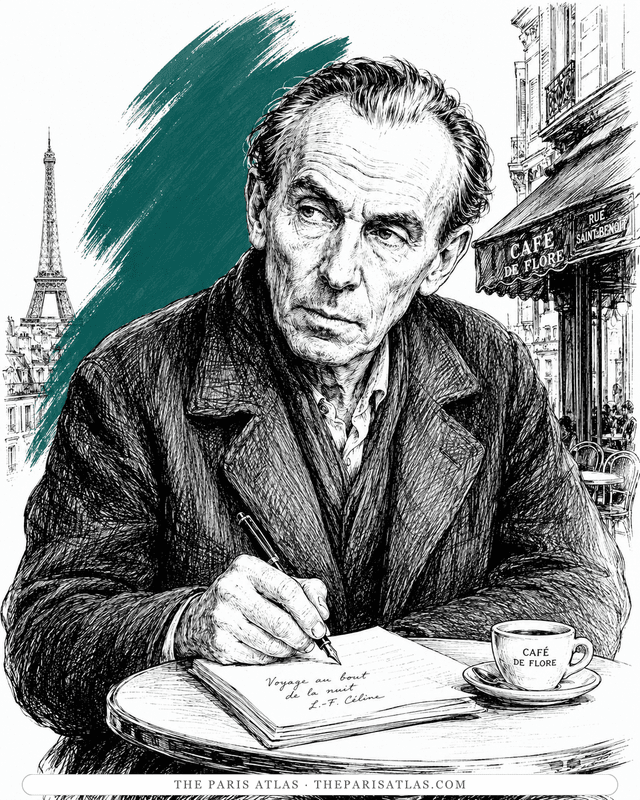
Louis-Ferdinand Céline
The doctor of the Paris slums who wrote the century's blackest, funniest novel — and changed the sound of French prose.
View author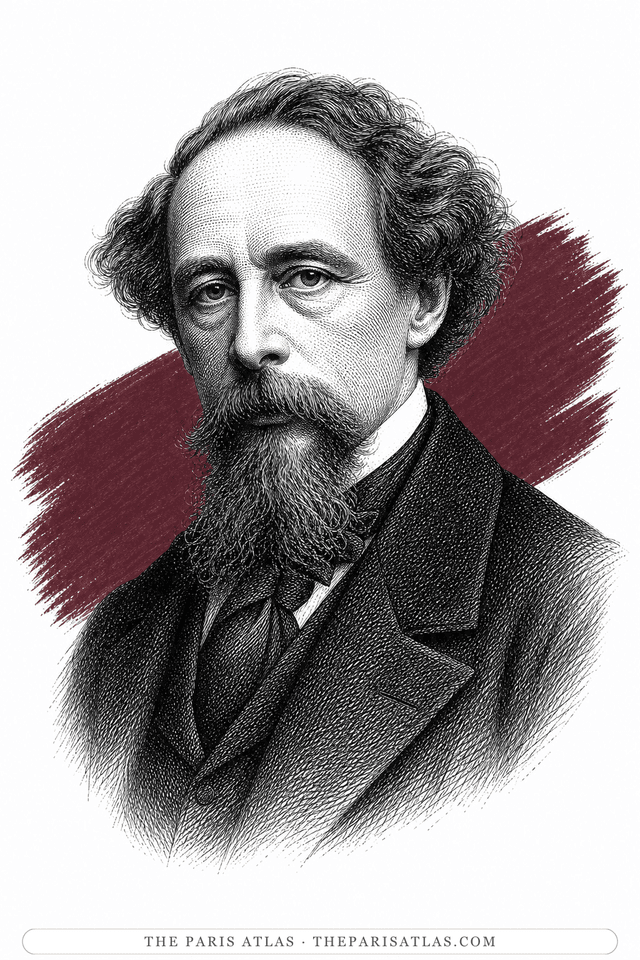
Charles Dickens
The most popular English novelist of the nineteenth century, who was never a Paris resident in the ordinary sense but kept coming back for twenty-five years: one winter in a rented mansion on the rue de Courcelles, a second winter on the Champs-Élysées writing Little Dorrit, repeated compulsive visits to the Paris Morgue — the riverside building where the city displayed its unidentified dead to the public — and a novel of the French Revolution, A Tale of Two Cities, that has shaped how English readers picture Paris ever since.
View author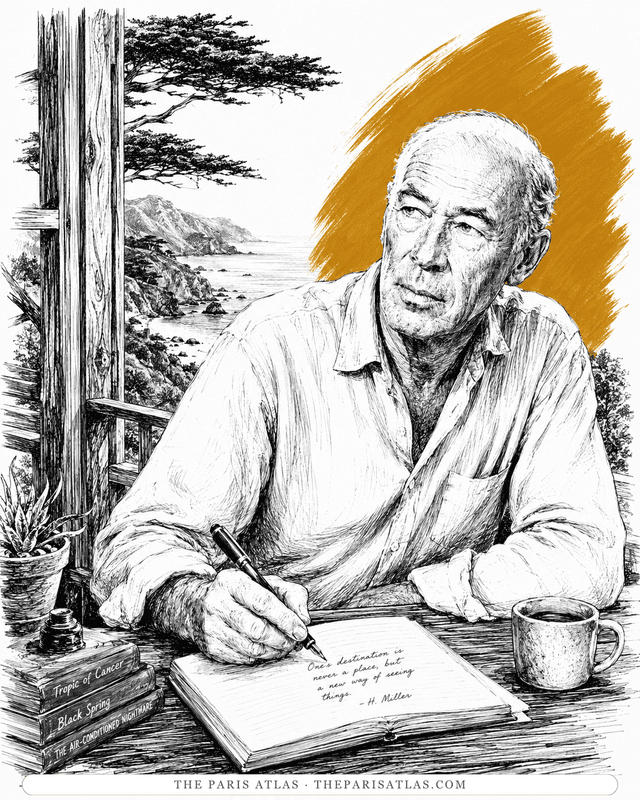
Henry Miller
The Brooklyn dropout who arrived in Paris broke at thirty-eight and wrote the exuberant, banned books that ended American censorship.
View author