Twenty Years After
Alexandre Dumas
Twenty Years After
The sequel, published in Le Siècle in 1845: the same four friends in 1648, older and on opposite sides.
Read our takeThe Three Musketeers
Alexandre Dumas
Four swordsmen, a queen's twelve diamonds and a branded woman, told to Paris in daily newspaper parts in the spring of 1844.
Alexandre Dumas published The Three Musketeers in daily parts in the Paris newspaper Le Siècle between 14 March and 14 July 1844. The story opens in April 1625. A Gascon of eighteen named d'Artagnan rides into Paris on a yellow pony to join the king's Musketeers. On his first day he quarrels with three of them, Athos, Porthos and Aramis, and ends up fighting beside them against Cardinal Richelieu's guards. The four then take up the cause of Queen Anne of Austria, who has given twelve diamond studs to the Duke of Buckingham, the English minister who loves her. Richelieu wants those studs seen to be missing at a ball. Working for him is Milady de Winter, a beautiful Englishwoman with a mark on her shoulder that she kills to keep secret.[1][2]
Dumas opens with a preface that claims a source. He says he found the Memoirs of M. d'Artagnan in the Royal Library in Paris, printed in Amsterdam by Pierre Rouge, and read in them of three musketeers named Athos, Porthos and Aramis. That book is real: Gatien de Courtilz de Sandras published it in 1700, and it was already largely invented. The preface then adds a second, wholly imaginary find, a folio manuscript called the Memoirs of the Comte de la Fère, which Dumas pretends to be printing. The real d'Artagnan, Charles de Batz de Castelmore, was born near Lupiac in Gascony between 1610 and 1620, arrested the finance minister Nicolas Fouquet at Nantes in 1661, and died at the siege of Maastricht in 1673. The novel moves him back a generation, to 1625.[1][3][4]
Le Siècle printed the first part on 14 March 1844 and the last on 14 July, and the Paris publisher Baudry issued the book in eight volumes the same year. The newspaper wanted an answer to Eugène Sue's Les Mystères de Paris, which had run in a rival paper the year before. Dumas wrote it with Auguste Maquet, a former schoolteacher whom Gérard de Nerval had introduced to him in 1839. Maquet supplied drafts and dialogue; Dumas supplied the structure, the documentation, the pace and the tone. Two sequels followed in the same newspaper, Twenty Years After in 1845 and The Vicomte de Bragelonne between 1847 and 1850.[2][5][6][7]
The Paris of the book is the Left Bank around the Luxembourg palace. D'Artagnan rents a garret in the Rue des Fossoyeurs; Monsieur de Tréville, captain of the Musketeers, keeps his hôtel in the Rue du Vieux-Colombier; Athos lodges in the Rue Férou, Aramis in the Rue de Vaugirard. The first duels are fixed for the waste ground by the Carmes-Deschaux convent behind the Luxembourg. The story also moves through the Louvre, the Hôtel de Ville, the Bastille and the Place Royale. Then it leaves Paris altogether: for London, Windsor and Portsmouth, for the siege of La Rochelle, and finally for Béthune and the river Lys near Lille.[1]
D'Artagnan reaches Paris in April 1625 with his father's advice, fifteen crowns and a letter to Monsieur de Tréville, which a stranger steals from him at an inn in Meung. In Tréville's antechamber he offends Athos, Porthos and Aramis in turn and agrees to fight all three that afternoon. Cardinal Richelieu's guards interrupt the duel, d'Artagnan takes the musketeers' side, and the four become inseparable. He lodges above Monsieur Bonacieux, a mercer, and falls in love with Bonacieux's young wife Constance, who serves Queen Anne of Austria. Through Constance he learns that the queen has given the Duke of Buckingham the twelve diamond studs the king gave her. Richelieu, informed by his agent Milady, has persuaded Louis XIII to demand that she wear them at a ball at the Hôtel de Ville.[1]
The four ride for London. Porthos is left wounded at Chantilly, Aramis at Crèvecœur, Athos under arrest at Amiens, and d'Artagnan reaches Buckingham alone. Milady has already cut two studs from the duke's doublet at a ball at Windsor; a jeweller named O'Reilly makes replacements in time. D'Artagnan hands the queen the studs at the ballet, and she leaves a ring in his hand. Constance is then carried off from a pavilion at St. Cloud. D'Artagnan courts Milady in her house at No. 6 Place Royale under a false name and, one morning, tears her nightdress and sees a fleur-de-lis branded on her shoulder. Athos has already told him, drunk, of a wife he hanged for the same brand.[1]
At the siege of La Rochelle Milady tries to poison d'Artagnan with a dozen bottles of Anjou wine, and a soldier named Brisemont dies in his place. Athos overhears Richelieu, through the stovepipe of an inn called the Red Dovecot, ordering Milady to have Buckingham killed, and takes from her at pistol-point the paper the cardinal has signed to cover whatever the bearer does. The four hold the bastion Saint-Gervais for an hour on a wager so they can plan in private. Milady sails for England, where Lord de Winter, her brother-in-law, locks her up under a Puritan officer named John Felton.[1]
The book tells its ending plainly, and so does this account. In five days of captivity Milady converts Felton to her cause with invented sufferings, and on 23 August 1628 he stabs Buckingham to death at Portsmouth. Milady crosses to France and hides in the Carmelite convent at Béthune, where the queen has placed Constance. When the four friends arrive she poisons Constance's glass, and Constance dies in d'Artagnan's arms. Athos then tells the others what he has kept from them: Milady is the wife he hanged.
The four, with Lord de Winter and a masked man in a red cloak, track Milady to a house on the Lys near Armentières and try her in the room. Each accuses her in turn. The masked man is the executioner of Lille, who branded her years before after she ruined his brother, a priest. All sentence her to death. The executioner rows her across the river and beheads her on the far bank; Athos pays him so that they act as judges, and he throws the money into the water. Back in camp Richelieu has d'Artagnan arrested, reads the paper Athos took from Milady, tears it up, and writes him a lieutenant's commission with the name left blank. Athos, Porthos and Aramis each refuse it, and Athos writes d'Artagnan's name in. In the epilogue Porthos marries his procurator's widow, Aramis enters a convent, Athos leaves the service in 1633, and d'Artagnan fights Rochefort three times before they shake hands.
Le Siècle sold the novel a day at a time, so a chapter had to end where a reader would buy the next issue. The chapter endings show the method. Chapter IX closes on the oath of all for one and one for all, and on d'Artagnan's warning that from that moment the four are at feud with the cardinal. Chapter XIV closes on a letter: Richelieu telling Milady to attend the first ball Buckingham attends, cut two diamond studs from his doublet and report. Chapter XVII ends with a voice through Constance's ceiling asking her to open the little door on the alley. Chapter XXXIX ends with a poet closing a manuscript titled Mirame, a Tragedy in Five Acts, and d'Artagnan recognising the cardinal. Each of these is a fact withheld until the last line.
The same shape governs whole runs of chapters. Milady's imprisonment in England is cut into five chapters titled Captivity: The First Day through The Fifth Day, one stage of Felton's seduction per part. Chapter LXI ends on a man walking into Milady's room at the convent: the Comte de Rochefort. Chapter LXIII ends with Athos, over Constance's body, asking for a scrap of paper on which Milady wrote the name of a village. Even the preface plays the game, promising to print the second part of the found manuscript only if the first succeeds. Dumas is telling his newspaper readers, in the first pages, that their purchases decide whether the story continues.
Auguste Maquet was a Paris schoolteacher, born in 1813, whom the poet Gérard de Nerval brought to Dumas in 1839. On this novel the division of labour is documented rather than rumoured. Maquet wrote preliminary drafts and stretches of dialogue and did much of the historical reading; the Bibliothèque nationale's account credits Dumas with the overall structure, the documentation, the pacing and the tone. The Société des Amis d'Alexandre Dumas lists Maquet as the novel's collaborator and notes that the two men also turned it into a play, La Jeunesse des mousquetaires, staged in 1849. The partnership lasted until 1856, when Maquet sued Dumas for money owed and the two stopped working together.
What Dumas did with the material is visible in the preface. He turns the true source, the Courtilz de Sandras memoir of 1700, into an anecdote about browsing in the Royal Library. Then he invents a second manuscript, numbered 4772 or 4773 and found with the help of the scholar Paulin Paris, and signs off as its godfather rather than its author. The joke sets the book's tone: history handled with a straight face and no reverence. The Société's entry adds a correction worth keeping. The three musketeers are Athos, Porthos and Aramis. D'Artagnan serves in the Guards for almost the whole book and receives his musketeer's commission only in the last chapter.
D'Artagnan sells his yellow pony for three crowns at the gate of St. Antoine, walks into the city, and rents a garret in the Rue des Fossoyeurs near the Luxembourg. He has a new blade fitted to his sword on the Quai de Feraille and learns that Monsieur de Tréville's hôtel is in the Rue du Vieux-Colombier, a few streets away. His three duels are fixed for noon, one and two o'clock behind the Luxembourg, by the convent of the Carmes-Deschaux. Chapter VII gives the friends' addresses. Athos has two small rooms in the Rue Férou, a few steps from the Luxembourg, with a jewelled sword from the time of Francis I that he will not pawn. Porthos lodges in the Rue du Vieux-Colombier and Aramis in the Rue de Vaugirard. Every one of those streets is a real Paris address, and the narrator gives them as plainly as he gives the dates.
The Right Bank belongs to power. Buckingham is led through the corridors of the Louvre to the queen; Bonacieux is carried to the Bastille and back and sees the pointed roof of the Hôtel de Ville as his carriage crosses the Place de Grève. The ballet of La Merlaison, where the studs must be worn, is staged at the Hôtel de Ville after eight days of preparation: scaffolds for the ladies, two hundred wax flambeaux, twenty violins paid double to play all night. Milady lives at No. 6 Place Royale, which the narrator calls the fashionable quarter of the day. The book uses these addresses the way it uses dates, as a frame of verifiable fact around invented people.
The trial in Chapter LXV is staged as a court. Athos stops d'Artagnan from shooting Milady on sight with the words that she must be tried, not assassinated. He names her in full, Charlotte Backson, once Comtesse de la Fère, then Milady de Winter, Baroness of Sheffield. D'Artagnan accuses her of poisoning Constance, of the Anjou wine that killed Brisemont, and of urging him to murder the Comte de Wardes. Lord de Winter accuses her of Buckingham's death and of his own brother's. Athos accuses her of the brand. Then the man in the red cloak unmasks as the executioner of Lille and tells how he branded her himself, after she led his brother, a young priest, to steal from his church. Each judge pronounces the sentence of death in turn.
Dumas gives Milady the last argument. On the riverbank she calls the men cowards, ten combined to murder one woman, and demands a real tribunal. Athos answers that she is not of the human species. He pays the executioner so that, in his words, it may be plain they act as judges, and the executioner throws the money into the Lys. Chapter LXVII then puts the objection into Richelieu's mouth: those who punish without licence to punish are assassins. The cardinal reads the paper that covers the bearer's acts, tears it up, and rewards d'Artagnan with a commission. Vincent Mollet, writing for the Société des Amis d'Alexandre Dumas, calls the book cheerfully amoral. Told from Milady's side, he points out, Athos tried to kill her and missed, d'Artagnan tricked his way into her bed, and six men then finished the job. The novel never disputes that reading; it simply asks the reader to side with the friends.
All for one, one for all.
Never fear quarrels, but seek adventures.
Friend, be a man! Women weep for the dead; men avenge them!
Four friends with one motto, each a different temperament, has been the template for adventure fiction since 1844. Reading the original shows how much later versions leave out, including the ending.
The Rue Férou, the Rue du Vieux-Colombier, the Rue de Vaugirard, the Luxembourg and the Place Royale are all in the text and all still on the map.
Dumas wrote for a newspaper reader who might not buy tomorrow's issue. The chapter endings still pull, and the book can be read a chapter a night the way Paris read it.
The villain gets the brand, the poison, the five-day seduction of a Puritan and the last speech at her own execution. She is the reason the book is darker than its reputation.
A Gascon of eighteen who arrives in Paris in April 1625 on a yellow pony, with fifteen crowns and a letter that is stolen before he can deliver it.
The eldest of the three, a nobleman under an assumed name who never speaks of women and drinks alone at night.
The loud one, who shows off a gold baldric that is plain buff at the back and courts a procurator's wife for her husband's strongbox.
A musketeer of twenty-two or twenty-three who intends to become a priest, keeps a servant dressed in black, and receives letters from a duchess.
Richelieu's agent, a blonde Englishwoman of great beauty who lives at No. 6 Place Royale and carries a brand on her shoulder.
Louis XIII's first minister, thirty-six or thirty-seven and already grey, who runs the state and the plot from behind a table.
The mercer's wife and the queen's seamstress, who sends d'Artagnan to London and pays for it with her life.
Captain of the king's Musketeers, a Gascon who rose from nothing on courage and the king's friendship, and whose hôtel in the Rue du Vieux-Colombier is the book's first destination.
The king, who likes Tréville, fears the cardinal, gives d'Artagnan forty pistoles for a duel, and demands to see his wife's diamonds at the ball.
D'Artagnan's servant, a Picard whom Porthos found on the Pont de la Tournelle, who carries letters to London and holds the horses at St. Cloud.
Milady's maid, twenty or twenty-two, who loves d'Artagnan, lets him into her mistress's room, and dresses him in her own clothes to get him out.
The queen of France, twenty-six or twenty-seven, Spanish-born and watched by her husband and his minister, who gives Buckingham the studs.
George Villiers, the English king's favourite, who crosses to Paris in disguise to see the queen and wears her diamonds on his doublet.
The man of Meung: the cardinal's equerry with a scar on his temple, who steals d'Artagnan's letter in the first chapter and arrests him in the last.
Milady's English brother-in-law, whose life d'Artagnan spares in a duel and who later locks her up in his own house.
The Puritan officer set to guard Milady, who in five days becomes her instrument and stabs Buckingham at Portsmouth.
14 March 1844
The first daily part of Les Trois Mousquetaires appears in the Paris newspaper Le Siècle.
14 July 1844
The serial ends in Le Siècle after four months.
1844
Baudry, Paris, publishes the first book edition in eight octavo volumes.
1845
The sequel Vingt ans après runs in Le Siècle; Le Vicomte de Bragelonne follows there between 1847 and 1850.
1849
Dumas and Auguste Maquet stage the novel as the play La Jeunesse des mousquetaires.
1856
Maquet sues Dumas over money owed and their collaboration ends.
26 November 1948
MGM releases George Sidney's film, with Gene Kelly as d'Artagnan and Lana Turner as Milady.
18 April 1974
Richard Lester's film, made in 1973 with Michael York and Faye Dunaway, opens in the United States.
12 November 1993
Disney's version, with Chris O'Donnell, Kiefer Sutherland and Charlie Sheen, is released.
5 April 2023
Pathé releases Martin Bourboulon's Les Trois Mousquetaires: D'Artagnan, with François Civil, Vincent Cassel, Romain Duris, Pio Marmaï and Eva Green; a second part, Milady, follows in December.


Twenty Years After
Alexandre Dumas
The sequel, published in Le Siècle in 1845: the same four friends in 1648, older and on opposite sides.
Read our takeThe Man in the Iron Mask
Alexandre Dumas
The final part of the third and last d'Artagnan novel, where the story of the four ends.
Read our takeThe Count of Monte Cristo
Alexandre Dumas
Written with Auguste Maquet in the same years and serialised in a rival newspaper while this book was still running.
Read our takeQueen Margot
Alexandre Dumas
Dumas's other great Paris novel of 1845, set in the Louvre fifty years before the musketeers.
Read our takeNo. The three are Athos, Porthos and Aramis. D'Artagnan serves in the Guards under Monsieur Dessessart for almost the whole book and receives his musketeer's commission in the final chapter.
Yes. Charles de Batz de Castelmore, comte d'Artagnan, was born near Lupiac in Gascony between 1610 and 1620, arrested the finance minister Fouquet for Louis XIV in 1661 and died at the siege of Maastricht in 1673. Dumas took the name from a largely invented memoir published in 1700 and moved him back to 1625.
In daily parts in the Paris newspaper Le Siècle from 14 March to 14 July 1844, and as a book in eight volumes from Baudry the same year.
D'Artagnan proposes it in Chapter IX, after the affair of the Bonacieux house, and the four repeat it together with their hands joined. Porthos has to be told to hold out his hand and swear.
Richard Pevear's Penguin Classics translation (2006) is complete and modern, and in copyright. Wordsworth prints William Barrow's 1846 translation complete. Signet's edition is a revised nineteenth-century text the publisher calls unabridged. Project Gutenberg's free text is the anonymous nineteenth-century translation quoted above. Many other cheap editions are silently shortened.
Mostly on the Left Bank around the Luxembourg: d'Artagnan's garret in the Rue des Fossoyeurs, Tréville's hôtel in the Rue du Vieux-Colombier, Athos in the Rue Férou, Aramis in the Rue de Vaugirard, and the duelling ground by the Carmes-Deschaux. The Louvre, the Hôtel de Ville, the Bastille and the Place Royale, now the Place des Vosges, carry the court scenes.
No. It was written for adult newspaper readers and includes seduction, poisoning, a branded woman, a political assassination and a private trial ending in a beheading. Abridged children's versions leave most of that out.
No. Auguste Maquet, a former schoolteacher, supplied drafts, dialogue and research; Dumas gave the book its structure, pace and voice and signed it alone. The two also wrote the stage version together in 1849 and parted after a lawsuit in 1856.
Explore authors with a similar voice, perspective, and influence.

The doctor of the Paris slums who wrote the century's blackest, funniest novel — and changed the sound of French prose.
View author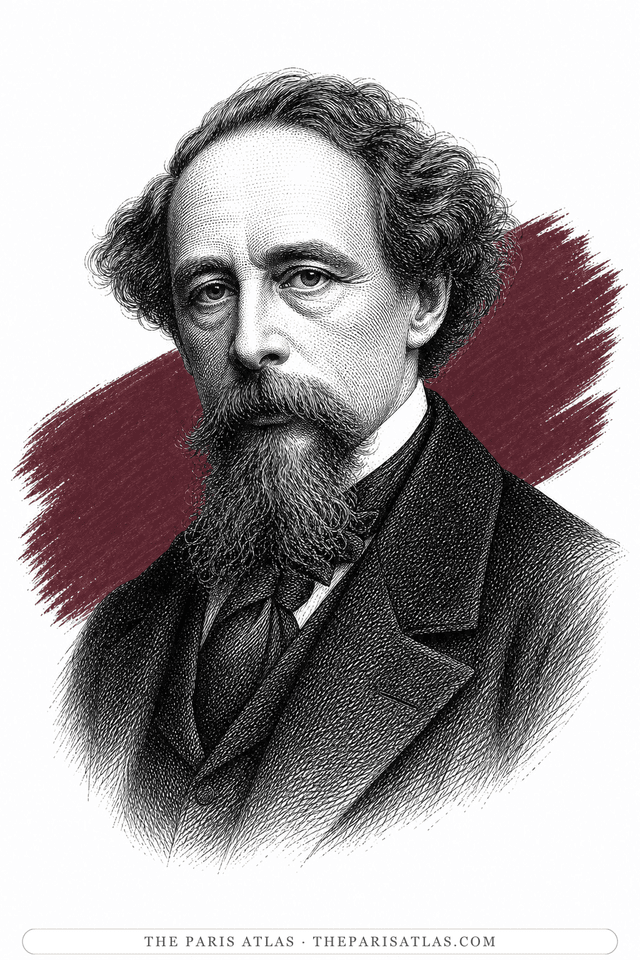
The most popular English novelist of the nineteenth century, who was never a Paris resident in the ordinary sense but kept coming back for twenty-five years: one winter in a rented mansion on the rue de Courcelles, a second winter on the Champs-Élysées writing Little Dorrit, repeated compulsive visits to the Paris Morgue — the riverside building where the city displayed its unidentified dead to the public — and a novel of the French Revolution, A Tale of Two Cities, that has shaped how English readers picture Paris ever since.
View author
The Brooklyn dropout who arrived in Paris broke at thirty-eight and wrote the exuberant, banned books that ended American censorship.
View authorThe sources below include the primary text, editions, scholarship, archival materials, and other records that informed this page. They document The Three Musketeers, its publication, and its place in literary history.

Pierre Ancery's 2016 RetroNews article on the 1844 press reception: Le Siècle's rivalry with the paper that ran Eugène Sue, Maquet's role, and the two sequels.

Sotheby's 2021 description of the first edition: Baudry, Paris, 1844, eight volumes in octavo, bound in four, and its rarity.
Larousse on Maquet: born 1813, introduced to Dumas by Nerval in 1839, chief collaborator on the Musketeers trilogy, and the 1856 lawsuit that ended the partnership.
Larousse's entry on the novel: 1844, the four in the queen's service against Richelieu, and the two sequels.
The Société's entry on the 1849 stage version by Dumas and Maquet.
AFI Catalog record for the 1948 MGM film: release date, George Sidney, Gene Kelly.
AFI Catalog record for Richard Lester's film and its United States release date.
AFI Catalog record for the 1993 Disney film and its release date.
AlloCiné record for Martin Bourboulon's 2023 film: release date, distributor and cast.
Penguin UK's page for Richard Pevear's translation: ISBN, 736 pages, translator.
Open Library record for the Oxford World's Classics edition: David Coward as editor, 2009, 663 pages.
Wordsworth's page: William Barrow's 1846 translation printed complete, Keith Wren's introduction, 592 pages.
Penguin Random House's page for the Signet edition: Eleanor Hochman's revised translation, stated complete and unabridged, 672 pages.
Open Library record for the Modern Library edition: Jacques Le Clercq's translation, 1999, 598 pages.
The primary text represented by this page, used for descriptions of the work’s contents and for any quoted passages shown here.
The primary text is the baseline reference for every book page. Additional references document publication history, interpretation, and historical context where that evidence is available.
 Explore more resources