Aramis
A musketeer of twenty-two or twenty-three who intends to become a priest, keeps a servant dressed in black, and receives letters from a duchess.
To take holy orders one day, and, until that day, to be loved by a woman of rank without anyone knowing her name.
The book
The Three Musketeers
Alexandre Dumas
At a glance
- Twenty-two or twenty-three
- The Rue de Vaugirard
- Bazin, a Berrichon, always in black
- A duchess in Tours, never named by him; the narrator names Madame de Chevreuse
Who they are in the book
Spoiler-freeAramis has an open, ingenuous face, a mild black eye and cheeks as rosy as an autumn peach. He speaks little and slowly, laughs without noise and pinches the tips of his ears to keep them pink. He is a musketeer for the time being and means to take orders; his servant Bazin already wears black in preparation. He lodges in the Rue de Vaugirard.
The women in his life are never named and always noble. A dropped handkerchief with a coronet starts his quarrel with d'Artagnan, and a letter from Tours, where Madame de Chevreuse is in exile, is enough to make him drop a thesis on theology and call for wine. The book treats his vocation as real and his worldliness as equally real.
How Aramis Is Portrayed
- The portrait, Chapter IIA stout young man of twenty-two or twenty-three with an open, ingenuous face, a black mild eye and downy rosy cheeks. His thin moustache is a straight line; he holds his hands up so the veins will not swell and pinches his ear-tips to keep them pink.
- The handkerchief, Chapter IVHe stands on a richly embroidered handkerchief with a coronet in the corner. D'Artagnan, meaning to be polite, pulls it out from under his foot, and the musketeers around them draw their own conclusions about the lady. The duel is fixed for two o'clock.
- Bazin in black, Chapter VIIHis servant is a Berrichon of thirty-five or forty, always dressed in black because his master hopes to enter the Church, who reads pious books and cooks a dinner of few dishes but excellent.
- The thesis, Chapter XXVIWounded at Crèvecœur, he is found arguing a thesis for his ordination with a curé and a Jesuit. A letter from Tours ends the argument, and he sends the theology to the devil and calls for wine.
- The prie-dieu, Chapter LXVIID'Artagnan finds him kneeling at a prie-dieu with his head on an open prayer book. He refuses the lieutenancy because the late adventures have disgusted him with military life; after the siege he will enter the house of the Lazarists.
- The convent, epilogueAfter a journey into Lorraine he disappears and stops writing to his friends. Madame de Chevreuse tells two or three intimates that he has retired into a convent, though nobody knows which.
Aramis quotes
All for one, one for all.
He judges Milady and pronounces her death with Porthos. In the epilogue he retires into a convent, and Bazin becomes a lay brother.
If you like The Three Musketeers


If you like Alexandre Dumas
Explore authors with a similar voice, perspective, and influence.

Louis-Ferdinand Céline
The doctor of the Paris slums who wrote the century's blackest, funniest novel — and changed the sound of French prose.
View author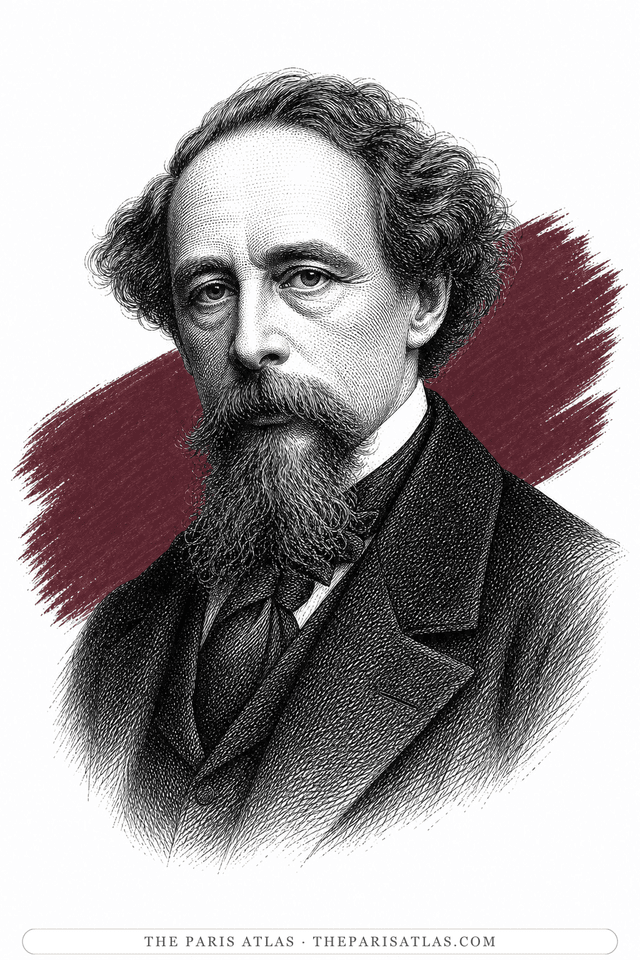
Charles Dickens
The most popular English novelist of the nineteenth century, who was never a Paris resident in the ordinary sense but kept coming back for twenty-five years: one winter in a rented mansion on the rue de Courcelles, a second winter on the Champs-Élysées writing Little Dorrit, repeated compulsive visits to the Paris Morgue — the riverside building where the city displayed its unidentified dead to the public — and a novel of the French Revolution, A Tale of Two Cities, that has shaped how English readers picture Paris ever since.
View author
Henry Miller
The Brooklyn dropout who arrived in Paris broke at thirty-eight and wrote the exuberant, banned books that ended American censorship.
View author