d'Artagnan
A Gascon of eighteen who arrives in Paris in April 1625 on a yellow pony, with fifteen crowns and a letter that is stolen before he can deliver it.
To be received into the king's Musketeers, and to keep Constance Bonacieux, whom he loves from the first evening he sees her.
The book
The Three Musketeers
Alexandre Dumas
At a glance
- Eighteen when he reaches Paris in April 1625; twenty-one at the end
- Gascony, the son of a poor gentleman of Béarn
- A garret in the Rue des Fossoyeurs, near the Luxembourg, above the mercer Bonacieux
- The Guards under Monsieur Dessessart; a lieutenant of Musketeers in the last chapter
- Planchet, a Picard whom Porthos found on the Pont de la Tournelle
Who they are in the book
Spoiler-freeD'Artagnan is the son of a poor Gascon gentleman who sends him to Paris with a horse, fifteen crowns, a recipe for a balsam that cures every wound not reaching the heart, and the advice never to fear a quarrel. On his first morning in the city he offends three musketeers in turn and agrees to fight all of them that afternoon. The duel never happens, because the cardinal's guards interrupt it and he draws his sword on the musketeers' side. He joins the Guards, not the Musketeers, and spends the book trying to earn the uniform of his friends.
He is quick, proud, easily in love and hard to frighten. He rides to London for the queen's diamonds, gets into Milady's bed under a false name, and sees the brand that she kills to conceal. Constance Bonacieux, the landlord's wife who first sets him to work for the queen, is the love he wants to keep. What the book gives him instead is the friendship of Athos, Porthos and Aramis.
How d'Artagnan Is Portrayed
- The portrait, Chapter IA Don Quixote of eighteen without armour, in a faded blue woollen doublet, with a long brown face, high cheekbones and a hooked nose. His father's sword knocks against his calves as he walks. His horse is a yellow Béarn pony of twelve or fourteen years with no hair in its tail.
- The father's advice, Chapter IThe elder d'Artagnan tells him to endure nothing from anyone except the cardinal and the king, to fight on all occasions and to fight the more because duels are forbidden. He gives him fifteen crowns, the horse and these counsels; his mother adds the balsam.
- Three duels in one afternoon, Chapter IVWithin an hour he barges into Athos's wounded shoulder, tangles himself in Porthos's gold baldric and picks up Aramis's dropped handkerchief. He is booked to fight them at noon, one and two o'clock behind the Luxembourg.
- The oath, Chapter IXAfter the Bonacieux affair he proposes the motto all for one, one for all. Athos and Aramis cry out to Porthos to hold out his hand and swear, and the four repeat the formula together.
- The ride to London, Chapters XX to XXIIHe leaves Paris with the three friends and loses them one by one at Chantilly, Beauvais and Amiens. He reaches Buckingham alone, waits while the jeweller O'Reilly replaces the two studs Milady cut at Windsor, and hands the queen her diamonds at the ballet at the Hôtel de Ville. She leaves a ring in his hand.
- Milady's shoulder, Chapter XXXVIIConfessing that he came to her bed as the Comte de Wardes, he tears her nightdress and sees the fleur-de-lis. She comes at him with a poniard; he escapes through Kitty's room in a flowered robe, a hood and slippers.
- The commission, Chapter LXVIIRichelieu writes him a lieutenant's commission in the Musketeers with the name left blank. He offers it to Athos, Porthos and Aramis in turn; each refuses, and Athos writes d'Artagnan's name in.
d'Artagnan quotes
All for one, one for all.
Never fear quarrels, but seek adventures.
Friend, be a man! Women weep for the dead; men avenge them!
Constance dies in his arms at the Carmelite convent at Béthune, poisoned by Milady. He accuses Milady first at her trial, demands her death, and then, hearing her cries on the riverbank, cannot watch; Athos draws his sword to keep him from stepping toward her. Richelieu has him arrested, reads the cardinal's own paper, tears it up and makes him a lieutenant of Musketeers. In the epilogue he fights Rochefort three times, wounds him three times, and they shake hands.
If you like The Three Musketeers


If you like Alexandre Dumas
Explore authors with a similar voice, perspective, and influence.
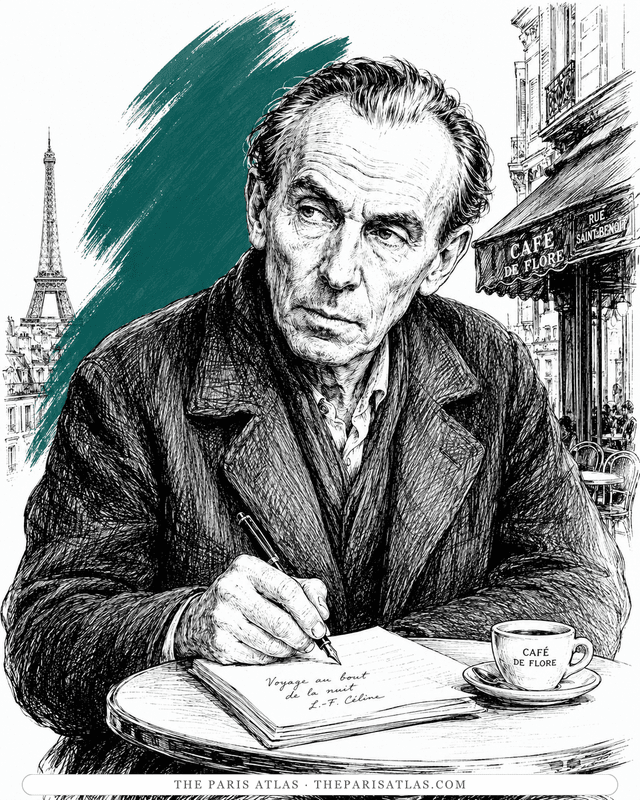
Louis-Ferdinand Céline
The doctor of the Paris slums who wrote the century's blackest, funniest novel — and changed the sound of French prose.
View author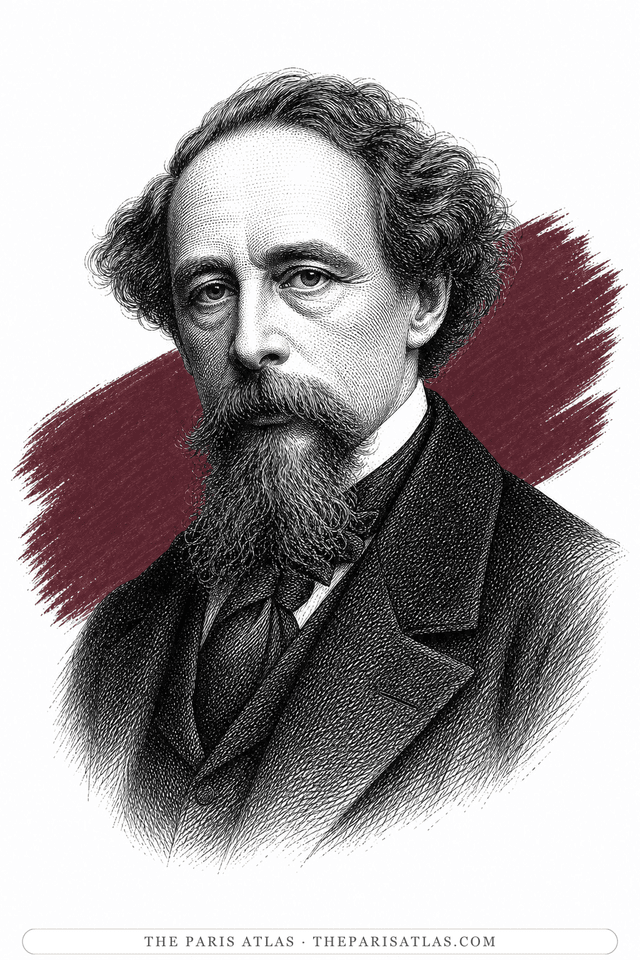
Charles Dickens
The most popular English novelist of the nineteenth century, who was never a Paris resident in the ordinary sense but kept coming back for twenty-five years: one winter in a rented mansion on the rue de Courcelles, a second winter on the Champs-Élysées writing Little Dorrit, repeated compulsive visits to the Paris Morgue — the riverside building where the city displayed its unidentified dead to the public — and a novel of the French Revolution, A Tale of Two Cities, that has shaped how English readers picture Paris ever since.
View author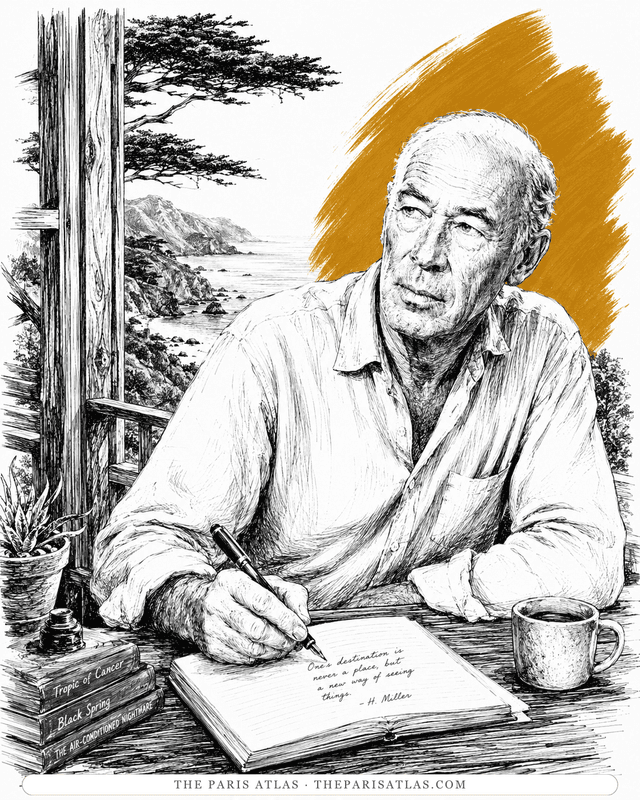
Henry Miller
The Brooklyn dropout who arrived in Paris broke at thirty-eight and wrote the exuberant, banned books that ended American censorship.
View author