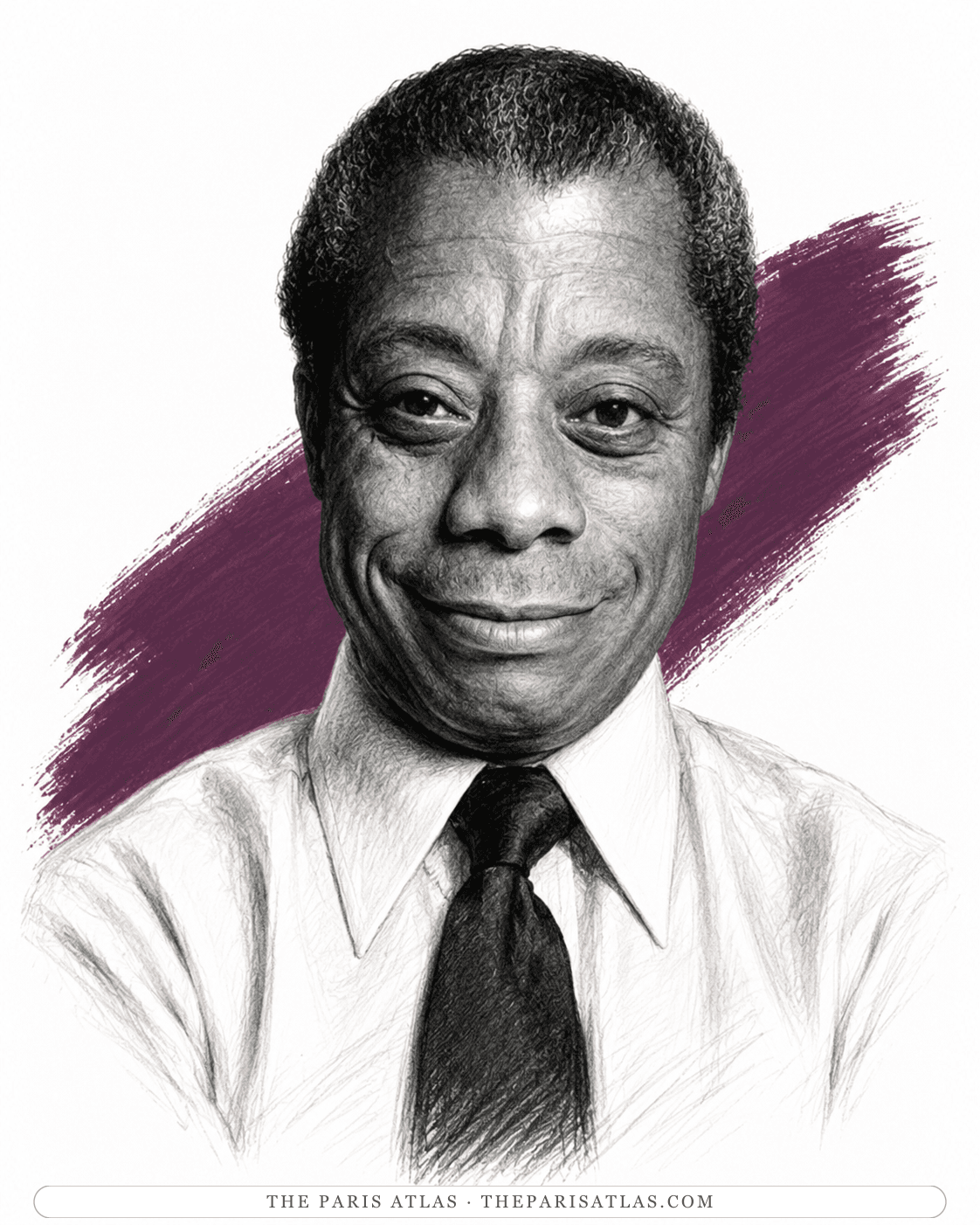
James Baldwin quotes about freedom
25 quotations, each verified against its source and credited to the work it comes from — the wording as James Baldwin wrote or said it, not as the internet passes it around. Drawn from the 316 in the full collection.
And these nights were being acted out under a foreign sky, with no-one to watch, no penalties attached—it was this last fact which was our undoing, for nothing is more unbearable, once one has it, than freedom.
If your countrymen think that privacy is a crime, so much the worse for your country.
I long to crack that mirror and be free. I look at my sex, my troubling sex, and wonder how it can be redeemed, how I can save it from the knife.
I done made up my mind to live all I can while I can. If that’s a sin, well, I’ll go on down to Hell and pay for it. But don’t you fret, Reverend—it ain’t your soul.
She thought of her mother as already in the grave; and she would not let herself be strangled by the hands of the dead.
I remember, he was later to say, the day my dungeon shook and my chains fell off.
She knew that the kind of imprisonment that love might impose was also, mysteriously, a freedom for the soul and spirit, was water in the dry place, and had nothing to do with the prisons, churches, laws, rewards, and punishments, that so positively cluttered the landscape of her aunt’s mind.
They were so free that they believed in nothing; and didn’t realize that this illusion was their only truth and that they were doing exactly as they had been told.
I love America more than any other country in the world, and, exactly for this reason, I insist on the right to criticize her perpetually.
But our humanity is our burden, our life; we need not battle for it; we need only to do what is infinitely more difficult—that is, accept it.
In overlooking, denying, evading his complexity—which is nothing more than the disquieting complexity of ourselves—we are diminished and we perish; only within this web of ambiguity, paradox, this hunger, danger, darkness, can we find at once ourselves and the power that will free us from ourselves.
It is really quite impossible to be affirmative about anything which one refuses to question; one is doomed to remain inarticulate about anything which one hasn’t, by an act of the imagination, made one’s own.
For Paris is, according to its legend, the city where everyone loses his head, and his morals, lives through at least one histoire d’amour, ceases, quite, to arrive anywhere on time, and thumbs his nose at the Puritans—the city, in brief, where all become drunken on the fine old air of freedom.
At this point, too, it may be suggested, the legend of Paris has done its deadly work, which is, perhaps, so to stun the traveler with freedom that he begins to long for the prison of home—home then becoming the place where questions are not asked.
I had not known that when one’s shoelaces and belt have been removed one is, in the strangest way, demoralized. The necessity of shuffling and the necessity of holding up one’s trousers with one hand turn one into a rag doll.
Take no one’s word for anything, including mine—but trust your experience. Know whence you came. If you know whence you came, there is really no limit to where you can go.
If the concept of God has any validity or any use, it can only be to make us larger, freer, and more loving. If God cannot do this, then it is time we got rid of Him.
They are, in effect, still trapped in a history which they do not understand; and until they understand it, they cannot be released from it.
This is why the most dangerous creation of any society is that man who has nothing to lose. You do not need ten such men—one will do.
You know, and I know, that the country is celebrating one hundred years of freedom one hundred years too soon. We cannot be free until they are free.
The power of the white world is threatened whenever a black man refuses to accept the white world's definitions.
To act is to be committed, and to be committed is to be in danger.
One can give nothing whatever without giving oneself—that is to say, risking oneself. If one cannot risk oneself, then one is simply incapable of giving. And, after all, one can give freedom only by setting someone free.
Furthermore, I have met only a very few people—and most of these were not Americans—who had any real desire to be free. Freedom is hard to bear.
I was icily determined—more determined, really, than I then knew—never to make my peace with the ghetto but to die and go to Hell before I would let any white man spit on me, before I would accept my “place” in this republic.
From the books
Every book with a quote collection of its own, each line verified against the text.
- Giovanni's Room quotes · 76 lines (1956)
- Go Tell It on the Mountain quotes · 59 lines (1953)
- If Beale Street Could Talk quotes · 41 lines (1974)
- Notes of a Native Son quotes · 76 lines (1955)
- The Fire Next Time quotes · 46 lines (1963)
Newsletter
Join our newsletter
New stories about art, literature and famous places around the world.