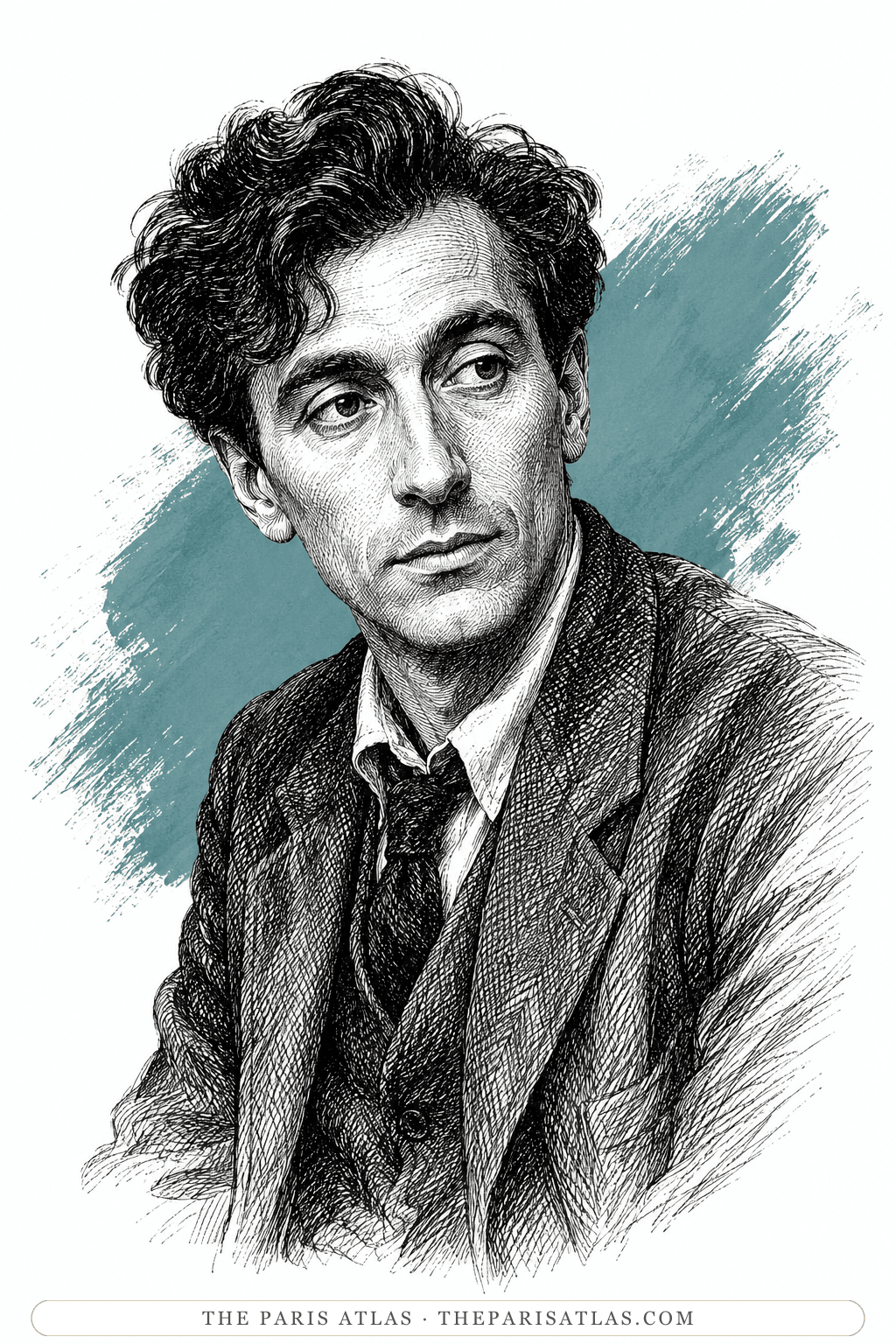
Jay
A painter Sabina knew in Paris seven years earlier and slept with, now back in New York because of the war. He dresses Fifth Avenue windows for money and paints Sabina as a woman in fragments.
To get past what he calls Sabina's false mysteries to whatever is underneath — he says so in as many words, and it is the same appetite that drives the paintings.
The book

At a glance
- A painter, an old lover of Sabina's, and one of her two judges at the end
- Montparnasse, seven years before the novel's present
- Designing Fifth Avenue window displays
- He recurs through Nin's five-novel sequence, most fully in Ladders to Fire
- Henry Miller · 1891–1980 · Paris and New York
Who they are in the book
Spoiler-freeJay is a painter in A Spy in the House of Love, the 1954 novel by the French-born American writer Anaïs Nin. He belongs to the last section of the book, at the night club where the whole cast finally sits at the same tables.
He and Sabina have a history. They met in Montparnasse seven years before, when he was one of the international artists living in Paris, and they had an affair he still finds funny to remember. He has come back to New York because the war ended that world: he tells the table that the French consulate sent a messenger asking the useless ones to leave Paris, and that the artists cleared out in a day.
He earns his living designing window displays on Fifth Avenue and is cheerfully cynical about it. He is also the person in the book who has been painting Sabina for years without her understanding what the pictures meant, and one of the two who deliver a verdict on her at the end — the other being the man with the notebook.
Readers have always identified Jay with the American writer Henry Miller, whom Nin knew closely in Paris in the 1930s, and the same figure carries that identification across the whole of her novel sequence. Miller is a model, not a portrait: Jay in this book is a painter, and nothing in the novel names him.
This profile is drawn from the Swallow Press edition of 1995, read in the Internet Archive's scan of the book.
How Jay Is Portrayed
- How he looks nowSabina finds him at a table with a face she thinks resembles Lao Tzu: half bald, rimmed with frosty white hair, the small narrow eyes half closed and laughing.
- The Fifth Avenue windowsComplimented on them, he laughs and says he has the power to stun passers-by, and that while they are stunned by modern art the advertisers can get on with their poisonous jobs.
- Leaving ParisHe describes the exodus: anyone who could not be drafted was one more mouth to feed, so the consulate sent word to let the useless ones leave. He names the friends who went to worse places than New York — one sent back to Germany, one to Spain, a Hungarian husband with polio put in a camp.
- The paintings on the wallSabina has seen his work for years without reading it. Standing in front of it in the night club she finally does: a dance of fragments to the rhythm of debris, and an exact picture of how she feels inside.
- How he used to paint herAs a mandrake with fleshly roots, carrying a single purple flower, her eyes red-gold and burning from behind trees — a tropical growth too rich for everyday life, and best seen in brief appearances.
- Brutal honestyWhen he shakes his head kindly with the slow playfulness of a bear, Sabina knows a devastating remark is coming, and that he will call it honesty. She talks faster to head it off.
- "But what is she hiding behind these false mysteries?"Said savagely, and out of genuine frustration. Her habit of raising a corner of the truth and then denying all of it provokes in him a desire he compares to the desire to force a locked door.
- The elevator in ParisHe asks whether she remembers it and then laughs uncontrollably at the memory: the two of them unable to stop kissing, riding up and down while other people kept pressing the button and failing to get in.
If you like A Spy in the House of Love


If you like Anaïs Nin
Explore authors with a similar voice, perspective, and influence.

Henry Miller
The entangled careers of the Villa Seurat: she financed and prefaced his scandal, he detonated her prose — and each wrote the other into the century's record.
View author
Louis-Ferdinand Céline
The doctor of the Paris slums who wrote the century's blackest, funniest novel — and changed the sound of French prose.
View author
Martha Gellhorn
War correspondent who covered the Spanish Civil War, D-Day, and conflicts across five more decades; Hemingway's third wife, 1940–1945.
View author