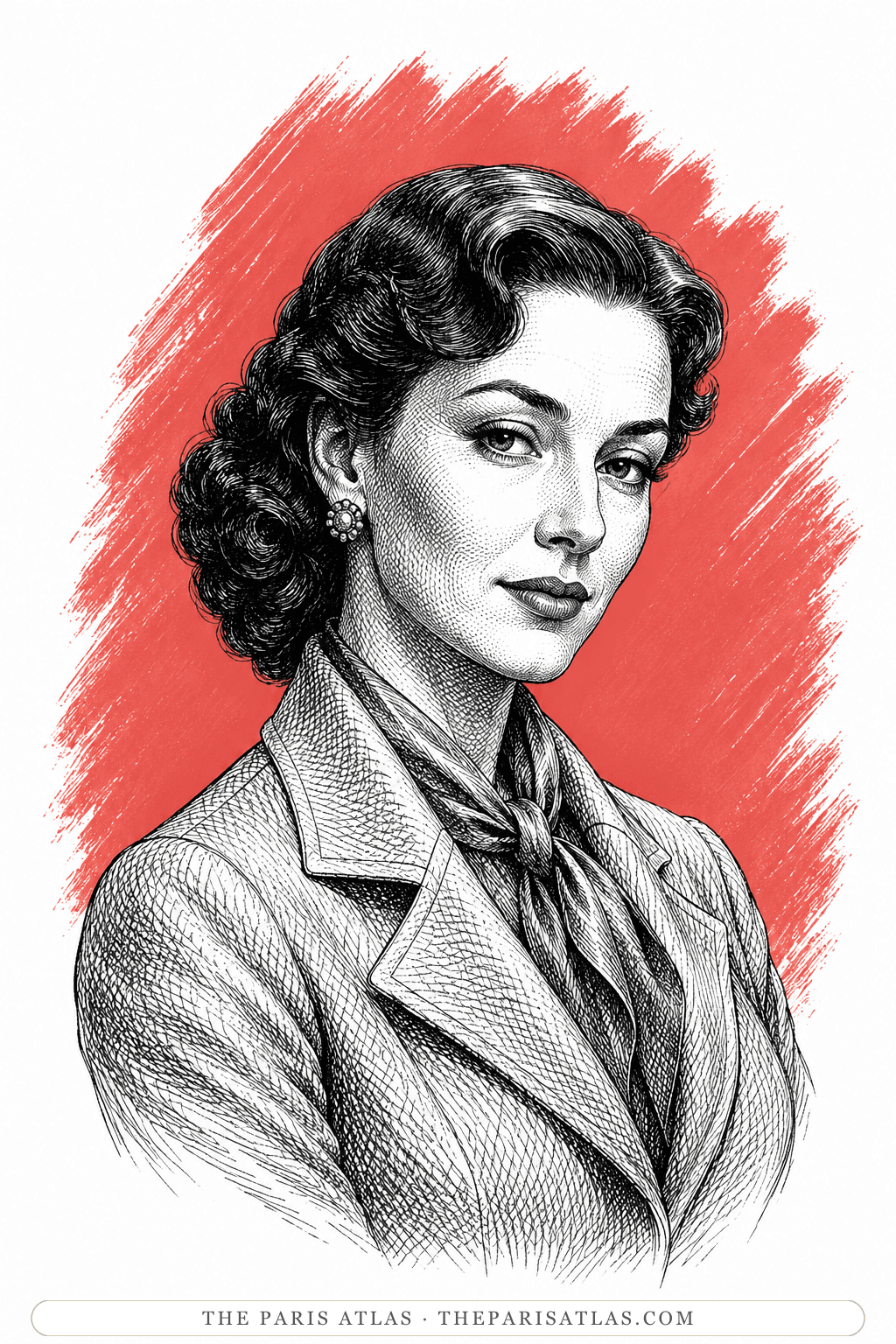
Sabina
A woman of thirty in New York who keeps several lovers at once and tells her husband she is away on tour with a theatre company. She is not an actress. The novel follows her through the days in which the arrangement starts to come apart.
To have all of her loves at once and still be one person — which she says outright, asking someone to hold her so she will stop racing from one love to another.
The book

At a glance
- The central character. She tells people she is an actress
- Thirty, and married to Alan for ten years
- New York, with an episode at a beach town on Long Island
- Hungary, which she fears could one day be used to deport her
- Alan, her husband; Philip, a singer; Mambo, a drummer; John, a grounded pilot; Donald, a young man
Who they are in the book
Spoiler-freeSabina is the central character of A Spy in the House of Love, a short novel published in 1954 by the French-born American writer Anaïs Nin. It is set in New York and on Long Island during the Second World War and just after. Sabina is thirty and has been married for ten years to a calm, much older-seeming man named Alan. She is also conducting several affairs, and she accounts for the nights and weeks she spends elsewhere by telling Alan she is an actress touring with a company. She has never acted in a play.
The novel is not a story about being caught. On its first page Sabina dials a telephone number at random in the middle of the night and reaches a man who tells her his profession is lie detector. He has the call traced, finds her in a bar within the hour, and follows her for the rest of the book. What comes after that is her circuit of lovers — an opera singer, a drummer, a young pilot invalided out of the war, a boy who cannot grow up — with a different Sabina assembled for each one, and the man with the notebook somewhere behind her.
What exhausts her is not the risk of discovery but the work of keeping the versions from meeting. She weighs which cinema to suggest by which lover might be sitting in it; she runs through her own inventions in the dark afterwards, checking them for contradictions. The book gives that condition a phrase and repeats it: she is a woman in pieces, and the pieces are all sincere.
This profile is drawn from the Swallow Press edition of 1995, read in the Internet Archive's scan of the book. Sabina had appeared once before, in Nin's 1936 prose poem House of Incest, and she recurs across the five linked novels Nin called the continuous novel; this is the one that belongs to her.
How Sabina Is Portrayed
- Dressing as a costume decisionShe chooses clothes the way an actor is assigned a part, and the choice is made against fear rather than for pleasure. The cape is her favourite because she believes it carries a swagger she thinks men are allowed and women are not: a toreador's fling, a warrior's shield, a flag of attack. On one morning the mirror, the shoes and the cape each tell her she is prepared.
- Red and silver, the first time she is seenThe man who has come to the bar to find her sees a woman in red and silver and thinks of fire engines going through New York, the gong of catastrophe. His first thought on looking at her is that everything will burn.
- The dress with a hole in the sleeveShe keeps wearing it because of what it once let her say. Standing outside a restaurant too grand for her nerve, she could not admit she was afraid to go in, so she said instead that she could not go in with a hole in her sleeve.
- Stories that erase themselvesIn the bar she describes visiting the baths in Morocco and learning from the prostitutes there how to paint her eyes with kohl. Asked whether she got an infection, she says the kohl is blessed at the mosque. Then she starts another story that cancels the first, and no listener can say afterwards whether she was in Morocco, read about it, or heard it in a bar.
- The wedding ring at the bottom of the bagOn her way to a lover she sits down on a Fifth Avenue bus, opens an overfull handbag, and replaces her wedding ring with a Hindu ring hung with tiny bells. The wedding ring goes to the bottom of the bag. Every gesture she makes for the rest of the evening is accompanied by a small ringing.
- Coming homeShe arrives back to Alan needing a bath and a change of clothes immediately, which he never understands. Then she lies awake beside him going over what she has just told him — the hotel she described but never stayed in, the actors she named — checking it for anything that could later be disproved.
- The body that will not follow the planLying at the bottom of a sailing boat with the singer Philip, at the moment she has arranged and pursued, nothing happens. Nin writes it flatly: high fever and no climax. Sabina is angry at a core in her that will not melt, and the unspent heat is what makes strangers say how sensual she is.
- Small enough to be run overWalking down a street lined with truck garages, she feels the wheels grow to her own height and her bones turn brittle. A tall woman appears beside her walking without terror, and then vanishes: it was a shop mirror. The reflection is a strong woman of thirty. The self underneath it could be crushed by a wheel.
- The name she does not answer toSomeone in the bar leans over and shouts her name at her, and she does not respond at first, as if it were not her own. Someone nearer repeats it before she acknowledges it.
Nothing is exposed and nobody is punished. In the last pages Sabina sits in a night club with the painter Jay, the dancer Djuna and the lie detector, and the reckoning is a conversation. Djuna tells her the man following her is her own guilt in a borrowed shape, and that the enemy of a love is never outside it. The lie detector tells her she invited him herself, gave him the power to judge her, and that a court would have sentenced her more lightly than she sentences herself. He also tells her that Philip is in hospital with a broken ankle and has put on weight, and watches her turn her face away from the wreck of a man she had dressed as a myth.
Djuna takes her upstairs to her studio and puts a record on. A Beethoven quartet plays. Sabina slides down to the floor against the phonograph, her skirt spreading and settling like a parachute coming down, and weeps. The lie detector's last line is an offer of a homeopathic remedy for people who cry at music, which is either a kindness or the final joke at her expense.
If you like A Spy in the House of Love


If you like Anaïs Nin
Explore authors with a similar voice, perspective, and influence.

Henry Miller
The entangled careers of the Villa Seurat: she financed and prefaced his scandal, he detonated her prose — and each wrote the other into the century's record.
View author
Louis-Ferdinand Céline
The doctor of the Paris slums who wrote the century's blackest, funniest novel — and changed the sound of French prose.
View author
Martha Gellhorn
War correspondent who covered the Spanish Civil War, D-Day, and conflicts across five more decades; Hemingway's third wife, 1940–1945.
View author