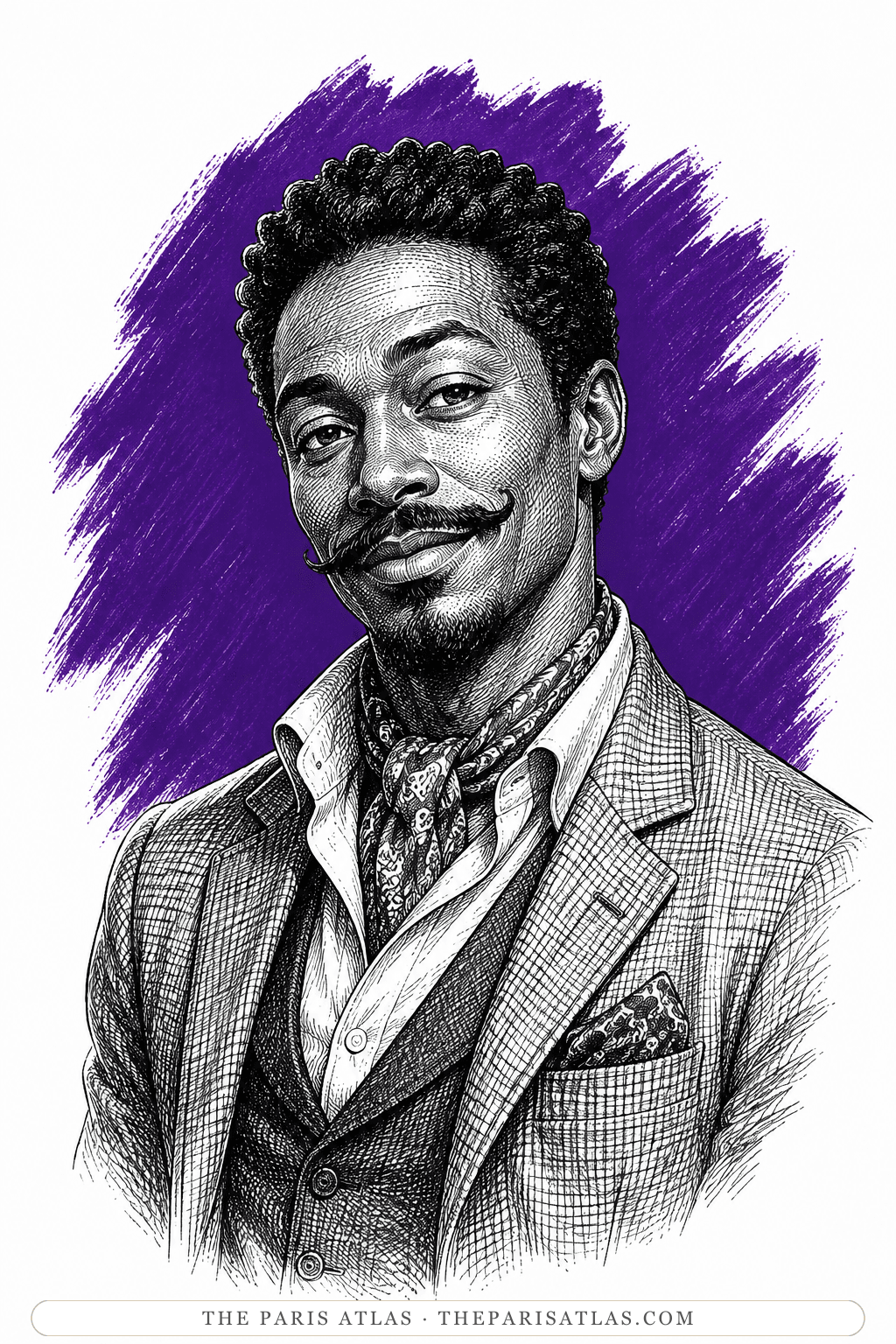
Mambo
A drummer who owns the New York night club named after him. He is a composer and a writer, and he accuses Sabina of wanting the drummer and never the artist. The novel's sharpest exchange belongs to him.
To be loved as the composer he is rather than the drummer she desires — he says so directly, more than once, and it is the only thing he asks her for.
The book

At a glance
- A drummer, and one of Sabina's lovers
- The New York night club that carries his name
- A mathematician, a composer and a writer, not an entertainer
- A Caribbean island Sabina has never seen and imagines constantly
Who they are in the book
Spoiler-freeMambo is one of Sabina's lovers in A Spy in the House of Love, the 1954 novel by the French-born American writer Anaïs Nin. He is a Black musician from an island, and he runs the New York night club that carries his name. He lives on a small street without an exit, where Sabina pictures his name on a letter box alongside those of E. E. Cummings and Djuna Barnes.
Sabina finds him through his drumming, after her husband gives her records of island music she cannot travel to hear. She takes him for what the drumming makes her feel, and Mambo knows it. He is the only one of her lovers who names what she is doing to him while it is happening.
The book is explicit about the sexual side of the affair and about how much of it runs on Sabina's fantasy of his island. It is also explicit about his objection: he is a mathematician, a composer and a writer, and none of that is what she has come for.
This profile is drawn from the Swallow Press edition of 1995, read in the Internet Archive's scan of the book.
How Mambo Is Portrayed
- Formal Spanish between setsWhen the musicians stop playing they sit at a table near Sabina's and talk in an elaborate, stilted sixteenth-century colonial Spanish, the language of old ballads. Their politeness makes her smile and tempts her to break it.
- Turning round at the sound of a ringSabina shakes her cigarette against her vanity case and the little bells on her Hindu ring tinkle. The drummer turns his face to her and smiles, as if such a small sound were an inadequate answer to his drumming.
- "For me, it's everything or nothing."The anger arrives suddenly, in the middle of a gentle refusal. He tells her he has known a woman like her before, that what she feels is desire but not for him, and that it is aimed at his race and at a sensual power he is presumed to have.
- "Because I am African."He takes her by the wrists and speaks close to her face: everywhere desire, and at the moment of giving, withdrawal. He asks what she actually knows about him, and tells her he is not an entertainer. Then he asks whether she would come to his island, marry him, bear his children and wait on his grandmother — knowing the answer.
- The standing reproach"You don't love me" is the sentence he repeats to her through the affair, and the novel says he is right: what she embraces in him is the music, the trees, the drums and the island he came from.
- "Drum! Mambo, drum! Drum for me."Said in bed, at the point where the difference between them has almost closed. It reopens it.
- His loyalty, from the outsideA regular at the club explains that Mambo cuts off his drinks early in the evening so he will not lose his job at the morgue, and that once Mambo starts drumming nothing can sober him up or make him keep a promise.
If you like A Spy in the House of Love


If you like Anaïs Nin
Explore authors with a similar voice, perspective, and influence.

Henry Miller
The entangled careers of the Villa Seurat: she financed and prefaced his scandal, he detonated her prose — and each wrote the other into the century's record.
View author
Louis-Ferdinand Céline
The doctor of the Paris slums who wrote the century's blackest, funniest novel — and changed the sound of French prose.
View author
Martha Gellhorn
War correspondent who covered the Spanish Civil War, D-Day, and conflicts across five more decades; Hemingway's third wife, 1940–1945.
View author