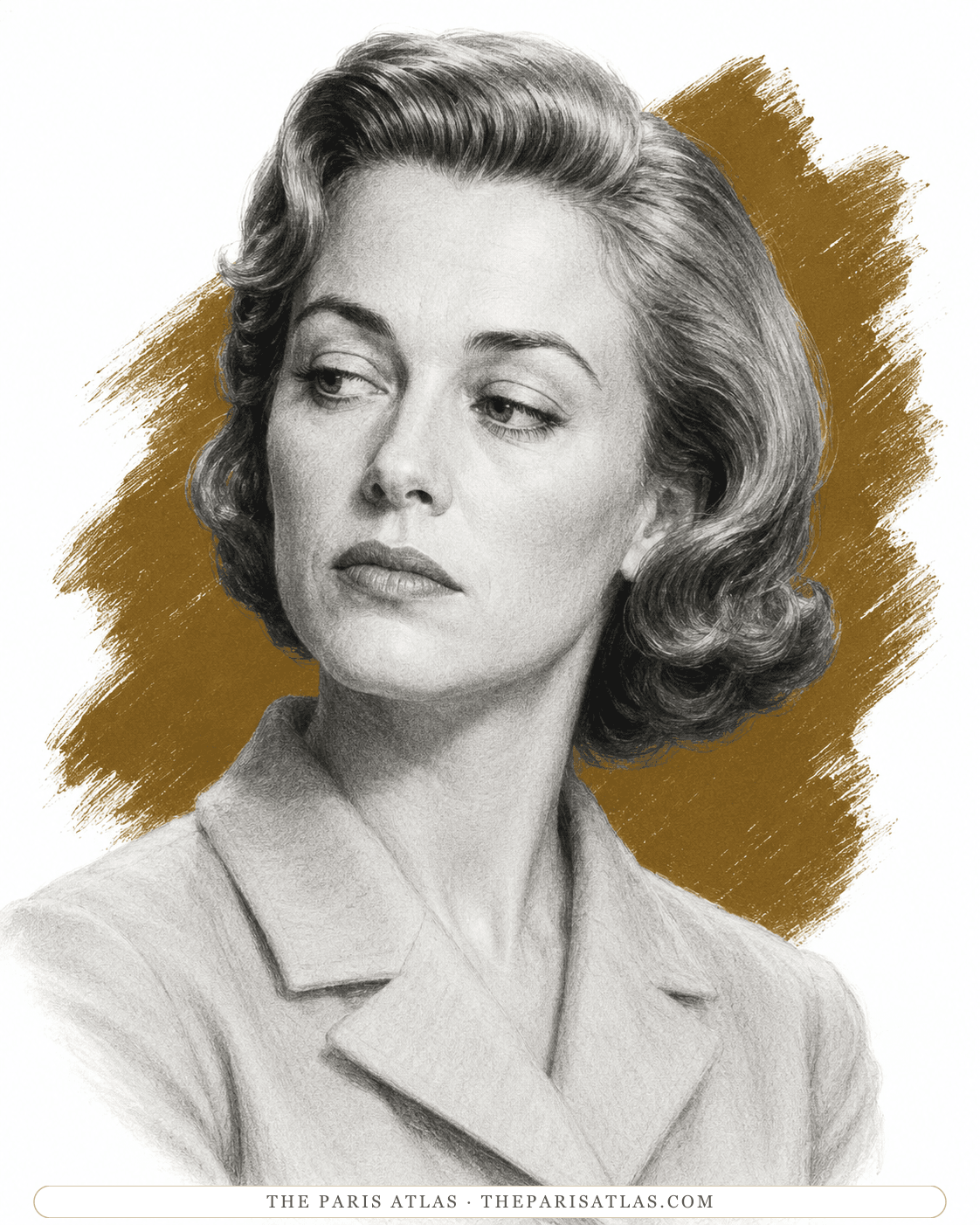
Cass
Married to Richard, and increasingly unable to respect the man his success has made him.
To be seen by her husband again. She says it to Vivaldo before she says it to anyone else, and then twice more in the same breath, so that it is unmistakable.
The book

At a glance
- Richard Silenski's wife; mother of Paul and Michael
- Clarissa
- Thirty-four
- New England, of "plain old American stock"
- Twelve years, since the middle of the war, when she was twenty-one
- Paul, eleven; Michael, eight
- An apartment with wide windows over the river
Who they are in the book
Spoiler-freeCass Silenski is the one settled adult among James Baldwin's invented New Yorkers, and the settlement does not hold. She is thirty-four, married twelve years to the novelist Richard Silenski, and the mother of two boys, Paul, who is eleven, and Michael, who is eight. The family lives in an apartment with wide windows over the river, cheap for what it is because the previous tenants stayed so long, and the others in the book envy the space.
She comes from New England, of what she calls plain old American stock, and she is fond of remembering that one of her ancestors was burned as a witch. She met Richard during the war, when she was twenty-one and he was twenty-five; she waited it out near a San Francisco shipyard while he spent most of his service in a quartermaster depot in North Africa. She is small and fair, and the book keeps noting that people underestimate her size.
Her given name is Clarissa. She does not use it, and when Ida Scott finds the dedication page of Richard's novel — for Clarissa my wife — she tells Cass she does not seem like the Clarissa type. That small dislocation is close to Cass's whole trouble. She has spent twelve years shaping her life around a man, saying no to things because of him and believing things because of him, and the novel opens the question of what she did to Richard in the process.
By the summer she has two problems she cannot say out loud in the same room. Richard has published a successful murder novel and become someone whose work she does not think is serious. And she has stopped being visible to him. She puts it to Vivaldo Moore in a cocktail lounge, crying without bothering to stop: he doesn't see me any more — he doesn't see me.
How Cass Is Portrayed
- The smileRufus meets it in Washington Square and finds it at once chilling and warm. It is warm because it is affectionate and chilling because it is amused. It is the first thing anyone in the book notices about her, and it goes on being accurate.
- The witchShe describes herself as New England, of plain old American stock, and enjoys mentioning the ancestor who was burned as a witch. Rufus, who cannot quite place her in the white world she seems to belong to, finds her thoroughly mysterious.
- Small and fairFrail and fair when Rufus first sees her sitting alone on the rim of a circle in the park; her head is the golden one in a silhouette at sunset. Eric, walking her through a museum, thinks she stands as erect as a soldier and is no bigger, as they said in the South, than a minute. Vivaldo, who has known her since he was a boy, only slowly registers that she is a woman with good legs who knows how to move.
- ClarissaRichard's book is dedicated for Clarissa my wife, and Ida reads it out at the bar and says Cass had her fooled, that she does not seem to be the Clarissa type. Cass says Richard put it there partly to tease her.
- The householdThe Saturday she hosts the publication lunch, one boy has been fighting with everybody since breakfast, Richard has spanked him, and Cass greets her guests in the hall apologizing for absolute chaos while the shouting sorts itself out down the corridor. She reappears later in a high-necked, old-fashioned, burgundy dress with her hair up.
- What she does all dayHer own account: she sits in that house like a housekeeper, minds the children, makes meals, scrubs toilet bowls and answers the phone, and her husband does not see her. She adds that she has never been aggressive and has never had to be.
- The thing she cannot say at homeShe has told Vivaldo in front of Richard that the book is wonderful and he must read it. Alone with Vivaldo she says she does not think Richard's work is any good any more and that he cannot forgive her for it. She reports Richard's verdict on her as well: that she is a New England snob and a man-killer.
- Counting the hoursWorking herself up to a phone call, she takes a taxi to the Loew's Sheridan, climbs to the balcony, cries at a Doris Day picture, checks her watch, tells herself that she is thirty-four years old and should go downstairs and call him, and then makes herself wait.
- At the funeralShe goes because Vivaldo cannot face going alone, sits in the last row nearest the door, and is one of only two white people in the chapel. Watching Rufus's father weep in the front row, she thinks that whatever was in that man's heart has gone into oblivion with his son and will never be expressed now.
- Cross-examined by IdaCass offers, unwillingly and knowing it is a bad question, that she deserves some credit for walking out of the world she came from. Ida asks her what exactly she has walked out on, and suggests they call it nature instead: that Cass saw Richard, wanted him, and got married. Cass gets angry and cannot say why.
- Her manners with servants of the plotShe uses Vivaldo and Ida as cover for where she is going, and knows she is doing it. When Ida later uses her the same way, Cass recognizes the transaction, does not object, and finds the cigarette bitter.
- What she sees in IdaStanding in her own living room while Ida asks a room of white people where her brother is, Cass notices that some part of Ida is enjoying it — the attention, the power she holds for the moment. It makes Cass angry, and then she thinks: good, it means she will get through whatever is coming. She has already started preparing herself for the worst.
- EnvyRiding home from the funeral, listening to Vivaldo hum the blues under his breath and think about Ida, she finds herself hating his youth and his expectations and his masculinity, and envying Ida. It is the first sign the book gives that her own arrangement is not going to hold.
If you like Another Country


If you like James Baldwin
Explore authors with a similar voice, perspective, and influence.

Louis-Ferdinand Céline
The doctor of the Paris slums who wrote the century's blackest, funniest novel — and changed the sound of French prose.
View author
Henry Miller
The Brooklyn dropout who arrived in Paris broke at thirty-eight and wrote the exuberant, banned books that ended American censorship.
View author
Ernest Hemingway
Author of The Sun Also Rises and A Moveable Feast; his pared-down style, developed in 1920s Paris, became the most imitated in American prose.
View author