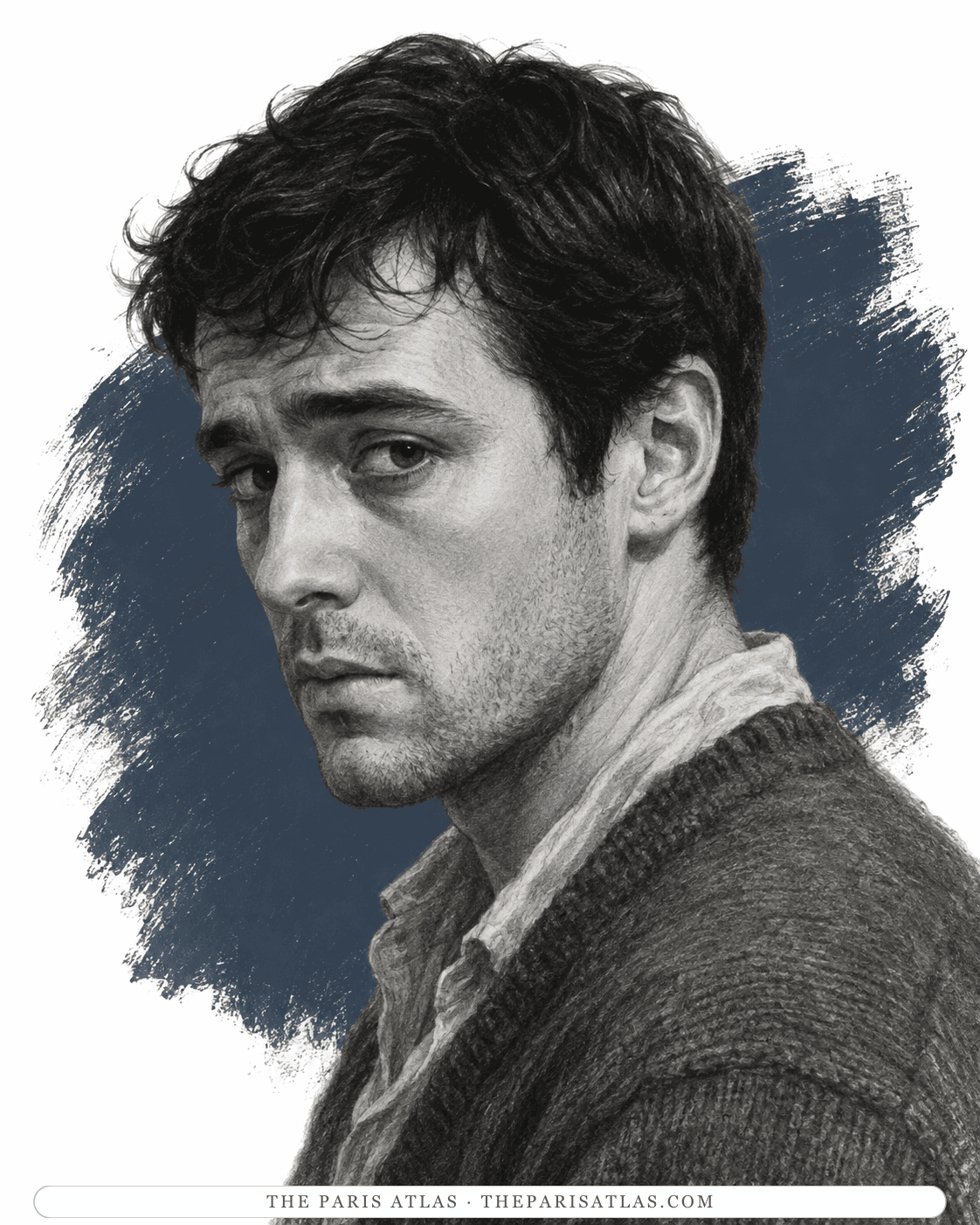
Vivaldo Moore
A struggling white novelist, Rufus's closest friend, and unable to stop asking himself what he failed to see in time.
To finish the novel and to be loved. He puts both into the same insomniac thought, face down on the bed: I've got to finish that damn novel, and then, Oh, God, make her love me, oh God, let me love.
The book

At a glance
- Clerk in a midtown bookshop; a novelist who has not finished a novel
- Daniel Vivaldo Moore
- Twenty-eight
- The slums of Brooklyn; the family runs a hardware store
- A first-floor apartment on Bank Street, in the Village
- A novel about Brooklyn, begun at seventeen
- Cass and Richard Silenski — Richard taught him English in high school
Who they are in the book
Spoiler-freeVivaldo Moore was the last person to see Rufus Scott alive, and he spends the rest of James Baldwin's novel on that fact. His full name in the book is Daniel Vivaldo Moore, and Rufus introduces him to strangers as an Irish wop. He is white, he is twenty-eight, works in a midtown bookshop and takes moving jobs on the side, and has been writing a novel for so long that Cass Silenski dates it from when he was seventeen.
He grew up in the slums of Brooklyn over a family hardware store, with a father he describes as an awful coward, a mother going quietly mad behind the counter, a brother, and a sister he speaks about with contempt. He also ran with a gang there, and the worst thing he tells anyone in the book he did with them. He got out to the Village and to Harlem, where, he admits, he was hardly ever there in the daytime.
The novel he cannot finish is about Brooklyn. His difficulty with it is stated as a difficulty with people: the characters are all named and all destined, and none of them will move or speak convincingly, because they do not trust him. Baldwin lines this up against everything else Vivaldo does, which is to press people for a candour he will not offer first.
After the funeral he begins seeing Ida Scott, and by April she has moved into his apartment on Bank Street. The relationship is the rest of his story. He loves her, he is jealous of the producer paying for her singing lessons, he cannot say so, and he spends whole nights in phone booths ringing his own apartment. He is also, by his own account, sure that he loved Rufus, and increasingly unsure whether that is true or whether he feared and envied him.
How Vivaldo Moore Is Portrayed
- How he looksTall, lean and clumsy. Rufus's own phrase for him is the tall, lean, clumsy white boy who was his best friend. Black hair, black eyes, black eyebrows and a very white face; arriving at a door out of the rain, his features read to Cass as so many streaks of charcoal on a dead white surface. Long, heavy hands. His hair falls into his eyes and he throws his head back sharply to clear it.
- Ida on his feetIntroducing him to Cass in a joke voice, she says she would not trust him with any tools whatever, that he is just as clumsy as they come, and that she is always expecting him to fall over those front feet he's got.
- Two jobs and a typewriterSome weeks he works nights at the bookshop and some weeks days; on top of that he takes moving work. He will not take the better-paid jobs, because they come with a future he does not want. The typewriter sits in the room accusing him of the years he has spent chasing easier and less honourable seductions instead.
- BrooklynA hardware store, a father who pretended everything was fine while knowing neither of his sons respected him, and a neighbourhood where you had to be tough because people were dying around you all the time for nothing. He says his whole family thinks he is a bum and are mainly frightened of what he will do next.
- What he did with the gangHe tells Cass about it in a taxi on the way back from the funeral, and says he has never known whether the man lived. Seven of them drove a young homosexual from the Village to a Brooklyn garage, forced him to perform oral sex on all of them, beat him, took his money and his clothes and left him on the cement floor in winter.
- JaneThe girlfriend before Ida: grey-haired, older than him, never combed, in ravelled sweaters and paint-covered jeans, and given to loud performances about race in front of Black strangers. A night out with her and Rufus ended in a bar fight that put Vivaldo in hospital for ten days and cost him three stitches in the scalp.
- What he tells Rufus about blameAsked directly whether he blames him for what happened to Leona, Vivaldo says that if he were not Rufus's friend he probably would, that Rufus acted like a bastard, and that he is not going to put him down for it: we're all bastards, that's why we need our friends.
- The vigilThe last time he saw Rufus before the disappearance, he stayed the night rather than leave him alone. Lying beside him in the dark he had the feeling that Rufus wanted to be held, and that it had to be by a man, and he did not move. He tells this to nobody for a year, and says he was afraid Rufus would not understand that it was only love.
- The phone boothsWhen Ida is out he rings his own apartment from bars and lets it ring, then goes back, drinks, and rings again. He constructs whole itineraries for her — the singing teacher, the restaurant, the producer's office — and works out how long these things take. He describes himself, accurately, as making himself sick with his fears and his fantasies.
- What he says to Eric about herThat he cannot see how he can live with Ida and cannot see how he can live without her, that he gets through every day on a prayer, and that every morning he is surprised to find her still beside him.
- The street scene with JaneRunning into her on MacDougal Street with a new man, he is treated to a loud performance about how liberal he is and what she would do if she were as liberal as he is. He walks away before it turns into something worse, and notices that the Black men on the street now suspect him of being an ally and the Italians he grew up among now know he cannot be trusted.
- The question underneathAlone in a bar, he asks himself what Ida sees when she looks at him, whether he loves her at all, and whether he dared offer himself to her only because she was not white and so would not dare despise him. Baldwin lets the question stand without answering it.
If you like Another Country


If you like James Baldwin
Explore authors with a similar voice, perspective, and influence.

Louis-Ferdinand Céline
The doctor of the Paris slums who wrote the century's blackest, funniest novel — and changed the sound of French prose.
View author
Henry Miller
The Brooklyn dropout who arrived in Paris broke at thirty-eight and wrote the exuberant, banned books that ended American censorship.
View author
Ernest Hemingway
Author of The Sun Also Rises and A Moveable Feast; his pared-down style, developed in 1920s Paris, became the most imitated in American prose.
View author