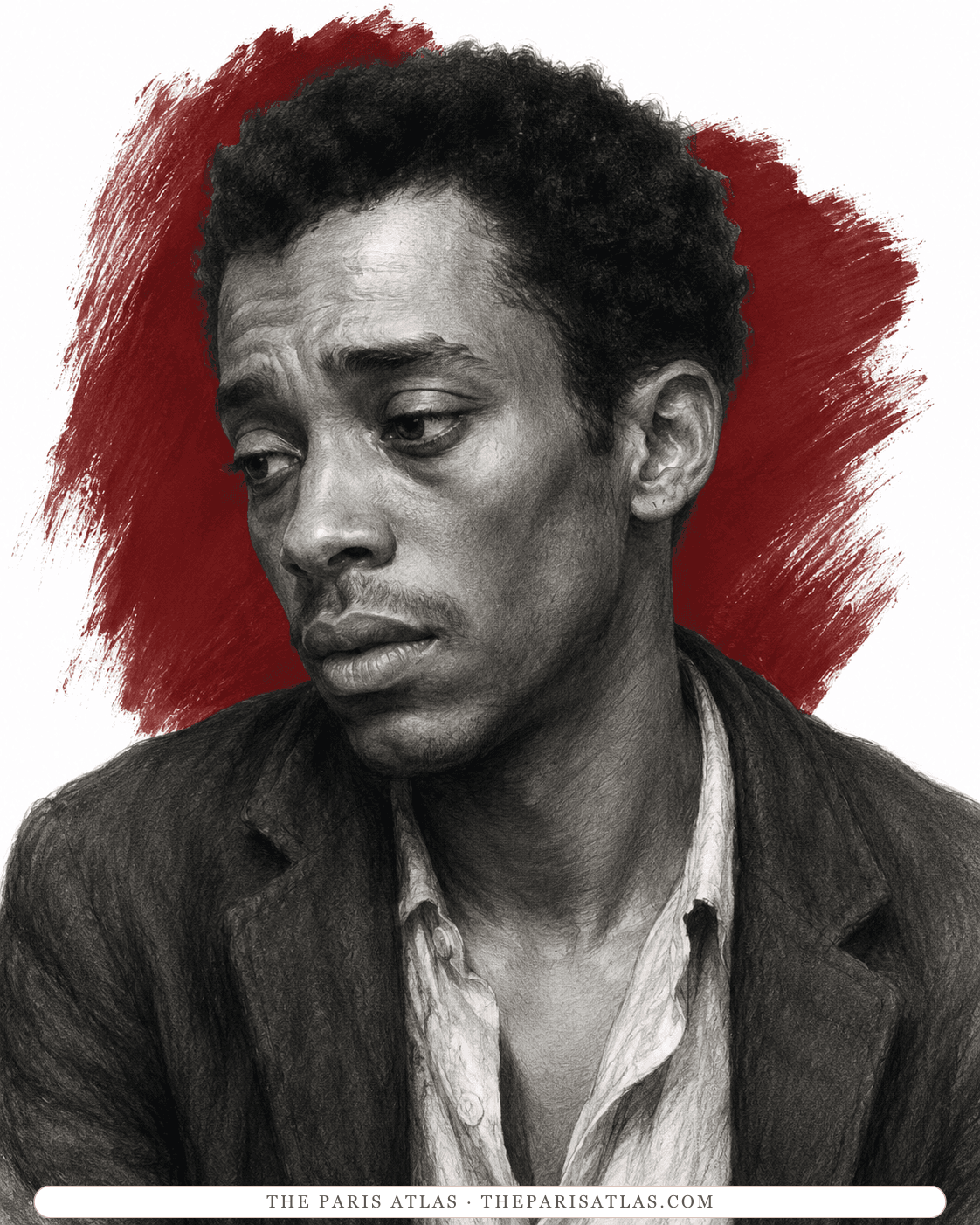
Rufus Scott
A Black jazz drummer in New York, out of work and out of money. He dies early, and the rest of the novel is what his death leaves behind.
To be helped, and to be loved by somebody who is not paying him for it or being paid by him. He says the first part out loud once, to Vivaldo, after dropping the knife he had been holding: "Somebody's got to help me, somebody's got to help me. This shit has got to stop."
The book

At a glance
- Jazz drummer, New York; out of work
- Born on the eastern edge of Harlem, a block from the Harlem River
- Ida Scott, his younger sister; parents still in Harlem
- The Navy; he came back through England
- Bought for him by his father
- Vivaldo Moore, who lives on Bank Street in the Village
- Leona, at St. James Slip, on the edge of the island
Who they are in the book
Spoiler-freeJames Baldwin's novel opens on Rufus Scott and then spends four hundred pages on his absence. He is invented, like everyone else in the book: a jazz drummer in New York, out of work since the night the story flashes back to, and in hiding for about a month by the time the first page finds him. He is walking north on Seventh Avenue in a leather jacket and summer slacks in freezing weather, riding the subways at night because he has nowhere to sleep. He wants to use the bathroom in a jazz club he knows and cannot make himself go in, because someone will recognize him and see the state he is in.
He grew up on the eastern edge of Harlem, a block from the Harlem River, where he and other children swam off the garbage-heavy bank. His father, a broken-down man who worked hard for very little, played guitar for him at weekends and bought him his first set of drums. He has a younger sister, Ida Scott, and he was in the Navy long enough to bring her an Indian shawl back from England. Baldwin gives the moment she puts it on as the moment Rufus first sees that Black people are beautiful.
The affair that ends his working life begins at a club on 125th Street, where he picks up a white woman from Georgia named Leona. They move in together, first in the Village and then on the eastern edge of the island, and he beats her, repeatedly and without a reason he can name, until her family has her committed. Baldwin does not present the violence as a mystery to Rufus. He knows what he is doing while he does it, and the knowledge is part of what destroys him.
After Leona is taken back to Georgia, Rufus disappears for six weeks. He surfaces once, at his friend Vivaldo Moore's apartment on Bank Street, eats a pizza, drinks, and spends an evening at a bar with the people who used to be his friends.
Then he walks to the George Washington Bridge and jumps. He dies by suicide about eighty pages into a four-hundred-page novel. The book gives the reasons circumstantially rather than as a single cause: no work and no money, no place to sleep, a night on the street that ended with him accepting a sandwich from a man he could not bear to be touched by, the police who look at him in a way they do not look at his white friends, and the fact that the person he had hurt most was also the last person who loved him.
How Rufus Scott Is Portrayed
- The night the book opensFreezing weather and summer clothes. He pulls up the collar of a leather jacket, and the wind gets through his slacks; his shoes and trousers are too thin, his stomach is growling, and he does not dare stop to take a leak. He has been in hiding for nearly a month and has been riding the subway all night. Outside the jazz club he imagines somebody looking up and saying, Isn't that Rufus Scott?, and he cannot go in.
- The drummerHis father bought him his first set of drums. By the time we meet him he is well enough known that people used to come up to the stand to tell him he would do great things. The book stages his last night of work around another musician's solo, a young saxophonist blowing one phrase over and over, which Rufus hears as the question Do you love me? When the set ends, Baldwin notes flatly that he had played the last set of his last gig.
- How he movedVivaldo had never associated him with violence, because his walk was always deliberate and slow and his tone mocking and gentle, and then remembers how Rufus played the drums. Eric, years later and an ocean away, remembers a half-beat, loping, cocky walk, the way he held a cigarette, and the way he threw his head back when he laughed.
- What a year had done to his faceVivaldo knows the face so well that he has stopped looking at it. When he does look, in the last week, he finds fine lines in the forehead, a deep crooked line between the brows, and a tension that has soured the mouth. He wonders what the eyes are seeing, because they had not been seeing it a few years before.
- The sisterHe teases Ida, and he is proud of her, and he is also aware that she expects a great deal of him and is watching. He knows in advance exactly what she will say about a white girlfriend, and he rehearses her line to himself before she can say it: that he would never have looked twice at Leona if she had been Black.
- How he sees LeonaHe looks at her in the club and registers her as poor and Southern and white before anything else: a damp, colorless face, straight pale hair, older than he is, probably over thirty, a body too thin. He decides on the spot that he wants her. Walking out into the street at three in the morning he realizes she will shortly be the only white person left in the crowd, and it makes him uneasy, and the uneasiness makes him angry.
- The beatingsThe novel states them without cushioning. He accuses her, repeatedly and falsely, of sleeping with other Black men. He throws her down, pins her against furniture, drags her by the hair, and uses her in whatever way he thinks will humiliate her most; and then leaves and picks fights with white men in bars. He tells Vivaldo, unprompted, that he knows what he did to her.
- The man outside the barLate in his last weeks a well-dressed white man comes out of a bar and offers to feed him. Rufus takes a corned beef sandwich on rye, cannot keep it down, and is certain everyone in the room knows the arrangement. In the street afterward he says he has nothing to give anybody, and then, twice, "I was hungry." He tells the man he doesn't want to die and doesn't want to kill him and asks to be let go to his friends. The man lets him go.
- What he did to EricEric Jones, a white actor from Alabama, had a pair of cufflinks made for Rufus's birthday with the money that was to have bought his own wedding rings. Rufus took the gift as a confession and used it. Baldwin is explicit that Rufus despised Eric for being Southern and may have slept with him in order to despise him more completely, and that he told Eric he was inferior to a woman. He remembers it, on his last night alive, as something he wishes he could undo.
- The knifeVivaldo walks into the apartment on the last night of the Leona period and finds Rufus standing near the door holding a knife. Vivaldo says he is not trying to hurt him, only to help. Rufus stares, seems to want to believe it, drops the knife and falls against him, shaking.
- The questions he asksLying on the bed afterwards he asks Vivaldo whether he has ever wished he were queer, and then what two people want from each other when they get together, and whether Vivaldo knows. Vivaldo says he just wants to get laid. Rufus laughs until he cries, and it is the worst laugh Vivaldo has ever heard.
- The last eveningAt Benno's Bar the room seems to him like something remembered from a dream. A girl he once slept with looks straight at him and does not appear to recognize him. When Cass and Richard Silenski leave and only Vivaldo and his girlfriend Jane are left, the empty seats between them feel to Rufus like a chasm between himself and the white boy and the white girl.
If you like Another Country


If you like James Baldwin
Explore authors with a similar voice, perspective, and influence.

Louis-Ferdinand Céline
The doctor of the Paris slums who wrote the century's blackest, funniest novel — and changed the sound of French prose.
View author
Henry Miller
The Brooklyn dropout who arrived in Paris broke at thirty-eight and wrote the exuberant, banned books that ended American censorship.
View author
Ernest Hemingway
Author of The Sun Also Rises and A Moveable Feast; his pared-down style, developed in 1920s Paris, became the most imitated in American prose.
View author