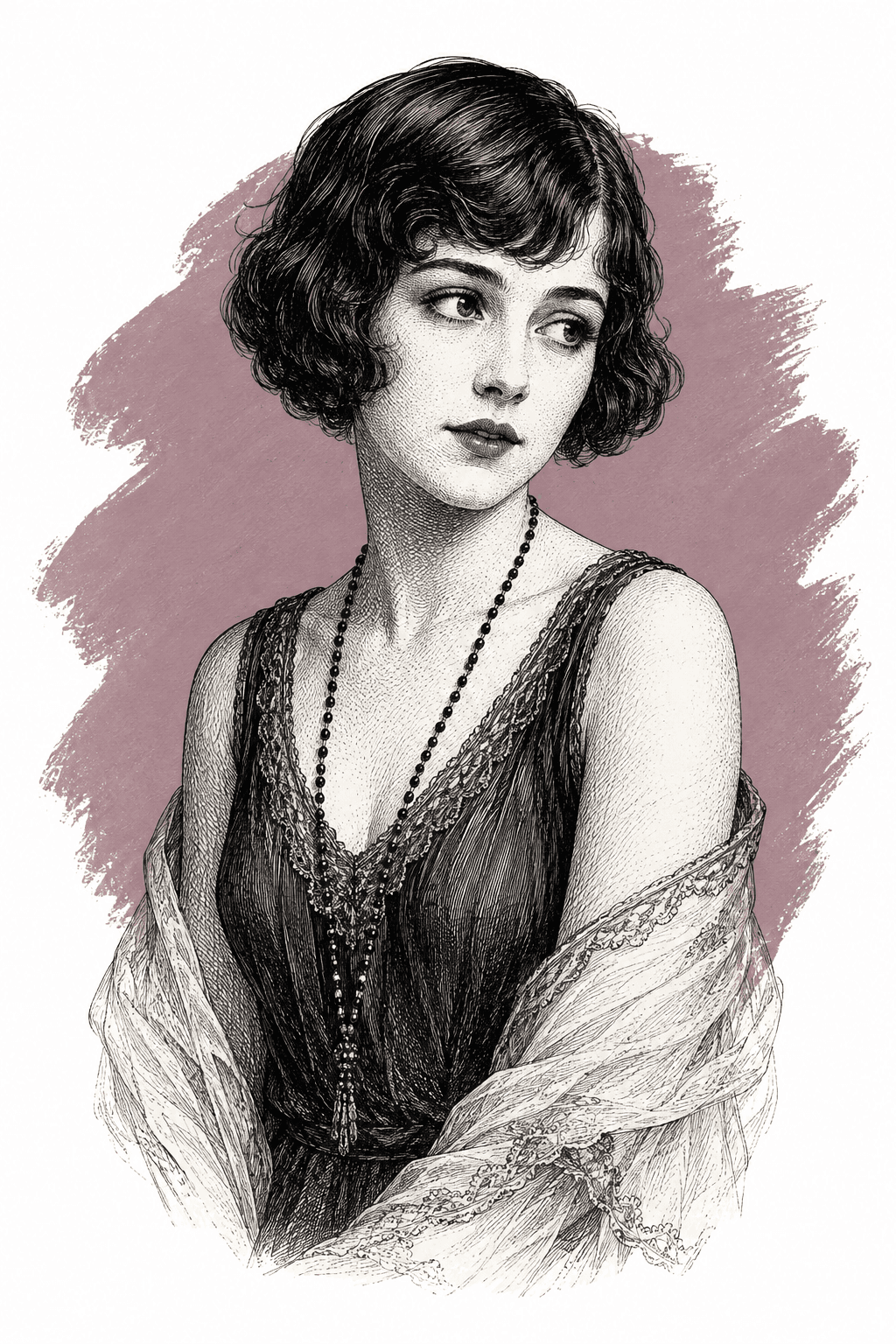
Bernice
The visiting cousin in “Bernice Bobs Her Hair”: pretty, rich, dull at parties, and the one person in the story who gets her own back.
To be one of the girls people compete for. She has grown up on novels in which women are loved for mysterious womanly qualities and cannot understand why it is not happening to her.
The book

At a glance
- The central character of “Bernice Bobs Her Hair,” the fifth of the eight stories
- Eighteen
- Eau Claire, Wisconsin, where her family is the richest in town and her mother gives dinners for her before every dance
- Never given. She is Bernice, or Marjorie's cousin from Eau Claire
- Little Women, which Marjorie tells her is out of style, and the popular girls' novels of Annie Fellows Johnston
Who they are in the book
Spoiler-freeBernice is the central character of “Bernice Bobs Her Hair,” the best-known story in F. Scott Fitzgerald's 1920 collection Flappers and Philosophers. The book never gives her a surname. She is eighteen, from Eau Claire, Wisconsin, where her family is the wealthiest in town, and she is spending August with her cousin Marjorie Harvey in a small city where the young people's lives run on country-club dances. She is good-looking, with dark hair and a high colour, and no fun whatsoever, and the local boys have worked this out. At the Saturday dance they take turns with her as a duty, and one of them stands outside the ladies' room brandishing a piece of timber and telling his friends he means to hit her on the head with it when she comes out.
The story is about what happens when she finds out. Overhearing Marjorie tell her mother that she is hopeless, Bernice offers to do exactly as she is told, and Marjorie rebuilds her from the eyebrows outward: how to brush them, how to dance, how to be pleasant to unpopular boys, and what to say. The line Marjorie gives her to say is that she is thinking of having her hair bobbed — cut short, which in 1920 was close to a scandal. It works. Within a week Bernice is being cut in on all evening and Marjorie's own favourite is parking his car outside the house for her.
How Bernice Is Portrayed
- How the boys talk about herWarren McIntyre, who dances a duty dance with her every Saturday, thinks of her as pretty and dull, and wonders whether she is a poor conversationalist because she gets no attention or gets no attention because she is a poor conversationalist. When he tries a practised line on her — “You’ve got an awfully kissable mouth,” he begins quietly — she jumps, goes red, and calls him fresh.
- What she can talk aboutNothing. Marjorie's summary to her mother is that she has never heard Bernice say anything to a boy except that it is hot, or that the floor is crowded, or that she is going to school in New York next year, and that sometimes she asks them what kind of car they have and then tells them what kind she has.
- The night she overhearsOn her way to say good night to her aunt she stops outside the door and hears Marjorie call her absolutely hopeless. Marjorie's mother objects that popularity is cheap; the answer comes back at once: “It’s everything when you’re eighteen,” said Marjorie emphatically. Bernice, standing in the hall, hears all of it.
- She agrees to be rebuiltThe next afternoon she tells Marjorie that she may be right about things, possibly not, but that if she is told why the boys are not interested she will try. Marjorie makes her promise to do exactly as she is told, sensible or not, and then starts on her eyebrows.
- The line about her hairAt the country-club dinner-dance she turns to the man on her left and asks whether he thinks she ought to bob her hair. “Because I’m considering it. It’s such a sure and easy way of attracting attention.” Then, loudly enough for the table: “I want to be a society vampire, you see,” she announced coolly, and went on to inform him that bobbed hair was the necessary prelude.
- A borrowed opinionAsked whether she believes in bobbed hair, she says gravely that she thinks it is unmoral, and then adds that you have either got to amuse people or feed them or shock them. Marjorie had taken the line from Oscar Wilde and handed it to her.
- What she works out afterwardsLying in bed after her first successful evening, she runs through it and finds one rebellious thought: Marjorie supplied the conversation, but Marjorie had got most of it out of books, and it was Bernice's own voice that had said the words, her own lips that had smiled, her own feet that had danced.
- In the barber's chairDriven downtown by a crowd that has called her bluff, she walks in, tells the fat barber: “I want you to bob my hair.” When he gapes, she tries again: “My hair — bob it!” The narration follows what she is feeling rather than what is being done: the combs coming out, the unfamiliar hairpins, and the knowledge that she will never again feel the long pull of her hair down her back.
Marjorie, quietly losing Warren McIntyre to her, calls the bluff in front of the whole crowd at a bridge party, and they drive Bernice down to the Sevier Hotel barber shop to watch her go through with it. She does. The cut is bad, and she is the first person in the room to say so. Warren's eyes go cold, and Marjorie asks him to run her down to the cleaners.
That night Bernice packs her trunk, writes a note to her aunt, and goes into Marjorie's room while she is asleep. She finds one of the two blond braids, holds it slack so the sleeper feels no pull, and cuts it off with a pair of shears, then the other. Walking away down the moonlit street with her suitcase and the braids still in her hand, she passes Warren's house and throws them onto his porch. The last line of the story is hers: “Scalp the selfish thing!”
If you like Flappers and Philosophers


If you like F. Scott Fitzgerald
Explore authors with a similar voice, perspective, and influence.

Ernest Hemingway
Fitzgerald vouched for him to Scribner's before they had met, then edited him better than he edited himself; the friendship's five rounds are chronicled in our journal.
View author
Henry Miller
The Brooklyn dropout who arrived in Paris broke at thirty-eight and wrote the exuberant, banned books that ended American censorship.
View author
Louis-Ferdinand Céline
The doctor of the Paris slums who wrote the century's blackest, funniest novel — and changed the sound of French prose.
View author