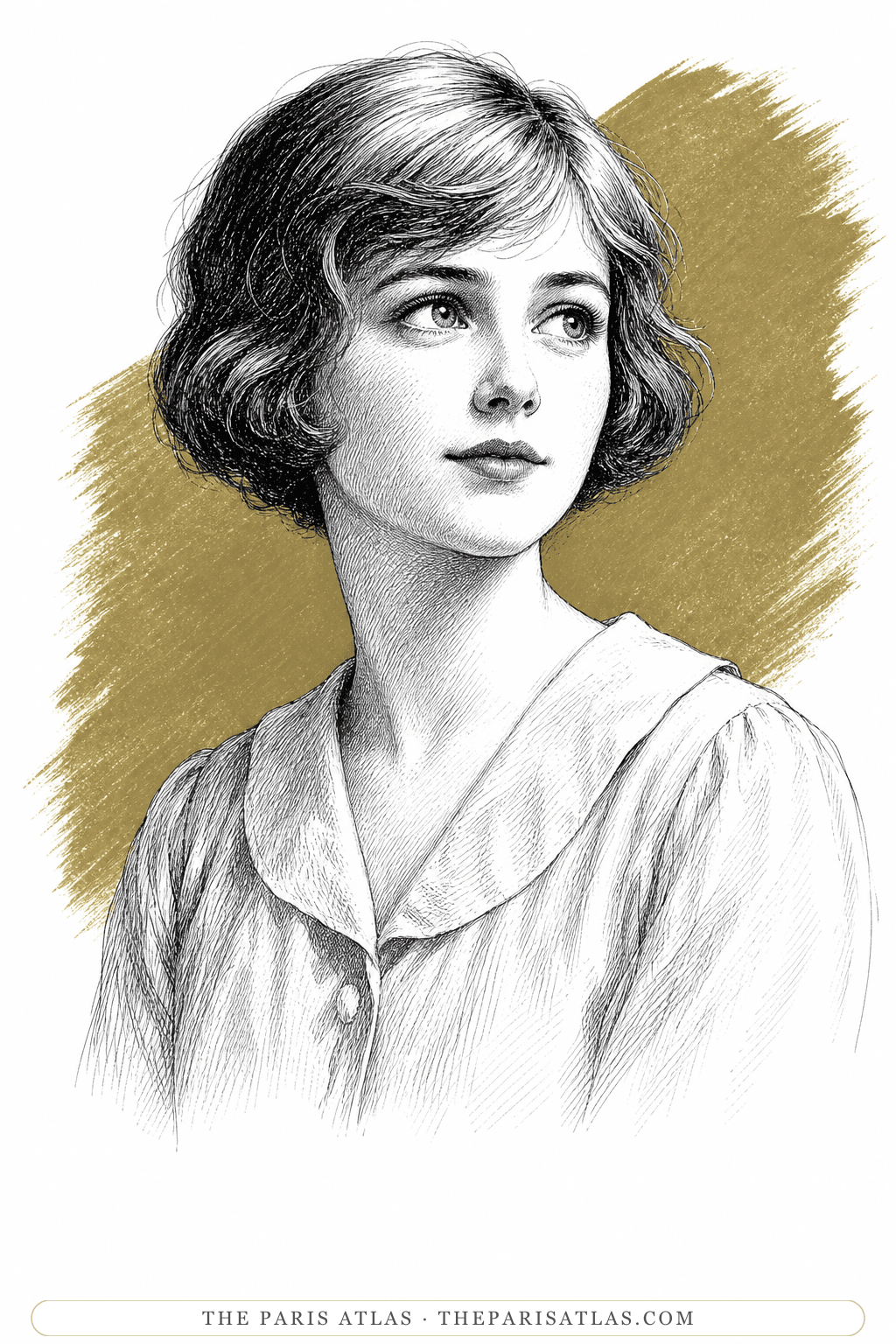
Sally Carrol Happer
The nineteen-year-old from small-town Georgia in “The Ice Palace,” who loves the South and leaves it anyway.
To go somewhere things happen. “I want to go places and see people. I want my mind to grow. I want to live where things happen on a big scale.” She says it to Clark Darrow, the friend she has known longest, and never takes it back.
The book

At a glance
- The central character of “The Ice Palace,” the second of the eight stories
- Nineteen
- Tarleton, in southernmost Georgia — an invented town Fitzgerald used again in later stories
- Harry Bellamy, tall, broad and brisk, from an unnamed Northern city she reaches by overnight train
- Bobbed, and corn-coloured. Harry's mother disapproves of it
- Zelda Fitzgerald · 1900–1948 · Montgomery, Alabama
Who they are in the book
Spoiler-freeSally Carrol Happer is the central character of “The Ice Palace,” the second story in Flappers and Philosophers and the strongest in it after “Bernice Bobs Her Hair.” She is nineteen and lives in Tarleton, in southernmost Georgia, a town where the heat is constant and the shops seem to open in order to go back to sleep. She has bobbed corn-coloured hair, an entirely unhurried manner, and, as she puts it, several rather clearly defined sides.
Her favourite place in Tarleton is the cemetery, and the story's first serious scene is set there: she walks her Northern fiancé past a headstone reading Margery Lee, 1844–1873, invents a whole life for the woman under it, and then takes him down the hill to the thousand grey crosses of the Confederate dead. Sally Carrol is invented, but that scene is not. Before they married, Zelda Sayre, later Zelda Fitzgerald, walked Fitzgerald through the Confederate graves at Oakwood Cemetery in Montgomery, Alabama, and told him he could never understand how she felt about them. He answered that he understood well enough to put it on paper, and this story is where he put it. What she gave him was the graveyard and one thing she said in it, not a character drawn from her life. The rest of the story asks what happens when a person who is made of one place agrees to live in another.
How Sally Carrol Happer Is Portrayed
- The town, in one exchangeThe story opens with her chin on a fifty-two-year-old window-sill watching a friend's ancient Ford break down outside. He whistles; she says “Good mawnin’.” He tells her it is not morning. She asks whether it is not, sure enough, and goes back to eating her apple.
- What she thinks of the boys she grew up withShe tells Clark Darrow that they will all be failures, not only in money but in being ineffectual and sad, and then, immediately, that she would not change him for the world, and that the things which will make him fail are the things she will always love: the living in the past, the lazy days, the carelessness and generosity.
- Two sides, stated plainlyShe explains why she cannot marry him: “There’s two sides to me, you see. There’s the sleepy old side you love an’ there’s a sort of energy — the feeling that makes me do wild things.” The second side, she says, is the part that may be useful somewhere, and that will last when she is not beautiful any more.
- The cemeteryShe takes Harry Bellamy to a headstone reading Margery Lee, 1844–1873, and builds the woman out loud: dark hair with a ribbon in it, hoop-skirts of Alice blue and old rose, the sort of girl born to stand on a pillared porch and welcome people in. Then she points down the hill: “Those are the Confederate dead,” said Sally Carrol simply.
- Her one warning about the NorthTold that the winter carnival will be like fairyland if she has never really seen snow, she asks whether she will be cold. Harry says she will not be shivery cold, because it is hard and dry. Her reply: “I guess I’m a summer child. I don’t like any cold I’ve ever seen.”
- Acting a partOn her first evening in the Northern city she tells her fiancé “Where you are is home for me, Harry.” The narration adds that as she said it she had the feeling, for almost the first time in her life, that she was acting a part.
- Feline and canineAt the dinner party she tells a professor she has just met that she divides people into feline and canine regardless of sex, that she is feline and so is he, and so are most Southern men and most of the girls in the room. Harry, she says, is canine, distinctly, and so is every man she has met that night.
- The quarrelWhen Harry follows a joke about a badly dressed man by calling small-town Southerners degenerates, lazy and shiftless, she tells him to hush his mouth, that they are her best friends, and that a Southerner would not talk the way he is talking. The tears come afterwards, in the hallway, when she asks him to marry her the following week because she is frightened of quarrels like that one.
On carnival night Harry takes her down a chute into the maze of passages under the ice palace, gets ahead of her, and disappears. The lights go out. She is lost in the dark for two hours, convinced she will freeze and be found preserved in the ice, and at the worst of it she believes she is being held by Margery Lee, the woman from the Georgia headstone, hoop-skirt and all.
A search party finds her by torchlight and rubs her face with snow. The man holding her is Roger Patton, the university professor she had liked at her first dinner party in the North. What she says as she is carried out is a scream: she wants to get out of here, she is going back home, and then, over and over, tomorrow.
The last section is April in Tarleton. The same window, the same rattling Ford, the same friend, and the same greeting word for word. “Good mawnin’.” “Tain’t mawnin’, Sally Carrol.” He asks whether she wants to go swimming, and she does. The story closes exactly where it opened, and that is the answer it gives.
If you like Flappers and Philosophers


If you like F. Scott Fitzgerald
Explore authors with a similar voice, perspective, and influence.
Ernest Hemingway
Fitzgerald vouched for him to Scribner's before they had met, then edited him better than he edited himself; the friendship's five rounds are chronicled in our journal.
View author
Henry Miller
The Brooklyn dropout who arrived in Paris broke at thirty-eight and wrote the exuberant, banned books that ended American censorship.
View author
Louis-Ferdinand Céline
The doctor of the Paris slums who wrote the century's blackest, funniest novel — and changed the sound of French prose.
View author