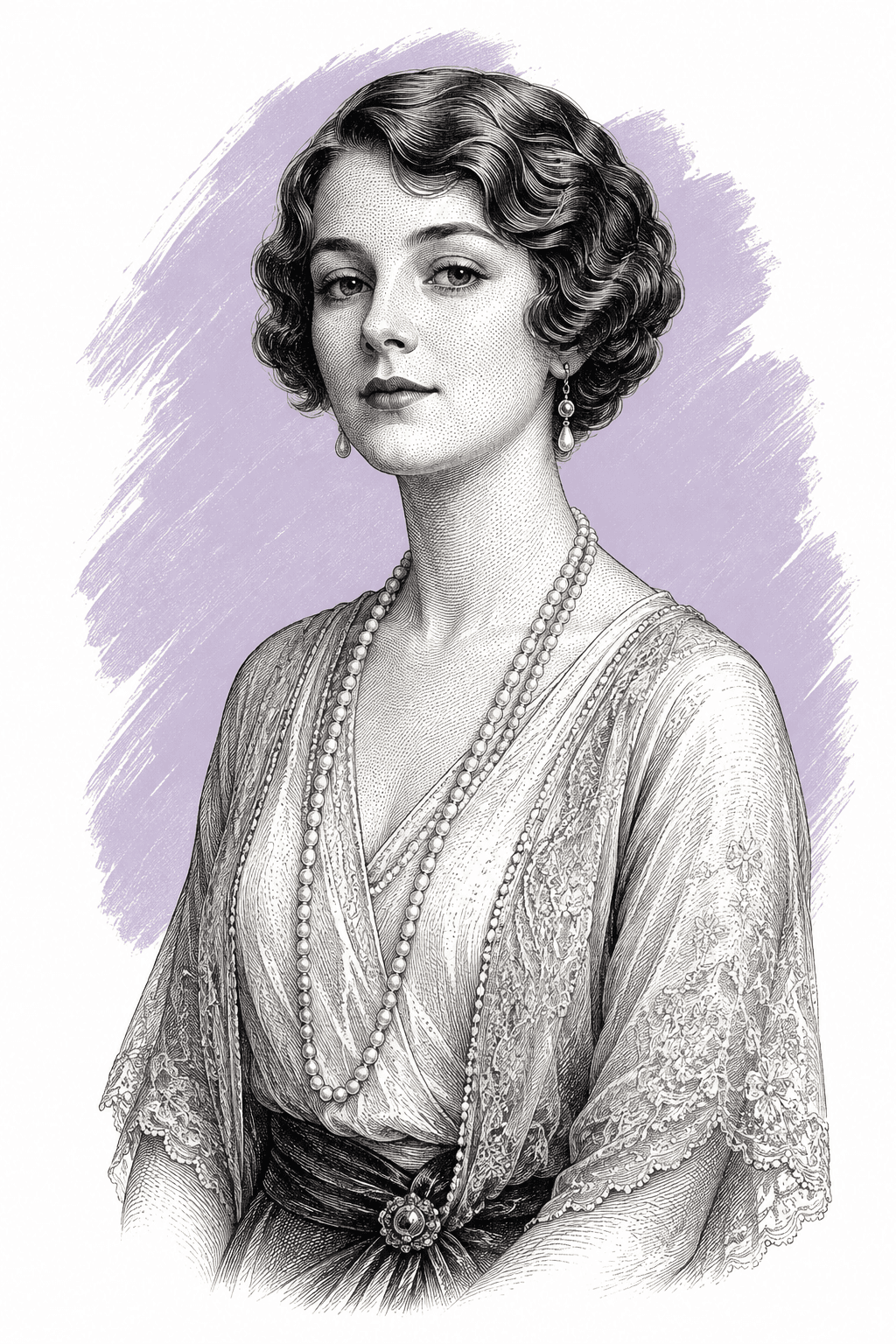
Evylyn Piper
The woman at the centre of “The Cut-Glass Bowl,” whose life is measured out against a wedding present she never wanted.
To keep what she has. After the first scene she stops accentuating her smile, and the surge of love she discovers too late for her husband is spent on her children instead.
The book

At a glance
- The central character of “The Cut-Glass Bowl,” the fourth of the eight stories
- Twenty-seven, thirty-five, and forty-six, in four scenes across twenty years
- Harold Piper, of Piper Brothers, wholesale hardware — nine years older, handsome with marginal notes
- Donald, away at school and later in the infantry; Julie, who is three in the second scene
- A wedding present from Carleton Canby, whom she refused. He said it was like her: hard, beautiful, empty, and easy to see through
Who they are in the book
Spoiler-freeEvylyn Piper is the central character of “The Cut-Glass Bowl,” the fourth story in Flappers and Philosophers and the bleakest. She is beautiful, married to a wholesale hardware man nine years older than she is, and living in the nicest smaller house in an unnamed American town. The story follows her from twenty-seven to forty-six in four scenes.
The object of the title is an enormous cut-glass punch bowl, two and a half or perhaps three and a half feet across, given to her as a wedding present by a man she had turned down — who told her, when he handed it over, that it was like her: hard, beautiful, empty, and easy to see through. It is too big for the sideboard. It stays in the house for twenty years, and every disaster in the story reaches her through it.
How Evylyn Piper Is Portrayed
- How she is introducedThrough a visitor's eyes, as the beautiful Mrs. Harold Piper, radiating what the narration calls the divine vagueness that helps to lift beauty out of time. The visitor spends the call collecting gossip about the young man who has been dropping in on her.
- Ending the affairFreddy Gedney arrives unannounced after her letter. “I’m through, Fred,” she said slowly, and her lips had never looked to him so much like tearings from a rose. She tells him her husband already knows, that she knows exactly how far she can go with Harold, and that being in the room with him is one of the things she cannot do.
- The sound the bowl makesHiding Gedney in the dark dining room while she tries to get her husband upstairs, she hears a floorboard creak and then a hollow ringing note like a gong through the whole house. Gedney's arm has struck the bowl. Everything that follows in the marriage follows from that noise.
- What she is left withIn the minutes when she discovers how much she loves her husband she also sees how permanently she has hurt him. A month of reproaches, then silence, then a barrier. When a flood of feeling comes back a year later, the narration is flat about it: her great opportunity was gone, and there simply wasn't anything left.
- The argument over which bowlOn her thirty-fifth birthday, with a business partner and his wife coming to dinner, Harold wants to make the punch in the big one. She insists on the small one and says why: “I don’t want any drunken men in the house.” He lifts it out of her hands and carries it back to the sideboard, and she leaves the room.
- The evening she cannot stopThe punch goes round all through dinner and the men come in from the dining room drunk. Her husband lectures the new partner on how to be accepted in town, a cousin blows a dead cigar into the wife's lap, and the party ends in a quarrel on the doorstep. She hears none of the end of it, because the maid has come to tell her the baby's hand is swollen.
- How she counts her life at forty-sixStepping onto the porch after family bridge, she remembers a moonlight affair of her youth and works out the arithmetic: it was astonishing to think that life had once been the sum of her current love-affairs, and it was now the sum of her current problems.
- The letter she has not seenA maid confesses that she mislaid a long narrow envelope from the afternoon post. Evylyn sits down heavily in the middle of the search. “No,” said Evylyn slowly, “but I know where the letter is. Go ’way, Martha. I know.” She has never been told and does not need to be.
Julie cut her thumb on the bowl at three o'clock on the afternoon of the dinner party. By eleven it is blood poisoning, and she loses the hand. She grows up in her mother's shadow, keeping an artificial hand in her dress pocket and refusing to use it, and Evylyn eventually gives up having her dresses made without pockets.
Eleven years later the mislaid envelope is a War Department telegram about Donald, lying inside the bowl on the sideboard where the maid put it down. Evylyn reads it in the dining room. What she does then is lift the bowl in both arms, carry it out through the library and the front door, and swing herself round on the stone steps to throw it — and falls with it. The story's last paragraph is neighbours running and a still black form on the sidewalk in a scatter of coloured glass.
If you like Flappers and Philosophers


If you like F. Scott Fitzgerald
Explore authors with a similar voice, perspective, and influence.

Ernest Hemingway
Fitzgerald vouched for him to Scribner's before they had met, then edited him better than he edited himself; the friendship's five rounds are chronicled in our journal.
View author
Henry Miller
The Brooklyn dropout who arrived in Paris broke at thirty-eight and wrote the exuberant, banned books that ended American censorship.
View author
Louis-Ferdinand Céline
The doctor of the Paris slums who wrote the century's blackest, funniest novel — and changed the sound of French prose.
View author