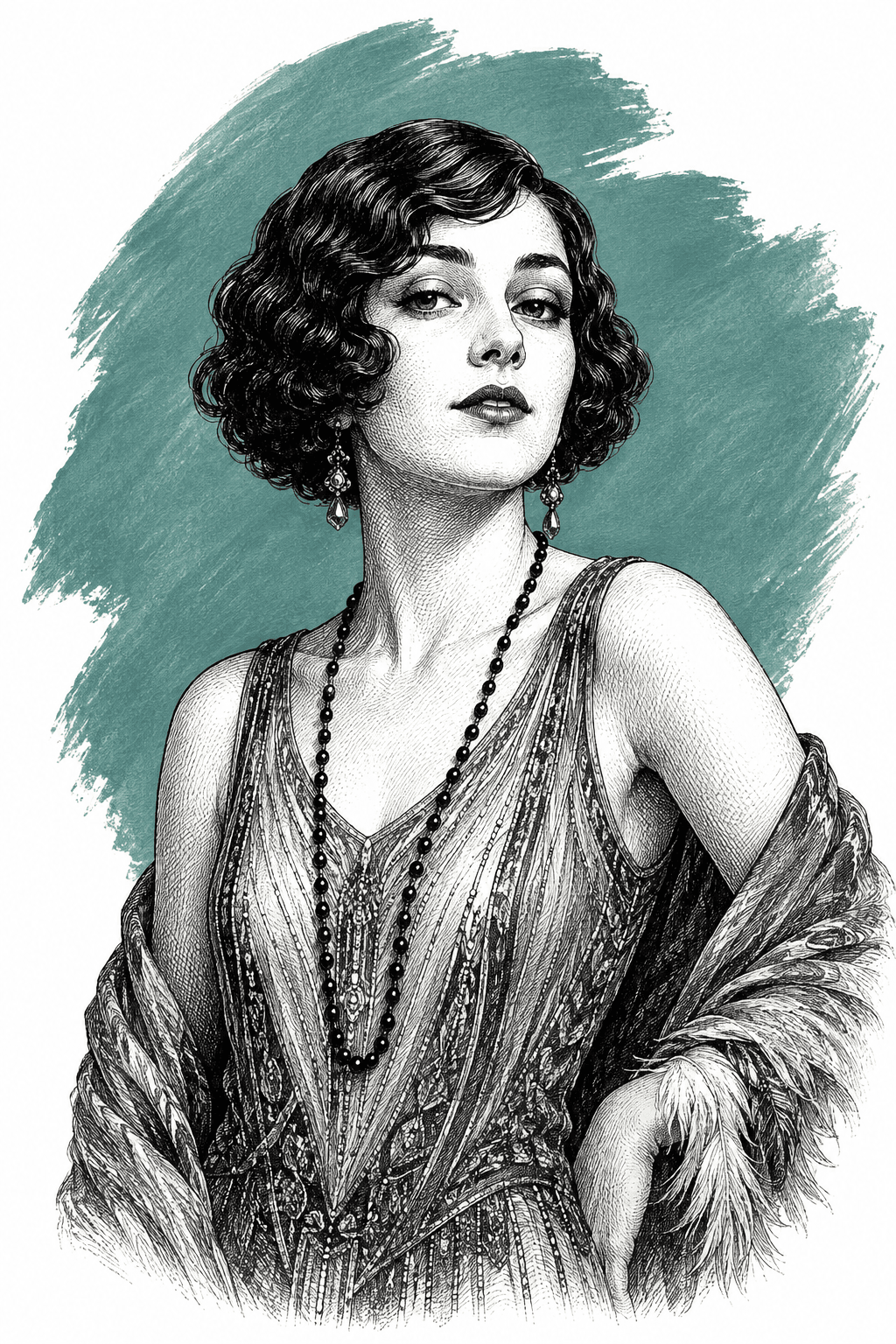
Marcia Meadow
The nineteen-year-old dancer in “Head and Shoulders,” sent up to a prodigy's rooms as a joke and still there at the end.
To be looked at, which she says outright: she got into the habit of having people look at her, and she likes it.
The book

At a glance
- The dancer in “Head and Shoulders,” the third of the eight stories
- Nineteen
- Veronica Meadow, of Passaic, New Jersey
- A song about a Blundering Blimp and a dance in the last act of a musical comedy called Home James
- Five thousand Pall Malls, offered by Horace's cousin Charlie Moon, for calling on him
Who they are in the book
Spoiler-freeMarcia Meadow is the shoulders of “Head and Shoulders.” She is nineteen, blonde by natural pigment, and appears nightly in a touring musical comedy called Home James, singing a song about a Blundering Blimp in the first act and doing a shaky, shivery, celebrated dance in the last. A student bets her five thousand cigarettes that she will not call on his cousin Horace Tarbox, the seventeen-year-old philosophy prodigy, and she takes the bet.
She talks in a slang that Horace can barely parse and cuts through everything he says. Her real name is Veronica; she was born in Passaic, New Jersey, and got out of a Trenton tea-room by trying a song and dance with a cabaret singer. A newspaper columnist ate his milk-toast at the right restaurant one night, wrote a poem about her, and printed her thank-you letter in his column with the observation that her style was like that of the Victorian essayist Thomas Carlyle, only more rugged, and that she should quit dancing and take up literature.
How Marcia Meadow Is Portrayed
- Her entranceShe lets herself into his study, sits down in the armchair he has named Hume, and opens with “Well, Omar Khayyam, here I am beside you singing in the wilderness.” He has not looked up from his book yet and assumes she is the laundry.
- Why she calls him Omar“I know,” agreed Marcia, nodding — “your name’s Horace. I just call you Omar because you remind me of a smoked cigarette.” She keeps it up until he asks her to marry him, and then stops.
- Her advice about the word onlyTold he is only seventeen, she remembers a girl who could never say sixteen without putting only in front of it, and whom everyone ended up calling Only Jessie. “‘Only’ is a bad habit, Omar — it sounds like an alibi.”
- Her philosophy, offered to a philosopherHe asks why she wants him to kiss her and whether she goes round kissing people. “Why, yes,” admitted Marcia, unruffled. “’At’s all life is. Just going round kissing people.” His objection is that in the first place life is not just that, and in the second place he will not kiss her.
- On her own actWhen he says he should think she would detest the dance, she answers: “It’s fun to do it. I like to do it.” She adds that it is only an acrobatic stunt, hard enough to do, and that she rubs liniment into her shoulders for an hour every night.
- The bargain that names the storyRefusing to give up her hundred and fifty a week for his hundred and twenty-five: “We’ll call ourselves Head and Shoulders, dear,” she said softly, “and the shoulders’ll have to keep shaking a little longer until the old head gets started.” She will quit, she says, when he is making three hundred a month.
- The trade she makes with himShe will read one of the difficult books off his shelf if he will join a gymnasium three nights a week. She picks the diary of Samuel Pepys, the seventeenth-century Londoner whose journals are a standard classic, says it will be like digesting plate glass, and calls it taking one big dose of Sammy.
- The manuscript in the bureauAfter three months laid up she asks him to take a stack of paper to the columnist who once printed her letter: “I wrote it just the way I talk, just the way I wrote that letter to him.” Her instructions are to tell him Horace once got the highest marks in Princeton, and that this one is a world beater.
They marry in February, take a flat in Harlem, and swap places. Horace leaves the university for a clerk's job and then for a trapeze act at the Hippodrome; Marcia stops dancing when a baby is on the way, and writes a book in bed over three months.
It is published as Sandra Pepys, Syncopated, serialised at three hundred dollars an instalment and out in book form in March, and it is a hit — reviewed as a contribution to American dialect literature, compared to Mark Twain's Huckleberry Finn, sponsored by the columnist who had printed her letter. The family moves to a bungalow in Westchester County with a sound-proof study in it.
The last scene is Horace coming home to find Anton Laurier, the French philosopher who was once his idol, sitting in his living room, having driven out to meet Sandra Pepys. Laurier hands him a clipping that describes Mr. Tarbox as the acrobat husband of a prodigy. Horace's advice to the great man is about raps at the door: do not answer them, and get a padded one.
If you like Flappers and Philosophers


If you like F. Scott Fitzgerald
Explore authors with a similar voice, perspective, and influence.

Ernest Hemingway
Fitzgerald vouched for him to Scribner's before they had met, then edited him better than he edited himself; the friendship's five rounds are chronicled in our journal.
View author
Henry Miller
The Brooklyn dropout who arrived in Paris broke at thirty-eight and wrote the exuberant, banned books that ended American censorship.
View author
Louis-Ferdinand Céline
The doctor of the Paris slums who wrote the century's blackest, funniest novel — and changed the sound of French prose.
View author