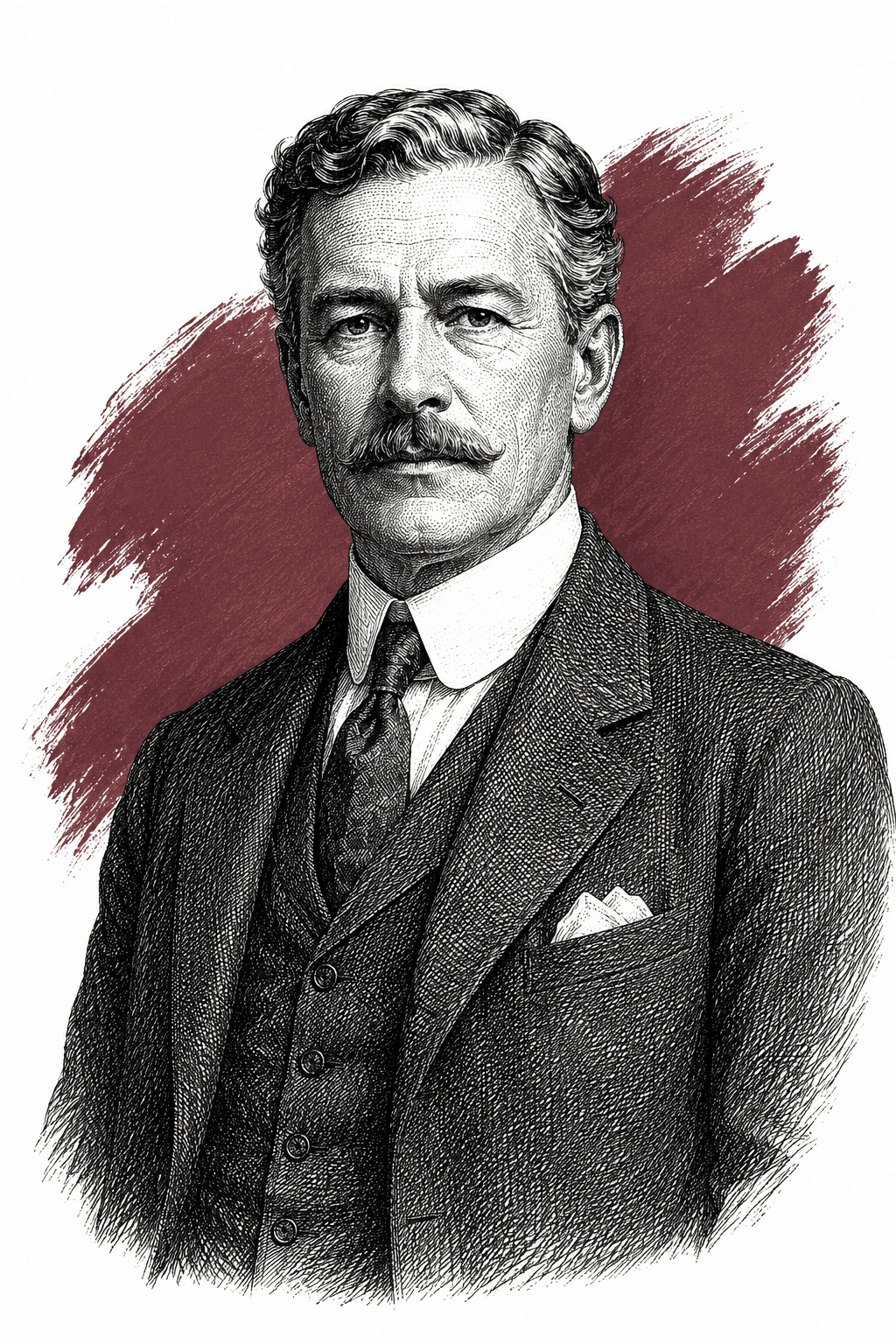
Samuel Meredith
The man in “The Four Fists” who has been punched in the face four times, and says he would not lose the lump on his jaw for anything.
To be in the right. The trouble is that he is usually certain he already is, which is what the four fists are for.
The book

At a glance
- The subject of “The Four Fists,” the eighth and last story
- Fourteen, his twenties, his early thirties, and thirty-five
- Phillips Andover Academy, then an unnamed university where he drove coaches and believed passionately in good form
- Runner for a Wall Street bank, then close to the financier Peter Carhart, who had been his father's friend and watched him for six years first
Who they are in the book
Spoiler-freeSamuel Meredith is the subject of “The Four Fists,” which closes Flappers and Philosophers. The story is told by an acquaintance who explains at the start that nobody wants to hit him now, but that for most of his life his face had a quality in it that made men want to — and that his career is not one story but four, each of them a punch.
He was brought up in European hotels by a nervous mother, sent to Phillips Andover at fourteen when she had a collapse, and arrived with a valet who asked whether there was anything else, Master Samuel. His roommate hit him within three weeks. The three blows that follow come from a tired labourer on a New York streetcar, from the husband of a woman he was pursuing, and from a New Mexico rancher whose land he had been sent to take.
How Samuel Meredith Is Portrayed
- What the story says about his faceNot the shape. He was pleasant-looking from youth, broad-browed, with frank grey eyes. Something else. The narrator compares it to the kissable quality that lurks in a girl's lips, and says that in Samuel's case it was strong enough to shape his whole life.
- The first fistAt fourteen, from his thirteen-year-old roommate Gilly Hood, over a bed and a month of remarks about Gilly's friends. The month afterwards is the worst of his life, and by the beginning of his last year at school Gilly is his closest friend.
- The second fistIn his twenties, on a New York horse-car, when a labourer smelling of garlic fails to give up his seat to a young woman and Samuel says so twice, then follows him off and makes a remark about the lower animals. The man drops his pail and knocks him into the gutter: “Don’t laugh at me!” cried his assailant. “I been workin’ all day. I’m tired as hell!”
- What he understood in the gutterGetting up and waving his friends back, he remembers Gilly Hood and knows intuitively that he has been wrong again. The man's rest was the protection of his family, and he had more use for the seat than any young girl did. What he says is “I’ve been a damn fool.”
- The third fistFrom the husband of a young woman he had met on the ferry over to New Jersey and courted for months over lunches at a restaurant. When the man finally comes home to find them, Samuel makes a speech about the right to happiness and is knocked down on the front path. He is bigger by inches and pounds, squares off, and knows at once that he will not hit back.
- The fourth fistAt thirty-five, sent to New Mexico to close a squeeze on seventeen ranches. An old settler named McIntyre comes to the office half an hour early and describes the house he built at seventeen, the wife he took there at twenty-one, and the son who was born and died in it: “Forty summers I’ve saw the sun come up over those mountains and drop down red as blood in the evening, before the heat drifted off and the stars came out.” Samuel answers that it is business and inside the law, and McIntyre knocks him down.
- The lump on his jawHe has never been sure which fist left it and says he would not lose it for anything. Reporters call the habit of stroking his chin before a decision a nervous characteristic. It is not: it is so that he can feel again what he calls the gorgeous clarity, the lightning sanity of those four fists.
He gets up from the fourth punch, walks out, comes back in and tells the assembled ranchers that McIntyre has convinced him they are absolutely right and the Carhart interests absolutely wrong, and that as far as he is concerned they can keep their ranches for the rest of their days. Then he sends two telegrams: one to the man who set the deal up, one to Peter Carhart himself.
He does not sleep that night, knowing it is the first outright failure of his business career and that it will probably end his prospects. The answers come in the morning. From San Antonio, three words: “You blamed idiot!” From New York, seven: “Deal off come to New York immediately Carhart.” The man who built the squeeze is summoned and broken by July. In August, at thirty-five, Samuel Meredith is made Carhart's partner in all but name.
If you like Flappers and Philosophers


If you like F. Scott Fitzgerald
Explore authors with a similar voice, perspective, and influence.

Ernest Hemingway
Fitzgerald vouched for him to Scribner's before they had met, then edited him better than he edited himself; the friendship's five rounds are chronicled in our journal.
View author
Henry Miller
The Brooklyn dropout who arrived in Paris broke at thirty-eight and wrote the exuberant, banned books that ended American censorship.
View author
Louis-Ferdinand Céline
The doctor of the Paris slums who wrote the century's blackest, funniest novel — and changed the sound of French prose.
View author