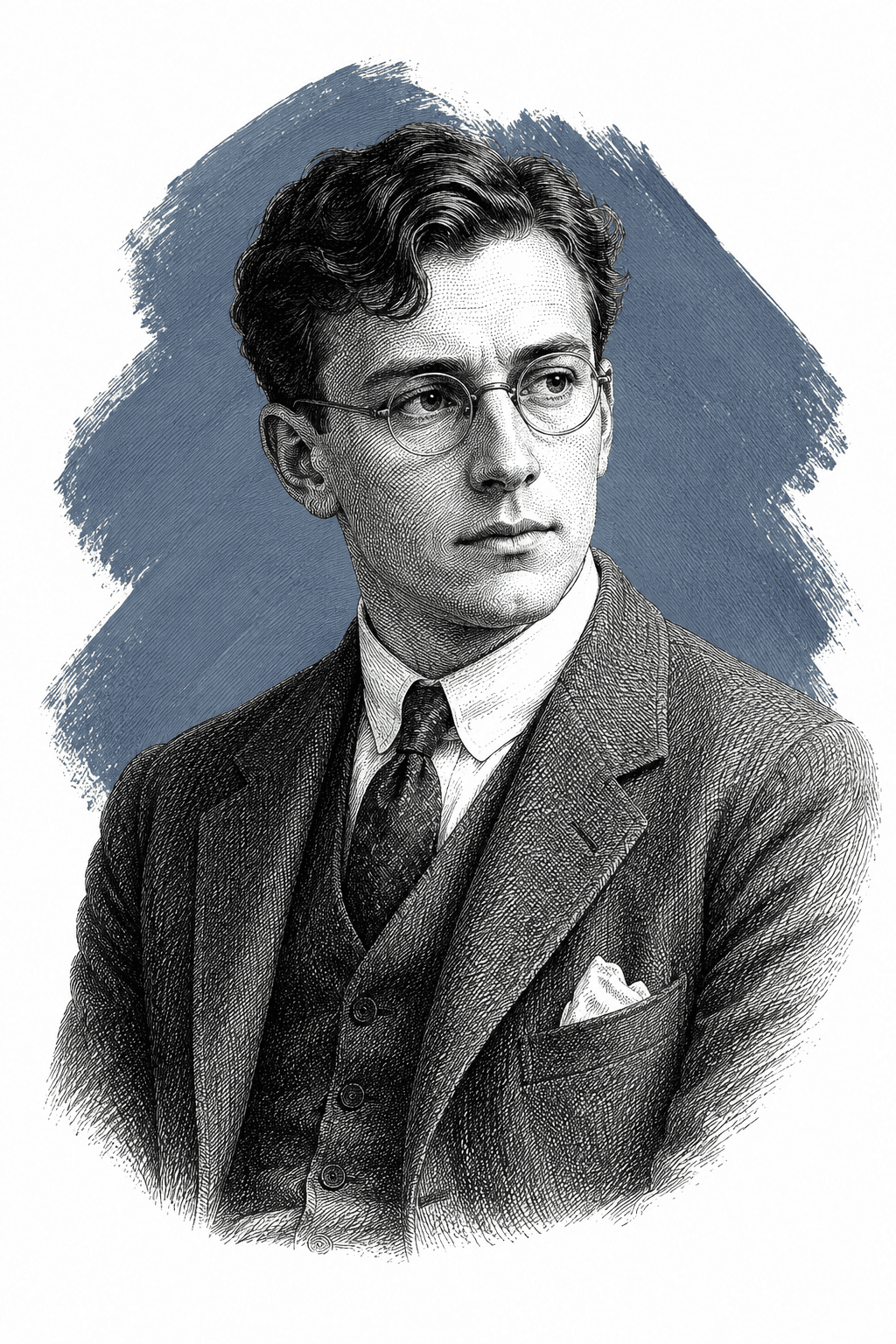
Horace Tarbox
The seventeen-year-old philosophy prodigy in “Head and Shoulders,” who has read everything and done nothing.
Not to be a laboratory specimen. He complains that his intellectual development is treated as a joke by janitors and chemists alike, and asks whether he looks like a cartoon of a clever Boston boy.
The book

At a glance
- The prodigy in “Head and Shoulders,” the third of the eight stories
- Seventeen when the story opens, eighteen when he marries
- Princeton entrance examinations at thirteen; a master's degree at Yale at seventeen
- Modern philosophy — a realist of the school of Anton Laurier, with Bergsonian trimmings, in his own description
- Clerk with a South American export company, then a trapeze act at the Hippodrome
Who they are in the book
Spoiler-freeHorace Tarbox is the half of “Head and Shoulders” referred to in the title as the head. He passed the Princeton entrance examinations at thirteen with top marks in nine subjects, led the sophomore class at fifteen, and at seventeen has gone up to Yale to take a master's degree. He is tall and slender with near-sighted grey eyes, coughs when he is uncomfortable, paces when he is thinking, and keeps two armchairs by his fire that he has named Berkeley and Hume, after the philosophers George Berkeley and David Hume.
His father, an economics professor, answered every question the boy ever asked and then decided to run an experiment in precocity; seven ear operations between nine and twelve kept him away from other children and, as Horace puts it, ripe for forcing. By sixteen he was tired of being a freak but finished the degree anyway. Then a chorus dancer walks into his rooms as somebody's practical joke, sits down in Hume, and the experiment ends.
How Horace Tarbox Is Portrayed
- How his teachers describe himA professor at Yale complains about him to a colleague: “I never feel as though I’m talking to him,” expostulated Professor Dillinger to a sympathetic colleague. He makes the man feel as though he were talking to Horace's representative, and half expects him to say that he will ask himself and find out.
- The two armchairsHe changes chairs in the course of an evening by way of exercise and variety. One he calls Berkeley, the other Hume. When Marcia Meadow sits down uninvited in the chair called Hume, his first thought is that she has materialised out of Hume, and that if he looks hard enough he will see the leather through her.
- How he introduces himselfDeadpan, to a woman who has just asked for letters he supposedly bought from her grandfather in 1881: “I am only seventeen years old. My father was not born until March 3, 1879. You evidently have me confused with some one else.”
- The account of his childhood“I was a ‘why’ child. I wanted to see the wheels go round.” Seven ear operations between nine and twelve kept him apart from other boys; while his generation laboured through Uncle Remus he was enjoying Catullus in the original; at sixteen he decided somebody had made a bad mistake.
- The first refusalAsked for a kiss he declines on principle, and on the ground that it might become a habit and he cannot get rid of habits. He then shouts up the stairwell after her to make sure she has not misunderstood him: he does not consider kissing intrinsically irrational.
- His verdict on his upbringingListing the objections to marrying at eighteen, Marcia mentions his family. His face goes crimson at the enormity of what he is about to say: “My people can go way back and sit down!”
- What he does about moneyWhen a baby is coming and the clerk's salary will not cover it, he walks to the gymnasium where he has been doing trapeze work three nights a week, finds the fat man who told him there was money in it, and asks whether he was in earnest. Within four days he has an engagement.
- What he understands at the endLying awake after reading his wife's manuscript: “Poor gauzy souls trying to express ourselves in something tangible.” Marcia with her written book, he says, and himself with his unwritten ones — trying to choose our mediums and then taking what we get, and being glad.
If you like Flappers and Philosophers


If you like F. Scott Fitzgerald
Explore authors with a similar voice, perspective, and influence.

Ernest Hemingway
Fitzgerald vouched for him to Scribner's before they had met, then edited him better than he edited himself; the friendship's five rounds are chronicled in our journal.
View author
Henry Miller
The Brooklyn dropout who arrived in Paris broke at thirty-eight and wrote the exuberant, banned books that ended American censorship.
View author
Louis-Ferdinand Céline
The doctor of the Paris slums who wrote the century's blackest, funniest novel — and changed the sound of French prose.
View author