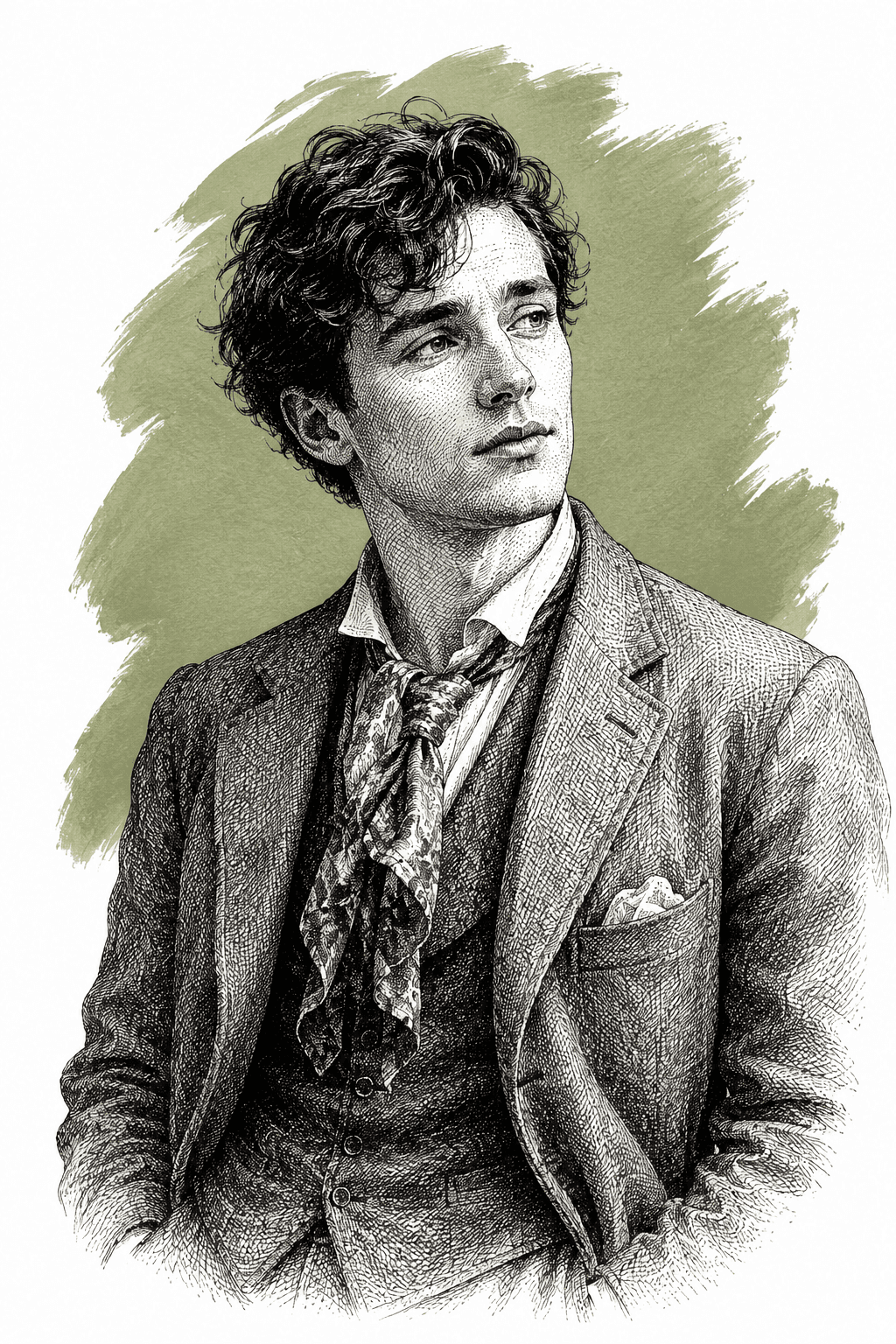
Curtis Carlyle
The young man who takes the yacht in “The Offshore Pirate”: a ragtime musician, by his own account, with a million dollars and a plan to become a rajah.
To stop being looked at as an entertainer. He describes the private dances at three thousand dollars a night as the thing that decided him, because they took place in houses he could not have gone into in the daytime.
The book

At a glance
- The man who takes the yacht in “The Offshore Pirate”
- Twenty-five
- Ragtime — three trombones, three saxophones and his own flute, on the Orpheum circuit and then Broadway
- Babe, the smallest of the six musicians, who takes command below decks and has sailed these waters in every capacity
Who they are in the book
Spoiler-freeCurtis Carlyle is the name given by the man who boards Ardita Farnam's yacht in “The Offshore Pirate” with six musicians and a rowboat. He is twenty-five, dark, trimly built, with the blue eyes of a healthy baby in a sensitive face, and he arrives announcing that the women and children will be spared. Over the next week he tells Ardita his life story: a poor white childhood in a Tennessee town, a musical gift picked up beside the piano of a Black woman named Belle Pope Calhoun who played at children's parties, ragtime in cafés around Nashville at thirteen, and then Broadway with a six-piece band and more money than he had dreamed of.
The point of the account is his bitterness about it. He is sick of playing to rooms he could not enter in daylight, and he has invented a name for what he wants instead, aristocracy, which he intends to buy with a million dollars, in India, after five years and a change of accent. Whether any of this is true is the story's question.
How Curtis Carlyle Is Portrayed
- How he arrivesUp the ladder before Ardita understands what is happening, and straight into a performance: “The women and children will be spared!” he said briskly. “All crying babies will be immediately drowned and all males put in double irons!”
- The bandHe introduces the seven of them as Curtis Carlyle and his Six Black Buddies, late of the Winter Garden and the Midnight Frolic, and says that as of today they are fugitives with a twenty-thousand-dollar reward on them. The white sacks slung over the musicians' shoulders, he says, contain Florida mud.
- What he says he wants money forWatching the moonlight on the yacht: “I’ve always wanted to be rich — and buy all this beauty.” Later, more precisely: “this is the beauty I want. Beauty has got to be astonishing, astounding — it’s got to burst in on you like a dream, like the exquisite eyes of a girl.”
- Why he will not finish the storyHe breaks off before the part Ardita most wants, and says why: “I want to hang on to those few breathless, heroic moments when I stood out before them all and let them know I was more than a damn bobbing, squawking clown.”
- The planIndia first, then Afghanistan, where he intends to buy a palace and a reputation and reappear in England after five years with a foreign accent and a mysterious past. He wants leisure to read an immense amount. Ardita's response is to laugh at how well he tells a story.
- How he takes losingWhen the revenue boat appears he refuses to let the crew fight, since it would be a bow and arrow against a machine gun, and turns down burying the money. His only comment on Babe, who offered to try: “There’s the best friend I ever had. He’d die for me, and be proud to, if I’d let him.”
None of it was true. When the boarding party arrives he tells her himself: “My name isn’t Carlyle. It’s Moreland, Toby Moreland.” He is the colonel's son whose dinner invitation she had refused on the first page — he had heard about her wild career, arranged the entire hold-up to meet her, and had a rocket sent up the night before so that the two fathers could come and find them.
The sacks really did contain Florida mud, which he says was one of the two true things he told her. The Russian bracelet was got from the red-haired woman by her uncle's detective. Ardita guesses the second true thing without being told.
If you like Flappers and Philosophers


If you like F. Scott Fitzgerald
Explore authors with a similar voice, perspective, and influence.
Ernest Hemingway
Fitzgerald vouched for him to Scribner's before they had met, then edited him better than he edited himself; the friendship's five rounds are chronicled in our journal.
View author
Henry Miller
The Brooklyn dropout who arrived in Paris broke at thirty-eight and wrote the exuberant, banned books that ended American censorship.
View author
Louis-Ferdinand Céline
The doctor of the Paris slums who wrote the century's blackest, funniest novel — and changed the sound of French prose.
View author