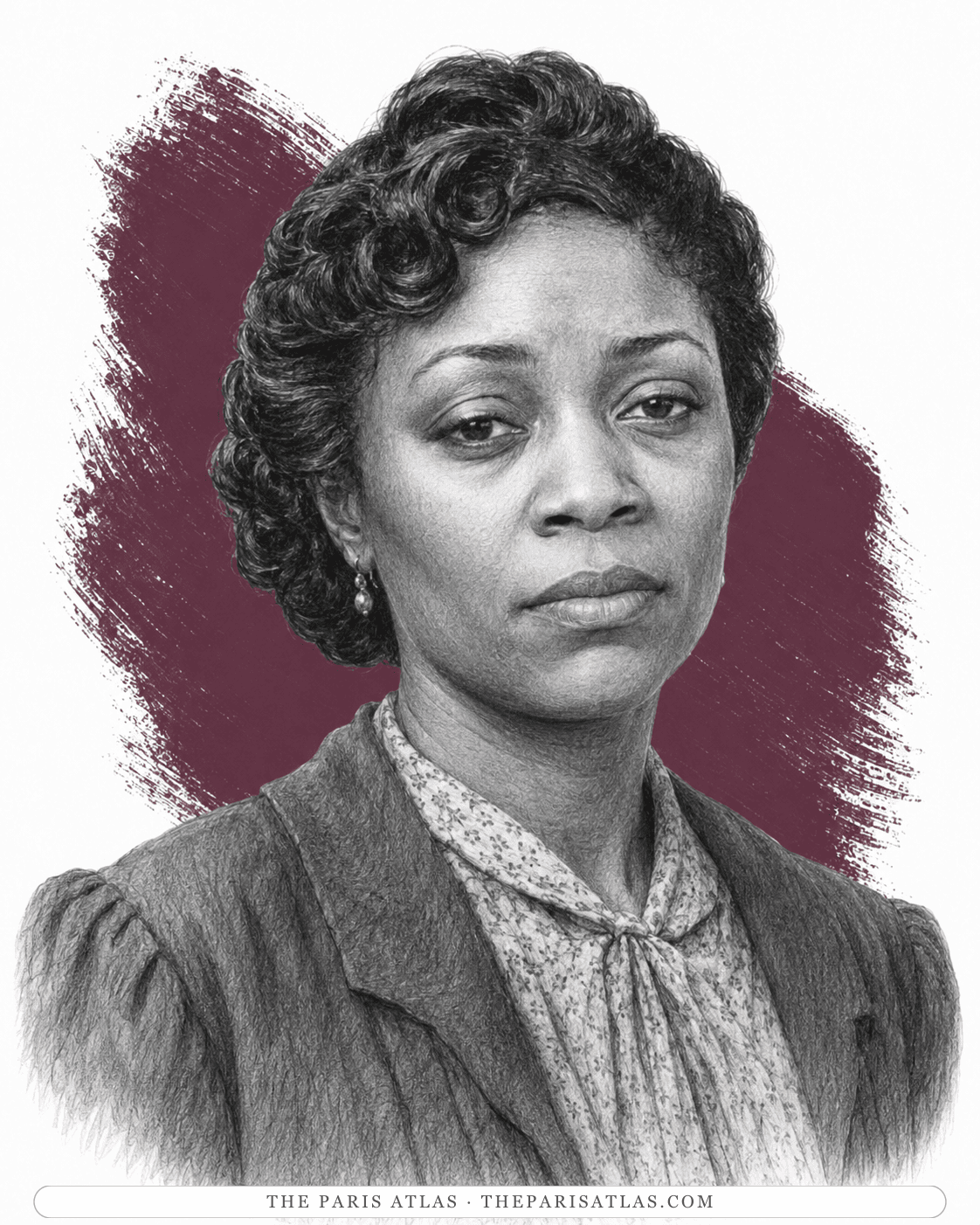
Elizabeth Grimes
John's mother and Gabriel's second wife. Proud, tired, pregnant again, and carrying a history from before Harlem that the novel takes its time reaching.
To get John safely through. She has been afraid for him since he was an infant in her arms on a summer street, and at the tarry service she is not praying for herself. She weeps that night for his deliverance.
The book

At a glance
- John's mother; Gabriel Grimes's second wife, Harlem
- 1900 — one year younger than the century
- Maryland, raised by an aunt after her mother died
- The winter of 1920, to a back room in Harlem
- Chambermaid at the hotel where Richard worked the elevator; later, cleaning offices at night
- Expecting another child; the household's washing is hers
- Through Florence, on a Sunday afternoon in her parlour
Who they are in the book
Spoiler-freeElizabeth Grimes is John Grimes's mother, Gabriel Grimes's second wife, and one of the three adults James Baldwin stops the novel to give a full history to. In the present tense of the book she is pregnant again, doing the family's washing at the kitchen tub on a Saturday morning, and managing the distance between her husband and her sons.
Her own section goes back to Maryland. Her mother died when she was eight — fair, beautiful, delicate, mostly in bed with spiritualist pamphlets, and never loved by her daughter. Her father was dark like Elizabeth, gentle and proud, told her she was the finest little lady in the land, and ran what her aunt called a house. When the mother died, the aunt arrived, decided he was no fit person to raise a girl, and took her away. Elizabeth never accused her father of anything. She spent the rest of her childhood at war with the aunt, and says the pride and bitterness she carried against her was the only thing that got her through it.
She was one year younger than the century. In 1919 she noticed a sullen twenty-two-year-old grocery clerk called Richard, who moved like a cat and said thank you as though it were a curse, and who wanted to leave the South. She fought her aunt for permission to follow him to New York, won it on conditions, and arrived in the winter of 1920 into a back room in Harlem belonging to a spiritualist who held séances on Saturday nights. She took work as a chambermaid in the hotel where Richard ran the elevator.
What happened to Richard is what put her in the Temple of the Fire Baptized. She met Florence over early-morning coffee after a night cleaning offices, and met Gabriel in Florence's parlour on a Sunday afternoon. She had expected an older man, bald or grey, and found one younger than his sister with all his hair and teeth, and an unexpected kindness in his eyes.
How Elizabeth Grimes Is Portrayed
- Her face nowJohn looks at her one morning as though she were a stranger and sees the dark hard lines running downward from her eyes, the deep permanent scowl in her forehead, the down-turned, tightened mouth, and her strong, thin, brown arms.
- The photograph he has seen onceA picture taken before he was born: a face young and proud and lifted, with a wide mouth made beautiful by a smile and a glow in the enormous eyes. The book calls it the face of a girl who knew that no evil could undo her. The photograph on the mantelpiece is a different one, taken just after her marriage.
- Over the washtubSaturday morning, arms wet and soapy to the elbows, sweat standing on her brow, an apron improvised around her waist. She is still wearing it that evening when Roy is carried in bleeding.
- The birthdayShe says she never asked what he wanted, holds his face away from her by the chin, tells him he is getting to be a right big boy and that his mama is counting on him, and puts coins into his palm to go and buy himself something.
- How she answers her husbandCalmly, dryly, and without moving. She tells him plainly that Roy went across the city looking for a fight, that Roy was trying to cut throats too, and that he can thank his Redeemer the boy is not dead. When he says the boy is his son, she says Roy is her son as well, that she carried him nine months, and that Gabriel has no right in the world to speak to her that way.
- The face that will not tellJohn's constant impression of her is that she is not saying everything she means, and that her face gives nothing away. On the one morning it does tell him something, what it tells him is that her thoughts are bitter.
- Little-bitRichard's names for her, in public and in front of people: Little-bit, Sandwich Mouth, Funnyface, Frog-eyes. She would not have taken them from anybody else, and her aunt's word for what she had become — kept woman — is one she rolls on her tongue at night, tart as lemon rind.
- At the station houseWalking between two policemen down a long sunlit street with a small crowd following, she keeps her head up and feels her skin settle over her bones like a mask. She will not weep in front of them or ask them for anything. She waits out their questions and their laughter and gets what she came for: where he is being held, and when she can see him.
- The ring she had no right toLiving alone with the baby in a furnished room, she wore a wedding ring and let people think she was a young widow. She turned down every invitation, pleading the child, until people stopped asking and decided she was stuck up.
- Breaking, onceIn Florence's kitchen she finally says out loud that she was scared, and that he had not left her, he had died. Then she weeps as though she will never be able to stop, and Florence holds her head against her breast and tells her to hush before she frightens the boy.
- What she says about the darkMaking conversation with Gabriel for the first time, nervous and reaching for something to say, she offers a line of her aunt's: folks had better not do in the dark what they are scared to look at in the light.
Richard is the reason her section exists.
Her marriage was made on a promise.
If you like Go Tell It on the Mountain


If you like James Baldwin
Explore authors with a similar voice, perspective, and influence.

Louis-Ferdinand Céline
The doctor of the Paris slums who wrote the century's blackest, funniest novel — and changed the sound of French prose.
View author
Henry Miller
The Brooklyn dropout who arrived in Paris broke at thirty-eight and wrote the exuberant, banned books that ended American censorship.
View author
Ernest Hemingway
Author of The Sun Also Rises and A Moveable Feast; his pared-down style, developed in 1920s Paris, became the most imitated in American prose.
View author