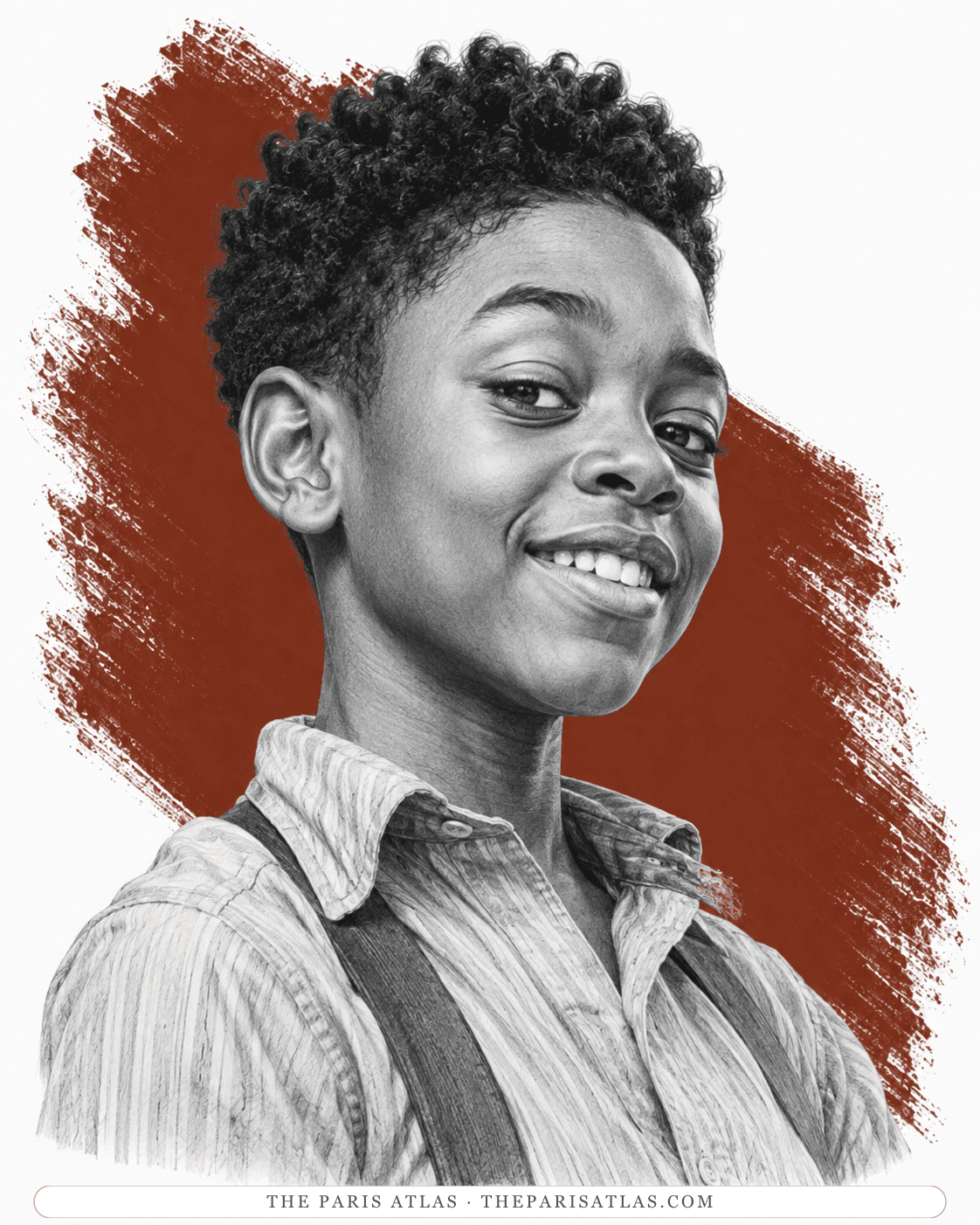
Roy Grimes
John's younger half-brother — reckless, favoured by Gabriel, and completely indifferent to the religion the household runs on.
To be let alone. He puts it plainly at the breakfast table: he does not want his father beating on him all the time, and he is not a dog.
The book

At a glance
- The second son in the Grimes household, Harlem
- Not given; younger than John, who turns fourteen
- The Intermediate Sunday school class, taught by Brother Elisha, when he stays for it
- Goes to the west side with a group of boys and comes home cut above the left eye
- That he and his father are exactly alike
- That white people did it, and that John should take it as a warning
Who they are in the book
Spoiler-freeRoy Grimes is the second son in the household at the centre of James Baldwin's first novel, and the one his father cannot be angry with for long. He shares a bed with his older brother John, sits in the same Sunday school class, and has no interest whatever in the religion the family runs on.
The book uses him as a straight comparison. Nobody expects Roy to know his Sunday school lesson, and nobody minds much when he slips out between Sunday school and morning service and does not come back all day. What John gets for being clever and obedient is a father who calls him ugly. What Roy gets for being neither is a father who calls him the apple of his eye. Roy has worked this out and says so.
On the Saturday the novel covers he goes across the city to the west side with a group of boys, deliberately looking for a fight, and is brought home with a knife wound down his forehead. The rest of that evening is the family's argument about whose fault it is, and it ends with his father taking off his belt.
How Roy Grimes Is Portrayed
- Quiet when his father is homeWalking to church on a Sunday morning he says nothing, and the book gives the reason in the same clause: because his father is home. The rest of the week he talks constantly.
- Sunday schoolHe never knows the golden text either, but nothing follows from it. He has often slipped out between Sunday school and morning service and stayed out for the day.
- In the church itselfHe came along one rare Saturday to help John clean it, and spent the time cursing in the house of God and making obscene gestures in front of the images of Jesus. John remembers this as one of the things his own sin resembles.
- What he was willing to watchHe and John once watched a man and a woman in the basement of a condemned house. The woman wanted fifty cents and the man flashed a razor. John was frightened and never watched again. Roy did.
- The voice he uses on his brotherA shrill, little-girl tone he knows John hates. Asked whether there is anything special for breakfast, he wants to know scornfully whether John has a craving for something.
- Arguing with his motherHe lists what his father does not want him to do — movies, the streets, friends, anything at all — and says that when he has children he will not treat them like this. Then he grins, asks whether she will still be there when he is in trouble, does a dance step, and hits John lightly on the forehead on the way past.
- The woundA knife, luckily not very sharp, from the middle of his forehead where his hair begins down to the bone above his left eye: a crazy half-moon ending in a fuzzy tail that ruins the eyebrow. The scar will darken into his skin, but the divided eyebrow will not come back together, and the lift it leaves will stay with him.
- He does not cry outNot when he staggers into the house blinded by his own blood, and not under the belt. John, who has been enjoying the trouble, notices that and feels a sudden sympathy he had not planned on.
- What he says to his fatherAfter Gabriel strikes Elizabeth, Roy sits up on the sofa and tells him, in a shaking voice, not to touch his mother. Told that he has cursed his father, he says nothing and does not drop his eyes.
- AfterwardsWhen Florence catches the belt, his mother rushes to the sofa and takes him in her arms, crying harder than John has ever seen anyone cry. Roy catches her around the neck and holds on as though he were drowning.
- The apple of his father's eyeFlorence's phrase, said to Gabriel's face in the middle of the row. Elizabeth's version is blunter: Roy and his father are exactly alike, and Gabriel has beaten him in that very room too many times for going out with the same boys.
He is not at the church that night; he is at home with a bandage on his forehead.
If you like Go Tell It on the Mountain


If you like James Baldwin
Explore authors with a similar voice, perspective, and influence.

Louis-Ferdinand Céline
The doctor of the Paris slums who wrote the century's blackest, funniest novel — and changed the sound of French prose.
View author
Henry Miller
The Brooklyn dropout who arrived in Paris broke at thirty-eight and wrote the exuberant, banned books that ended American censorship.
View author
Ernest Hemingway
Author of The Sun Also Rises and A Moveable Feast; his pared-down style, developed in 1920s Paris, became the most imitated in American prose.
View author