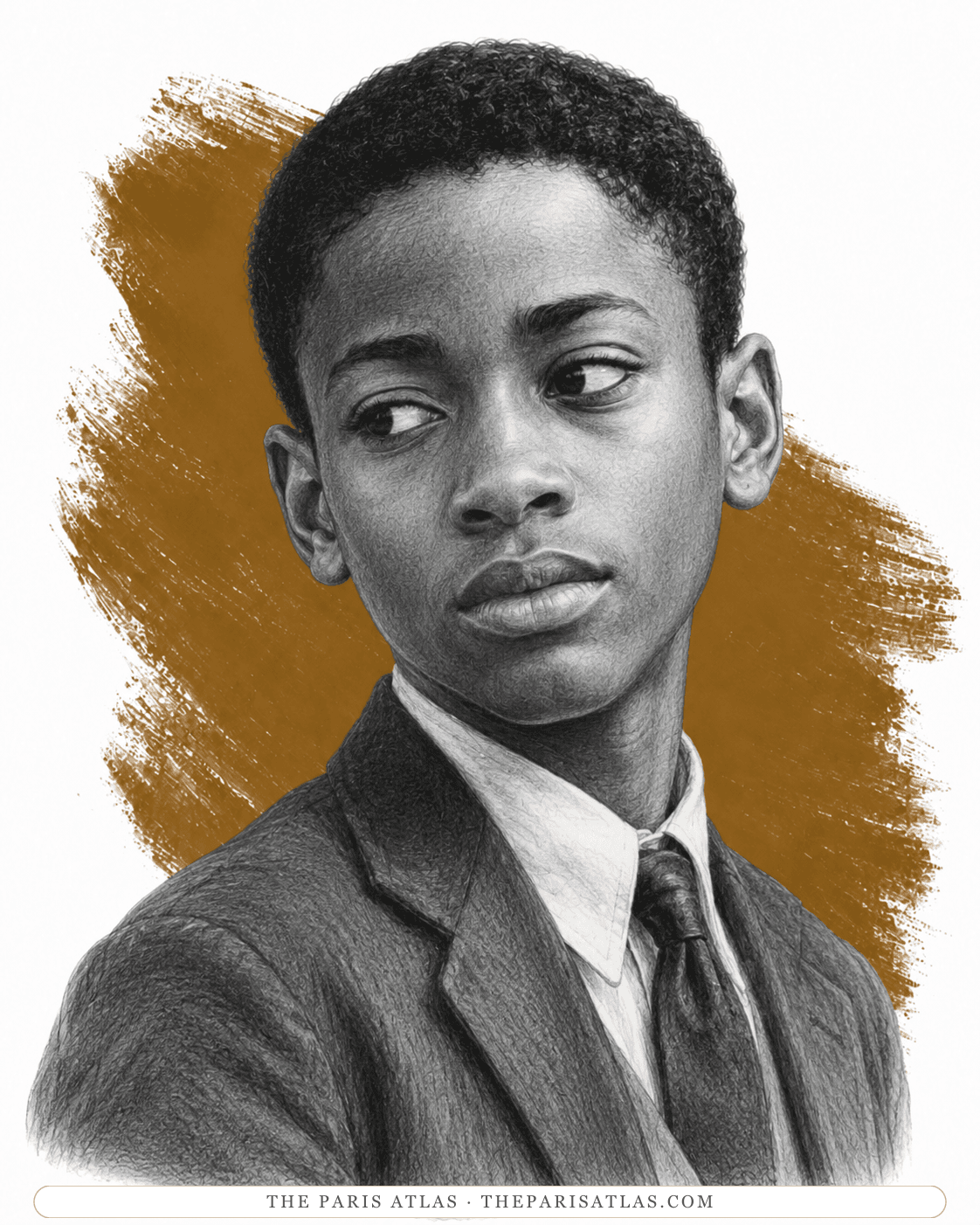
John Grimes
Fourteen on the day the novel covers, and the one the church is waiting on. Clever, watchful, and not at all sure he wants to be saved.
Not to become his father. The book puts it as a decision already taken: he would not be like his father, or his father's father. What he pictures instead is a world where he eats good food, wears fine clothes and goes to the movies as often as he likes.
The book

At a glance
- The eldest child in the Grimes household, Harlem
- Fourteen; the novel covers his birthday
- A Saturday in March 1935
- The Temple of the Fire Baptized, where Gabriel Grimes is head deacon
- Excels, though not at mathematics or basketball. A principal singled him out at five as a very bright boy
- His brother Roy and sisters Sarah and Ruth; his mother is expecting another child
- Sweeping and dusting the church before the tarry service, with his father's key
- Ugly, and the smallest
Who they are in the book
Spoiler-freeJohn Grimes is the invented central character of James Baldwin's first novel, and almost all of the book's present tense belongs to him. It covers one day: Saturday, his fourteenth birthday, in Harlem in March 1935. He wakes with the feeling that something irrevocable has happened to him, and his first thought is whether anyone will remember the birthday at all. Once or twice before, nobody has.
What he believes has happened is sexual. The novel states it in a line and then leaves it to work on him all day: he had sinned with his hands, alone in the school lavatory, thinking of older boys. Everything the household does that Saturday — the sweeping, the Bible lesson, the long service at the end of it — happens over the top of that.
He is the clever one. He does well at school, though not at mathematics or basketball, and people say he has a Great Future and might become a Great Leader of His People. When he was five a principal with white hair and an iron face stopped in front of his class to tell him he was a very bright boy, and he has carried the moment since as a kind of shield: proof that he has a power other people lack and might one day use to get out. At home the account of him is different. His father calls him ugly, tells him his face is the face of Satan, and says the cleft in his chin is the mark of the devil's little finger.
His father, Gabriel Grimes, is head deacon at the Temple of the Fire Baptized, a storefront church a few streets away, and the family's week runs through it. John cleans it on Saturdays with his father's key. The whole congregation is waiting for him to be saved, and he has decided, walking around Manhattan that afternoon, that he might rather be damned.
How John Grimes Is Portrayed
- Waking on his birthdayA Saturday in March 1935. He stares at a yellow stain on the ceiling above his head, which slowly turns into a woman's nakedness, while Roy sleeps beside him with a small whistling sound. The neighbours' radios are silent and nobody in the house is up. The silence is what frightens him.
- Looking for his own faceDusting the living-room mirror, he watches his face appear out of the cloud and is shocked that it has not changed. He can only see details — two great eyes, a broad low forehead, the triangle of his nose, an enormous mouth, the barely perceptible cleft in his chin — and cannot put them together into an answer to the thing he most wants to know, which is whether he is ugly.
- The Saturday workSweeping a carpet so faded it is all one swimming colour and so frayed it tangles with the broom, then furniture oil and a damp cloth over the mantelpiece: photographs, greeting cards, flowered mottoes, two silver candlesticks holding no candles, and a green metal serpent poised to strike. In the evening he opens the church at six and sweeps that too.
- The photograph he hatesThe family keeps baby pictures on the mantelpiece. In his, he lies naked on a white counterpane, and visitors laugh and call it cunning. Roy is in a gown, Sarah in a bonnet, Ruth in her mother's arms. He is sullen with anyone who laughs at it, and they decide he is a "funny" child.
- What his father says about white peopleThat they are wicked, that God will bring them low, that not one of them ever loved a Black man, and that John will find out soon enough how evil they can be. John has read enough to know some of it is true — men burned in the electric chair for things they had not done, beatings in riots, last hired and first fired — and he still cannot make it square with the teacher who once bought him a bottle of cod liver oil when he was sick.
- The hill in Central ParkPast the reservoir, where women in fur coats walk great dogs, a steep overgrown path leads to a clearing and his favourite hill. He runs up it like an engine, or a madman, willing to throw himself into the skyline in front of him, and at the top he stops, because he remembers that the people in that city did not look at him.
- Fifth AvenueHe comes out of the park among the horse-carriages, invents himself a farm and a horse called Rider and a beautiful wife making breakfast, then wonders what church any of these people go to. Outside a shop, watching a doorman in a brilliant uniform, he decides he does not dare go in, and hears his father's laugh: no, nor tomorrow neither.
- The library he has never enteredHe loves 42nd Street, though not for the stone lions outside the main library building. He is a member of the Harlem branch and entitled to take books from any library in the city. He has never gone into that one because the building is so big.
- The film he chooses insteadHe buys a ticket with his birthday money and does not look back at the street, in case one of the saints should see him. The film is about a blonde woman in London with tuberculosis, who drinks and smokes and is cruel to a student who loves her. His sympathy goes entirely to her. He wants to be like her, only more powerful and more thorough and more cruel, and he cannot find in himself any wish for her redemption.
- Wrestling in the back roomElisha lifts him off the floor and tries to squeeze the breath out of him. John, much the smaller, uses that to confound him, and holds the deadlock until Elisha's foot slips. Watching the veins rise on Elisha's forehead and neck, John is filled with a wild delight, and when it is over he asks Elisha to teach him wrestling one time.
- The birthday moneyHis mother says she never asked what he wanted, opens his palm and puts coins into it, warm and wet from her hand, and tells him to go and get himself something. He stares up at her face, wants to put his head against her and cry, and looks down at the coins instead.
The novel's long middle section establishes something John does not know.
He goes down on the church floor at the end of the day and stays there all night.
If you like Go Tell It on the Mountain


If you like James Baldwin
Explore authors with a similar voice, perspective, and influence.

Louis-Ferdinand Céline
The doctor of the Paris slums who wrote the century's blackest, funniest novel — and changed the sound of French prose.
View author
Henry Miller
The Brooklyn dropout who arrived in Paris broke at thirty-eight and wrote the exuberant, banned books that ended American censorship.
View author
Ernest Hemingway
Author of The Sun Also Rises and A Moveable Feast; his pared-down style, developed in 1920s Paris, became the most imitated in American prose.
View author