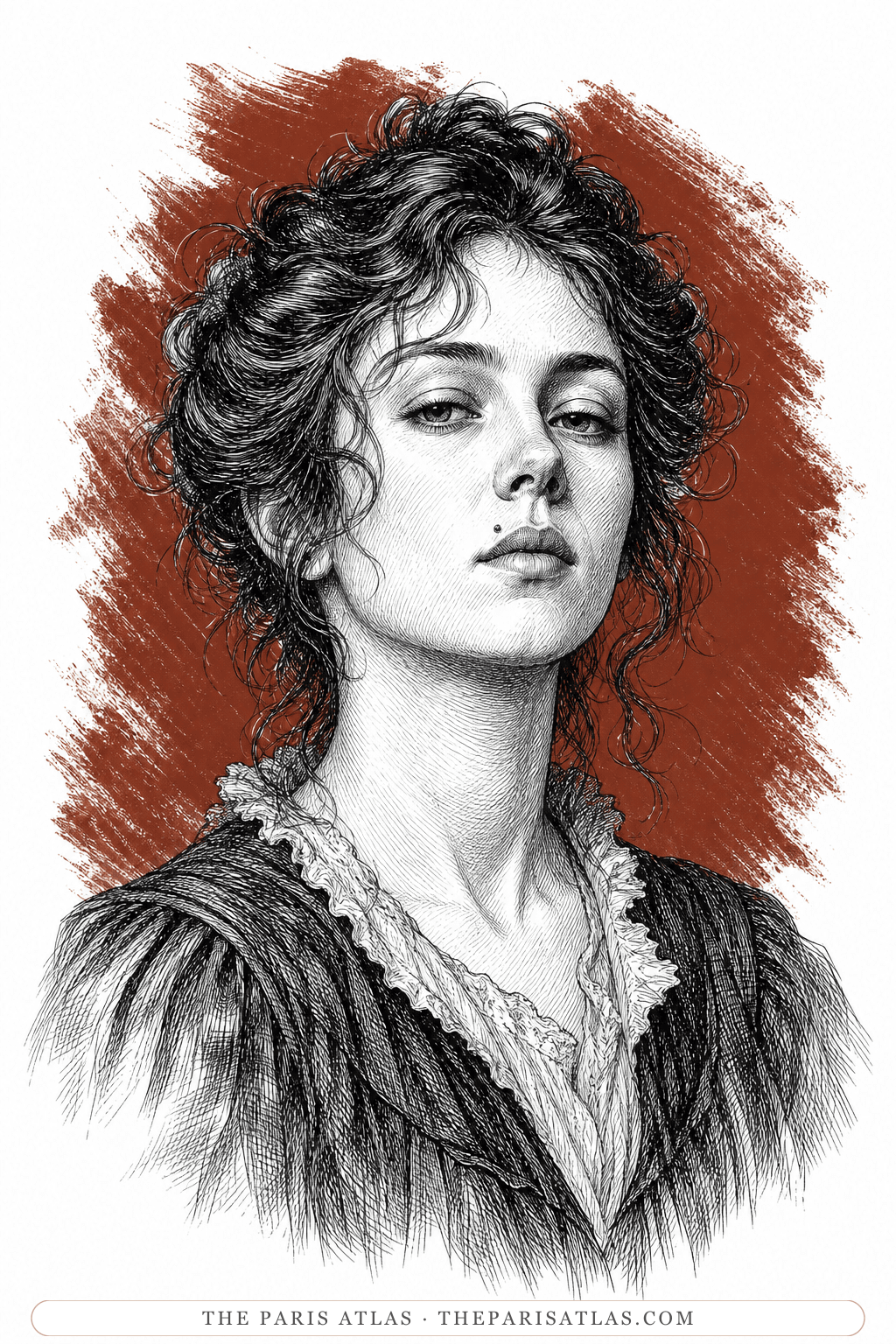
Kate-Careless
The mistress — a street singer's daughter and former child actor who arrived in 1897 and stayed, and bore her children in the next room to the wife's.
Somewhere comfortable to be. Her first words on arriving at the cabin, laughing and crying at once with the feathers in her hat shaking, are that they have it very comfortable here.
The book

At a glance
- Wendell's mistress, resident in the household from 1897
- A street-singing contralto from Cork and a Pre-Raphaelite painter of the sea
- Child actor at the Haymarket; then a houseboat on Lake Erie
- A mole on her lip
- Sophia, who told her to call her Mother
- Elisha, Elsie and Aaron
Who they are in the book
Spoiler-freeKate-Careless is an invented character in Ryder, the 1928 first novel by the American writer Djuna Barnes, and the third adult in Wendell Ryder's household. She was the girl with the mole on her lip whom Amelia once watched combing her hair at a window in Shepherd's Bush, years before either of them knew the other's name. Her mother was a contralto from Cork with a voice too big for her body who sang in the London streets for coins; her father painted the sea; and Kate sat beside the street organ playing tra la la.
She came into the Ryder household in early 1897 and did not leave. She is drawn from the mistress Wald Barnes moved into the family house at Cornwall-on-Hudson.
How Kate-Careless Is Portrayed
- The child performerShe played a drummer at the Haymarket on Thursdays and Saturdays in soiled pink tights and a thirteenth-century troubadour's cap with a pink ostrich feather, and a consumptive on Tuesdays and Wednesdays in a torn grey garment with her coughs arranged in mathematical groups.
- The uncertain parentageHer mother and father may not have been married; the book asks whether that makes her a bastard and answers that nobody can say how craftily a child makes legitimacy prey on her condition. She left the question, along with the rest of the family background, to her sister.
- The houseboatShe ran off with a landscape painter who did thatched cottages around Richmond in yellow watercolour and drank, as the book puts it, from a leaking bung. They kept house on a houseboat on Lake Erie, where she entertained on a full dinner service catalogued down to the eleven soup plates, and went boating at night to argue about suicide. In early 1897 she gave up boating.
- The entranceShe arrives at the cabin in a herring-bone bodice of dragon's-blood cashmere, a hat that is a waving paradise of feathers, and a mohair belt buckled to match, at the point in her life when she is beginning an imperceptible drift toward stoutness. Sophia introduces her as a new daughter. Amelia, holding a broom, says she remembers her.
- "What Kate Was Not"A whole chapter imagines the other women she might have been — Kate-Why-Not in a city apartment, Kate-the-Doll, Kate-the-Whirlwind, Kate-the-Kick-Up, Kate-Cast-Pot emptying a chamber pot onto a judge's wig — and answers each one in the affirmative, in a different formula every time, before refusing the last flatly: might she have been Kate-Careful? Ah, never, never, never.
- The birth in the music-roomShe goes into labour on the same evening as Amelia, in a different room of the same small house. Amelia, hearing her, works out that when Wendell left her nine months ago to the day, he had not gone for firewood. Kate's child is a girl, and is born in the last line of the chapter.
- A-dunging with AmeliaThe two women clean Wendell's dovecote together, on their four feet with besoms, while he is elsewhere having fancies. Kate pitches three dead squabs out the window and asks Amelia to tell her the reason that Wendell has fancies and they have the cleaning; Amelia's answer — "To man is the vision, to his wife the droppings!" — pleases her enough that she says, "Sometimes I wish you were the mother of my children, for you have good fancies."
- Leaving home foreverAfter the battle of the chiselled head, wife and mistress each leave home forever on the same day — Amelia on the horse, Kate on the red cow, Sally. They meet on the Park Road singing answering bawdy verses, trade "Goat-skin!" for "Pig's-bladder!", and have what Amelia calls a fair fight for the first time in their lives, until Kate bursts into weeping and borrows Amelia's linen handkerchief. Riding home she settles her own position: "neither in this world nor yet in another, shall I rise to claim more than the half of a man!" The children cheer them back to the farm, and Amelia stables both animals, for Kate was poor in most capacities.
- The knit codpiecesShe and Amelia sit either side of the fire knitting codpieces for Wendell, Kate's blue, Amelia's red, trading double-edged talk until owner and poacher flare up again and they brawl till blood flows and hair falls. The fight stops only because it is past dinner-time, and Wendell will be coming home hungry.
If you like Ryder


If you like Djuna Barnes
Explore authors with a similar voice, perspective, and influence.

Henry Miller
The Brooklyn dropout who arrived in Paris broke at thirty-eight and wrote the exuberant, banned books that ended American censorship.
View author
Louis-Ferdinand Céline
The doctor of the Paris slums who wrote the century's blackest, funniest novel — and changed the sound of French prose.
View author
Martha Gellhorn
War correspondent who covered the Spanish Civil War, D-Day, and conflicts across five more decades; Hemingway's third wife, 1940–1945.
View author