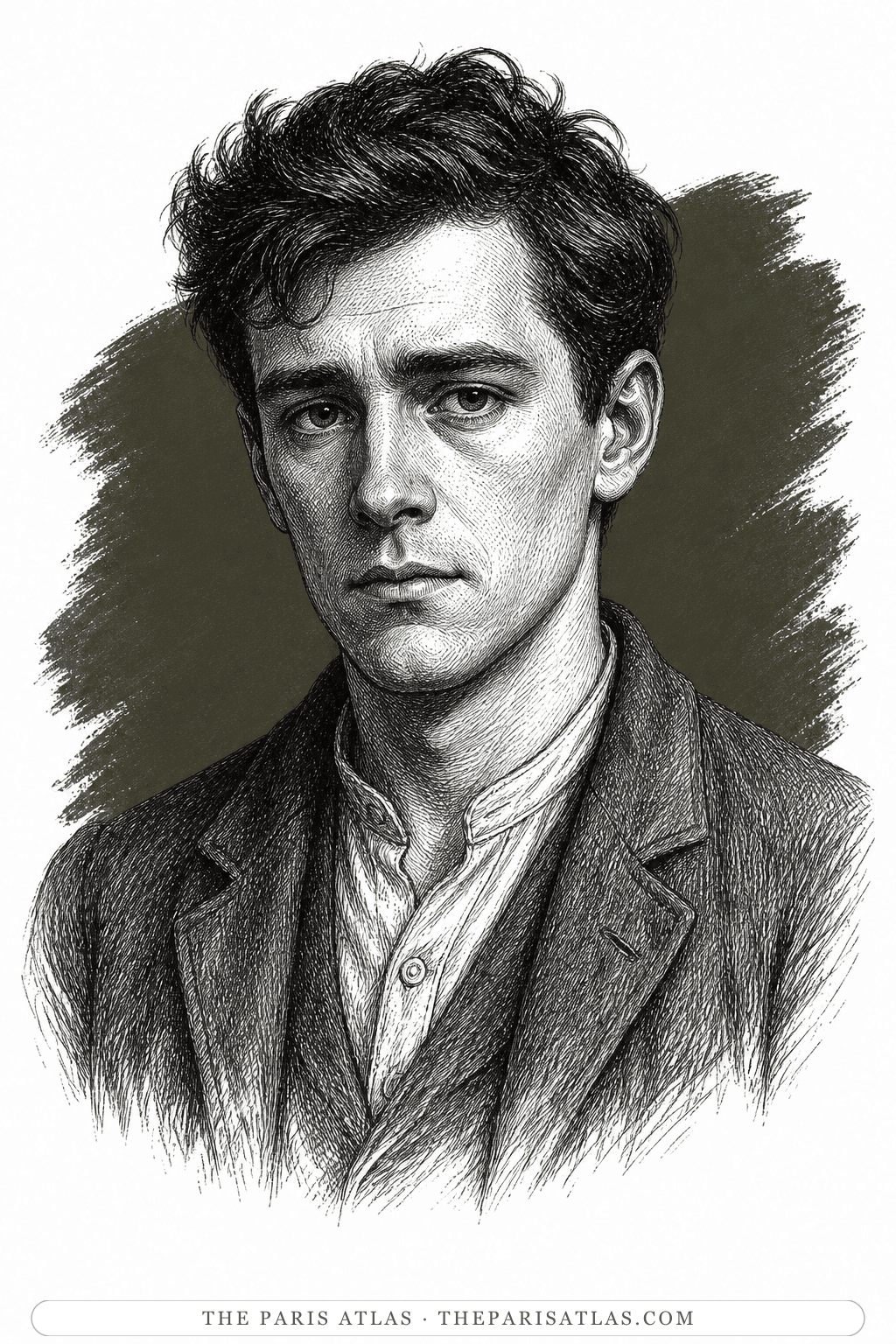
Timothy
Wendell and Amelia's eldest — the boy sent running for the doctor, and the young man who tries to reform a prostitute and loses his watch-chain doing it.
To save somebody. When he finally gets the chance he spends a whole chapter on it and is robbed while he talks.
The book

At a glance
- Eldest son of Wendell and Amelia
- Morose; useful in some way that cannot yet be named
- Elisha, ridden by music, and Hannel, the youngest
- Julie
Who they are in the book
Spoiler-freeTimothy is an invented character in Ryder, the 1928 first novel by the American writer Djuna Barnes, and the eldest of Wendell Ryder's children by his wife Amelia. His birth is narrated in a single paragraph of deliberately biblical plainness, and his name is given in a sentence of its own.
His father, describing his children to a hall full of neighbours, calls him morose, says he cannot say how he will be useful to nature but that he will be useful, and predicts that it will take him all his life to unravel the tangle of his upbringing.
How Timothy Is Portrayed
- The boy who runs for the doctorOn the night both women are in labour he passes the window whispering through the casement, is told by his sister to run for Dr O'Connor, and turns and runs down the road in the dark. Earlier the same evening he is in the upper field with the labourer, calling the screaming from the house the heavenly choir.
- The love litanyA whole chapter of his courtship is set out as alternating speeches with a woman called Light-o'-Love, in which he addresses her as his rabbit, his coney, his pie, his finch, his pudding and his grouse, and works down through her small gut and great gut, her tendons and muscles, her faults and her fairness, ending on "my Judas, my Jesus!"
- The interrogationTrying to find the exact moment a prostitute might have repented, he asks her about every posture and occupation he can think of — praying, travelling, at a window, in bed, in another's bed, going upstairs, coming down, morning, noon, evening, midnight — and gets "No" to every one, until she tells him it was never at all, and that he would have saved them both trouble by asking outright.
- The sermon he preaches at herHe tells her that in the days that are not there were great men and great sins and chariots that smoked on the wheel, and that now all wisdom has shrunk and redemption is a small thing and no wonder. Then he weeps, strokes her, and says he will give her up for the width of her soul.
- What it costs himWhile he talks and weeps her hands are on him, cunning and cautious. She leaves with his watch-chain, his cuff-links and his roll of a hundred, promising to do better, most exceptional better. He finds out in the morning, sits on the bed older and poorer, and swears the largest oath he is able.
- The racesHe dresses in a fine striped vest with corded revers, plum socks and high varnished boots, and takes his losses to the racecourse on the principle that the horses and the cards and the dice shall have what he has wasted on women. He shouts and sweats and gambles, and the chapter ends with him crying that God shames himself in him.
- The fishing tripOn the Beast Thingumbob expedition he retells the day the family's moving van overturned with Kate's sewing machine aboard — he had jumped up and down in his Lord Fauntleroy suit screaming "There she goes!" — and at the crab pot he pushes in ahead of his sister, so that Julie could not see.
- The aunt's reportHis first affair reaches the book secondhand, in a letter from Amelia's sister in London: he has taken up with half-wit, white-haired Polish Lena, who lies at all hours beside the roadway in the underbrush. The aunt files it among the misfortunes of women.
If you like Ryder


If you like Djuna Barnes
Explore authors with a similar voice, perspective, and influence.

Henry Miller
The Brooklyn dropout who arrived in Paris broke at thirty-eight and wrote the exuberant, banned books that ended American censorship.
View author
Louis-Ferdinand Céline
The doctor of the Paris slums who wrote the century's blackest, funniest novel — and changed the sound of French prose.
View author
Martha Gellhorn
War correspondent who covered the Spanish Civil War, D-Day, and conflicts across five more decades; Hemingway's third wife, 1940–1945.
View author