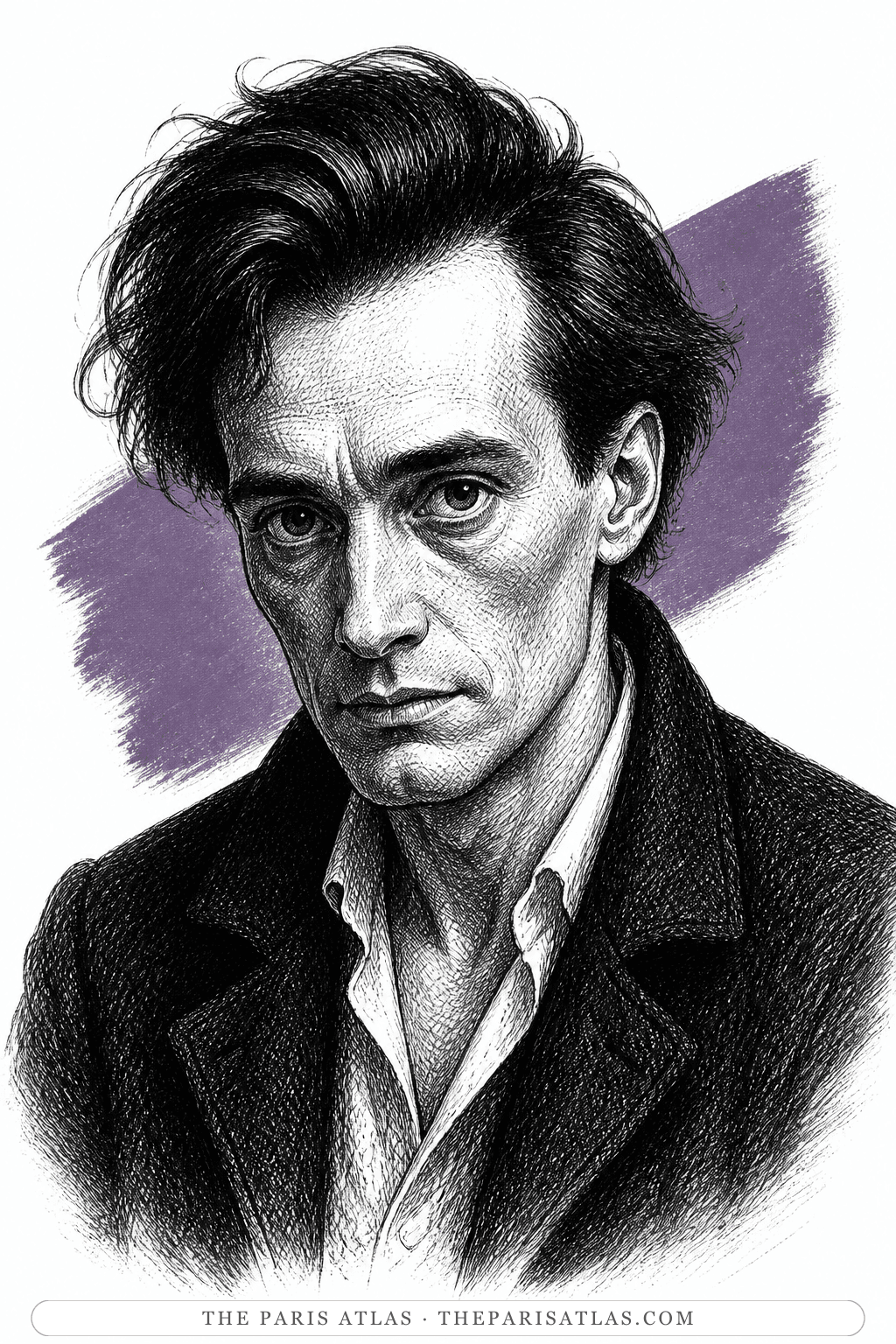
Antonin Artaud
The French poet and theatre director she met in 1933. He wrote her letters for a year, then accused her of never having loved him.
To find one person who will go into his madness with him.
The book

At a glance
- 'Artaud' — a French poet and theatre director, introduced by her analyst
- 1933, in the middle third of the volume
- Letters both ways, walks across Paris, and a bond neither of them can name
- Antonin Artaud · 1896–1948 · Marseille
Who they are in the book
Spoiler-freeAntonin Artaud was a French poet, actor and theatre theorist. He is remembered for the Theatre of Cruelty, his idea that a performance should work on an audience the way a plague or a ritual does, by contagion rather than by argument. Nin met him in 1933 through her analyst René Allendy, who had tried and failed to get him off the drugs that were destroying him.
He is the most physically vivid person in the volume. She writes down a gaunt face and visionary eyes, a manner that swings between fire and exhaustion, a stutter under strain, and a habit of taking the deepest chair in the corner of a room as if it were a cave. They talk about condensation and essences, about magic and the kabala, and about whether analysis is any use to a poet.
The friendship runs on letters and long walks through Paris and ends in an accusation. When he decides she has never loved him he tells her so to her face, and adds that her love for her father is an abomination. Her own verdict is that she loved the poet who walked inside her dreams and could not be physically bound to the man.
How Antonin Artaud Is Portrayed
- The lookLean and taut, a gaunt face with visionary eyes, a sardonic manner: weary one minute and fiery and malicious the next (page 195).
- What he wanted the theatre to doHe talks about the ancient rituals of blood and the lost magic of contagion. No talking, no analysis, no objective stage — a ritual in the middle of the audience that would shock people back into ecstasy (page 195).
- The Sorbonne lectureBilled to speak on the theatre and the plague, he lets go of his argument partway through and begins acting out death by plague. The hall laughs, hisses, and empties, doors banging. He goes on to the last gasp and stays on the floor; then he walks over to Nin, kisses her hand, and asks her to the café (page 200).
- How he writesPainfully, in spasms, at great strain. He is poor, he owns nothing, he keeps nothing, and he cannot understand why she stores her diaries in iron boxes (pages 195–197).
- Why he refused analysisHe talked to Allendy several times and then declined, calling it a formula while admitting it had helped. He told Nin he had never needed it because he had never entirely lost his equilibrium (pages 196, 218).
- The hand on the kneeIn the garden at Louveciennes, having read to her from his book on Heliogabalus, he puts a hand on her knee. She makes no answering gesture and says something kind instead; he withdraws it, and they sit very still (page 236).
- The breakHe tells her he sensed from her letters that she had ceased to love him, or had never loved him, that another love has taken hold of her, and that he knows it is her father. Then he tells her she gives everyone the illusion of maximum love (page 255).
- The photograph in the studioMuch later, cleaning out the Villa Seurat studio for Henry Miller to move into, she finds a photograph of Artaud in a closet. He had refused to give photographs away, fearing that someone might stick pins in them; she stores it away without putting a tack through it (pages 359–360).
If you like The Diary of Anaïs Nin, 1931–1934


If you like Anaïs Nin
Explore authors with a similar voice, perspective, and influence.

Henry Miller
The entangled careers of the Villa Seurat: she financed and prefaced his scandal, he detonated her prose — and each wrote the other into the century's record.
View author
Louis-Ferdinand Céline
The doctor of the Paris slums who wrote the century's blackest, funniest novel — and changed the sound of French prose.
View author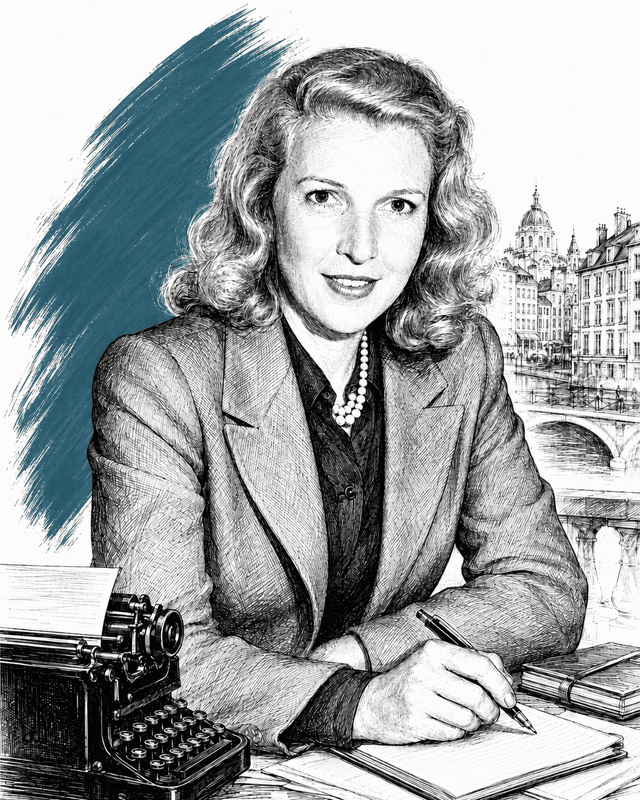
Martha Gellhorn
War correspondent who covered the Spanish Civil War, D-Day, and conflicts across five more decades; Hemingway's third wife, 1940–1945.
View author