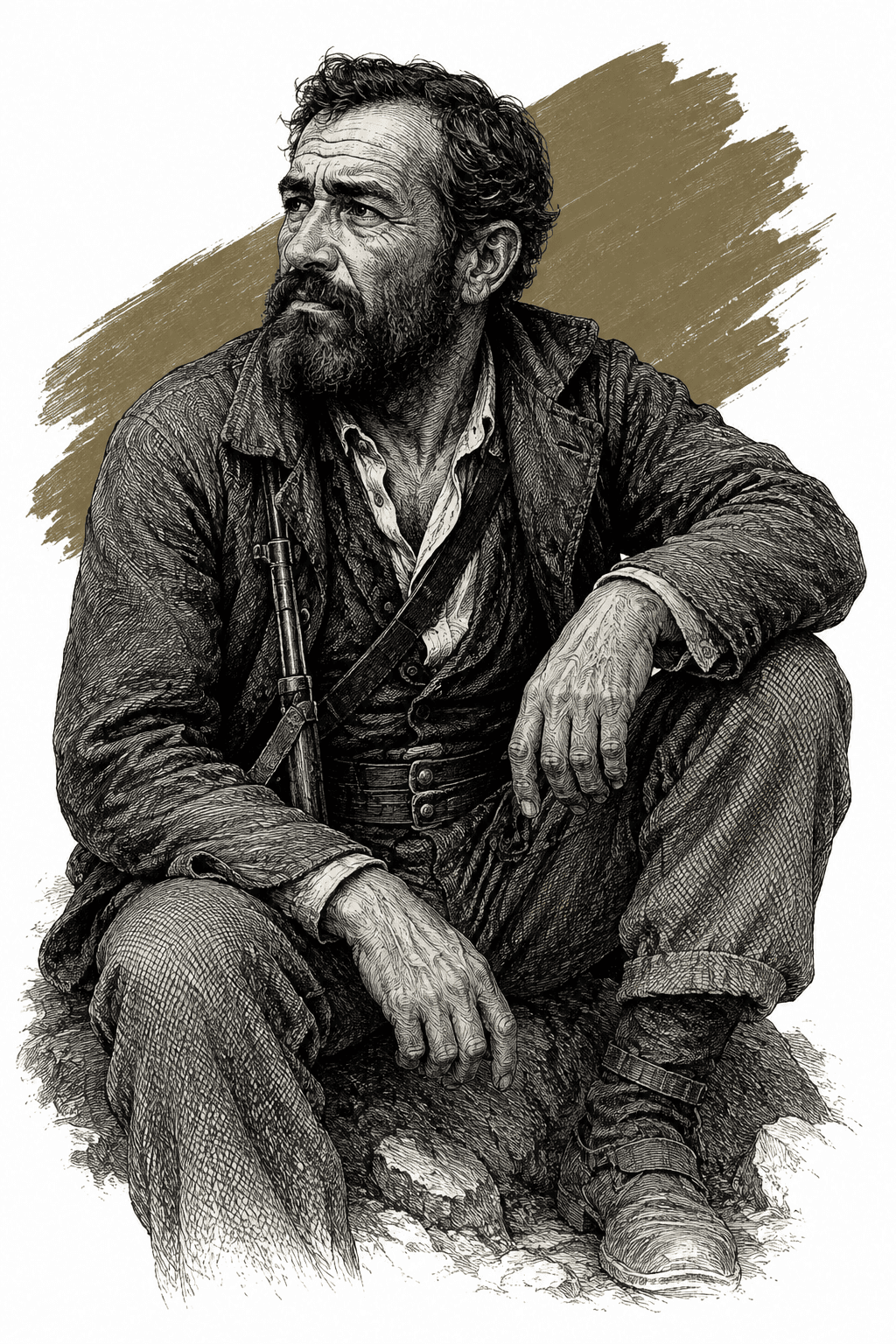
El Sordo
The leader of the second guerrilla band in the mountains north of Madrid. His name is Santiago; everyone calls him the deaf one.
To go on fighting from somewhere he can also leave. The question he keeps putting to Robert Jordan and to Pilar is not about the bridge but about afterwards: where the bands are supposed to work from once these mountains are full of soldiers.
The book

At a glance
- El Sordo — leader of the second guerrilla band, the one Robert Jordan needs
- Santiago, which only Pilar uses
- Fifty-two
- In one ear; the book stages every conversation around which side he can hear from
- A pinch bottle of Scotch whisky, kept for visitors and drunk half and half with water
- Horses. The snow that falls in the middle of the novel makes the tracks readable
Who they are in the book
Spoiler-freeThere are two bands of guerrillas fighting for the Spanish Republic in this stretch of mountain north of Madrid, behind the fascist line, and El Sordo leads the second one, from caves hidden by scrub pine in a rounded gulch-head high above the treeline. His real name is Santiago, and the only person who uses it is Pilar, who runs the other band; everybody else calls him El Sordo, which is Spanish for the deaf one. He is fifty-two, short and heavy, brown-faced and bow-legged from a life spent with cattle, and he turns his head to put his good ear towards whoever is talking.
Robert Jordan, the American sent to blow a bridge in the valley, needs roughly twice the men the first band can give him, so he walks up the mountain to ask for the rest. El Sordo listens, puts two or three practical questions, and agrees — without ceremony, and without pretending the job is anything other than what it is.
He speaks a clipped, stripped English he picked up from foreigners, dropping most of the small words. It reads at first like a comic accent and stops reading that way very quickly.
How El Sordo Is Portrayed
- Santiago, called the deaf onePilar greets him across the clearing by his own name, Santiago, and it is the only time anybody does. He is grey-haired with wide-set yellow-brown eyes and a thin-bridged hooked nose, clean-shaven, in a sheepskin-lined jacket buttoned to the neck on a warm day. His deafness is written into the staging: people speak to the side of his head, and he turns to catch them.
- "Knew many English. Always much whiskey."He comes out of his cave with a pinch bottle of Scotch under one arm, three glasses hooked on his fingers and an earthenware water jar in the other hand, and explains where he learned to keep the stuff: "Knew many English. Always much whiskey." He pours himself half a glass and fills it up with water.
- He says yesJordan tells him the operation needs double the men available and will probably be bad. El Sordo does not haggle. "Dentro de la gravedad," he says, and translates it himself — within the limits of the danger — then grins and asks whether it will be bad. When the talk turns to numbers he is unbothered: "Is the same to me," Sordo said simply and not boasting. "Better four good than much bad. In this war always much bad, very little good. Every day fewer good."
- The horse he shotCaught in the open with cavalry behind him, he rides for the nearest hill, hauls his wounded horse up the last of the crest by the bridle, holds it trembling in the middle of the firing and shoots it exactly at the crossing of the lines between its eyes and its ears. As it goes down he drops behind its warm back and gets his automatic rifle working. Afterwards he leans over and pats it on the shoulder where the muzzle burned the hide.
- Fifty-two years oldWounded in the head and the arm, drinking from a leather wine bottle with his good hand, he looks up at the sky. "He was fifty-two years old and he was sure this was the last time he would see that sky." What makes him angry is not that, but the hill: it is shaped like a sore and is no use for anything except dying on, and he cannot get his men off it.
- Better than the aspirinAn officer below starts bellowing insults up the slope, hoping to draw fire and find out whether anyone is still alive. El Sordo, who has to turn his good ear to hear any of it, is delighted. "Sordo grinned. He could just hear the bellowed insults by turning his good ear. This is better than the aspirin, he thought." Then he calculates how many of them the insults might be worth.
- What living isThe book gives him the plainest statement it has about why any of this matters. He is not afraid of dying and cannot picture it. "But living was a field of grain blowing in the wind on the side of a hill. Living was a hawk in the sky." The list goes on into water jars, threshing chaff, a horse under him and a carbine under his leg.
The snow is what kills him:
If you like For Whom the Bell Tolls


If you like Ernest Hemingway
Explore authors with a similar voice, perspective, and influence.

Louis-Ferdinand Céline
The other great stylist the Great War produced — where Hemingway cut the language down, Céline set it on fire. The same wound, opposite treatments.
View author
Henry Miller
Paris on no money a decade later, with the restraint removed. Miller called Hemingway's Paris a tourist's Paris; readers get to referee.
View author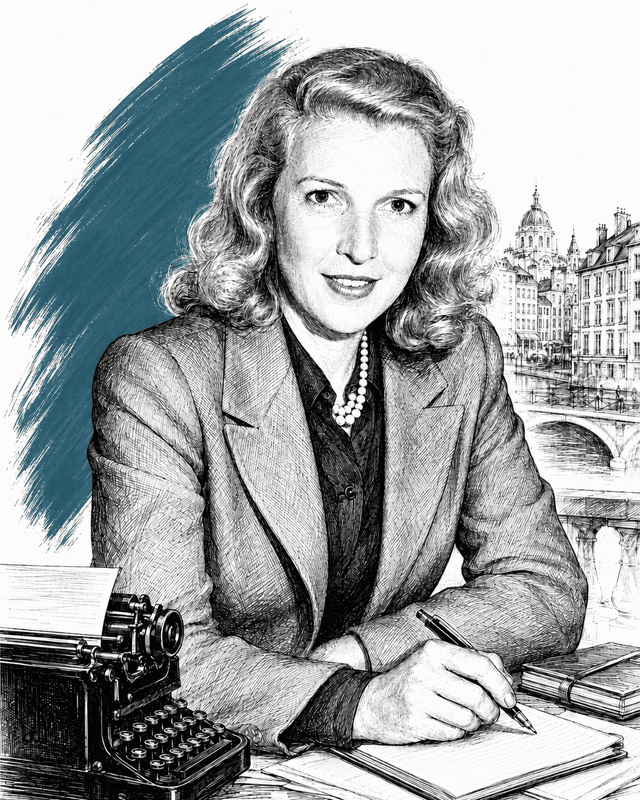
Martha Gellhorn
War correspondent who covered the Spanish Civil War, D-Day, and conflicts across five more decades; Hemingway's third wife, 1940–1945.
View author