Maria
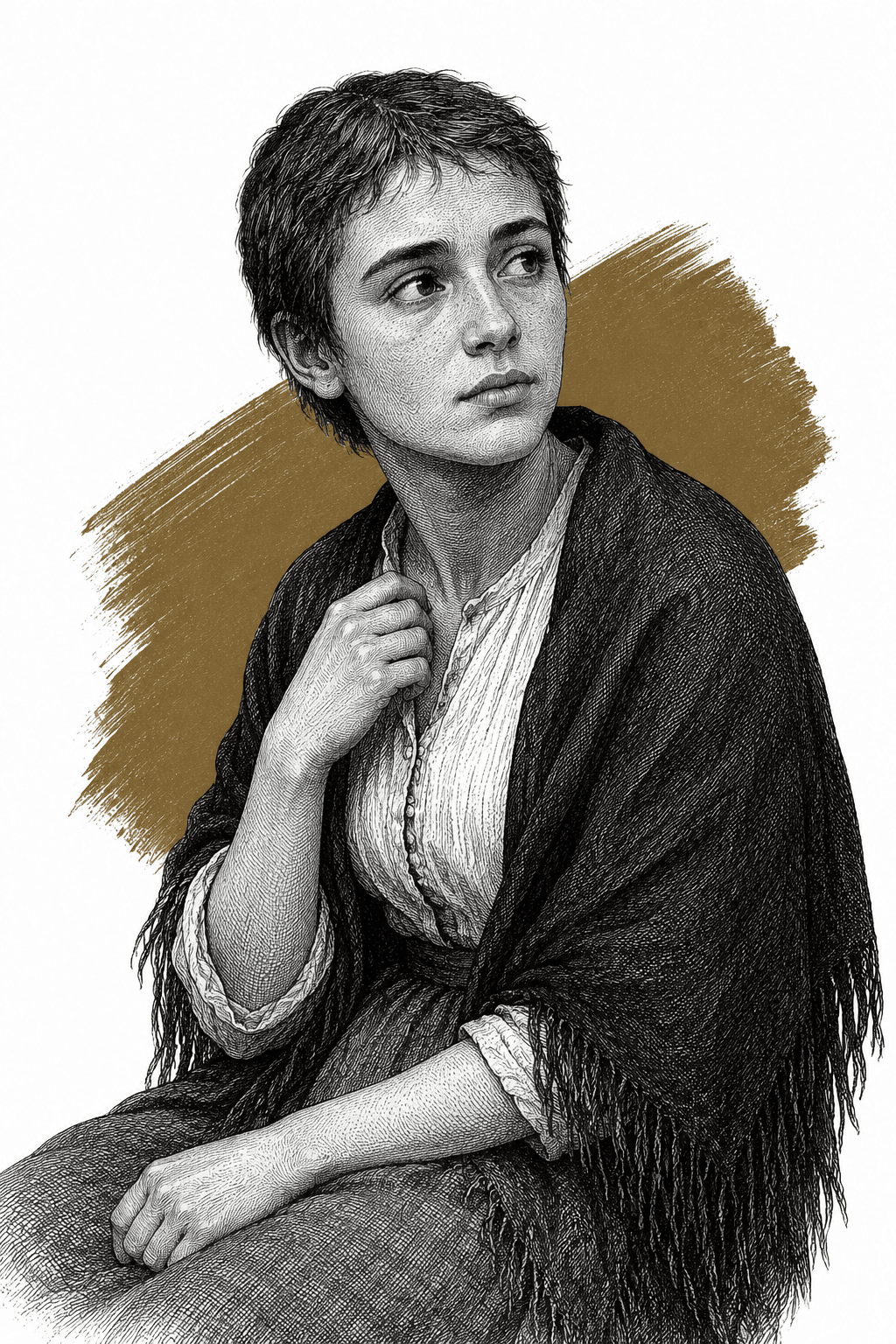
A young Spanish woman the band pulled off a wrecked prison train three months before the novel starts. Her hair is growing back from a prison shave.
To belong to Robert Jordan completely and go wherever he goes. On the first night he offers to arrange somewhere safe for her and she refuses it flatly: "No. No. No. With thee and I will be thy woman."
The book

At a glance
- Maria — called "rabbit" by Robert Jordan and "guapa" by Pilar
- The mayor of her village, shot with her mother against the wall of the slaughterhouse
- Shaved regularly in the prison at Valladolid, and three months growing back
- She was a prisoner on a train they blew up, and hid in the rocks afterwards
- Pilar, who has kept every man in the band away from her since the train
- "my Inglés"
Who they are in the book
Spoiler-freeMaria is the daughter of the mayor of a small Spanish town, and the novel finds her three months into the Spanish Civil War, living with a band of guerrillas in a cave in the mountains north of Madrid. When the fascists took her town, the Civil Guard shot her father and mother against the wall of the village slaughterhouse because her father was a Republican. Falangist militiamen then herded the town's women and girls through the streets to the square. In the barber's chair they cut off Maria's braids with a razor, gagged her with them and clipped her head bare; they carried her across the square and up into her father's office in the town hall, and raped her there. The book states this plainly, in her own voice, and does not linger.
She was sent to the prison at Valladolid, where her head was shaved regularly, and was on a train being moved south when Pablo's band blew the track. She hid in the rocks. Pilar, the woman who runs that band, made the men carry her, and hit her own husband Pablo with a rope every time he tried to put her down. That was three months before Robert Jordan arrives, and her hair has grown back to a short, rippling crop.
Robert Jordan, the American demolition expert who arrives to blow a bridge with the band's help, meets her on his first afternoon in the camp, when she carries out the iron platter of stewed rabbit. She is in the sleeping bag with him that night, and for the rest of the three days the novel treats what happens between them as the only future either of them is likely to get.
How Maria Is Portrayed
- The haircutThe first thing Jordan notices, and carefully does not stare at, is her cropped head. She saves him the trouble: "That is the way I comb it," she said to Robert Jordan and laughed. "Go ahead and eat. Don't stare at me. They gave me this haircut in Valladolid. It's almost grown out now." When she runs a hand over it, the hair flattens and rises again like a grain field in wind.
- What was done to herOn their last night she tells him the whole of it herself, in order, without softening anything. Her father shouted "Viva la República" as they shot him against the slaughterhouse wall, and her mother, standing at the same wall, shouted a cheer for her husband, the mayor of the village. Then the barber's chair, the braids cut off with a razor and used as a gag, the clippers. Her account of what happened afterwards in her father's office is one sentence: "And it was there that the bad things were done."
- "I tell thee this for thy pride"Before she tells him any of it she tells him the part she thinks he will need: "Never did I submit to any one. Always I fought and always it took two of them or more to do me the harm. One would sit on my head and hold me. I tell thee this for thy pride." She has decided in advance what a husband would want to know, and gives him that first.
- Where the noses goShe has never kissed anybody. On the first night she kisses him on the cheek and then asks the practical question: "Where do the noses go? I always wondered where the noses would go." A page later she is promising to try to kiss him very well.
- The same thingJordan says his father shot himself. Maria's answer is not sympathy but arithmetic: her own father could not get hold of a weapon at all, and she is glad Jordan's father had the good fortune to obtain one. "Then you and me we are the same," Maria said. She puts her hand on his arm and looks into his face when she says it.
- "It was a thing I cannot tell thee"Pilar cross-examines her about what happened in the heather, and Maria will not be drawn: "The earth moved," Maria said, not looking at the woman. "Truly. It was a thing I cannot tell thee." Pilar, who says the same thing used to happen to her every night when she was young, is unable to decide whether to be pleased or bitter about it.
Maria quotes
I loved you when I saw you today and I loved you always but I never saw you before.
She asks Pilar what she should do about not being a virgin and is told, in effect, that nothing was done to her that counts, which Jordan repeats to her in the sleeping bag on the first night. Whether the book is offering that as truth or as the kindest available lie is left open.
If you like For Whom the Bell Tolls


If you like Ernest Hemingway
Explore authors with a similar voice, perspective, and influence.

Louis-Ferdinand Céline
The other great stylist the Great War produced — where Hemingway cut the language down, Céline set it on fire. The same wound, opposite treatments.
View author
Henry Miller
Paris on no money a decade later, with the restraint removed. Miller called Hemingway's Paris a tourist's Paris; readers get to referee.
View author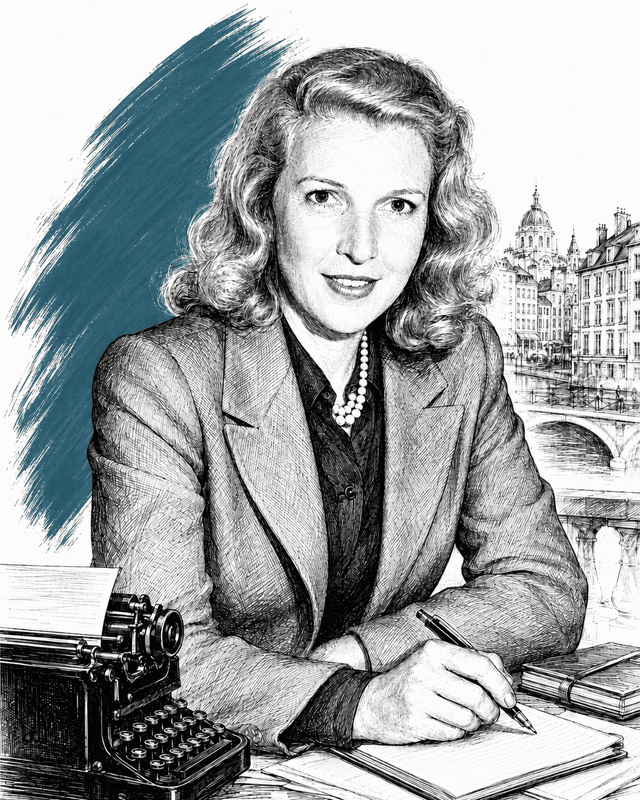
Martha Gellhorn
War correspondent who covered the Spanish Civil War, D-Day, and conflicts across five more decades; Hemingway's third wife, 1940–1945.
View author