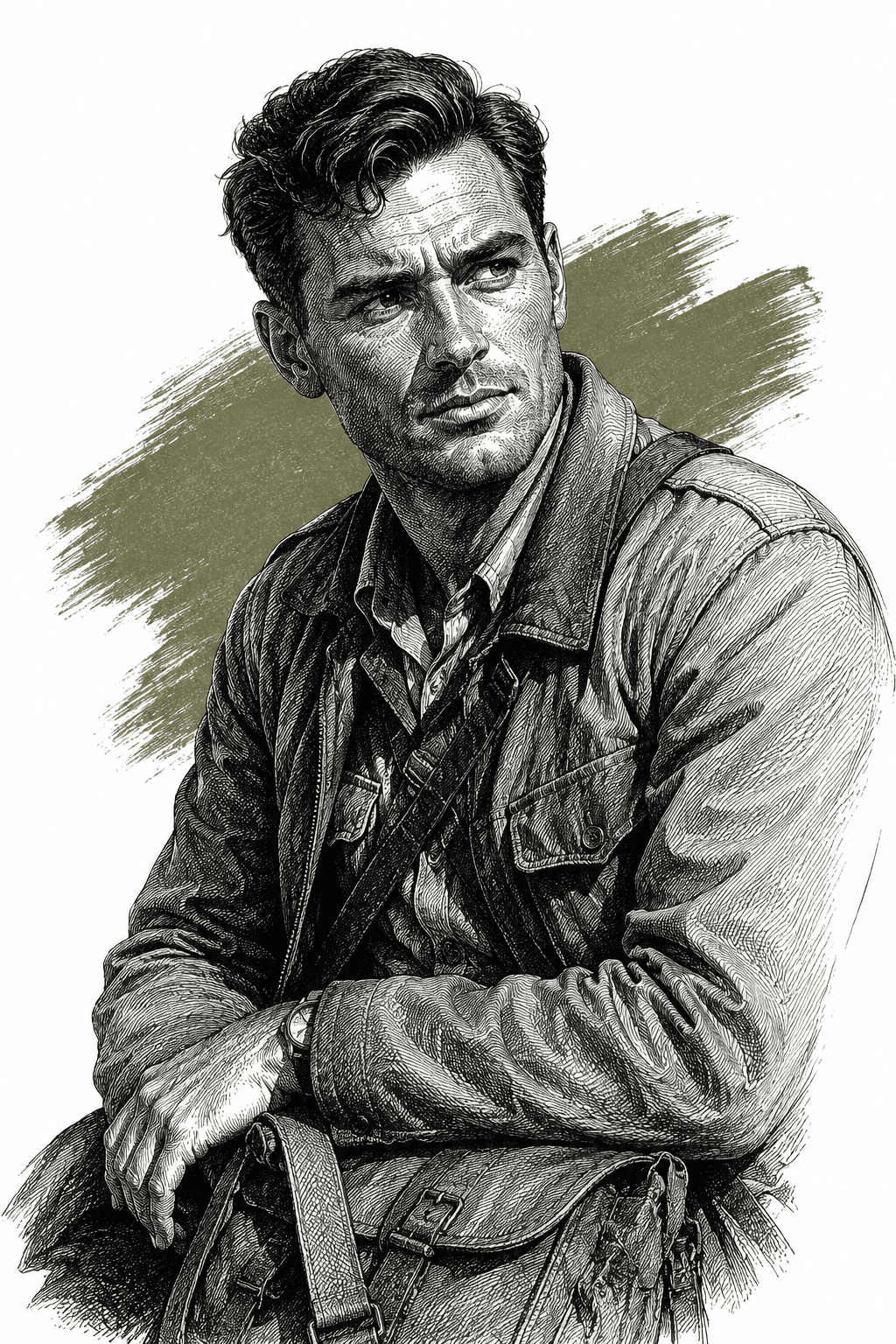
Robert Jordan
An American who teaches Spanish at a university in Montana and blows up bridges for the Spanish Republic. He is given one bridge and three days.
To blow the bridge at the right minute — not before, not after — and to get the people helping him out alive afterwards.
The book

At a glance
- Robert Jordan — an American demolition expert working behind the fascist lines for the Spanish Republic
- Instructor in Spanish at the University of Montana, on leave and expecting to be blacklisted at home
- "the Inglés" — the Englishman — by the band, who go on calling him that after learning he is American
- General Golz, who commands the Republican division making the attack
- Two packs of explosive, wire, detonators, an exploder, and a submachine gun
- Three days, ending at whatever hour the attack begins
Who they are in the book
Spoiler-freeRobert Jordan is an American, an instructor in Spanish at the University of Montana, and a volunteer in the Spanish Civil War. That war began in 1936, when part of the Spanish army rose against the elected government of the Republic. Jordan fights for the Republic. The soldiers on the other side are called fascists throughout the book, and the enemy he is sent behind is theirs.
His speciality is demolition. He has blown trains and roads and bridges of every size, and he is good enough at it that a Russian general commanding a Republican division asks for him by name. The order he is given is narrow and hard: destroy a bridge in the Guadarrama mountains north of Madrid at the exact hour a Republican attack begins, so that the enemy cannot bring tanks and reinforcements up the only road.
To do it he needs the guerrilla band that lives in a cave above the bridge. It is nominally led by a man called Pablo, who no longer wants to fight anything; it is actually led by Pablo's wife, Pilar; and among its people is a young woman named Maria. The novel covers the three days between Jordan walking into their camp and the hour the attack is set for.
How Robert Jordan Is Portrayed
- Flat on the forest floorThe novel's first sentence puts him on the ground looking down at his target: "He lay flat on the brown, pine-needled floor of the forest, his chin on his folded arms, and high overhead the wind blew in the tops of the pine trees." Below him is the oiled road through the pass, the stream beside it, and the bridge.
- The orderGeneral Golz gives him the job in an upstairs room with a lamp and a big map. "To blow the bridge is nothing," Golz had said, pointing with a pencil, and asked whether Jordan understood. Jordan said he did, and Golz said it again harder: "Absolutely nothing. Merely to blow the bridge is a failure." It has to go when the attack starts, because that is the only road the enemy can bring tanks and artillery up.
- A teacher on leaveHe is not a professional soldier and knows it. Working out charges in the mountains, he catches himself sounding pleased: "You do very well for an instructor in Spanish at the University of Montana, he joked at himself." He also thinks about taking Maria home to Missoula, and assumes he is on a blacklist there for good.
- "No I am an anti-fascist"Asked in the cave whether he is a communist, he says: "No I am an anti-fascist." He is equally exact about how people address each other. When the band use joking titles, he refuses to play: "Camarada to me is what all should be called with seriousness in this war. In the joking commences a rottenness."
- The last dynamiterThe man who had this job before him, Kashkin, was wounded too badly to be moved and had made the band promise to shoot him. Jordan first tells them he does not know what happened. Later he says it straight: "I shot him," Robert Jordan said. "He was too badly wounded to travel and I shot him."
- His father's revolverAsked whether his father is still active in the Republic, Jordan answers, "He shot himself." His father used a single-action Smith and Wesson that had belonged to Jordan's grandfather, a cavalry officer. After the funeral the coroner handed the gun back. Jordan rode up to a deep green lake in the mountains, leaned out over a rock, dropped it in by the muzzle and watched it go down until it was out of sight.
Robert Jordan quotes
I have fought for what I believed in for a year now. If we win here we will win everywhere. The world is a fine place and worth the fighting for and I hate very much to leave it.
There is nothing else than now. There is neither yesterday, certainly, nor is there any tomorrow. How old must you be before you know that? There is only now, and if now is only two days, then two days is your life and everything in it will be in proportion.
Today is only one day in all the days that will ever be. But what will happen in all the other days that ever come can depend on what you do today.
The attack goes ahead even though Jordan has sent word that the enemy is expecting it. In the escape across the road
If you like For Whom the Bell Tolls


If you like Ernest Hemingway
Explore authors with a similar voice, perspective, and influence.

Louis-Ferdinand Céline
The other great stylist the Great War produced — where Hemingway cut the language down, Céline set it on fire. The same wound, opposite treatments.
View author
Henry Miller
Paris on no money a decade later, with the restraint removed. Miller called Hemingway's Paris a tourist's Paris; readers get to referee.
View author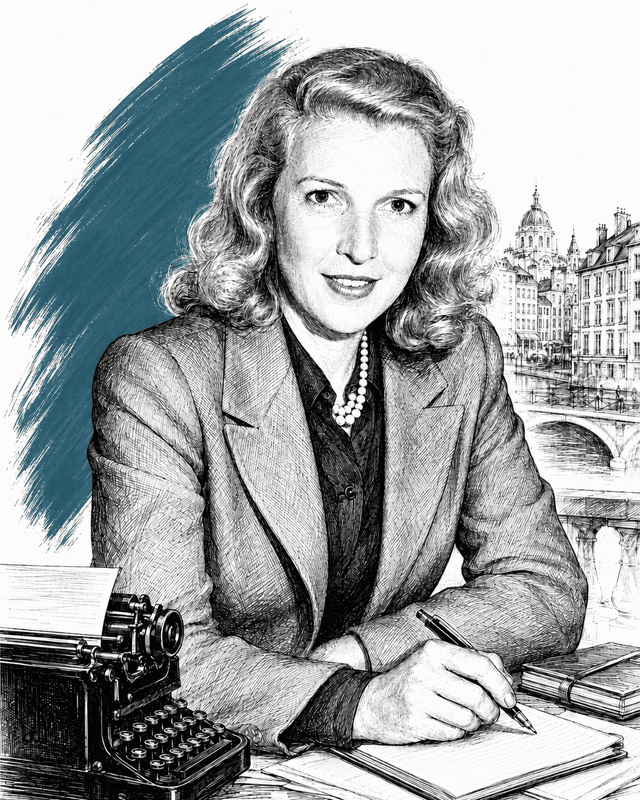
Martha Gellhorn
War correspondent who covered the Spanish Civil War, D-Day, and conflicts across five more decades; Hemingway's third wife, 1940–1945.
View author