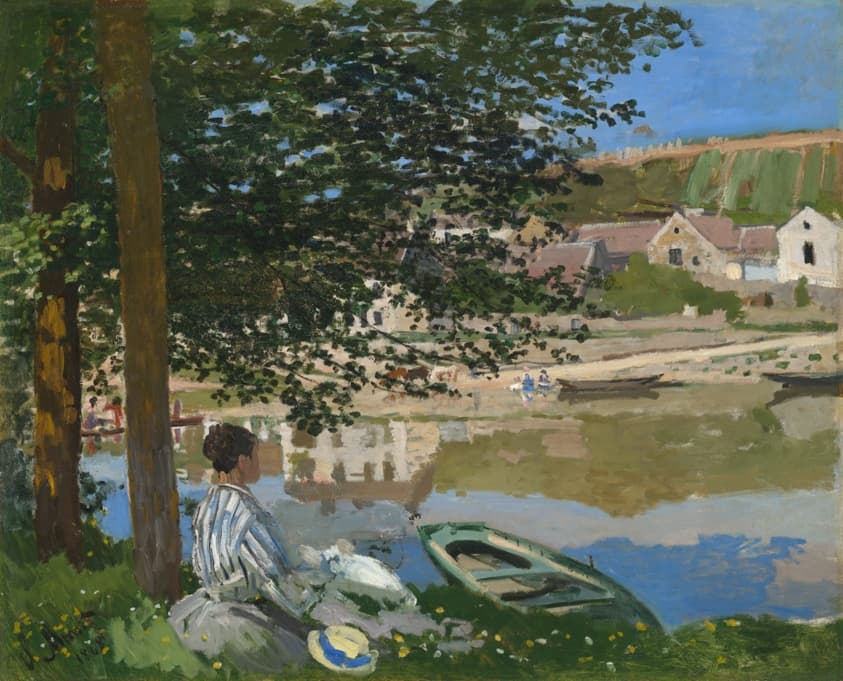
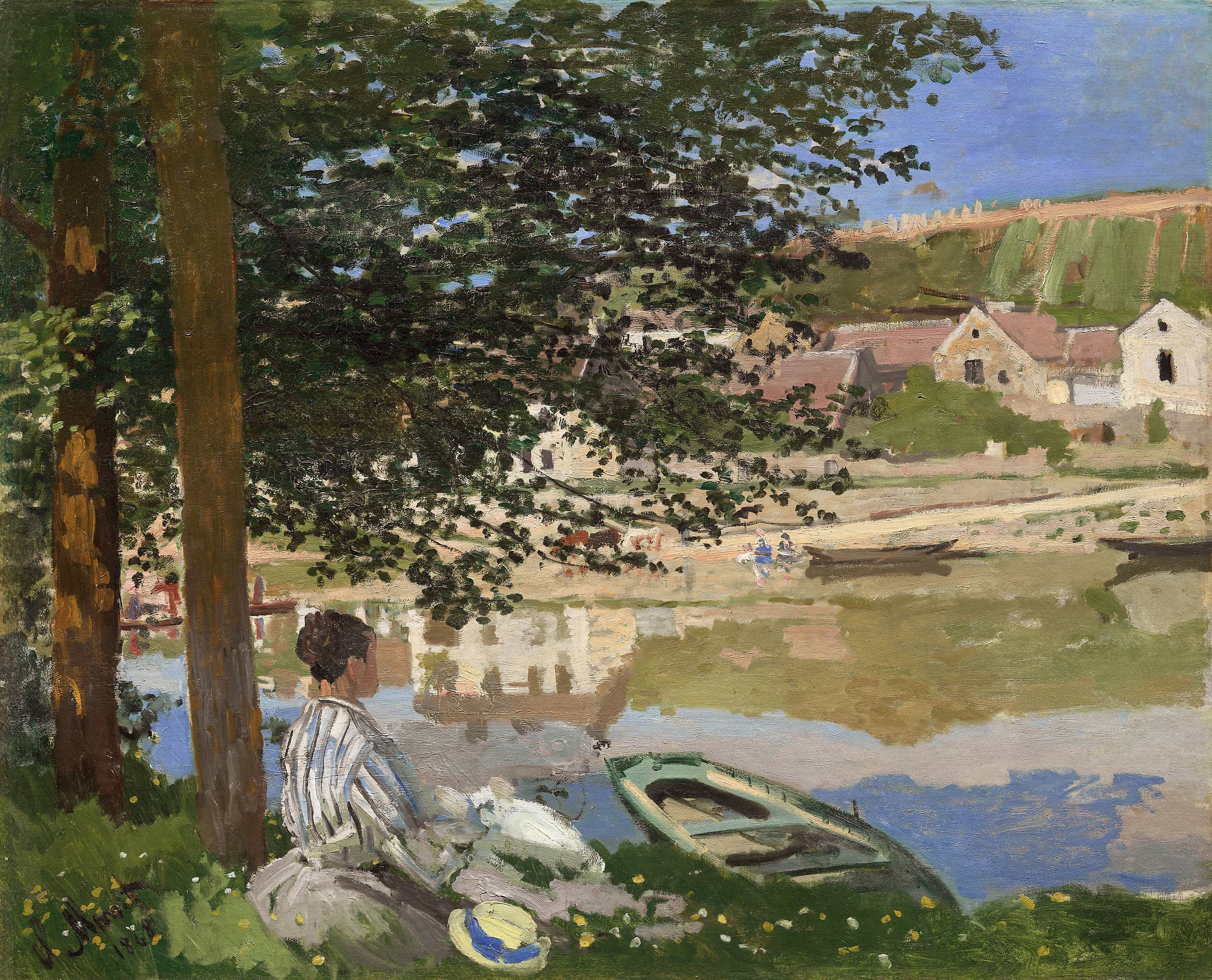
On the Bank of the Seine, Bennecourt
by Claude Monet
Camille Doncieux on an island in the Seine, painted in 1868 during a few poor months at Gloton that Émile Zola had recommended to Monet as somewhere cheap to live within reach of Paris. It is the only canvas known to survive from that stay.
- 1868
- Oil on canvas
About Claude Monet
A woman, a river, a village opposite
Camille sits on the bank of an island in the Seine with her back to us, in a striped dress, looking across the water toward the hamlet of Gloton. A rowing boat is drawn up at the left — presumably how the two of them got there. The far bank carries pale houses and a screen of trees, and the whole of it comes back at us again, upside down and broken, in the reflection that occupies the bottom third of the canvas.
The reflection is the radical part. It is painted in flat, loaded, separate strokes that do not describe anything so much as register colour and movement, and at close range they stop being houses and trees at all. To a viewer in 1868, trained on smooth finish, this would have read as unfinished rather than as bold.
Zola's cheap village
Monet was in his late twenties, not yet known, and short of money. The novelist Émile Zola — a friend from the Paris circle around Manet — pointed him toward Gloton, next to Bennecourt, as a rural retreat he could afford and could still get to and from Paris easily.
The stay was brief and produced, so far as survives, this one painting. Technical examination has found pentimenti beneath the surface: in an earlier state Camille held a child in a bonnet, almost certainly the couple's baby son Jean. Monet painted him out.
From 500 francs to Chicago
The painting belonged to the collector Louis Aimé Léon Clapisson, who by 1889 valued it at 500 francs. Durand-Ruel bought it in April 1892 for 1,500 francs and sold it a month later, on 18 May 1892, to the Chicago retailer Potter Palmer for 7,500 francs — the tripling in four weeks a fair picture of what was happening to Impressionist prices in the 1890s. It descended in the Palmer family and was given to the Art Institute of Chicago in 1922.
Close reading
Reading the work, detail by detail
This early river painting holds a figure, a village, and their reflection in a single quiet surface. The close views reveal how little Monet separates person, foliage, and water.
1.Camille is present but not posed
Her pale dress catches the light, but her face is withheld and her body turns toward the river. She is the nearest figure and not the picture's social center. Monet uses her to set the scale of the bank and the privacy of the looking.
2.The opposite bank exists twice
White walls and dark trees above the water return as softened vertical bands below it. The reflection is not a mirror copy; current and broken brushwork loosen the architecture into color.
3.Near foliage becomes a screen
The brightest leaves sit close to the picture plane and partly obstruct the view. Their sharp yellows and greens make the distant bank seem cooler and farther away. Depth comes from color temperature as much as perspective.
4.The empty boat connects the bank to the water
The boat angles away from the grassy bank, its pale interior divided by dark crosspieces. Those straight edges stand out against the loose reflections around it. Its position links the shaded foreground to the open river without adding another figure to the scene.
5.Two trunks hold the near edge of the scene
The trunks form two firm vertical bands beside the softer mass of leaves. Warm brown highlights separate their surfaces from the deep green shade. Because the trunks continue beyond the top edge, they make the viewer's shaded bank feel much closer than the houses across the river.
6.The hillside rises above the village
Above the roofs, the green hillside is divided by narrow pale lines. The bright strip along its crest separates the land from blue sky. This compact area adds an upward slope behind the village, giving the scene another layer beyond the horizontal riverbanks.
Timeline
1868
Monet and Camille Doncieux stay at Gloton, near Bennecourt, on Zola's recommendation; he paints this canvas.
1892
Durand-Ruel buys it in April for 1,500 francs and sells it to Potter Palmer on 18 May for 7,500 francs.
1922
Given to the Art Institute of Chicago by the Palmer family.
Where to see it
Art Institute of Chicago
111 South Michigan Avenue, Chicago, IL 60603, United States
Displays and loans can change. Check whether this work is on view before making a special trip.
Plan your visit on the museum’s official website (opens in a new tab)Frequently asked questions
Who is the woman in the painting?
Camille Doncieux, Monet's companion and later his first wife. She was the model for many of his figure paintings of the 1860s and 1870s.
What is the connection to Émile Zola?
Zola recommended Gloton to Monet as a cheap country base within easy reach of Paris. The two men knew each other through the Paris circle around Édouard Manet.
Was there originally a child in the picture?
Yes. Pentimenti — traces of earlier paint layers — show that Camille first held a bonneted child, presumably the couple's son Jean, whom Monet later painted out.
Where is the painting now?
At the Art Institute of Chicago, in the Potter Palmer Collection (accession number 1922.427).
More by Claude Monet
If you like Claude Monet
Explore painters from the same movements and circles.
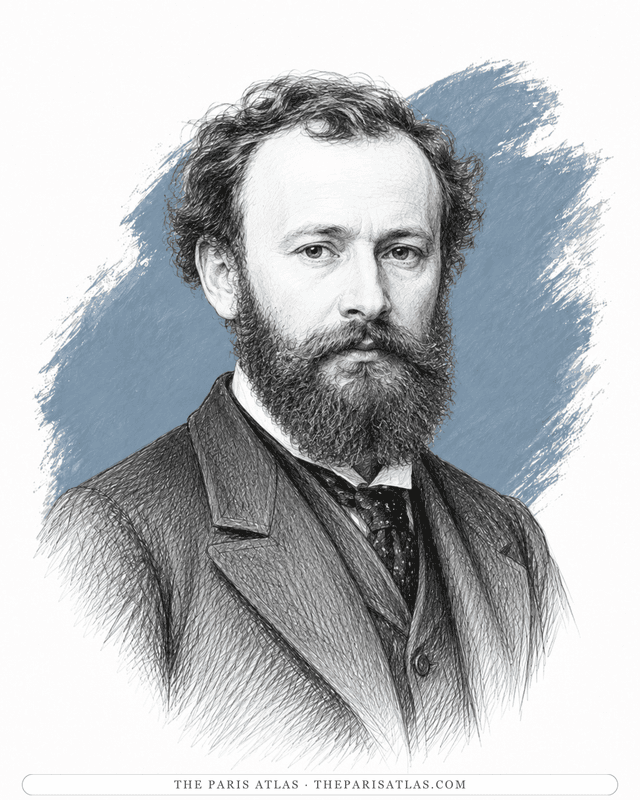
Édouard Manet
The admired elder of the independents — he painted beside Monet, befriended Morisot, and refused to show in all eight of the group's exhibitions.
View artist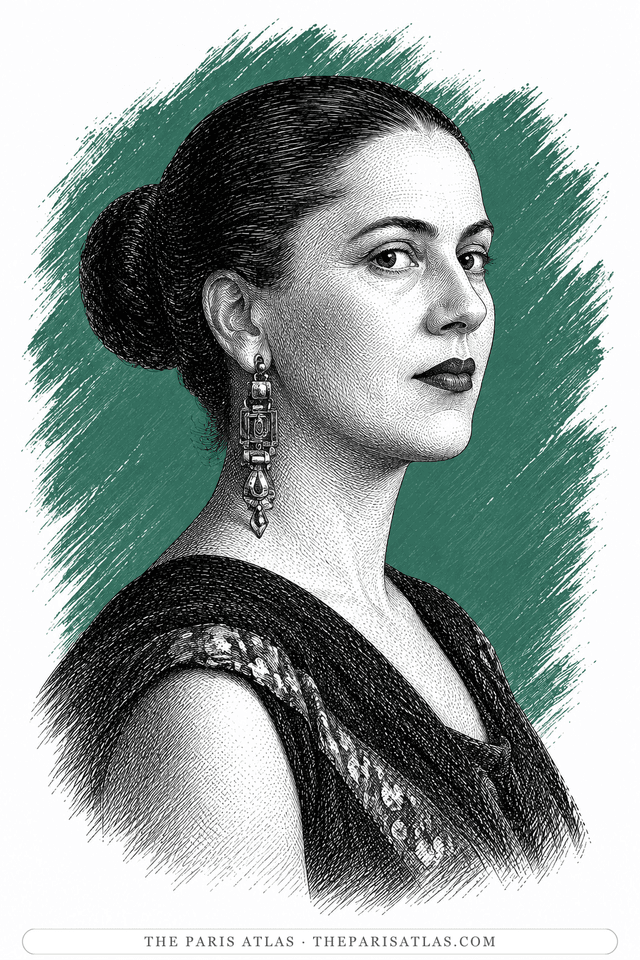
Tarsila do Amaral
Brazilian painter who spent the 1920s moving between São Paulo and Paris, studied Cubism under André Lhote, Albert Gleizes and Fernand Léger, and used what she learned to paint Brazilian towns, railways, plants and bodies. Her 1928 painting Abaporu prompted the manifesto that gave the Anthropophagic movement its name.
View artist
Gustave Caillebotte
Painter of Haussmann's geometry and the group's organizer-financier; his bequest of Impressionist paintings forced the French state to take the movement in.
View artist
References
The sources below include collection records, catalogues, scholarly research, and primary materials that informed this page. They document On the Bank of the Seine, Bennecourt, its making, and its place in cultural history.


1On the Bank of the Seine, Bennecourt — Art Institute of Chicago
WebsiteArt Institute of ChicagoUsed forWeb source consulted for documented facts and historical context presented on the On the Bank of the Seine, Bennecourt page.
2Claude Monet (1840–1926) — The Metropolitan Museum of Art
WebsiteThe Metropolitan Museum of Art, 2004Used forWeb source consulted for documented facts and historical context presented on the On the Bank of the Seine, Bennecourt page.
3Timeline — Maison et jardins de Claude Monet, Giverny
WebsiteFondation Claude MonetUsed forThe Fondation Claude Monet chronology places Bennecourt within Monet's early work along the Seine.
4Claude Monet — Musée Marmottan Monet
WebsiteMusée Marmottan MonetUsed forThe Musée Marmottan Monet collection supplies independent museum context for Monet's early landscapes and artistic development.
These references provide the documented foundation for this work's history and interpretation. Claim-level citations remain attached to the specific claims they support.
 Explore more resources